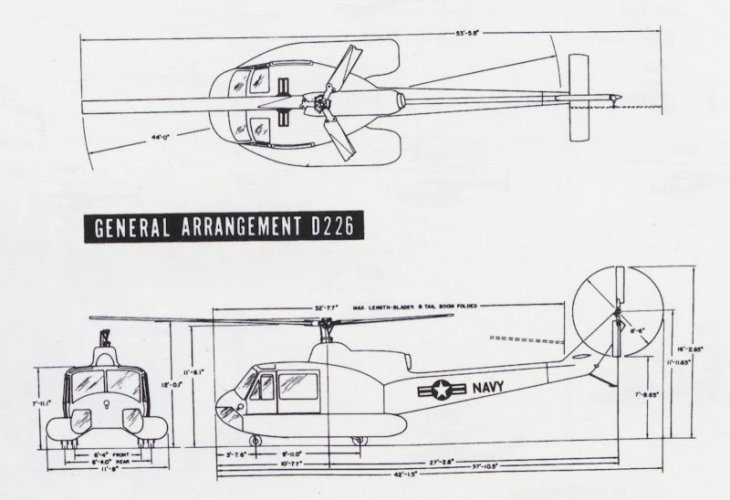
TS-136 USN Amphibious Utility Helicopter (alternatives to Kaman SH-2 Seasprite)

hesham

ACCESS: USAP
Senior Member
Joined
26 May 2006
Messages
37,567
Reaction score
19,617
From Spangenberg files,

In 1956 the USN issued a high demanding specification for a
fast amphibious utility helicopter,the contenders were Kaman,
Bell,Sikorsky,Vertol and Hiller.
The contenders were;


Kaman K-19 (single-engined) & K-20 (twin-engined)
Hiller Model-1070
Bell D-226 & D-227
Sikorsky S-62
Vertol V.80,V.81 & V.82

The winner was Kaman K-20 and built as Seasprite helicpter.
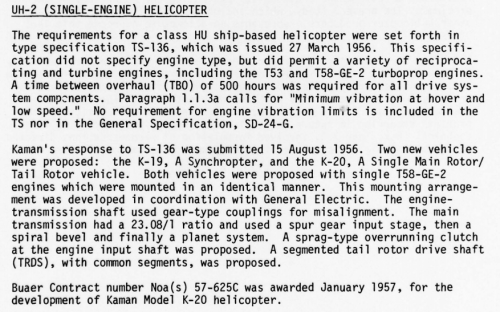
 
From Ailes 30/7/1960,

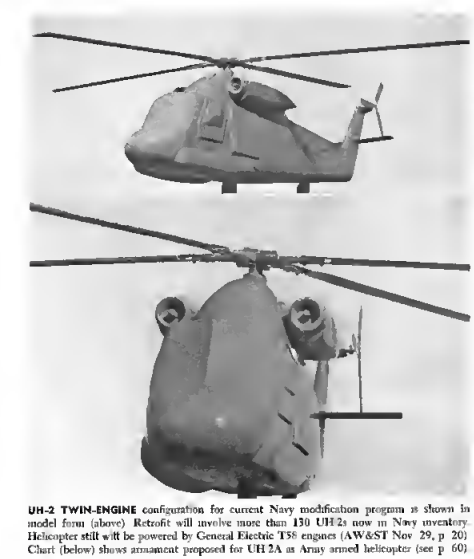
here is a Model for Kaman Seasprite,but I suspect if it was K-19 single engined Project or K-20 ?.
 

Attachments

  • 1.png
    1.png
    581.2 KB · Views: 260
According to the last post you made in this thread, the K-19 was a Synchrocopter, meaning two interleaved counter-rotating props. So this model with a top and tail rotor is clearly the K-20.
 
From AW 1965,

if that was Kaman K-20's Model,can we imagine the single engined
K-19,how it look like ?.
 

Attachments

  • 1.png
    1.png
    134.1 KB · Views: 194
From anther report from, Michigan University,

here is a small Info about Kaman K-19,it had a two-rotor
configuration.
 

Attachments

  • 1.png
    1.png
    28.8 KB · Views: 158
From AW 1965,

if that was Kaman K-20's Model,can we imagine the single engined
K-19,how it look like ?.

Not very likely. Remember, they K-19 is described as a synchrocopter, so two intermeshed top rotors. That would lead to a different fuselage shape.

I suspect this may have been an internal designation for some relative of the Kaman H-43 Huskie/HOK. Interesting paragraph from a site focusing on the Huskie: https://www.ragay.nl/kaman-htk-hok-huk/hok-design-development-test

15 Feb 1957 marks the start of the HU2K-1 aerodynamic investigation program. Not related to the history written in these website pages, however, the start of the development of a new Kaman helicopter is mentioned here to show the Kaman Corp. efforts for system's innovations and performance. It was for a single main and tail rotor configuration aircraft which was proposed and also submitted in the event that the proposed HOK-3N synchropter configuration might prove to be limited in order to satisfy future NAVY requirements. The HU2K-1 was proposed with a Navy funded GE T-58 engine program, which was expected to satisfy future NAVY helicopter turbine engine requirements (comment by Mr. A.D. Rita)

So this proposed K-19 synchropter might be the same or similar to the HOK-3N, which I believe the same site also refers to as the K-600-3N. In essence, a turbine Huskie/HOK with the engine moved out of the cabin, freeing up a good deal of internal volume.

Proposal for the Kaman K-600-3N turbine powered utility helicopter for the US Navy.

The installation of the lighter, higher powered turbine engine provides significant increases over the established performance of the HOK-1. The greatly enlarged internal cabin space made available by the “external” mounting of the engine, in combination with the substantial power margin, provides a service helicopter of unique capabilities.

The proposed K-600-3N was an advanced helicopter which will :

-- exploit the extensive growth potential of the HUK-1 with a minimum of design, development, testing and tooling.

-- provide a gas turbine powered utility helicopter for fleet service use in the shortest possible time.

-- utilize a substantial percentage of the logistic support already established for the HUK-1.

-- have a fuselage completely devoted to useful load but which retains the over-all size compactness of the HUK-1.

-- be comprised of components that are either already service tested or whose principles have been developed and refined by this Corporation.

(Kaman Report R-150, dated 02 May 1957) for drawing click here
 
Last edited:
The implication, that I've just confirmed from JAWA 1967-68, is that the early Seasprite utility models ( up to UH-2C ) were capable of water landings as they had a sealed flotation hull. A Kaman rescue-kit retrofit program added a cabin-door ramp to help haul survivors into the cabin when seaborne.

This flotation capability may have been lost with the later LAMPS versions.
 
The implication, that I've just confirmed from JAWA 1967-68, is that the early Seasprite utility models ( up to UH-2C ) were capable of water landings as they had a sealed flotation hull. A Kaman rescue-kit retrofit program added a cabin-door ramp to help haul survivors into the cabin when seaborne.

This flotation capability may have been lost with the later LAMPS versions.
And arguably for good reason. Takes more pull to get out of the water, and there's the threat of waves catching the rotors in relatively mild weather.
 
From Spangenberg files,

In 1956 the USN issued a high demanding specification for a
fast amphibious utility helicopter,the contenders were Kaman,
Bell,Sikorsky,Vertol and Hiller.
The contenders were;


Kaman K-19 (single-engined) & K-20 (twin-engined)
Hiller Model-1070
Bell D-226 & D-227
Sikorsky S-62
Vertol V.80,V.81 & V.82

The winner was Kaman K-20 and built as Seasprite helicpter.
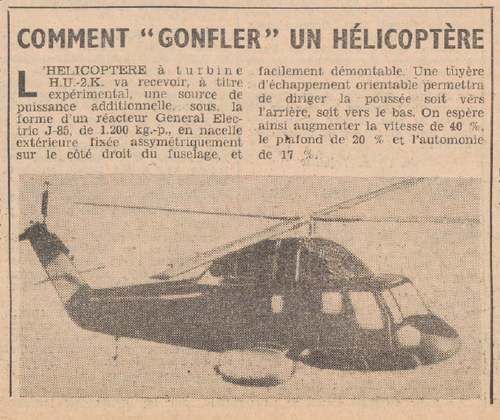
The Seasprite was not a twin-engined helicopter from the start.

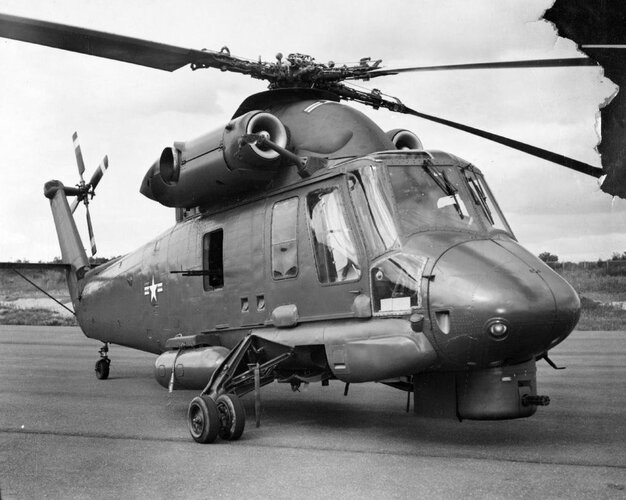
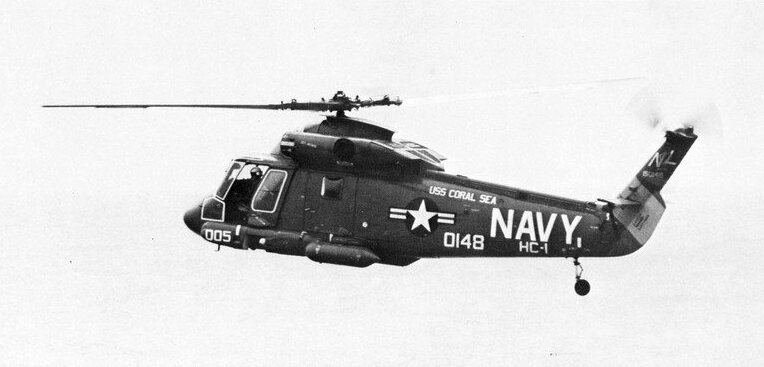
Kaman H-2A and H-2B variants had a single General Electric T58 engine.
H-2C/D/E/F variants all had two T58 engines.
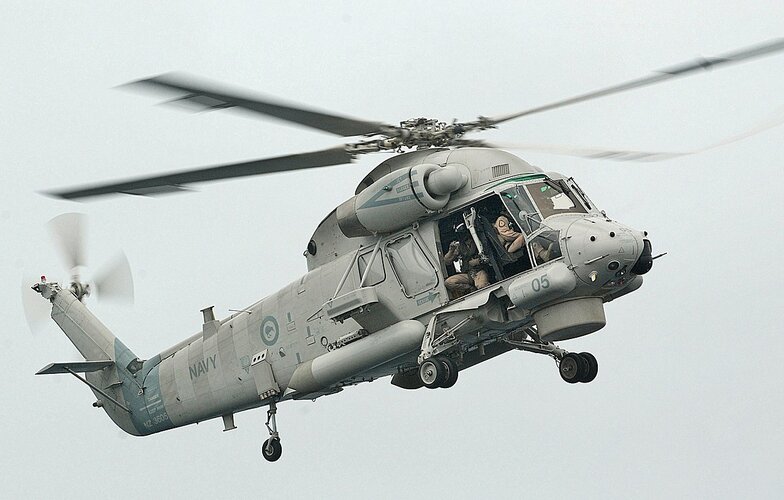
SH-2G had two General Electric T700 engines.
All images from wiki.
 

Attachments

  • Kaman SH-2G.jpg
    Kaman SH-2G.jpg
    193.6 KB · Views: 103
  • Kaman HH-2C front.jpg
    Kaman HH-2C front.jpg
    115.4 KB · Views: 97
  • Kaman UH-2C.jpg
    Kaman UH-2C.jpg
    138.1 KB · Views: 89
  • Kaman UH-2A front.jpg
    Kaman UH-2A front.jpg
    227.2 KB · Views: 102
  • Kaman UH-2A.jpg
    Kaman UH-2A.jpg
    35.1 KB · Views: 103
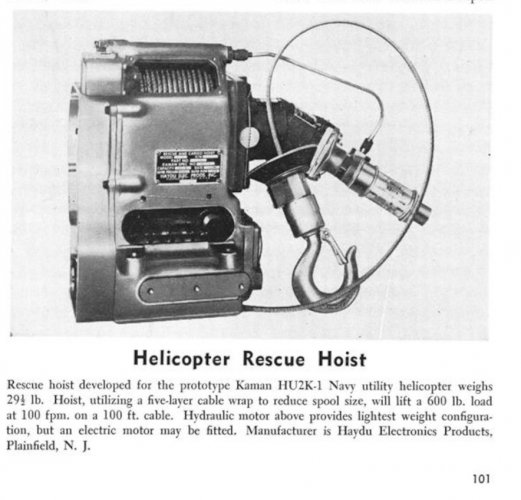
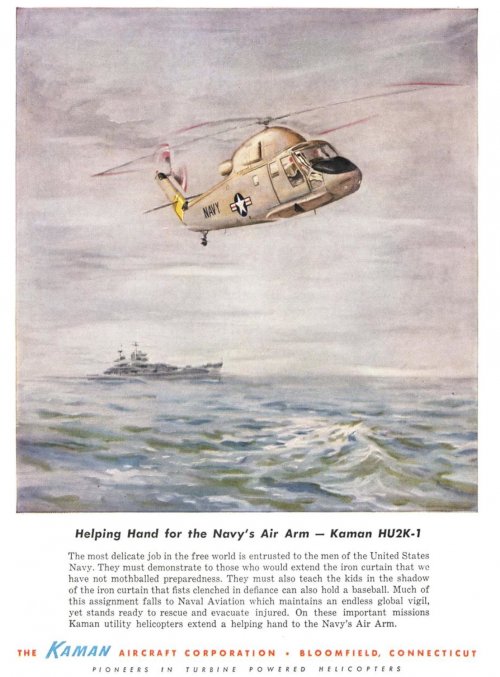
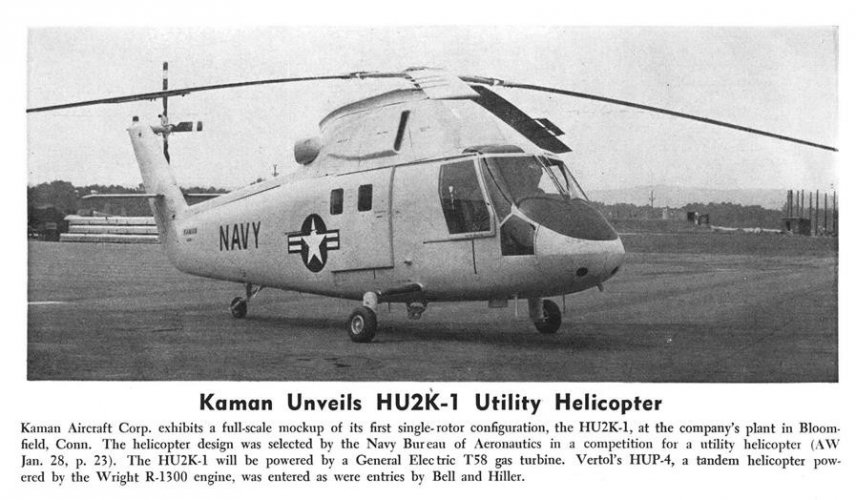
A couple of HU2K-1 scraps from AvWeek;:

1. Kaman rescue hoist designed for the competition ( 29.5lb weight, could lift 600lb over 100ft cable at 100fpm! )
2. The most bombastic ad I think I've ever seen for a helicopter: fists clenched in defiance can also hold a baseball
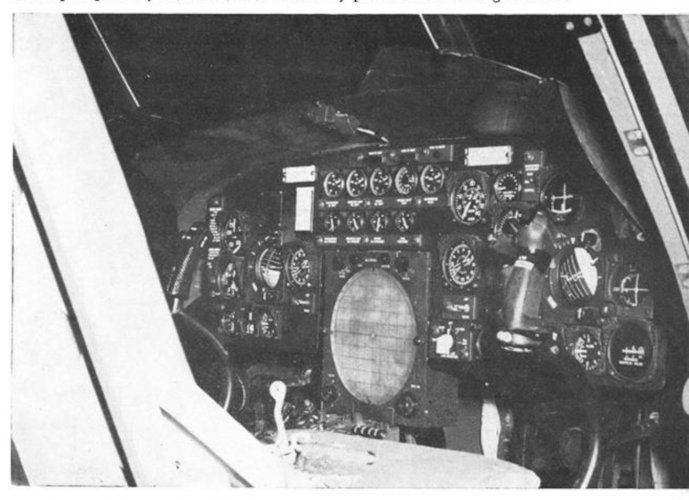
3. Cockpit mockup
4. October 1957 airframe mockup, note undercarriage appears to have been fixed at this point, or at least they hadn't finished design of the retraction arrangements, and tailwheel is quite far forward - almost where it would be relocated later for LAMPS
 

Attachments

  • Kaman_Rescue_Hoist_AvWeek_19590413_051.JPEG
    Kaman_Rescue_Hoist_AvWeek_19590413_051.JPEG
    136.4 KB · Views: 79
  • Kaman_HU2K1_AvWeek_19580728_019.JPEG
    Kaman_HU2K1_AvWeek_19580728_019.JPEG
    525 KB · Views: 78
  • HU2K1_Cockpit_Mockup_AvWeek_19591026_046.JPEG
    HU2K1_Cockpit_Mockup_AvWeek_19591026_046.JPEG
    226.5 KB · Views: 81
  • HU2K1_Mockup_AvWeek_19571104_018.JPEG
    HU2K1_Mockup_AvWeek_19571104_018.JPEG
    111.7 KB · Views: 76
Last edited:
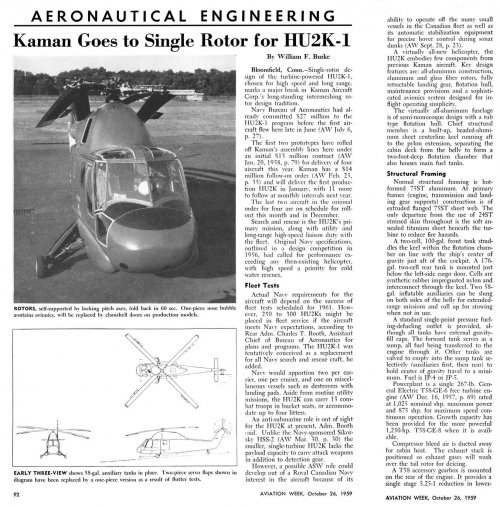
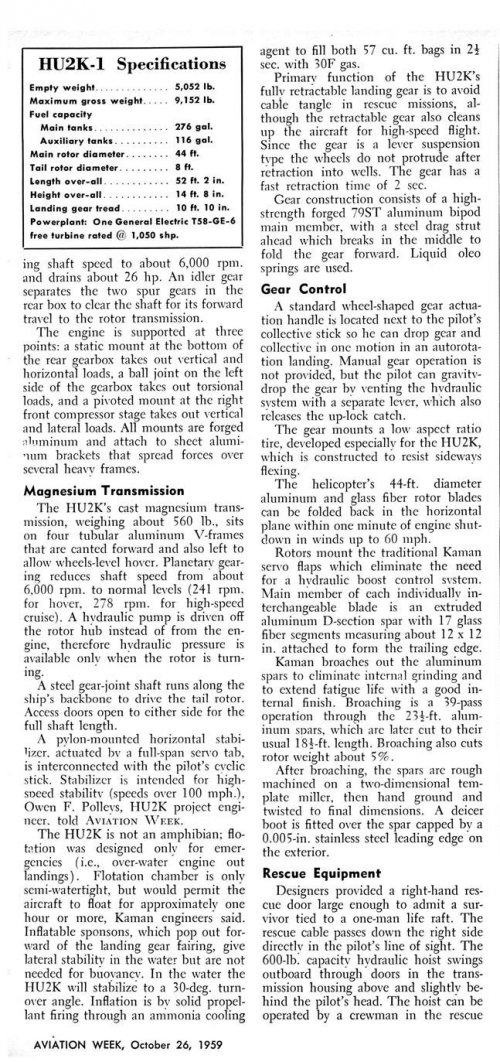
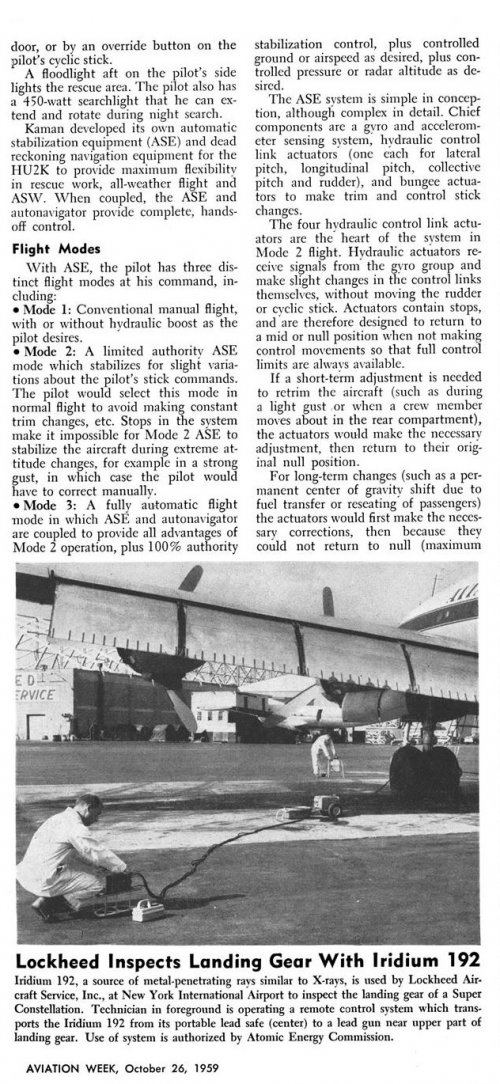
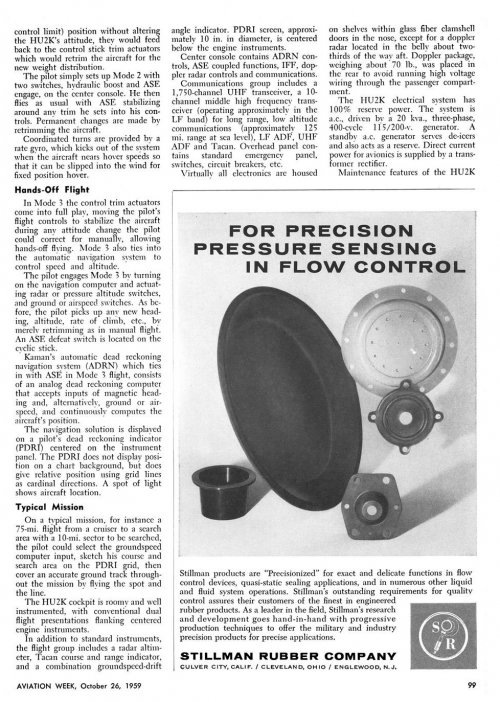
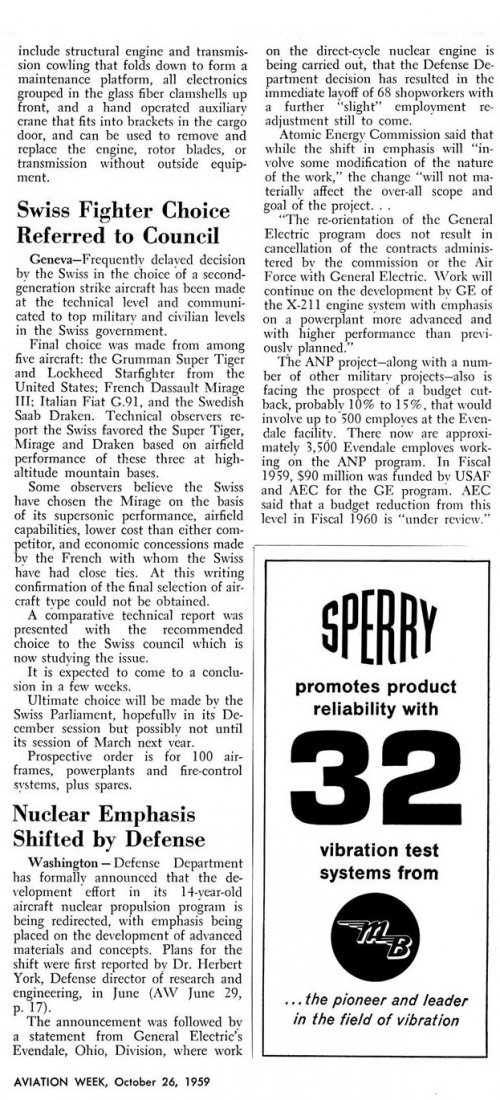
And a further HU2K-1 info-dump from AvWeek, 26 Oct 1959. More internal details than I've ever seen written about the Seasprite.

Some aspects:

  1. When fitted with bucket seats it could accommodate 13 troops ( must have been cosy ) or four litters
  2. Fuselage wasn't designed to be truly amphibious but 2ft-deep floatation chamber was semi-watertight to enable floating for up to one hour at up to 30 deg list. Lateral stability by pop-out bags ahead of main gear.
  3. Tail rotor was de-iced by exhaust gases
  4. Two inflatable 58gal auxiliary fuel bladders could be slung under the belly and rolled-up when not needed
  5. Cast magnesium transmission weighed 560lb, converted 6000rpm turbine output to 241rpm ( hover ) or 278rpm( high-speed cruise )
  6. Horizontal stabilizer came into effect over 100mph
  7. Undercarriage retracted in 2 seconds, although aerodynamically useful its primary purpose was to avoid tangling in rescue cables
  8. Custom main tyres designed to resist side loadings
  9. Starboard cabin door sized to fit a survivor in a liferaft
  10. Three modes to Kaman-designed Automatic Stabilization Equipment:
    1. Manual flight, with or without hydraulic boost
    2. Stablilizes slight variations in pilot's control stick commands ( without itself moving the stick or rudder )
    3. Fully-automated, coupled to auto-navigator, full-authority, plus maintaining radar or pressure altitude, moving the pilot's controls as required
  11. PDRI ( Pilot's Dead Reckoning Indicator ) in the centre console showed aircraft position as a point of light, pilot could pre-plot a mission profile on the grid and then 'fly' the light spot along the route
  12. A hand-cranked crane fitted into brackets on the cargo door and allowed the engine, rotor blades and transmission to be removed without further equipment

Considering all that, it's not surprising that Kaman won the competition . They seem to have put a vast amount of effort and consideration into the design, considering they were still a small player and had no real sea-going experience.
 

Attachments

  • HU2K1_Detail_AvWeek_19591026_046.JPEG
    HU2K1_Detail_AvWeek_19591026_046.JPEG
    494 KB · Views: 77
  • HU2K1_Detail_AvWeek_19591026_047.JPEG
    HU2K1_Detail_AvWeek_19591026_047.JPEG
    343.6 KB · Views: 64
  • HU2K1_Detail_AvWeek_19591026_048.JPEG
    HU2K1_Detail_AvWeek_19591026_048.JPEG
    339.1 KB · Views: 50
  • HU2K1_Detail_AvWeek_19591026_049.JPEG
    HU2K1_Detail_AvWeek_19591026_049.JPEG
    442.5 KB · Views: 50
  • HU2K1_Detail_AvWeek_19591026_051.JPEG
    HU2K1_Detail_AvWeek_19591026_051.JPEG
    336.3 KB · Views: 81
03 Sep 1956:

Vertol Aircraft Corp's entry in the navy utility helicopter competition is the HUP-5, a turbine-powered version of the HUP-2


In March 1957, having lost the Navy contract and with further Army procurement of the H-21 curtailed, Vertol sacked 170 staff ( 61 engineers and 109 engineering office staff ) due to lack of work.
 
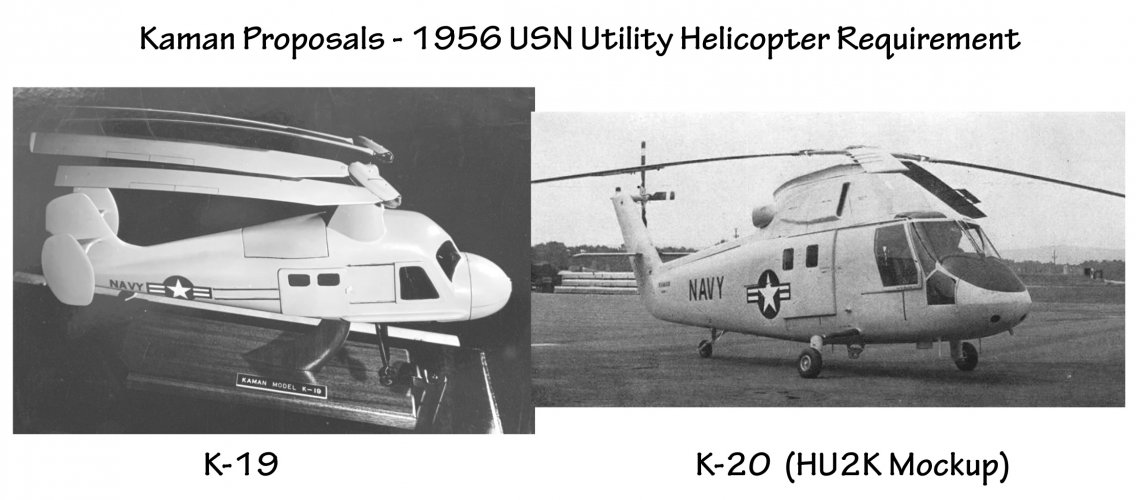
K-19 model picture from Szabolos Fülöp and new to me. As noted above, Kaman proposed two alternatives for the U.S. Navy utility helicopter requirement, a synchropter (K-19) and a more conventional helicopter (K-20) but with their servo-flap rotor control system, both to be powered by a single T58 (the K-19 engine inlet is probably between the two rotor pylons and the exhaust on the left hand side of the cowling). The K-19's landing gear is clearly retractable; the K-20's doesn't appear to be at this point. The K-19 had a more efficient hover and lack of susceptibility to wind direction at low speeds but the K-20 was faster and met the specification requirement from that standpoint. It was selected and designated the HU2K.
 

Attachments

  • US Letter.jpeg
    US Letter.jpeg
    448.3 KB · Views: 87
Sorry, no. However, an additional tidbit on the Kaman proposals. The K-19 appears to have a retractable landing gear and the HU2K mockup, as stated above, appears to have a fixed gear. The synchropter configuration was great for hover (efficient, insensitive to wind direction, low down wash) but not for speed, and that was one of the requirements. My guess is that it had retractable gear for more speed and the conventional configuration didn't require it to meet the requirement (the major benefit was reportedly that it got the landing gear out of the way for the rescue hoist).
 
Thank you my dear Tailspin,

and last question,please if you have more projects for Kaman,
from Szabolos Fülöp ?.
 

Similar threads

Back
Top Bottom