Yes, you could use Starship as a recoverable ballistic missile. Dump the payload before reaching orbit.
Yep. Per my original post:

"How long until Space Force starts wondering about Starship as a bomber? One flight tossing out 100 tons of terminally guided conventional bombs then it continues around the planet and is captured on a tower. Fully reusable. Wouldn't be a nuclear capable vehicle, obviously, and it wouldn't be immune to a nuclear strike. They'd also have to harden the facilities against cheap drones. . .makes one go "hmmmm"."

Hell, there's no reason they couldn't boost into orbit after dispensing munitions and do post-attack BDA. Would depend on payload, fuel load, etc. but 5- 10 years down the road, with the production rates they're talking about? Lots of possibilities.
 
a. ICBM and space launch have different trajectories. ICBMs go to 700 mile peak altitude, launch vehicles typically 150 miles.
b. There is no "drop" them. ICBMs burn out in less than 3 minutes and the warhead is on trajectory to its target.
c. Can't launch, go over target and land at launch site in one orbit.
d. to let go of warheads and continuing to orbit means blasting the warheads with engine exhaust.
e. Shuttle one orbit mission and FOBS requires entering orbit and then firing deorbit engines. FOBS stage followed warhead to target
 
Last edited:
Hell, there's no reason they couldn't boost into orbit after dispensing munitions and do post-attack BDA.
Yes, there is. If it was feasible, the vehicle would be past the target and not in view of it by the time of impact,
 
a. ICBM and space launch have different trajectories. ICBMs go to 700 mile peak altitude, launch vehicles typically 150 miles.
b. There is no "drop" them. ICBMs burn out in less than 3 minutes and the warhead is on trajectory to its target.
c. Can't launch, go over target and land at launch site in one orbit.
d. to let go of warheads and continuing to orbit means blasting the warheads with engine exhaust.
e. Shuttle one orbit mission and FOBS requires entering orbit and then firing deorbit engines. FOBS stage followed warhead to target
So how does Starship land in the Indian Ocean then? And you're taking "drop" too literally. In this context it just means "deploy".
 
Yes, there is. If it was feasible, the vehicle would be past the target and not in view of it by the time of impact,
Boost, deploy warheads before reaching orbital speed (during a coast phase obviously), continue boost to orbital speed, perform one orbit, look down, deorbit.
 
Jim has stated over on NSF they have to include a pad at this new launch site for the Trident follow on. But I thought that was a long way out being D5LE was sea trial tested in September 2025, and D5LE2 is a long way off let alone retirement?
 
Jim has stated over on NSF they have to include a pad at this new launch site for the Trident follow on. But I thought that was a long way out being D5LE was sea trial tested in September 2025, and D5LE2 is a long way off let alone retirement?
That is what the government documents said. This isn't the government building a new pad for new requirements. It is if someone wants to use the LC-46 area for super heavy rockets, they have to pay for the construction of a new pad at 51 for the Navy and replicate the existing infrastructure at 46.
 
So climb at the ballistic trajectory then turn, laterally shift, and accelerate to orbit.
Any direction starship goes, exhaust will hit the warheads.
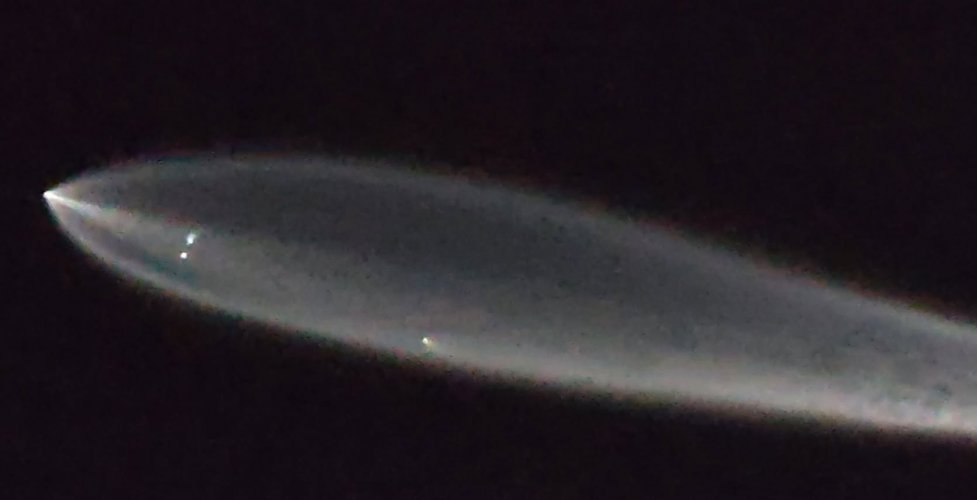
This is a Falcon 9 MVac plume, it is 220klb thrust. Starship is going to put out >3Mlb thrust. The fairing halves and first stage are the little dots.
 

Attachments

  • 513917581_23944646445228240_7854612159648339205_n.jpg
    513917581_23944646445228240_7854612159648339205_n.jpg
    38.9 KB · Views: 33
Any direction starship goes, exhaust will hit the warheads.
This is a Falcon 9 MVac plume, it is 220klb thrust. Starship is going to put out >3Mlb thrust. The fairing halves and first stage are the little dots.
What I am saying is: climb at ballistic trajectory, pop load as soon as you clear the atmosphere, translate missile multiple km laterally if you have to and adjust thrust vector to orbit, finally burn for orbit.

You have about 3 minutes to get the rocket clear of the payload, let's call it 200sec for mathematical simplicity. (Assuming that the OMS has enough fuel to fire for 3 minutes, of course) 1m/s/s OMS burn for 10 seconds will get you to 9.5m/s, coast at 9.5m/s for 180sec, 1m/s/s burn for 10sec to stop that drift. 1750m away from the payload cloud laterally.
 
What I am saying is: climb at ballistic trajectory, pop load as soon as you clear the atmosphere, translate missile multiple km laterally if you have to and adjust thrust vector to orbit, finally burn for orbit.

You have about 3 minutes to get the rocket clear of the payload, let's call it 200sec for mathematical simplicity. (Assuming that the OMS has enough fuel to fire for 3 minutes, of course) 1m/s/s OMS burn for 10 seconds will get you to 9.5m/s, coast at 9.5m/s for 180sec, 1m/s/s burn for 10sec to stop that drift. 1750m away from the payload cloud laterally.
There is no OMS on Starship, it is the Raptors.
The process to "translate missile multiple km laterally" is still going to point exhaust at the warheads.
 

Space Force Gives Boeing $2 Billion for Pair of Narrowband Communication Satellites​

https://www.airandspaceforces.com/space-force-boeing-2-billion-narrowband-communication-satellites/
The Space Force selected Boeing to extend the life of its Mobile User Objective System for narrowband satellite communications, awarding the company $2 billion to build two satellites for the program.

​

Chinese AI Agents Could Challenge Air and Space Operations, Planning​

https://www.airandspaceforces.com/chinese-ai-agents-air-and-space-operations-strike-planning/

Budget Supplemental Would Give Pentagon Billions for Epic Fury, Munitions, Space Force Programs​

https://www.airandspaceforces.com/b...gon-epic-fury-munitions-space-force-programs/
President Donald Trump’s administration is asking Congress for an extra $21 billion to boost munitions stockpiles, $17.3 billion to pay for operational costs from the conflict with Iran, and $4 billion for high-priority Space Force programs, according a June 24 supplemental funding request.

House Appropriations Committee approves $55.5 billion for U.S. Space Force​

https://spacenews.com/house-appropriations-committee-approves-55-5-billion-for-u-s-space-force/
 
Last edited:
There is no OMS on Starship, it is the Raptors.
The process to "translate missile multiple km laterally" is still going to point exhaust at the warheads.
Not much of it. And that's what guidance systems are for. We're not talking about ballistic RVs like on a PBV. (Whose exhaust is also impinging on unguided warheads.)
 
Not much of it. And that's what guidance systems are for. We're not talking about ballistic RVs like on a PBV. (Whose exhaust is also impinging on unguided warheads.)
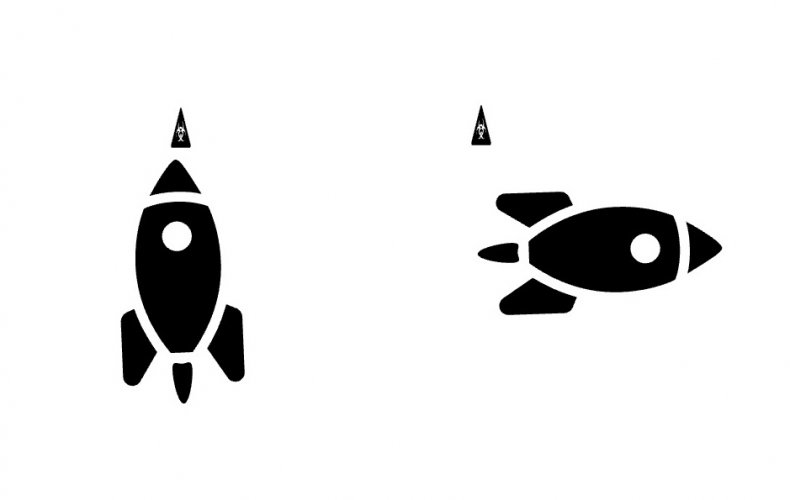
wrong, it would be more that the photo that I posted. The diagram below shows that the warhead would be blasted by the Starship.
 

Attachments

  • Presentation1.jpg
    Presentation1.jpg
    34.8 KB · Views: 20
wrong, it would be more that the photo that I posted. The diagram below shows that the warhead would be blasted by the Starship.
A warhead/propulsion module would have far higher density than a fairing half, be much further away, and not be directly behind Starship. Oh yeah, and as I've already said, the engines on Starship would be OFF.

"Boost, deploy warheads before reaching orbital speed (during a coast phase obviously), continue boost to orbital speed, perform one orbit, look down, deorbit."


1. Booster fires and returns to launch site.
2. "Starship" fires its engines long enough to establish a trajectory to the target area.
3. Engines shut down for coast and rocket immediately starts deploying warhead modules. (And not one at a time but quickly enough for the job.)
4. Once the last warhead module is clear (enough) Starship fires it's engines back up, either to continue around the planet and land at the takeoff site, or into orbit.
 
4. Once the last warhead module is clear (enough) Starship fires it's engines back up, either to continue around the planet and land at the takeoff site, or into orbit.
How long does it take to clear? How would they be much further away?

and how is it going to be able to hit targets north of 30 degrees with current launch sites planned without US overflight?
 

U.S. Space Force Victus Haze Proves Launch On Demand​

https://aviationweek.com/space/laun...-space-force-victus-haze-proves-launch-demand
The call came before sunrise over New Zealand’s Mahia Peninsula. Less than 17 hr. later, Rocket Lab launched a company-built satellite to space with its Electron rocket, marking a key milestone in a U.S. Space Force program designed to deploy spacecraft to orbit quickly in response to potential threats.

The Electron rocket lifted off on June 19 at 10:19 p.m. local time from one of two company pads in the Mahia Launch Complex. It took flight 16 hr. and 42 min. after the Space Force sent Rocket Lab the notice to launch on June 18, and the Pioneer spacecraft reached low Earth orbit approximately 9 min. later.
The effort, part of the service’s Victus Haze mission, required Rocket Lab to launch to a previously unknown orbit within 24 hr. of call-up. The company was then tasked with completing on-orbit checkout and vehicle commissioning within 72 hr. of launch before it approached a second spacecraft—built by True Anomaly and launched last month—and then snapping a photo and sharing that image in near real time with the mission team on the ground. Rocket Lab took about 37 hr. to complete spacecraft commissioning, the company announced June 22.
 

Deep-Space Radar Construction Delayed, GAO Says​

https://www.airandspaceforces.com/deep-space-radar-construction-delayed-gao-says/
DARC is a joint effort between the U.S., Australia, and the United Kingdom to use ground-based radars to track objects in geosynchronous orbit, up to 22,000 miles above Earth. The radars will provide 24/7, all-weather tracking, and once all three sites are online, will give the U.S. and its allies a continuous view of the entire GEO belt—greater coverage than is now possible with any other ground-based system. Under the pact, the Space Force is leading development, but the agreement allows the U.K. and Australia to operate and host the sites and participate in joint operations and exercises.
Northrop Grumman is on contract to build the first two facilities—one in Western Australia and a second in Wales. The Space Force hasn’t announced the location of the third site, which is expected to be in the U.S. and also built by Northrop, with a contract expected later this year or in early 2027.
 
Anyone know what frequency range DARC uses? I am assuming X band like most ABM radars? Or else S band?
 

Space Force Picks Two More Startups to Compete for Launch Missions​

https://www.airandspaceforces.com/s...more-startups-to-compete-for-launch-missions/
The service added Impulse Space and Relativity Space, both based in southern California, to its vendor pool for the program’s “Phase 3 Lane 1” contract, a new feature of the NSSL program meant to give the Space Force more lift options for lower-risk missions and to broaden the launch industrial base.

View: https://x.com/RocketLab/status/2075042451480518733?s=20
 
Last edited:
Has anyone mentioned the status of the tranche 3 transport layer? The tracking layer has beeexpanded to 100+ satellites on order, but there are rumors the transport layer is dead in favor of MILNET, which makes little sense to me. The SDA satellites operate on different frequencies and formats.
 
Has anyone mentioned the status of the tranche 3 transport layer? The tracking layer has beeexpanded to 100+ satellites on order, but there are rumors the transport layer is dead in favor of MILNET, which makes little sense to me. The SDA satellites operate on different frequencies and formats.
Not up yet according to post above but launches have resumed.

Space Force Chief Nominee: China Going ‘Breathtakingly Fast’ with Space Weapons​

https://www.airandspaceforces.com/space-force-chief-nominee-china-breathtakingly-fast/
 
Last edited:

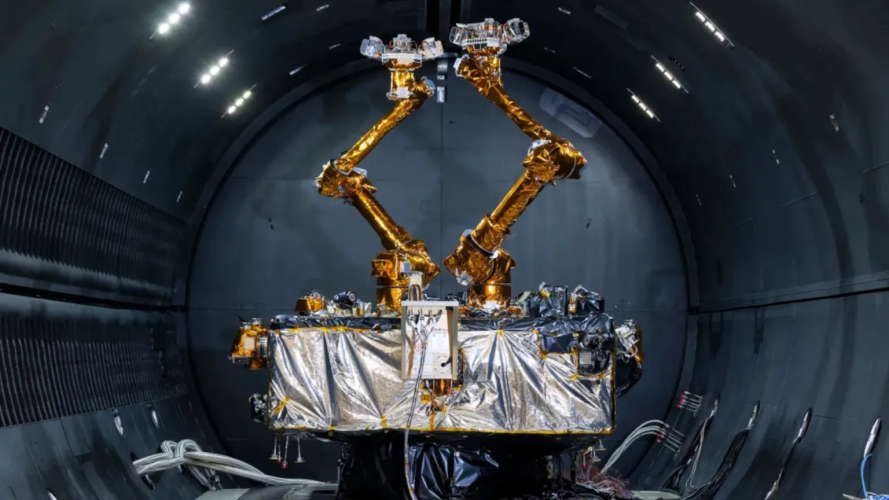
Could This New Northrop Spacecraft Use Its Robotic Arms To Attack Enemy Satellites?​

https://www.twz.com/space/could-thi...e-its-robotic-arms-to-attack-enemy-satellites
1784725746566.png
1784725790941.png

Space Force Launch Program Sees Demand Surge from 60 Missions to 170​

https://www.airandspaceforces.com/space-force-launch-program-demand-surge-60-170/
“The total number of estimated missions has now increased to approximately 170 due to the growing demand to deliver critical capabilities to orbit for the nation and warfighter,” the spokesperson said. “As a result, it was necessary to increase the … contract value in response to the new estimated mission quantities expected to be ordered under the Phase 3 Lane 1 contract.”
Those increases fall across several mission areas, including space-based moving target indication; data transport; missile warning, tracking and defense; and space domain awareness. The Space Force recently awarded SpaceX more than $6 billion to build satellites for the Space Data Network and a space-based AMTI constellation. The service also plans to launch new fleets of small surveillance and reconnaissance satellites under an effort called Andromeda, with the initial spacecraft slated to launch in 2029. The Space Force hasn’t said how many spacecraft those constellations will include, but it has set a contract ceiling of approximately $6 billion.
 
Last edited:

Space Force to Launch 18 Comms and Targeting Missions by End of 2027​

https://www.airandspaceforces.com/space-force-to-launch-18-comms-targeting-missions-by-end-of-2027/
The Space Force awarded SpaceX a $1.6 billion contract to conduct 18 launches for communications and targeting satellites by the end of 2027.
Space Systems Command said July 29 it would issue two task orders to the company as part of Phase 3 Lane 1 of its National Security Space Launch program. All 18 launches will fly on SpaceX’s reusable Falcon 9 rocket from Vandenberg Space Force Base, Calif.
The satellites are part of the Space Based Sensing and Targeting Portfolio, which includes the Space-Based Air Moving Target Indication program and the Space Data Network, two high-priority Space Force programs. While SSC’s release didn’t identify those programs by name, it highlighted the importance of both missions.
The service has approved seven companies to compete for missions under its Lane 1 contract:
  • SpaceX
  • United Launch Alliance
  • Blue Origin
  • Stoke Space
  • Rocket Lab
  • Relativity Space
  • Impulse Space

Space Force Eyes ‘Usable’ Airborne Target Tracking by ’28, More Capability to Follow​

https://www.airandspaceforces.com/space-force-usable-airborne-target-tracking-2028-more-to-follow/
The Space Force expects its nascent airborne moving target indicator program will have a “usable capability” in the next few years—but the official in charge of the program says there’s more work to be done beyond that to refine the sensing, data processing, and orchestration needed to deliver a global targeting capability from space.
 
Last edited:

New Anti-Satellite Weapons Now Officially A Top U.S. Priority​

"Our space assets need to shoot, move, and communicate just like the rest of the joint force," the head of U.S. Space Command says.
https://www.twz.com/space/new-anti-satellite-weapons-now-officially-a-top-u-s-priority
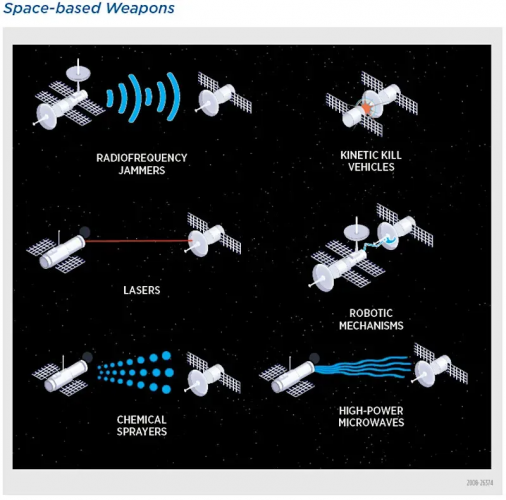
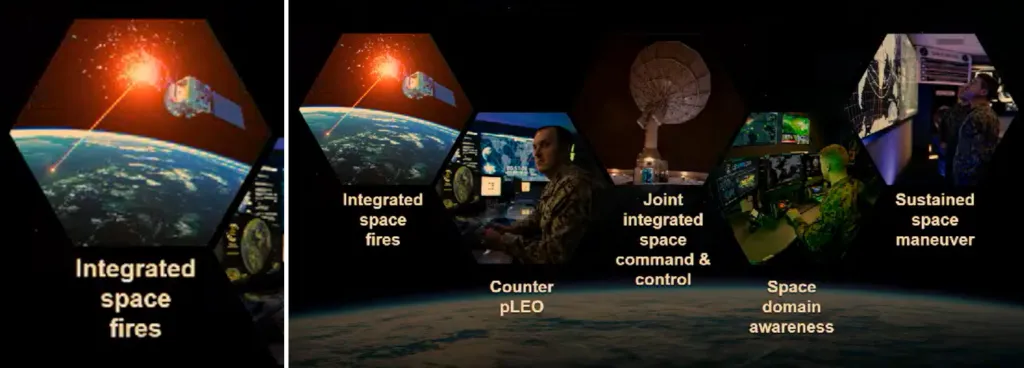
U.S. Space Force Gen. Stephen Whiting made an explicit call for new “integrated space fires” capabilities, including both non-kinetic and kinetic options in orbit and/or within the atmosphere, during a talk yesterday
Whiting did not elaborate on what these future integrated fires and counter-pLEO capabilities might look like. An accompanying briefing slide did include a graphic depicting a kinetic attack on a satellite originating from within the Earth’s atmosphere utilizing what might be a laser-directed energy weapon.
“If you have 10,000 satellites that are providing you with service, surely you’re not going to try and attack with a direct ascent ASAT [anti-satellite interceptors fired from within the Earth’s atmosphere] 10,000 satellites,” U.S. Army Lt. Gen. Rick Zellmann, Deputy Commander of SPACECOM, said during the panel. “I encourage our adversaries to try and shoot down 10,000 satellites that way. I don’t think they will. And, so, just like we do, our targeting folks will try to find the various nodes(sp? modes) where you can get a one-to-many solution.”

“Those, I think, one-to-many solutions for proliferated constellations are twofold. One is cyber,” he continued. “I think the other is directed energy, because that doesn’t cost too much for a shot, right? So those two technologies are the ones I’d be concerned about.”
At present, a family of ground-based electronic warfare systems called the Counter Communications System (CCS) is the U.S. military’s only publicly acknowledged offensive counter-space capability. In June, the U.S. Space Force announced it had “operationally accepted” the latest version of the system, called Block 10.3, and also known by the codename Meadowlands.


Space Force Plans Two More Missions to Test Tactically Responsive Maneuvers​

https://www.airandspaceforces.com/space-force-two-more-missions-responsive-maneuvers-orbit/
Impulse announced the $28 million contract award Aug. 12, saying it will provide two of its Mira spacecraft for missions in low-Earth orbit dubbed Victus Salo 2 and 3. The firm was already awarded a contract in October 2024 to provide a Mira for Victus Salo 1.
Mira is an orbital maneuver vehicle, or OMV; it is prepositioned in space to carry payloads or other assets from one orbit to another. All three Victus Salo missions will involve Mira spacecraft carrying government-provided payloads in low-Earth orbit, the firm said in its release.
The first Victus Salo mission is set for launch in 2027, Impulse said. When the Space Force announced the contract for that mission in 2024, it said it was hoping to launch in fall 2026. The second and third Salo missions have no public timeframe.
Impulse is also working on another tactically responsive space mission, Victus Surgo, that will involve a Mira spacecraft launching into a geostationary transfer orbit, with an end goal of ending up in geosynchronous orbit.
In space, maneuverability is often described as “Delta-V,” or a spacecraft’s ability to change its velocity. Mira has a Delta-V of 850 meters per second for a 100-kilogram payload.
Helios vehicle, slated to fly in 2027, is a high-energy upper stage designed to transport payloads from low-Earth orbit to higher orbits—a first for the NSSL program. The company said in a statement that the plan is to partner Helios with a standard medium-lift rocket.

Space Command to Host Live-Fly Advanced Maneuver Exercise​

https://www.airandspaceforces.com/space-command-to-host-live-fly-advanced-maneuver-exercise/
 

Attachments

  • 1786693293878.png
    1786693293878.png
    417.2 KB · Views: 3
  • 1786693345946.png
    1786693345946.png
    933.7 KB · Views: 10
  • 1786693378738.png
    1786693378738.png
    668.1 KB · Views: 12
Last edited:

Similar threads

Back
Top Bottom