Yes, I want to know if AH140 becomes the template for CCV, should the CMS be from the UK or other countriesYou mean AH140?
AH160 is a throwaway comment in an interview with Babcock and has never been referred to again.

You are using an out of date browser. It may not display this or other websites correctly.
You should upgrade or use an alternative browser.
You should upgrade or use an alternative browser.
The Future of the Royal Navy and the 'Hybrid Navy' Initiative - News, Platforms, Development and Speculation
- Thread starter Reuben James
- Start date

Reuben James
ACCESS: Top Secret
- Joined
- 15 September 2024
- Messages
- 546
- Reaction score
- 1,113
https://www.navylookout.com/should-...l-drone-flotilla-to-monitor-russian-warships/
https://www.hisutton.com/Free-World-USV.html
Sutton and the unnamed Navy Lookout author are advocating for a similar concept: replacing the role of the escort, or offshore patrol vessel, in monitoring coastal activity with a flotilla of uncrewed surface vessels.
It's an interesting concept, but one I think works far more effectively when the coastal drone swarm is operated in conjunction with a offshore support vessel in the vein of a Norwegian Standard Vessel.
The OSV could provide support for not just multiple vessels, but multiple swarms. Control does not necessarily have to be onboard the OSV. Instead, drawing inspiration from the Ukrainian battlefield, it could serve as a relay node, securing the connection between the coastal stations and the swarms themselves.
If equipped with a medium-range AShM (NSM most likely), the ship could hold an interloping vessel at risk, whilst leaving the monitoring and close escort role to the USVs.
Monitoring the frigate Grigorovich required a pair of OPVs. Seizing the tanker Smyrtos required a frigate and a mine hunter, with a destroyer lurking in the Channel. All in all, that's five warships to monitor two vessels.
A coastal mothership could provide the local support to the tanker seizure whilst escorting the frigate with the USVs.
https://www.hisutton.com/Free-World-USV.html
Sutton and the unnamed Navy Lookout author are advocating for a similar concept: replacing the role of the escort, or offshore patrol vessel, in monitoring coastal activity with a flotilla of uncrewed surface vessels.
It's an interesting concept, but one I think works far more effectively when the coastal drone swarm is operated in conjunction with a offshore support vessel in the vein of a Norwegian Standard Vessel.
The OSV could provide support for not just multiple vessels, but multiple swarms. Control does not necessarily have to be onboard the OSV. Instead, drawing inspiration from the Ukrainian battlefield, it could serve as a relay node, securing the connection between the coastal stations and the swarms themselves.
If equipped with a medium-range AShM (NSM most likely), the ship could hold an interloping vessel at risk, whilst leaving the monitoring and close escort role to the USVs.
Monitoring the frigate Grigorovich required a pair of OPVs. Seizing the tanker Smyrtos required a frigate and a mine hunter, with a destroyer lurking in the Channel. All in all, that's five warships to monitor two vessels.
A coastal mothership could provide the local support to the tanker seizure whilst escorting the frigate with the USVs.
Reuben James
ACCESS: Top Secret
- Joined
- 15 September 2024
- Messages
- 546
- Reaction score
- 1,113
Yeah, it seems likely that the CCV would use a UK CMS. BAE makes halfway decent systems.Yes, I want to know if AH140 becomes the template for CCV, should the CMS be from the UK or other countries
As an aside more broadly, the CCV and T32 seem to be one and the same. The T32 was intended to be an Arrowhead-derived frigate designed to operate multiple unmanned surface vessels. Anti-air warfare was one of the rumoured tasks.
The CCV is likely an Arrowhead-derived frigate designed to operate multiple unmanned surface vessels, with the anti-air warfare being the primary task.
The DIP didn't cancel T32 and T83, it cancelled T83, and renamed T32.

TorpedoJ
ACCESS: Secret
- Joined
- 11 October 2023
- Messages
- 434
- Reaction score
- 869
I can't tell how tongue in cheek that is.BAE makes halfway decent systems.
Reuben James
ACCESS: Top Secret
- Joined
- 15 September 2024
- Messages
- 546
- Reaction score
- 1,113
Sort of tongue in cheekI can't tell how tongue in cheek that is.
BAE-built systems are decent for what they do. That said, I don't believe they've ever independently built a system with Aegis-level capability.
Their submarine CMS, and their ASW-specific elements are probably very good.
I'm skeptical... For coastal coverage the equation heavily favors land-based air (UAVs) in terms of coverage area, speed, and ability to redeploy along a long coastline. Likewise, launching JSMs or guided bombs from land-based fighters that are already paid for is much cheaper than buying a new dedicated mothership platform and arming it with NSMs.Sutton and the unnamed Navy Lookout author are advocating for a similar concept: replacing the role of the escort, or offshore patrol vessel, in monitoring coastal activity with a flotilla of uncrewed surface vessels.
It's an interesting concept, but one I think works far more effectively when the coastal drone swarm is operated in conjunction with a offshore support vessel in the vein of a Norwegian Standard Vessel. The OSV could provide support for not just multiple vessels, but multiple swarms.
If equipped with a medium-range AShM (NSM most likely), the ship could hold an interloping vessel at risk, whilst leaving the monitoring and close escort role to the USVs.
The role of patrol vessels has always been centered on things that require human intervention, such as boarding vessels or conducting SAR. That role doesn't go away with USV swarms which are useless for the intervention role and questionable for patrol if you need endurance and seakeeping. On top of that patrol vessels can greatly enhance their own coverage with organic UAVs, with a marginal cost per flight hour of basically zero for the newest electric UAVs... making small USVs redundant for surface coverage.
IMHO there's a better argument for long-range oceanic USVs (e.g. Atlantic Bastion), but that's not what is being suggested here.
Last edited:
Reuben James
ACCESS: Top Secret
- Joined
- 15 September 2024
- Messages
- 546
- Reaction score
- 1,113
Do aircraft not struggle with intervening at a threshold below hostilities?For coastal coverage the equation heavily favors land-based air (UAVs) in terms of coverage area, speed, and ability to redeploy along a long coastline. Likewise, launching JSMs or guided bombs from land-based fighters that are already paid for is much cheaper than buying a new dedicated mothership platform and arming it.
The role of patrol vessels has always been centered on things that require human intervention, such as boarding vessels or conducting SAR. That role doesn't go away with USV swarms which are useless for the intervention role and questionable for patrol if you need endurance and seakeeping. On top of that patrol vessels can greatly enhance their own coverage with organic UAVs, with a marginal cost per flight hour of basically zero for the newest electric UAVs... making small USVs redundant for surface coverage.
IMHO there's a better argument for long-range oceanic USVs (e.g. Atlantic Bastion), but that's not what is being suggested here.
Like, if your Russian frigate is encroaching into British waters, or conducting sabotage operations, you're not going to sink it.
A surface asset can block, or herd a frigate, instead.
Can't see how a USV swarm helps with herding or blocking a frigate... they'd just bounce off the steel hull and sink. Unfortunately that's a job for a real ship.Do aircraft not struggle with intervening at a threshold below hostilities?
Like, if your Russian frigate is encroaching into British waters, or conducting sabotage operations, you're not going to sink it.
A surface asset can block, or herd a frigate, instead.
Fortunately the number of Russian vessels encroaching is small enough that it shouldn't be hard to dispatch a patrol vessel or warship.

Brett Davidson
ACCESS: Top Secret
- Joined
- 26 September 2006
- Messages
- 4,449
- Reaction score
- 12,848
I expect that foredeck to be much wetter than shown the video...
Can the OPVs take a NSM installation? And probably borrow a Bofors from the Type 31.https://www.navylookout.com/should-...l-drone-flotilla-to-monitor-russian-warships/
https://www.hisutton.com/Free-World-USV.html
Sutton and the unnamed Navy Lookout author are advocating for a similar concept: replacing the role of the escort, or offshore patrol vessel, in monitoring coastal activity with a flotilla of uncrewed surface vessels.
It's an interesting concept, but one I think works far more effectively when the coastal drone swarm is operated in conjunction with a offshore support vessel in the vein of a Norwegian Standard Vessel.
The OSV could provide support for not just multiple vessels, but multiple swarms. Control does not necessarily have to be onboard the OSV. Instead, drawing inspiration from the Ukrainian battlefield, it could serve as a relay node, securing the connection between the coastal stations and the swarms themselves.
If equipped with a medium-range AShM (NSM most likely), the ship could hold an interloping vessel at risk, whilst leaving the monitoring and close escort role to the USVs.
Monitoring the frigate Grigorovich required a pair of OPVs. Seizing the tanker Smyrtos required a frigate and a mine hunter, with a destroyer lurking in the Channel. All in all, that's five warships to monitor two vessels.
A coastal mothership could provide the local support to the tanker seizure whilst escorting the frigate with the USVs.
The suggestion that small speedboat sized drones could hold a Russian frigate at risk is plausible "if its ambiguous whether it carries a 600kg explosive payload"...
Scott Kenny
ACCESS: USAP
- Joined
- 15 May 2023
- Messages
- 19,572
- Reaction score
- 28,042
Just about anything with the topweight available can take NSM racks.Can the OPVs take a NSM installation? And probably borrow a Bofors from the Type 31.
I'd want to step up to the Bofors 57mm over the 40mm.
You're still going to want a bigger speedboat hull. Not a 9m hull but more like a 20m hull. Offshore powerboats, like a Wellcraft Scarab or Cigarette boat.The suggestion that small speedboat sized drones could hold a Russian frigate at risk is plausible "if its ambiguous whether it carries a 600kg explosive payload"...
Then you stick a couple NSMs on it, a navalized LMM launcher or two for targets too small for NSMs, and a 600kg explosive payload forward. For extra fun, you want something like the Italian semi-submersible boats, so you can dive under that Russian or Chinese frigate and snap the keel.

- Joined
- 11 February 2007
- Messages
- 4,140
- Reaction score
- 8,885
You're still going to want a bigger speedboat hull. Not a 9m hull but more like a 20m hull. Offshore powerboats, like a Wellcraft Scarab or Cigarette boat.
Then you stick a couple NSMs on it, a navalized LMM launcher or two for targets too small for NSMs, and a 600kg explosive payload forward.
Or just use a Seababy.
Sort of like a Boom Patrol Boat, you mean? (Designed to blow large holes in Tirpitz)For extra fun, you want something like the Italian semi-submersible boats
https://www.iwm.org.uk/collections/item/object/1060008091
Scott Kenny
ACCESS: USAP
- Joined
- 15 May 2023
- Messages
- 19,572
- Reaction score
- 28,042
Too specific a threat. Seababy is essentially a very long range torpedo with more targeting options.Or just use a Seababy.
A 20+m Cigarette boat hull makes for a viable patrolling USV due to the other missiles on it.
Even a modified Class 1 Powerboat is a little too small for what I want.
Yes!Sort of like a Boom Patrol Boat, you mean? (Designed to blow large holes in Tirpitz)
https://www.iwm.org.uk/collections/item/object/1060008091
If the below deck space wasnt designed for a 57mm gun, you may be back with the 40mm. I would prefer both if they would fit, maybe fore and aft.I'd want to step up to the Bofors 57mm over the 40mm.
If you have NSM on a drone, don't go and make ita suicide drone. Build a more expendable version for that.Then you stick a couple NSMs on it, a navalized LMM launcher or two for targets too small for NSMs, and a 600kg explosive payload forward.
Scott Kenny
ACCESS: USAP
- Joined
- 15 May 2023
- Messages
- 19,572
- Reaction score
- 28,042
Assumption is that the NSMs would be expended before the drone turns into a torpedo.If the below deck space wasnt designed for a 57mm gun, you may be back with the 40mm. I would prefer both if they would fit, maybe fore and aft.
If you have NSM on a drone, don't go and make ita suicide drone. Build a more expendable version for that.
Anything with an NSM launcher is not stealthy or streamlined enough to get close to the target. I think a more stealthy version can at least get close enough to launch a torpedo. Alternatively a semi submersible could have the bulk of its fuel on a "trailer" that gets dropped before submerging.Assumption is that the NSMs would be expended before the drone turns into a torpedo.
Reuben James
ACCESS: Top Secret
- Joined
- 15 September 2024
- Messages
- 546
- Reaction score
- 1,113
In a world of terrible AI-slop adverts, only Anduril stands apart...
Reuben James
ACCESS: Top Secret
- Joined
- 15 September 2024
- Messages
- 546
- Reaction score
- 1,113
I doubt the Russians want to plow their frigate into a medium-sized USV anyway, though. Especially since there's a non-zero chance that those USVs might just explode.Can't see how a USV swarm helps with herding or blocking a frigate... they'd just bounce off the steel hull and sink. Unfortunately that's a job for a real ship.
Fortunately the number of Russian vessels encroaching is small enough that it shouldn't be hard to dispatch a patrol vessel or warship.
But I agree, the current number of encroaching vessels is too small to warrant dedicated escort groups.
Last edited:
But then again, a pack of Ukrainian USVs that somehow slipped into the Channel would get taken seriously.I doubt the Russians want to plow their frigate into a medium-sized USV anyway, though. Especially since there's a non-zero chance that those USVs might just explode.
But I agree, the current number of encroaching vessels is to small to warrant dedicated escort groups.
Reuben James
ACCESS: Top Secret
- Joined
- 15 September 2024
- Messages
- 546
- Reaction score
- 1,113
If it's got a decent radar - it's good in my book.
As for the LPD-size, maybe it'd be cheaper to build a large hull that can be easily maintained, with lots of space for future upgrades, lots of power generation, et cetera. Maybe we could even call it something new...
As for the LPD-size, maybe it'd be cheaper to build a large hull that can be easily maintained, with lots of space for future upgrades, lots of power generation, et cetera. Maybe we could even call it something new...
TorpedoJ
ACCESS: Secret
- Joined
- 11 October 2023
- Messages
- 434
- Reaction score
- 869
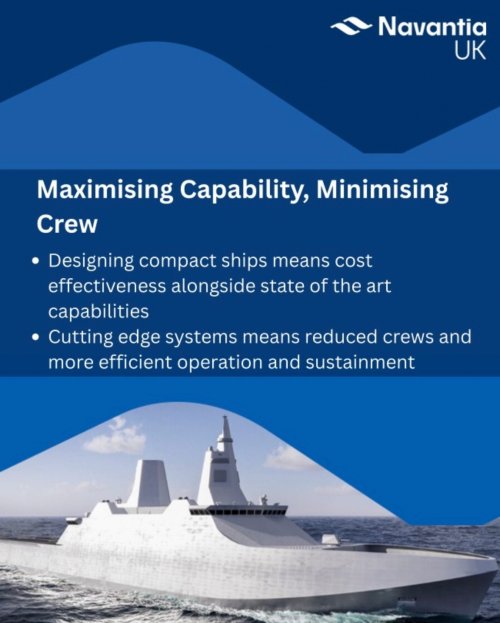
That's the SMART LPD, not a CCV candidate. Navantia always seem to show it with a substantial radar setup.If it's got a decent radar - it's good in my book.
As for the LPD-size, maybe it'd be cheaper to build a large hull that can be easily maintained, with lots of space for future upgrades, lots of power generation, et cetera. Maybe we could even call it something new...
What they showed as their CCV option was the Alfa 4000, which is not a path we want to go down.
Scott Kenny
ACCESS: USAP
- Joined
- 15 May 2023
- Messages
- 19,572
- Reaction score
- 28,042
I mean, if you have to have a large ship for other reasons, you might as well give it a big radar set for ABM and hypersonic detection for the whole group.That's the SMART LPD, not a CCV candidate. Navantia always seem to show it with a substantial radar setup.
Brett Davidson
ACCESS: Top Secret
- Joined
- 26 September 2006
- Messages
- 4,449
- Reaction score
- 12,848
A paper on the hybrid navy cites risks in committing so much to untested uncrewed systems and also the tightness of the deadlines.
https://ukdefencejournal.org.uk/six-common-combat-vessels-no-design-yet-a-2035-deadline/
https://878institute.org/wp-content...ains-Military-Deterrence-Gaps-August-2026.pdf
Robert Clark’s fifth recommendation is to reduce that risk by not starting from scratch. The existing Type 31 frigate design should be the template for the CCVs, he writes, because “a proven platform would minimise production risk, utilise existing supply chains” and maintain shipbuilding at Rosyth once the Type 31 programme finishes in the early 2030s, just as CCV production is expected to begin. Elsewhere he argues the yards at Rosyth “should be utilised for the incoming CCVs”.
...
Type 31 is currently in build at Rosyth. The paper’s related recommendations cover the Type 26 as an export platform and extending the Type 45 to cover the air defence gap left by the Type 83’s cancellation. The Ministry of Defence has not yet responded to the report.
https://ukdefencejournal.org.uk/six-common-combat-vessels-no-design-yet-a-2035-deadline/
https://878institute.org/wp-content...ains-Military-Deterrence-Gaps-August-2026.pdf
Robert Clark’s fifth recommendation is to reduce that risk by not starting from scratch. The existing Type 31 frigate design should be the template for the CCVs, he writes, because “a proven platform would minimise production risk, utilise existing supply chains” and maintain shipbuilding at Rosyth once the Type 31 programme finishes in the early 2030s, just as CCV production is expected to begin. Elsewhere he argues the yards at Rosyth “should be utilised for the incoming CCVs”.
...
Type 31 is currently in build at Rosyth. The paper’s related recommendations cover the Type 26 as an export platform and extending the Type 45 to cover the air defence gap left by the Type 83’s cancellation. The Ministry of Defence has not yet responded to the report.
Reuben James
ACCESS: Top Secret
- Joined
- 15 September 2024
- Messages
- 546
- Reaction score
- 1,113
https://share.google/gJmJ0mOedqiDkDTM6
Hine is of course very supportive of the hybrid navy, so long as he gets to keep building the T31.
As soon as the end of manned warships altogether is floated, Hine immediately downplays the power of autonomy.
Hine is of course very supportive of the hybrid navy, so long as he gets to keep building the T31.
As soon as the end of manned warships altogether is floated, Hine immediately downplays the power of autonomy.
Scott Kenny
ACCESS: USAP
- Joined
- 15 May 2023
- Messages
- 19,572
- Reaction score
- 28,042
I noticed that as well.They never seem to answer the question of how and what will carry the big radars.
Not that low, the waves will intermittently block the radar, but it might be viable to sit at the level of the weather deck. Though that also means you have troubles with BMD radar coverage fore and aft during turns. Grrr. One level above the weather deck?Maybe adjust Type-31 a smidge so it becomes a tumblehome hull with BMD radar at the waterline.
As long as you arent cooking the sailors... and I still think you can't realistically get BMD radars with sufficient power generation, seakeeping and range onto a hull that size.Not that low, the waves will intermittently block the radar, but it might be viable to sit at the level of the weather deck. Though that also means you have troubles with BMD radar coverage fore and aft during turns. Grrr.
Scott Kenny
ACCESS: USAP
- Joined
- 15 May 2023
- Messages
- 19,572
- Reaction score
- 28,042
Quite possibly.As long as you arent cooking the sailors... and I still think you can't realistically get BMD radars with sufficient power generation, seakeeping and range onto a hull that size.
I mean, the Constellation was only carrying the 3x9RMA version of SPY6 and it ended up as 7000tons. The 4x24RMA fits onto ~9500 tons, and the 4x37RMA needs 10,000. All with active stabilizers.
Reuben James
ACCESS: Top Secret
- Joined
- 15 September 2024
- Messages
- 546
- Reaction score
- 1,113
Yeah, apparently BAE's new AESA family are focusing on enhancing performance by boosting component sensitivity, rather than just the raw power throughput. Not sure if that's a genuine improvement, or an innovation forced upon them due to costs and space.Seems like the next generation radars might be smaller and maybe even multistatic. And not ready in time.
TorpedoJ
ACCESS: Secret
- Joined
- 11 October 2023
- Messages
- 434
- Reaction score
- 869
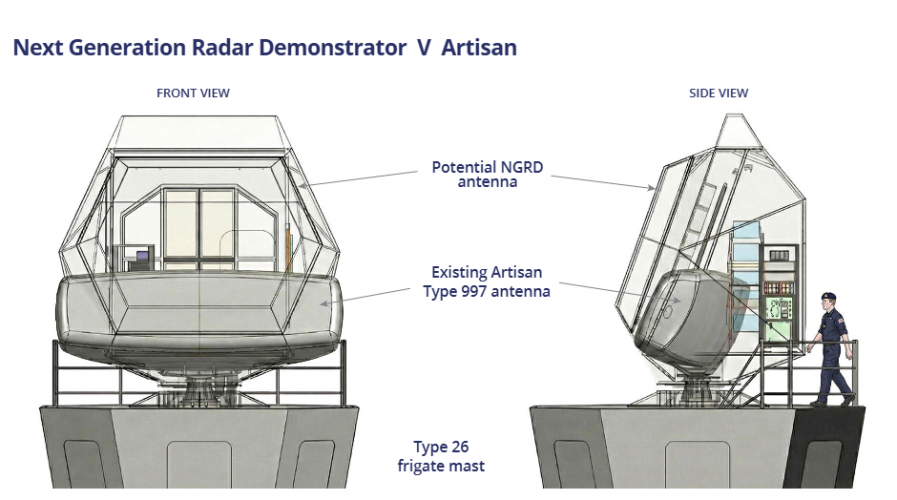
Their demonstrator is designed to fit in the same space as Artisan, which is a huge constraint. It is however very much larger and from the NL article has at least 200 and possibly as many as 600 of BAE's future TRM, which is described as more sensitive but with no mention of being more powerful than current radar, though it likely is with GaN.Yeah, apparently BAE's new AESA family are focusing on enhancing performance by boosting component sensitivity, rather than just the raw power throughput. Not sure if that's a genuine improvement, or an innovation forced upon them due to costs and space.
The indicated panels on FAWCS being slightly smaller than SPY-6 v1 would also support that.
Reuben James
ACCESS: Top Secret
- Joined
- 15 September 2024
- Messages
- 546
- Reaction score
- 1,113
That's not too far from a single Sampson array, right? They have about 600-700 T/RM per face.possibly as many as 600 of BAE's future TRM
TorpedoJ
ACCESS: Secret
- Joined
- 11 October 2023
- Messages
- 434
- Reaction score
- 869
It's an absolute upper limit, using the numbers from the NL article of a maximum of 75 TRMs per subarray and taking the extra trapezoidal spaces on the sides to be subarrays as well for 8x75=600 TRMs.That's not too far from a single Sampson array, right? They have about 600-700 T/RM per face.
Sampson is supposed to have 640 TRMs a side.
Scott Kenny
ACCESS: USAP
- Joined
- 15 May 2023
- Messages
- 19,572
- Reaction score
- 28,042
You're still looking at a ~9500 ton ship with USN hull and bulkhead thickness in that case, and I would not recommend going thinner for a ship intended to hang out in the winter North Atlantic!Their demonstrator is designed to fit in the same space as Artisan, which is a huge constraint. It is however very much larger and from the NL article has at least 200 and possibly as many as 600 of BAE's future TRM, which is described as more sensitive but with no mention of being more powerful than current radar, though it likely is with GaN.
The indicated panels on FAWCS being slightly smaller than SPY-6 v1 would also support that.
TorpedoJ
ACCESS: Secret
- Joined
- 11 October 2023
- Messages
- 434
- Reaction score
- 869
The 160m version of FAWCS as publicised was given as ~10000T so Burke flt3 dimensions but there was also a (more likely IMO) 150m version which wasn't any thinner.You're still looking at a ~9500 ton ship with USN hull and bulkhead thickness in that case, and I would not recommend going thinner for a ship intended to hang out in the winter North Atlantic!
RN historically has pretty decent build quality- the T23s lasted even with deliberately thinner hull plating as Atlantic ASW frigates- so I think we'd be fine on that front.
Build knowledge is not the problem for the Brits, it's funding. It's allways about the money. Or lack thereof.The 160m version of FAWCS as publicised was given as ~10000T so Burke flt3 dimensions but there was also a (more likely IMO) 150m version which wasn't any thinner.
RN historically has pretty decent build quality- the T23s lasted even with deliberately thinner hull plating as Atlantic ASW frigates- so I think we'd be fine on that front.
Reuben James
ACCESS: Top Secret
- Joined
- 15 September 2024
- Messages
- 546
- Reaction score
- 1,113
Similar threads
-
 Norwegian/British Future Mothership Programme - Discussion and News
- Started by Reuben James
- Replies: 43
-

-

-
Offense and Defense against Medium Craft swarms in and around the Seas
- Started by MadRat
- Replies: 5
-
