Reuben James
ACCESS: Top Secret
- Joined
- 15 September 2024
- Messages
- 546
- Reaction score
- 1,113
Apologies for the delay on a longer response, I was on holidayWhat carries the radar allowing for counter-hypersonics and BMD then? Aster B1NT will be right at the limit of what SAMPSON can do and the threat will only evolve in 50 years' time when the CCVs leave service. If even the Houthis were firing AShBMs in 2024 high altitude, high speed and manoeuvring targets are likely to become widespread; the Russians already have Zircon and will evolve it. Radar performance isn't just about range.
Artisan-NG is just the demonstrator for the NGTRM, which is scalable but has 4 rectangular modules in that case. Each module seems to be almost exactly a 1m by 0.5m (higher than they are wide) so slightly larger in area than an SPY-6 RMA. A 2x2 array seems to have been decided as compact enough to replace Artisan but the vast arrays on FAWCS, assuming that those and not the higher panels are based on NGTRM, are 5m square and so would be made up of 50 modules. Anything in between would be possible but bigger is better IMO.
 .
.I think it's unrealistic to assume that any modern warship will be able to cover the entire tracking profile of a hypersonic cruise missile or ballistic missile alone. The US MDA assumes a plethora of ground-based radars providing assistance to its destroyers during missile defence operations.
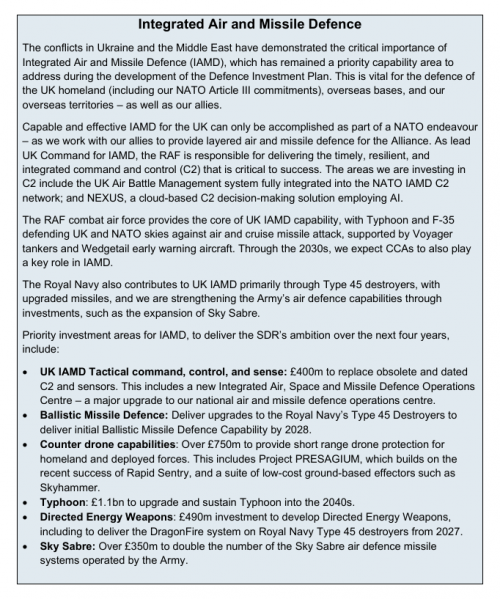
The DIP funds a significant investment in similar ground-based radar systems for the UK (and homeland air defence missiles as well).
With a unwritten (but all too obvious) shift to Atlantic operations, the RN could flood the North Atlantic with long-range search radars (S1850M type systems), working in tandem with the Russia-facing land-based radars and ground-based interceptors to provide constant off-board tracking all the way to interception.
If the Sampson/S1850M combination is achieving MRBM tracking capability on what is essentially a 90s technology base, I imagine the 2020s base that will support the future radars of the 2030s will offer significantly more capable baselines for the same footprint.
The individual CCV should still provide a localised capability for operations in the Middle East.
The Pacific would probably be out of bounds during a conflict. British surface assets would need American escort (and that would probably be fine, to be fair - there's no credible situation in which the UK goes up against China without the USA, Japan and Australia).
In short, I'm saying that the North Atlantic can rely on ground-based radars and prepositioned long-range search and fire-control radars onboard LUSV to provide instant and continuous tracking of a missile threat, rather than needing a single massive naval radar to do the job. The CCV just becomes an additional radar in that group. The trick will be fusing guidance and tracking data from disparate sensors into a single stream of information that an interceptor can use.
When withdrawn from the North Atlantic, the CCV should have a radar capable of operations in isolation (though perhaps similar ground-based radars should be considered for upgrading the current Cypriot installations), especially in the Middle East and Indian Ocean.
In the Pacific, reliance on allies is pretty much a given.
I would like to see the QEs upgraded with the control system and radars from FADS or whatever it is called now for exactly that reason. They are the tallest and largest ships in the fleet and would easily be able to host whatever radar the CCVs or T94 would carry, while the mission planning and ops room spaces could host spaces for commanding USVs. If the CCVs are as lightly equipped as some have suggested there is very little point having them in a CSG when such a large and flexible platform, which is already critical to the task group, can host the decision-making facility anyway.
I agree with this. They already have a large long-range search radar, and we should make more use of it.
Attachments
Last edited: