

- Joined
- 25 June 2009
- Messages
- 15,515
- Reaction score
- 9,447
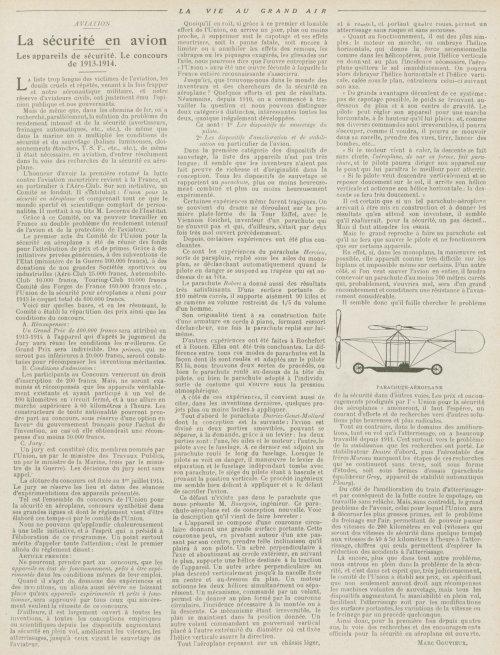
A very interesting entity by the name of "Union pour la sécurité en aéroplane" (Union for aeroplane safety) was founded in 1911 "thanks to the intervention of every aviation-related company". This effort resulted from a growing concern over the many accidents in those years when aviation was still in its infancy; searching for means of bringing more safety to aeroplanes was therefore, not just a laudable initiative, but an obvious necessity. The Union was founded by Bernard J. Dubos, a member of the Aéro-Club de France and presided by Inspector General of Mines Lecornu. It comprised the highest luminaries of the scientific world and a sample of every possible technical competence. Representatives for the Ministers of War, Public Works and Navy were also included. Honorary Presidents included Messrs. Cailletet, the baron of Zuylen, senator Reymond; Messrs. Loreau, Soreau, Renard and Deferres were vice-presidents.
An ambitious aeronautical safety competition was launched in 1912, with a prize of 400,000 Francs for the winner that could not be split (which implied there could be no tie). The creators of the competition each came with very different approaches but all agreed that it should cover a large spectrum of proposals, putting no limitations to either the working principles, nor the very nature of the devices submitted, considering that no-one truly knows wherein lied the solution for a relative, if not perfect, aeronautical safety. They suggested a list of devices liable to be considered (stabilizers, parachutes, landing carts, braking or rescue devices, etc.), insisting on the fact that it was purely indicative and by no means limitative. They subsequently designated a jury made up of scdisinterested individuals to supervise the trials.
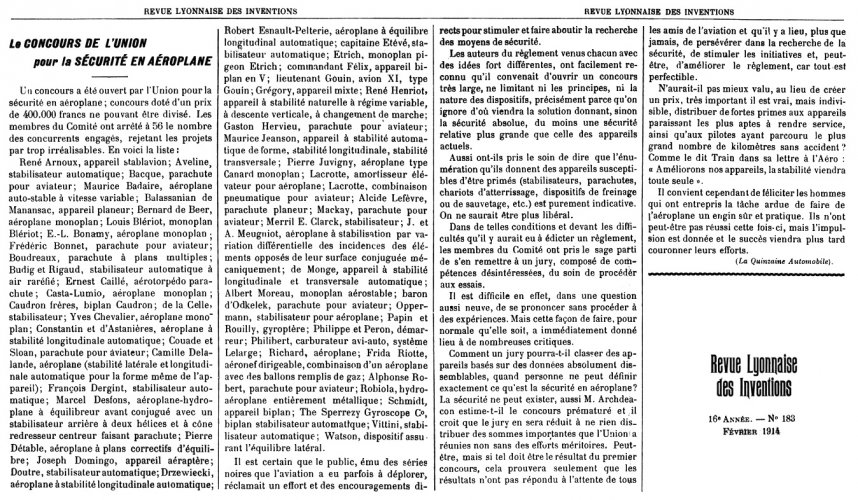
The members of the committee settled on a final list of 56 competitors after rejecting the projects which they deemed "unrealizable". Here is that list, as published by Revue Lyonnaise des Inventions in February 1914 (republished from La Quinzaine Automobile). The list contains a lot of individuals that mattered in the aviation business then and during the next decade or so, but also contains many other names sadly lost to history. Airplane submissions are highlighted in bold type:
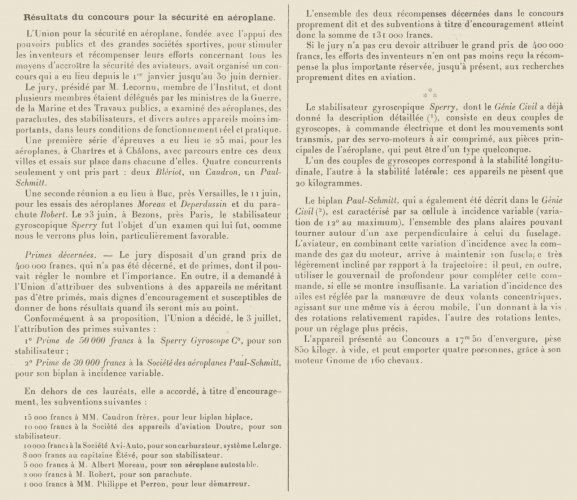
 The jury did not find any invention worthy of the FF 400,000 prize, but provisions had been made for bonuses that could vary in number and size. On July 3, the results were announced as follows:
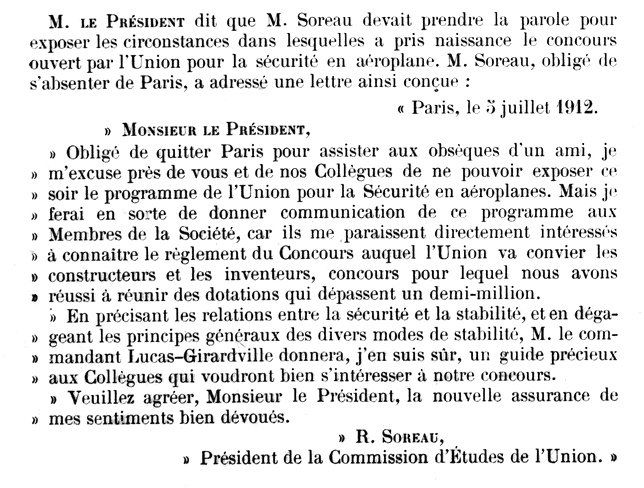
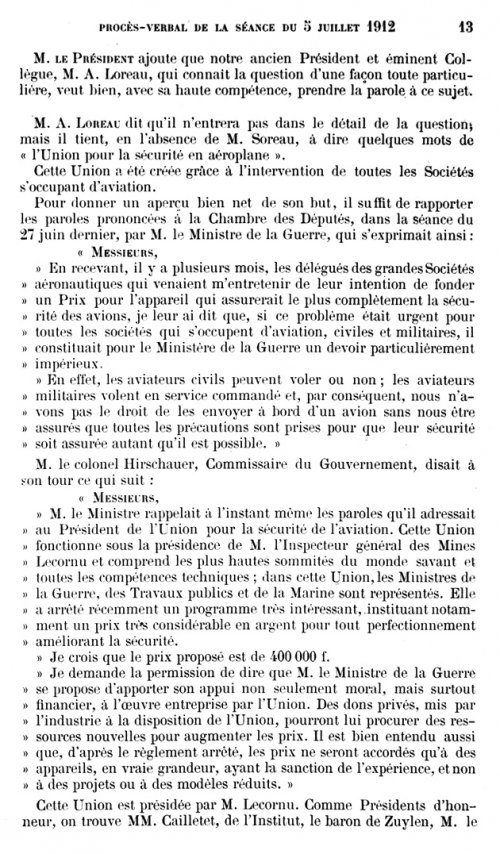
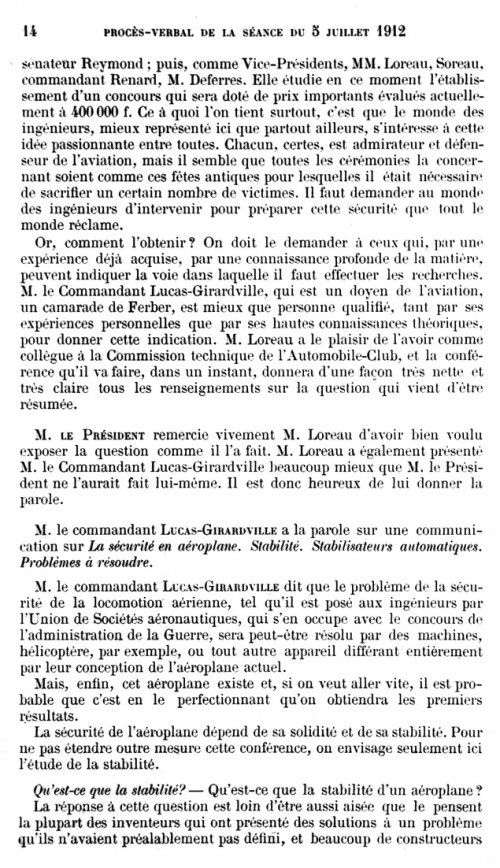
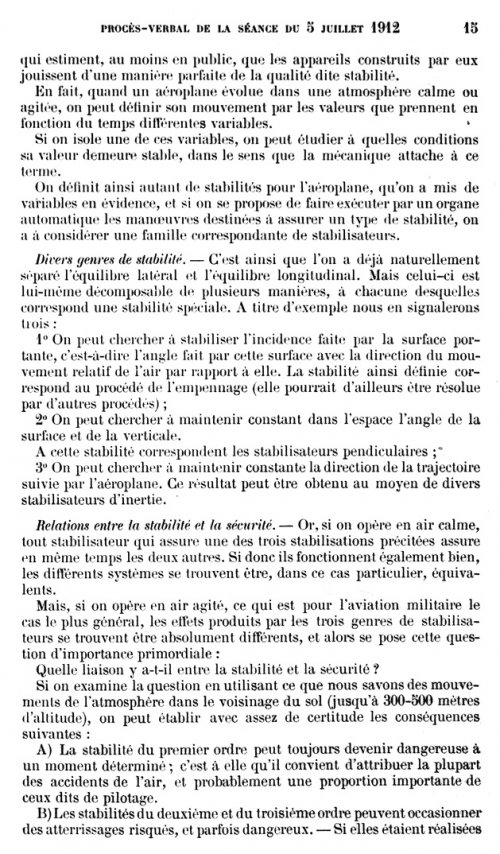
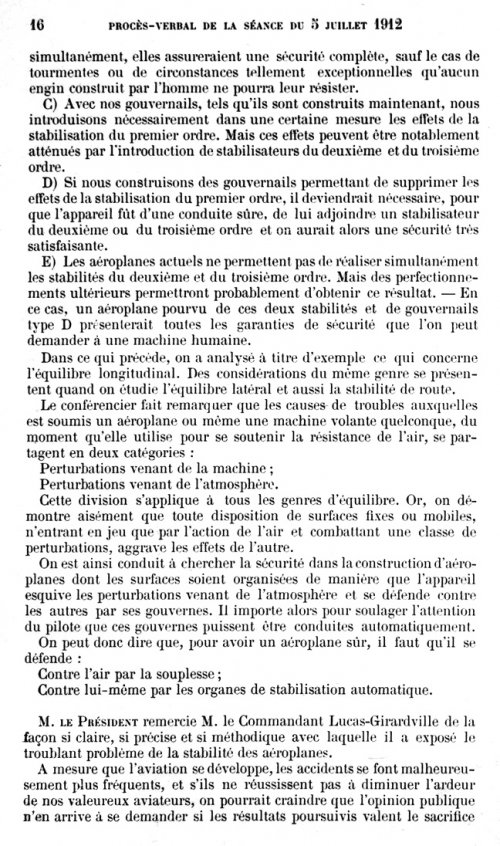
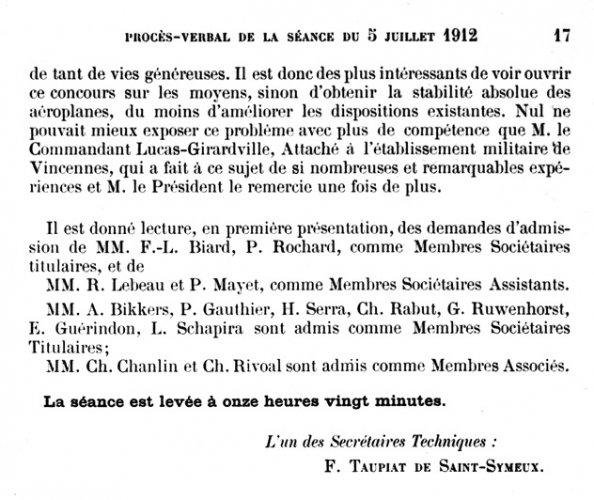
NOTE: I'm attaching below several documents, including the transcription of a July 5, 1912 session of the Société des Ingénieurs Civils de France, which exposes in detail the principles of the Union and develops the concept of aerial stability, as well as the Doutre vs. Etévé/Farman case law.
An ambitious aeronautical safety competition was launched in 1912, with a prize of 400,000 Francs for the winner that could not be split (which implied there could be no tie). The creators of the competition each came with very different approaches but all agreed that it should cover a large spectrum of proposals, putting no limitations to either the working principles, nor the very nature of the devices submitted, considering that no-one truly knows wherein lied the solution for a relative, if not perfect, aeronautical safety. They suggested a list of devices liable to be considered (stabilizers, parachutes, landing carts, braking or rescue devices, etc.), insisting on the fact that it was purely indicative and by no means limitative. They subsequently designated a jury made up of scdisinterested individuals to supervise the trials.
The members of the committee settled on a final list of 56 competitors after rejecting the projects which they deemed "unrealizable". Here is that list, as published by Revue Lyonnaise des Inventions in February 1914 (republished from La Quinzaine Automobile). The list contains a lot of individuals that mattered in the aviation business then and during the next decade or so, but also contains many other names sadly lost to history. Airplane submissions are highlighted in bold type:
- René Arnoux — appareil stablavion
- Aveline — stabilisateur automatique
- Bacque — parachute pour aviateur
- Maurice Badaire — aéroplane auto-stable à vitesse variable
- Balassanian de Manansac — appareil planeur
- Bernard de Beer — aéroplane monoplan
- Louis Blériot — monoplan Blériot
- E.-L. Bonamy — aéroplane monoplan
- Frédéric Bonnet — parachute pour aviateur
- Boudreaux — parachute à plans multiples
- Budig et Rigaud — stabilisateur automatique à air raréfié
- Ernest Caillé — aérotorpédo parachute
- Casta-Lumio — aéroplane monoplan
- Caudron Frères — biplan Caudron
- de la Celle — stabilisateur
- Yves Chevalier — aéroplane monoplan
- Constantin et D'Astanières — aéroplane à stabilité longitudinale automatique
- Couade et Sloan — parachute pour aviateur
- Camille Delalande — aéroplane (stabilité latérale et longitudinale automatique pour la forme même de l'appareil)
- François Dergint — stabilisateur automatique
- Marcel Desfons — aéroplane-hydroplane à équilibreur avant conjugué avec un stabilisateur arrière à deux hélices et à cône redresseur centreur faisant parachute
- Pierre Détable — aéroplane à plans correctifs d'équilibre
- Joseph Domingo — appareil aéraptère
- Doutre — stabilisateur automatique
- Drzewiecki — aéroplane à stabilité longitudinale automatique
- Robert Esnault-Pelterie — aéroplane à équilibre longitudinal automatique
- capitaine Etevé — stabilisateur automatique
- Etrich — monoplan pigeon Etrich
- commandant Félix — appareil biplan en V
- lieutenant Gouin — avion XI, type Gouin
- Grégory — appareil mixte
- René Henriot — appareil à stabilité naturelle à régime variable, à descente verticale, à changement de marche
- Gaston Hervieu — parachute pour aviateur
- Maurice Jeanson — appareil à stabilité automatique de forme, stabilité longitudinale, stabilité transversale
- Pierre Juvigny — aéroplane type Canard monoplan
- Lacrotte — amortisseur élévateur pour aéroplane
- Lacrotte — combinaison pneumatique pour aviateur
- Alcide Lefèvre — parachute planeur
- Mackay — parachute pour aviateur
- Merril E. Clarck — stabilisateur
- J. et A. Meugniot — aéroplane à stabilisation par variation différentielle des incidences des éléments opposés de leur surface conjuguée mécaniquement
- de Monge — appareil à stabilité longitudinale et transversale automatique
- Albert Moreau — monoplan aérostable
- baron d'Odkelek — parachute pour aviateur
- Oppermann — stabilisateur pour aéroplane
- Papin et Rouilly — gyroptère
- Philippe et Péron — démarreur
- Philibert — carburateur avi-auto, système Lelarge
- Richard — aéroplane
- Frida Riotte — aéronef dirigeable, combinaison d'un aéroplane avec des ballons remplis de gaz
- Alphonse Robert — parachute pour aviateur
- Robiola — hydro-aéroplane entièrement métallique
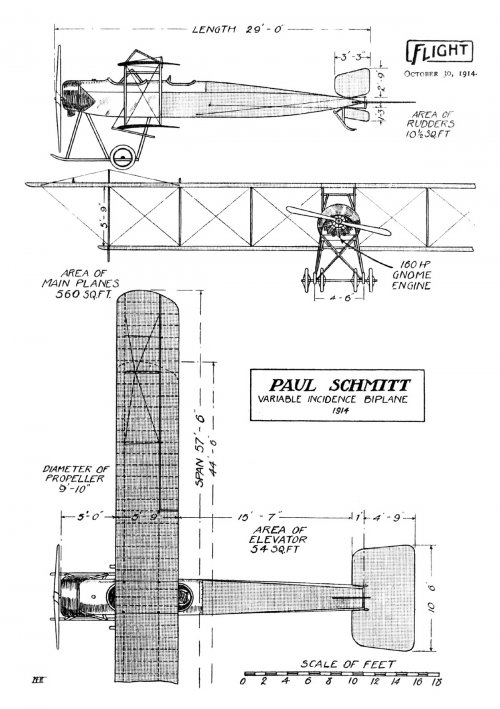
- Schmitt — appareil biplan
- The Sperry Gyroscope Co. — biplan stabilisateur automatique
- Vittini — stabilisateur automatique
- Watson — dispositif assurant l'équilibre latéral
 The jury did not find any invention worthy of the FF 400,000 prize, but provisions had been made for bonuses that could vary in number and size. On July 3, the results were announced as follows:
- the Sperry Gyroscope Co.—which had demonstrated a Curtiss F flying boat using the automatic stabilizer that was to make it famous—won a FF 50,000 bonus;
- the Société des Aéroplanes Paul-Schmitt won a FF 30,000 bonus for its variable-incidence biplane.
- FF 15,000 to the brothers Caudron for their two-seat biplane;
- FF 10,000 to the Société des appareils d'aviation Doutre for its stabilizer,
- FF 10,000 to the Société Avi-Auto for its Lelarge-system carburetor;
- FF 8,000 to captain Etévé for his stabilizer;
- FF 5,000 to Albert Moreau for his autostable airplane;
- FF 2,000 to Mr. Robert for his parachute;
- FF 1,000 to Messrs. Philippe and Perron for their starter.
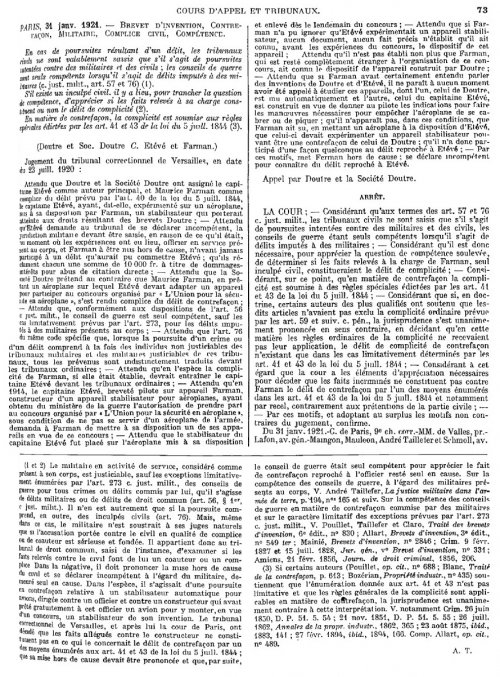
In an curious, unexpected development, Doutre sued Etévé and the Farman company after the war for patent infringement. Etévé, then an Army captain, had been cleared by the Ministry of War to participate in the competition, on condition that he do not use a military aircraft; He had therefore asked the Farman company to loan an airplane for his demonstration, which was fitted with his stabilizer and subsequently returned to Farman. The Versailles criminal court concluded that Farman could not be held responsible in any way and declared itself incompetent to judge whether Etévé himself could. Doutre appealed but the Court of Appeal confirmed the decision.
The Union for Aeroplane Safety continued to exist after World War I and to hold regular prized safety competitions. If you know of any plane that participated in those competitions, maybe even won one of them, this topic is the perfect place to share about it.
The Union for Aeroplane Safety continued to exist after World War I and to hold regular prized safety competitions. If you know of any plane that participated in those competitions, maybe even won one of them, this topic is the perfect place to share about it.
NOTE: I'm attaching below several documents, including the transcription of a July 5, 1912 session of the Société des Ingénieurs Civils de France, which exposes in detail the principles of the Union and develops the concept of aerial stability, as well as the Doutre vs. Etévé/Farman case law.
Attachments
-
 Concours de l'Union pour la Sécurité en Aéroplane 1.jpg138.8 KB · Views: 5
 -
 Concours de l'Union pour la Sécurité en Aéroplane 2.jpg298.5 KB · Views: 4
 -
 Concours de l'Union pour la Sécurité en Aéroplane 3.jpg310.8 KB · Views: 7
 -
 Concours de l'Union pour la Sécurité en Aéroplane 4.jpg303.9 KB · Views: 5
 -
 Concours de l'Union pour la Sécurité en Aéroplane 5.jpg317.3 KB · Views: 4
 -
 Concours de l'Union pour la Sécurité en Aéroplane 6.jpg116 KB · Views: 5
 -
 Concours de l'Union pour la Sécurité en Aéroplane, 1914.jpg556.9 KB · Views: 5
 -
 Doutre vs. Etévé, Dalloz, Jurisprudence générale, 1921.jpg625.8 KB · Views: 5
 -
 La Vie au Grand Air, 1913-06-21.jpg1.7 MB · Views: 3
 -
 résultats du concours, Le génie civil, 1914-07-25.jpg550.4 KB · Views: 6

