The effect of RAN 1964 Carrier Replacement Plan going Ahead?

For context, below is what the RAN was charged to do in war from 1962.
  1. To provide effective and sustained Naval contribution to the allied forces maintaining command of the seas in our areas of strategic interest.
  2. To contribute to and defence Australian military shipping en route to the areas of operations in Southeast Asia.
  3. To protect, within the Australian station, shipping carrying essential imports and exports.
  4. To co-operate with sister services in general operations of war including the defence of the Australian mainland and Australian island territories.
@Pioneer you espouse a very glass half empty view of capability, that since the RAN doesn't have a carrier for 3-4 months of the year (coinciding with the S.E.A. monsoon season with its bad flying weather) it shouldn't have a carrier for the other 8-9 months of the year.
The problem is lining up your refit schedule with the Monsoon season. You may be able to squeeze all the work into 4 months, remembering that the standard is 6 months at sea, 6 months in port, 6 months getting ready to go out to sea. But it'll take you 50% more shipyard workers to do that, and it'll be boom-and-bust because you're always going to have that extra work at the same time every year. Not good for keeping your shipyards busy.

The bigger problem is that if you do that, you have personnel that have never learned how to fly in the monsoons. Or rather, pilots who have never learned to land on a carrier in a monsoon.


The fact of the matter is that the Melbourne was bought and paid for and in service, was capable of operating a useful generation of aircraft from the mid 60 for 15 years and was due for a mid-life refit from about 1963. Once this generation of aircraft is purchased and refit undertaken Australia doesn't have to worry about growing aircraft weights etc until 1980 or so, as unlike the USN it only buys aircraft once in a generation and a carrier once in every 2 generations.
What aircraft are we buying in 1963? Skyhawks were in production until 1979, but I'm still really tempted by Harriers.
 
The problem is lining up your refit schedule with the Monsoon season. You may be able to squeeze all the work into 4 months, remembering that the standard is 6 months at sea, 6 months in port, 6 months getting ready to go out to sea. But it'll take you 50% more shipyard workers to do that, and it'll be boom-and-bust because you're always going to have that extra work at the same time every year. Not good for keeping your shipyards busy.

The bigger problem is that if you do that, you have personnel that have never learned how to fly in the monsoons. Or rather, pilots who have never learned to land on a carrier in a monsoon.
This is way Sydney should have been modernised aswell to allow one in refit and one at sea most of the time
What aircraft are we buying in 1963? Skyhawks were in production until 1979, but I'm still really tempted by Harriers.
Skyhawks i would say though I wouldn't mind the Etendard IV
 
The problem is lining up your refit schedule with the Monsoon season. You may be able to squeeze all the work into 4 months, remembering that the standard is 6 months at sea, 6 months in port, 6 months getting ready to go out to sea. But it'll take you 50% more shipyard workers to do that, and it'll be boom-and-bust because you're always going to have that extra work at the same time every year. Not good for keeping your shipyards busy.

The bigger problem is that if you do that, you have personnel that have never learned how to fly in the monsoons. Or rather, pilots who have never learned to land on a carrier in a monsoon.

It's not such a problem that you'd ditch such a powerful and existing capability for a lesser one that's more available. Even in refit the Melbourne and her CAG still exist, and refits can be hurried in an emergency, and CAGs can be re-deployed from Nowra to forward bases to support the RAN.

As for the 3 x 6 months operational tempo, that's for an operational deployment, like the RAN DDGs to the Vietnam War, or USN carriers to Yankee Station, or more recent RAN anti-piracy operations in the NW Indian Ocean. It doesn't apply to the RAN going out from Sydney during the week and back on weekends or heading north for the round of SEATO exercises and other Cold War activities for a few weeks.

What aircraft are we buying in 1963? Skyhawks were in production until 1979, but I'm still really tempted by Harriers.

I imagine Skyhawks and Trackers, they both were in service in 1959 when Melbourne's fate was first falsely announced.
 
It's not such a problem that you'd ditch such a powerful and existing capability for a lesser one that's more available. Even in refit the Melbourne and her CAG still exist, and refits can be hurried in an emergency, and CAGs can be re-deployed from Nowra to forward bases to support the RAN.
Depends on how much the ship has been cut into, but yes.


As for the 3 x 6 months operational tempo, that's for an operational deployment, like the RAN DDGs to the Vietnam War, or USN carriers to Yankee Station, or more recent RAN anti-piracy operations in the NW Indian Ocean. It doesn't apply to the RAN going out from Sydney during the week and back on weekends or heading north for the round of SEATO exercises and other Cold War activities for a few weeks.
Yes, if your standard "cruise" is only a couple of weeks out instead of 6 weeks out and 6 weeks back you can get away with fewer ships.
 
Yes, if your standard "cruise" is only a couple of weeks out instead of 6 weeks out and 6 weeks back you can get away with fewer ships.

No doubt the USN requests in 1966 and 1967 for deployment to Yankee station would have required the months-long workup and prolonged refit afterwards. However mostly the ship would do exercises on cruises 3 months or less, stopping in various allied ports for flag waving etc. The 1980 cruise to the Indian Ocean that left Sydney for Fremantle on 18 August and didn't return until 12 December was the Melbourne's longest deployment at just under 4 months away from Sydney.
 
No doubt the USN requests in 1966 and 1967 for deployment to Yankee station would have required the months-long workup and prolonged refit afterwards. However mostly the ship would do exercises on cruises 3 months or less, stopping in various allied ports for flag waving etc. The 1980 cruise to the Indian Ocean that left Sydney for Fremantle on 18 August and didn't return until 12 December was the Melbourne's longest deployment at just under 4 months away from Sydney.
FWIW Melbourne was at the Review of the Fleet at Spithead in 1977 for the late Queen's Silver Jubilee. Do you know how long that cruise lasted?
 
Increase Woman Royal Australia Navy Services to allow more men to go to sea, decommission HMAS Sydney and that gives you about 500 to 600 men, so it is possible
They did increase the WRANS to allow more men to go to sea and HMAS Sydney was decommissioned in 1973 anyway. Therefore, if the RAN took Centaur over at the end of 1965 or Hermes in the middle of 1970 that would only take you to 1973.
 
They did increase the WRANS to allow more men to go to sea and HMAS Sydney was decommissioned in 1973 anyway. Therefore, if the RAN took Centaur over at the end of 1965 or Hermes in the middle of 1970 that would only take you to 1973.
I would say if we got Centaur or Hermes the personal numbers would be authorized to be allowed to stay higher, to allow the operation of the carrier
 
Increase Woman Royal Australia Navy Services to allow more men to go to sea, decommission HMAS Sydney and that gives you about 500 to 600 men, so it is possible
I did suggest that women should be allowed to serve at sea from circa 1970, but I only had two replies, both of which were negative. @Scott Kenny said that the accommodation on an Oriskany wasn't suitable for mixed crews and @Volkodav didn't know what I was talking about.
 
The last paragraph of Message 27.
I've been deliberately using man, men and manning instead of crew and crewing, because the decision on what ship to buy would be taken shortly before the start of Women's Lib which would be in full swing when the ship entered service, so supplement the inadequate supply of men with women and allow them to serve at sea decades earlier than IOTL.
 
I did suggest that women should be allowed to serve at sea from circa 1970, but I only had two replies, both of which were negative. @Scott Kenny said that the accommodation on an Oriskany wasn't suitable for mixed crews and @Volkodav didn't know what I was talking about.
I would say women on ships wouldn't be possible untill the 80s, like originally when they went on in 83. Though if you increase the WRANS by 1.5x to 3x bigger in the 60s and 70s might be able to get the women on the ships in the late 70s maybe
 
However mostly the ship would do exercises on cruises 3 months or less, stopping in various allied ports for flag waving etc. The 1980 cruise to the Indian Ocean that left Sydney for Fremantle on 18 August and didn't return until 12 December was the Melbourne's longest deployment at just under 4 months away from Sydney.
I think it'd work.

3-4 months out at sea right before the Monsoons. 4 months in refit during the monsoons. And then 4-5 months of the ship only being out for a week or two at a time then coming back for the weekend, increasing in length over time.

Like I said, you'd likely need a much bigger Shipyard staff than the USN model, assuming that you need the same number of man-hours of maintenance and repairs done after the 4-month long cruise as you would after the USN 6-month long cruise.
 
Going all the way back to before the Nov 1959 announcement that Melbourne would be retired in 1963, stated to her theoretical end of life. Even that announcement was based on a false premise, 1963 was the theoretical point at which Melbourne would need a mid-life refit, one that after much hand-wringing she actually got in 1967. Given the way history panned out I think the optimum path would have been to work toward maximising this refit from 1959, all the pieces were available to be put together that early.
 
Going all the way back to before the Nov 1959 announcement that Melbourne would be retired in 1963, stated to her theoretical end of life. Even that announcement was based on a false premise, 1963 was the theoretical point at which Melbourne would need a mid-life refit, one that after much hand-wringing she actually got in 1967. Given the way history panned out I think the optimum path would have been to work toward maximising this refit from 1959, all the pieces were available to be put together that early.
I thought the 63 dat was for when she was to become a helicopter carrier
 
I thought the 63 dat was for when she was to become a helicopter carrier

This is the timeline of decisions I have, the only thing that is missing is the authorisation for the planned 1966 refit, although they knew about the mid-life refit back in 1959.
  • Nov 1959 Govt announced Melbourne to retire in 1963 at the end of her theoretical life (when half-life refit due)
  • 1960 retirement decision reversed, Melbourne would stay in service as ASW Helicopter carrier after 1963
  • 1961 27 Wessex helicopters ordered for Melbourne
  • May 1963 decision to fly current fixed wing aircraft from Melbourne to 1967,
    • Wessex being delivered
  • July 1964 investigations into Melbourne replacement completed, Melbourne deemed unsuitable, Essex class with F4Bs, S2E & E1s recommended by CNS,
    • equipping Melbourne with S2 alternative option
  • July 1964 Successful trials with S2 Trackers and A4 Skyhawks on Melbourne at Subic Bay
  • August 1964 CNS recommendation for Essex class with F4Bs, S2E & E1s rejected by C-COSC, CAS & CGS
  • September 1964 C-COSC & majority opinion recommendation to buy S2s for Melbourne accepted by Defence Minister,
    • existing planned refit already authorised
 
Just found something interesting in the NAA carrier replacement doc, Page 172 from the Secretary to the Minister (I don't know if these were Navy or Defence) in November 1964 comparing the Karel Doorman's visit to Australia in 1960. The Secretary states that the KD is a larger design carrier than Melbourne and can carry 35 aircraft in war, and that the Melbourne could carry at most 10 x A4s in a strike role.

Further, from the perspective of late 1964, says that the deterrent value of the Melbourne in 1968 shouldn't be compared with the KD in 1960 due to Indonesia acquiring Tu16 and Migs in the early 60s and how Melbourne can't carry many A4s.

That's an interesting argument, but if Melbourne was modified along the lines of KD from 1963 this argument would carry much less weight. For starters such a modified Melbourne would be able to carry more A4s in a strike role.
 
Just found something interesting in the NAA carrier replacement doc, Page 172 from the Secretary to the Minister (I don't know if these were Navy or Defence) in November 1964 comparing the Karel Doorman's visit to Australia in 1960. The Secretary states that the KD is a larger design carrier than Melbourne and can carry 35 aircraft in war, and that the Melbourne could carry at most 10 x A4s in a strike role.

Further, from the perspective of late 1964, says that the deterrent value of the Melbourne in 1968 shouldn't be compared with the KD in 1960 due to Indonesia acquiring Tu16 and Migs in the early 60s and how Melbourne can't carry many A4s.

That's an interesting argument, but if Melbourne was modified along the lines of KD from 1963 this argument would carry much less weight. For starters such a modified Melbourne would be able to carry more A4s in a strike role.
Do you know if the 35 was based on Melbourne's proposed air group based of Skyhawks, Trackers and Wessexs or KD air group in 1960. Cause 35 aircraft for war is quite impressive, I believe Syndey had 38 during Korea
 
Do you know if the 35 was based on Melbourne's proposed air group based of Skyhawks, Trackers and Wessexs or KD air group in 1960. Cause 35 aircraft for war is quite impressive, I believe Syndey had 38 during Korea

I don't know but I suspect it was the 1960 aircraft, Sea Hawks and Avengers. I also suspect that 35 of these aircraft is the point where the CAG 'binds' and cannot operate and a few less aircraft is more realistic.
 
I don't know but I suspect it was the 1960 aircraft, Sea Hawks and Avengers. I also suspect that 35 of these aircraft is the point where the CAG 'binds' and cannot operate and a few less aircraft is more realistic.
How much smaller is the sea hawk with its wings folder compared to the skyhawk?
Even if you could push it to 30 32 in a pinch during war thats quite impressive for how small of a carrier Melbourne is
 
How much smaller is the sea hawk with its wings folder compared to the skyhawk?
A lot.
Even if you could push it to 30 32 in a pinch during war that's quite impressive for how small of a carrier Melbourne is
Folding reduced the wingspan of a Sea Hawk from 39ft 0in to 13ft 4in according to Jane's All the World's Aircraft 1960-61. The non-folding wingspan of an A-4C/E was 27ft 5ft according to to Jane's Fighting Ships 1964-65. According to the same sources a Sea Hawk was 39ft 8in long and a Skyhawk was 42ft 11in long, so a Sea Hawk was shorter too, but only a bit, instead of a lot.

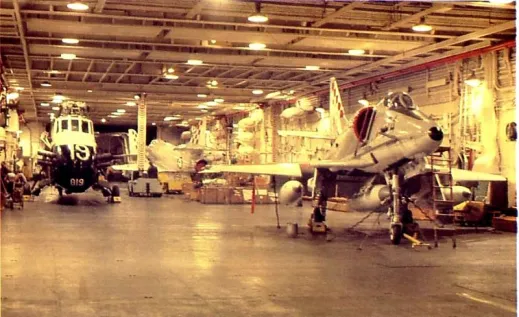
The hangars on a Colossus/Majestic class ship were 52ft wide. Therefore, Sea Hawks can be stowed three abreast with ease. Whereas (unless they were staggered) a Skyhawk could only be stowed one abreast. Except, I've seen photographs of them in Melbourne's hangar and the Skyhawks were parked at an angle so their noses nearly touched the hangar's side and which meant there was enough space to stow them two abreast. Unfortunately, I couldn't find any when I did an internet search doing my research for this message.

But AIUI a Skyhawk could carry more than twice the payload further than a Sea Hawk.
 
Last edited:
A lot.

Folding reduced the wingspan of a Sea Hawk from 39ft 0in to 13ft 4in according to Jane's All the World's Aircraft 1961. The non-folding wingspan of an A-4C/E was 27ft 5ft according to to Jane's Fighting Ships 1964-65. According to the same sources a Sea Hawk was 39ft 8in long and a Skyhawk was 42ft 11in long, so a Sea Hawk was shorter too, but only a bit, instead of a lot.

The hangars on a Colossus/Majestic class ship were 52ft wide. Therefore, Sea Hawks can be stowed three abreast with ease. Whereas (unless they were staggered) a Skyhawk could only be stowed one abreast. Except, I've seen photographs of them in Melbourne's hangar and the Skyhawks were parked at an angle so their noses nearly touched the hangar's side and which meant there was enough space to stow them two abreast. Unfortunately, I couldn't find any when I did an internet search doing my research for this message.

But AIUI a Skyhawk could carry more than twice the payload further than a Sea Hawk.
Where there any prototypes or plans for folding wings on the skyhawks?
 
A lot.

Folding reduced the wingspan of a Sea Hawk from 39ft 0in to 13ft 4in according to Jane's All the World's Aircraft 1960-61. The non-folding wingspan of an A-4C/E was 27ft 5ft according to to Jane's Fighting Ships 1964-65. According to the same sources a Sea Hawk was 39ft 8in long and a Skyhawk was 42ft 11in long, so a Sea Hawk was shorter too, but only a bit, instead of a lot.

The hangars on a Colossus/Majestic class ship were 52ft wide. Therefore, Sea Hawks can be stowed three abreast with ease. Whereas (unless they were staggered) a Skyhawk could only be stowed one abreast. Except, I've seen photographs of them in Melbourne's hangar and the Skyhawks were parked at an angle so their noses nearly touched the hangar's side and which meant there was enough space to stow them two abreast. Unfortunately, I couldn't find any when I did an internet search doing my research for this message.

But AIUI a Skyhawk could carry more than twice the payload further than a Sea Hawk.
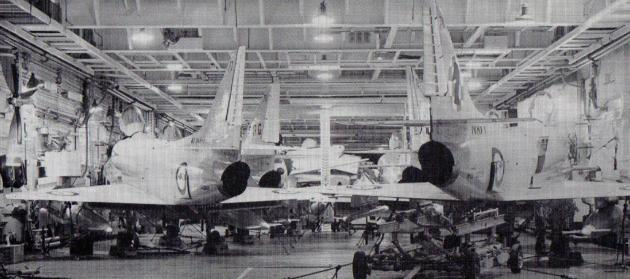
Melbourne's hangar.

1761643684858.png

1761643718897.png
 
Wing folding would add an additional 1,000lb or so of weight.
 
Where there any prototypes or plans for folding wings on the Skyhawks?
Not that I know of and there probably weren't any.

British naval aircraft tended to fold into smaller packages than their American equivalents. E.g. the Buccaneer folded into a smaller package than an Intruder. Which, I suspect is because they needed to, because British aircraft carriers tended to have smaller flight decks, smaller hangars and smaller lifts.

And I suspect that one of the reason why the Gannet had one Double Mamba engine in the nose instead of two Single Mambas in the wings was to reduce the folded wingspan. The Gannet folded from 54ft 4in to 19ft 11in. The wingspan of an S-2D Tracker folded from 72ft 7in to 27ft 4in and an E-1A Tracer folded from 72ft 4in to 27ft 4in.
 
Last edited:
Not that I know of and there probably weren't any.

British naval aircraft tended to fold into smaller packages than their American equivalents. E.g. the Buccaneer folded into a smaller package than an Intruder. Which, I suspect is because they needed to, because British aircraft carriers tended to have smaller flight decks, smaller hangars and smaller lifts.

And I suspect that one of the reason why the Gannet had one Double Mamba engine in the nose instead of two Single Mambas in the wings was to reduce the folded wingspan. The Gannet folded from 54ft 4in to 19ft 11in. The wingspan of an S-2D Tracker folded from 72ft 7in to 27ft 4in and am E-1A Tracer folded from 72ft 4in to 27ft 4in.
Fair enough. I wonder how small you could make the Skyhawk fold down. It would probably make the Light Fleet Carriers even more tempting for smaller powers then.
 
Fair enough. I wonder how small you could make the Skyhawk fold down. It would probably make the Light Fleet Carriers even more tempting for smaller powers then.
My guess, is not much, if at all.

One of the advantages a Centaur class ship had over the Colossus/Majestic class is that their hangars were 62ft wide. That was wide enough to allow Trackers, Traders and Tracers to be stowed two abreast and make it easier to stow Skyhawks two abreast.
 
My guess, is not much, if at all.

One of the advantages a Centaur class ship had over the Colossus/Majestic class is that their hangars were 62ft wide. That was wide enough to allow Trackers, Traders and Tracers to be stowed two abreast and make it easier to stow Skyhawks two abreast.
Copy, So another reason to get centaur or hermes.
 
Even if you could push it to 30 32 in a pinch during war thats quite impressive for how small of a carrier Melbourne is

Given Melbourne usually carried 20-22 aircraft getting to 24-26 is valuable because that increase will be entirely Skyhawks. An extra 4 Skyhawks means the Melbourne goes from an ASW carrier with the minimum ability to chase off shadowing aircraft or attack a missile boat to a reasonably balanced multi-role carrier. What's more once the SEATO ASW mission dies off in the early 70s the Melbourne can carry even more Skyhawks at the expense of a couple of Trackers and helicopters.
 
Given Melbourne usually carried 20-22 aircraft getting to 24-26 is valuable because that increase will be entirely Skyhawks. An extra 4 Skyhawks means the Melbourne goes from an ASW carrier with the minimum ability to chase off shadowing aircraft or attack a missile boat to a reasonably balanced multi-role carrier. What's more once the SEATO ASW mission dies off in the early 70s the Melbourne can carry even more Skyhawks at the expense of a couple of Trackers and helicopters.
Agree, though thats why I like the proposed county class for the RAN as it allows helicopters to be removed from Melbourne to allow more Skyhawks or Trackers
 
Agree, though thats why I like the proposed county class for the RAN as it allows helicopters to be removed from Melbourne to allow more Skyhawks or Trackers

Sure, but historically the decision to buy 27 Wessex in 1961 wasn't made in a good environment, with well-reasoned justifications against well-understood capabilities of Melbourne to utilise (or not) a new generation of aircraft, the utility of such aircraft and a good understanding of alternatives and their practicality for Australian circumstances.

If this issue was looked at with the most open mind from 1958, with the ~1963 half-life refit of Melbourne in mind and left of arc being the disbanding of the FAA and the right of arc being a strike carrier, I doubt the RAN would have bought 27 Wessex and only 8+2 A4s. At the very least I suspect a lower number of Wessex and higher number of A4s, maybe even the 18 suggested in 1964.

In that case there wouldn't be 'spare' Wessex helicopters to put on County classes DLGs.
 
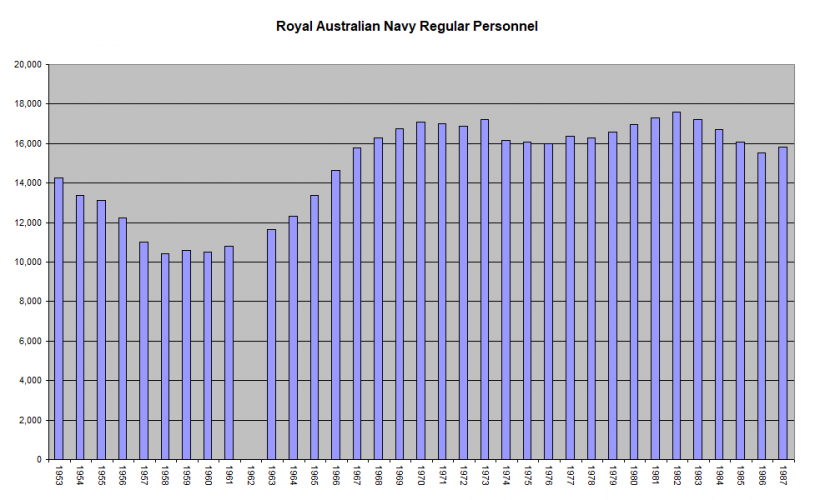
I wonder what happens if the big dip from 53 to 65 doesn't happen, if the RAN id able to keep 14,000+ plus numbers during that period how does that effect everything?
 
I wonder what happens if the big dip from 53 to 65 doesn't happen, if the RAN id able to keep 14,000+ plus numbers during that period how does that effect everything?
  • Australia isn't paid off in 1954 and serves as the RAN's training ship until Hobart completes her conversion.
  • Vengeance continues to be an operational aircraft carrier until relieved by Melbourne in 1955 instead of becoming a training ship (to relieve Australia) in 1954.
  • Sydney continues to serve as an operational aircraft carrier until 1962 instead of relieving Vengeance as the training ship in 1955 and being paid off in 1958.
  • Or the conversion of Hobart into a training ship is still abandoned and Vengeance relieves Australia as the RAN's training ship in 1955 (instead of being returned to the RN) and doesn't pay off until 1962 when she's relieved by Sydney.
 
  • Australia isn't paid off in 1954 and serves as the RAN's training ship until Hobart completes her conversion.
  • Vengeance continues to be an operational aircraft carrier until relieved by Melbourne in 1955 instead of becoming a training ship (to relieve Australia) in 1954.
  • Sydney continues to serve as an operational aircraft carrier until 1962 instead of relieving Vengeance as the training ship in 1955 and being paid off in 1958.
  • Or the conversion of Hobart into a training ship is still abandoned and Vengeance relieves Australia as the RAN's training ship in 1955 (instead of being returned to the RN) and doesn't pay off until 1962 when she's relieved by Sydney.
So Sydney gets modernise to melbourne standards? So the RAN wpuld have 2 carriers in service. Why Sydney only operating to 62
I wonder how Vengeance staying as the training ship would affect Brazil, would they just get a different colossus class?
Plus 4th daring, last 2 rivers and all the Qs and tribals modernised?
 

Similar threads

Back
Top Bottom