The longer this, and the other Australian procurement thread, goes on the more I'm reminded of the British and how the ~53,000t CVA01 was both the minimum acceptable standard and the maximum ship they could handle. In Australia's case this is the Melbourne's 60s upgrade.
For the stated SEATO ASW role some 10 ASW helicopters, 6 fixed wing ASW and 4 'fighters' were the minimum acceptable standard, although obviously more provides greater capability. However given budgets and available manpower the RAN can allocate to a carrier and its CAG the Melbourne, in one form or another, is the maximum that can fit into RAN procurement budgets and crewing limitations.
For mine the optimal RAN carrier path would be to get someone over the the Netherlands in 1958 and get to know the ins and outs of the Karel Doorman and Menas Gerais rebuilds and make all decisions with that full depth of knowledge.
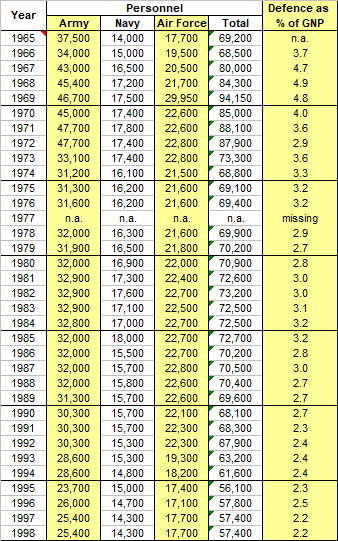
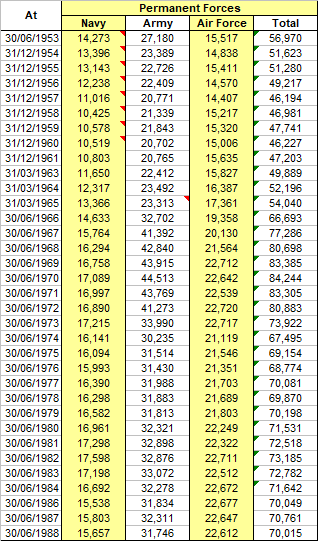
@NOMISYRRUC I notice the RAN and RAAF personnel numbers really climb during the 1964-72 'conscription for overseas service with the Regular Amy' years. The CMF was some 20,000 strong in 1960 after the end of the 1951-57/59 conscription period but grew to some 35,000 in 1968 with about half of these joining the CMF in order to avoid being conscripted to serve in Vietnam. I suspect a reasonable chunk of the RAN and RAAF growth in the same period might be for similar reasons.
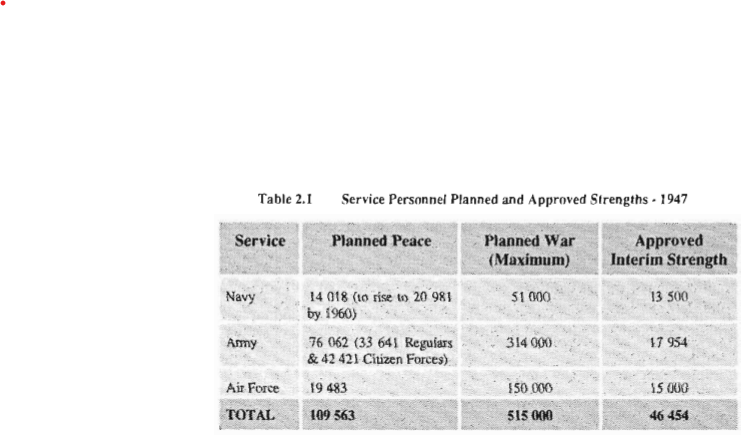
The NAA document pp43-45 says that to man an Oriskany with 218 officers and 2073 men the RAN would have to grow to 17,619 men by 1968, but from then current recruiting and retention trends the RAN would only reach 14,300-15,000 men. Conscription likely indirectly pushed the RAN to the high 16,000s - low 17,000s which is close to an Oriskany and likely capable of manning Hermes, but the RAN was also introducing submarines at the time which compete with the FAA for resources.
Some good and realistic points you make
Rule of cool - especially:
- the minimum acceptable standard and the maximum ship they could handle, and
-
but the RAN was also introducing submarines at the time which compete with the FAA for resources.
You're notion of liaising with 'the Netherlands to know the ins and outs of the
Karel Doorman and
Menas Gerais rebuilds and make all decisions with that full depth of knowledge', makes a lot of sense., if Australia could kick the idea of being subordinate to the British/Admiralty at the time....
Ideally, in this thread, Australian ship building would have developed the capacity and workforce skill to conduct such a rebuild of
Melbourne and for that matter
Syndey to such high standards as the
Karel Doorman. But failing that, was there scope for the Dutch to conduct such a rebuild for Australia?
I guess the other elephant in the room is the reality that a single carrier in time of threat/war isn't enough - given actual operations, maintenance/refitting and training cycles. For as clearly demonstrated time and time again, in the case of the RAN/
Melbourne, each and every time she went into maintenance/refit [or bloody repairs], for all intent and purposes, Australia lost it's 'must have carrier/ASW capabilty' for months on end. Or as apply demonstrated in the case of India, and her single
Majestic-class carrier INS
Vikrant, she failed to see combat, either in the 1962 Sino-Indian War or 1965 Indo-Pakistani War as she was in drydock maintenance each time....!
So using your "
For the stated SEATO ASW role some 10 ASW helicopters, 6 fixed wing ASW and 4 'fighters' were the minimum acceptable standard......", does Australia/RAN need to get real and forgo the notion of emulating the 'big boys and their toys' and be brutality serious in its threat assessment of the region vs a notion of mini power projection capability. And in doing so knuckle down on either building a new purposely designed and built Light Fleet Carrier by either Britain, France, or Netherlands to replace it's
Majestic/
Colossus-class Light Fleet Carrier's. For as much as acquiring tantalisingly priced used carriers from either Britian or U.S. still comes the reality that they are in fact:
- used - their life span and serviceability is already ticking away.....;
- both British and U.S. options, be it
Hermes or a
Essex class would require a timely and expensive refit, before they are taken on board by Australia/RAN;
- New and modern aircraft will be needed for such a carrier to be meaniful and fit for purpose.
In designing and building such a 'new' designed Light Fleet Carrier, Australia, intrinsically appreciative of manpower issues within it's ORBAT could ensue that all new carrier technologies are included within its design, from the getgo.
The 'new' design carrier could be designed/compartmitised with jet-powered aircraft in mind.
It could stipulate and incorporate overgrowth within the design, including such things as:
- anticipated growth in aircraft sizes and weights;
- Aircraft lift sizes and capacities;
- more than one aircraft lift;
- more than one catapult.
- longer stroke catapults;
- the degree of the angled flight deck;
- modern defensive weapons and supporting sensors;
- Air Conditioning specifically for the regions hot and humid climate;
- etc...
If Australia was smart, it would offer such a modern Light Fleet Carrier as a joint program, perhaps with Canada and the Netherlands. And, or offer such a design for export to the likes of Argentina, Spain, Brazil, India, etc, do as to replace their own
Majestic/
Colossus-class, and
Independence-class light carrier.....
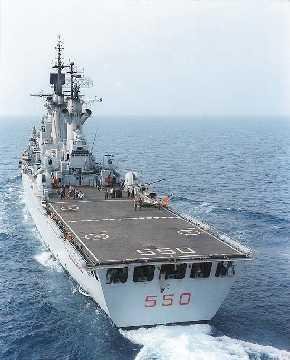
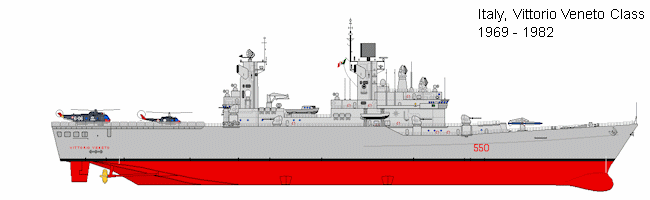
Failing to be able to afford purchasing, maintain and or manning two carriers effectively, should Australia seriously admit it can't stay in the 'carrier-club' and as such give away the romance of having a vessel in which to launch strikes against percieved enemies. If this was the realistic case, then perhaps the Australian government/RAN, which can focus on protecting its strategic sealines, in terms of ASW. As such, should Australia be considering two or three helicopter cruisers? Something the likes of the very capable Italian
Vittorio Veneto class:
Laid down 1965
Launched 1967
Commissioned: 1969
Displacement: 7,500 tons standard
9,550 tons full loaded
Complenent 557
Armament (as built):
1 × Mk 19 twin-arm launcher for 40 x RIM-2 Terrier and 20 x ASROC missiles
8OtoOto Melara 76/62mm MMI or Oto Melara 76/62mm Compact guns
2 × 324 mm triple torpedo tubes
Aircraft:
9 x Augusta AB 204
or later
9 x Augusta AB 212
or even later
6 x Augusta AB 61 Sea King helicopters
Importantly, and very relevant to Australia/RAN,
Vittorio Veneto class had very comprehensive C3 facilities incorporated into its design.
Incorporate two Ikara launchers and magazines......
Anyhow, just me thinking out loud.......
Regards
Pioneer