The effect of RAN 1964 Carrier Replacement Plan going Ahead?

Looking at the table in Message 190 Australia's economy seems to have been growing at the rate of 5-10% every year from 1950 to 1968.

This growth was somewhat uneven, the early 60s had a credit crunch and sluggish annual growth, just when big money was needed for Defence. The second half of the 60s to about 1971 saw explosive growth with several years over 7%, but this couldn't have been predicted when ordering stuff in sluggish 1963 for delivery in booming 1966.
 
Another thing i have just though when the RAN were selecting a carrier to buy from the Brits, post war they where offered the Colossus class, Majestics Class or Centaur Class. What Happens if the RAN selects the Centaur Class? This comes from the Empire Defence to Long Haul

What were some specifics? FWIW in 1948 when light carriers were flying the superlative Sea Fury their size wasn't a problem. It only became a problem by the late 50s and I believe even then it was a manageable problem.
 
Captain Killjoy for the win!

In my defence anyone can dream up anything, this whole thread comes from the delusion of the CN in 1963-65. While the CVA01/Essex/F4 ideas are delusion I'd say the 1968 offer of Hermes is much more realistic and worthy of more intense scrutiny.
I really like the idea of Hermes being brought for the RAN how many A4s, S2s, E1s & Helos would she be able to operate?
 
Another thing i have just though when the RAN were selecting a carrier to buy from the Brits, post war they where offered the Colossus class, Majestics Class or Centaur Class. What Happens if the RAN selects the Centaur Class? This comes from the Empire Defence to Long Haul
The Centaurs aren't for sale because the RN wants them because they can operate 30,000lb aircraft and the Colossus/Majestics can't. Otherwise they'd have been cancelled after VJ Day and scrapped on the slips. The only way for the RAN to get some with a POD of VJ Day is to buy some of the 4 Centaurs that hadn't been laid down and were cancelled after VJ Day.
 
The Centaurs aren't for sale because the RN wants them because they can operate 30,000lb aircraft and the Colossus/Majestics can't. Otherwise they'd have been cancelled after VJ Day and scrapped on the slips. The only way for the RAN to get some with a POD of VJ Day is to buy some of the 4 Centaurs that hadn't been laid down and were cancelled after VJ Day.
I must have misread the documeant
 
This growth was somewhat uneven, the early 60s had a credit crunch and sluggish annual growth, just when big money was needed for Defence. The second half of the 60s to about 1971 saw explosive growth with several years over 7%, but this couldn't have been predicted when ordering stuff in sluggish 1963 for delivery in booming 1966.
For what it's worth.
Australian GNP.png
15 years out of 17 when it was 5% or more. What was the rate of inflation in the 1950s and 1960s?

If British economic growth had been like that in the 1950s and 1960s this forum and Alternatehistory.com would be less than half their current size.
 
For what it's worth.
View attachment 789322
15 years out of 17 when it was 5% or more. What was the rate of inflation in the 1950s and 1960s?

If British economic growth had been like that in the 1950s and 1960s this forum and Alternatehistory.com would be less than half their current size.
Definitely would be and a quite a different world
Or you know something I don't.
I doubt it more like i misread it which would not surprise me

I was wondering if Australia brought Albion in 1960 when she was offered and upgraded her would the F-11B Super Tiger till be a viable option for her?
 
.........I'd say the 1968 offer of Hermes is much more realistic and worthy of more intense scrutiny.
Hermes is probably the most realistic choice gacilitating growth in overall capabilities, including:
- facilitating inherent growth in size, weight, and capability of then modern carrier-based aircraft;
- cost of purchasing;
- cost of modernising/upgrading;
- crew size........

I don't claim to know the condition of INS Viraat (formerly HMS Hermes), was officially retired from service in the Indian Navy in 2017, seems to give a good idea of Hermes possible longevity in RAN service......

Regards
Pioneer
 
Ive been thinking again, the modified county class for the RAN would have been a better choice for the RAN than the modified charles F. Adams class that we got orginally.

Though the modified county would have required a larger crew, having 3 helos would allow the RAN to remove 3 helos from the carrier and add more fighters or trackers to the carriers air wing, with the number of helos not dropping.

This would have also meant the joint RN/RAN GP Escort program wouldnt have fallen apart due to differing weapon wants, as the RAN wouldn't want the 5inch gun as they never had the Charles F. Adam class with its 5inch guns. Meaning the GP escort would go ahead with its 4.5inch Mk8 gun and Seacat (Or maybe Seacat 2 with joint RN/RAN Development)
 
Given the RAN bought S2s and A4s in the mid-late 60s and more A4s in 1971 these would stay in service until the end of their lives in about the mid 80s. However with the larger Hermes a larger and more balanced CAG would be possible.
facilitating inherent growth in size, weight, and capability of then modern carrier-based aircraft;

This is a problem and Navies like the RAN needed to be realistic about their capacity to keep up with this growth. However, unlike large navies such as the USN and RN the RAN is faced with decision points every 15-25 years and in the early 60s the RAN could choose aircraft that could fly from a minimally or maximally updated Melbourne and not have to think about this capability until 1980 therefore don't need to worry about constant aircraft growth. In contrast the USN was continually buying aircraft and the RN (until 1966 and in theory much later) buying jets in two cycles of bomber and fighter so had to constantly keep the various potential futures in mind.
 
Captain Killjoy for the win!

In my defence anyone can dream up anything, this whole thread comes from the delusion of the CN in 1963-65. While the CVA01/Essex/F4 ideas are delusion I'd say the 1968 offer of Hermes is much more realistic and worthy of more intense scrutiny.
It depends upon the size of the air group and whether they keep the electronics. In the 1960s Hermes had a crew of 2,100 which is only 200 less than the crew estimated for the Oriskany in RAN service.

She might end up with the a slightly larger crew (due to the more powerful machinery) than Melbourne, but the same number of aircraft as Melbourne of the same type as Melbourne. This is due to the RAN not being able to recruit enough sailors and the extra cost of paying them if they could, plus the cost of buying more and/or better aircraft. However, Hermes, due to being longer, beamier, faster and having 2 catapults that were more powerful than Melbourne's single catapult, would operate them more effectively.
 
Last edited:
IIUC the Centaurs final compliment with 12 Sea Vixens, 4 Gannet AEWs and helicopters was about 1800, maybe a touch less. I suspect Hermes would have a similar compliment in RAN service, less than 400 more than the Melbourne.
 
Well, if we are going back to 1943, why don't we have Australia pursue the potential transfer of Implacable and Indefatigable to the RAN?

The deal fell over because senior RAN naval staff (who were actually senior RN staff) left the government of the day out of the loop, and the UK government apparently assumed Australia wasn't going to bill them for the operational support that was being provided to British forces in SEA and the Pacific.

Why were the RN looking at transferring their two largest, most capable carriers? Crew shortages and they had significant numbers of new construction coming online, under construction and about to be laid down. Basically, within five years, they would be orphans, not as efficient as the 1942 or 1943 light fleet carriers, and not as capable as the Audacious and Malta classes. Besides, the RAN was seen as part of the RN in many ways; even post-war planning assumed this.

Now we have a scenario where Australia completes the war with two large, capable, arguably Armoured Strike Carriers, as opposed to the earlier, smaller, Armoured Fleet Carriers.

Going forward the 14' hangar height would have limited the aircraft types it could operate, but Hellcat, Bearcat, Avenger, all NA Furies and the Grumman Tiger all fit. Even the Vigilante ;)
 
Well, if we are going back to 1943, why don't we have Australia pursue the potential transfer of Implacable and Indefatigable to the RAN?

The deal fell over because senior RAN naval staff (who were actually senior RN staff) left the government of the day out of the loop, and the UK government apparently assumed Australia wasn't going to bill them for the operational support that was being provided to British forces in SEA and the Pacific.

Why were the RN looking at transferring their two largest, most capable carriers? Crew shortages and they had significant numbers of new construction coming online, under construction and about to be laid down. Basically, within five years, they would be orphans, not as efficient as the 1942 or 1943 light fleet carriers, and not as capable as the Audacious and Malta classes. Besides, the RAN was seen as part of the RN in many ways; even post-war planning assumed this.

Now we have a scenario where Australia completes the war with two large, capable, arguably Armoured Strike Carriers, as opposed to the earlier, smaller, Armoured Fleet Carriers.

Going forward the 14' hangar height would have limited the aircraft types it could operate, but Hellcat, Bearcat, Avenger, all NA Furies and the Grumman Tiger all fit. Even the Vigilante ;)
Ive heard about this proposal before. i wonder how the Implacables would preform with a victorious style rebuild post war, would this increase the hanger height? Would the be F-4 Capable?
 
IIUC the Centaurs final compliment with 12 Sea Vixens, 4 Gannet AEWs and helicopters was about 1800, maybe a touch less. I suspect Hermes would have a similar compliment in RAN service, less than 400 more than the Melbourne.
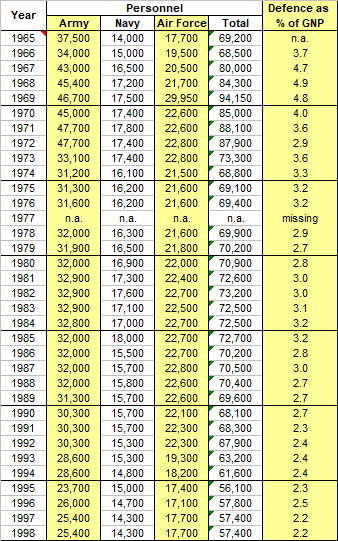
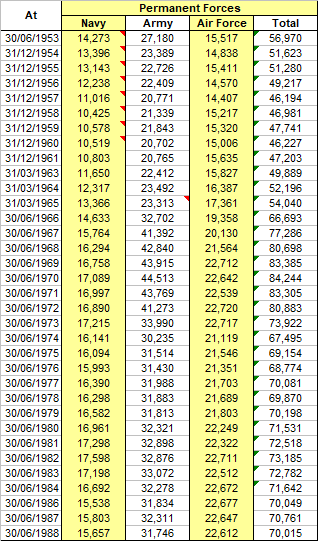
Unfortunately, Melbourne's crew was 1,335 from 1972 onwards. (According to the table in Post 31.) So we're taking about the thick end of 500 men for a service which had an average of 16,600 personnel from 1972 to 1981.
 
Unfortunately, Melbourne's crew was 1,335 from 1972 onwards. (According to the table in Post 31.) So we're taking about the thick end of 500 men for a service which had an average of 16,600 personnel from 1972 to 1981.
Not Impossible
 
Only if a pair of destroyers or frigates are paid off to compensate. @Rule of cool says recruiting more personnel is impossible. If it was possible they could recruit enough for the Oriskany as proposed in 1964.
Increase Woman Royal Australia Navy Services to allow more men to go to sea, decommission HMAS Sydney and that gives you about 500 to 600 men, so it is possible
 
Only if a pair of destroyers or frigates are paid off to compensate. @Rule of cool says recruiting more personnel is impossible. If it was possible they could recruit enough for the Oriskany as proposed in 1964.

Recruiting 500 over and above Melbourne's for Hermes is easier than 1,000 over and above Melbourne's for an Oriskany. I'd say that 1,000 is impossible in practice and 500 is too difficult but possible.

Another thing is that the RAN only bought 8+2 A4s in 1967 and had to forego 2 subs to get another batch of 8+2. A bigger carrier, able to carry more aircraft will mean a bigger aircraft bill that might come at the expense of something else.
 
Recruiting 500 over and above Melbourne's for Hermes is easier than 1,000 over and above Melbourne's for an Oriskany. I'd say that 1,000 is impossible in practice and 500 is too difficult but possible.

Another thing is that the RAN only bought 8+2 A4s in 1967 and had to forego 2 subs to get another batch of 8+2. A bigger carrier, able to carry more aircraft will mean a bigger aircraft bill that might come at the expense of something else.
Though if an earlier and larger order of aircraft is ordered it might not be as a big of a problem
 
Regular ADF Personnel 1965-1988

ADF Personnel 1965-88.png

Source: Encyclopaedia Britannica Books of the Year 1966 to 1999

Notes
It's source was the International Institute of Strategic Studies.
The book for 1965 didn't say what the proportion of GNP spent on defence was.
My local reference library doesn't have the book for 1977.
The source document says 18,000 regular naval personnel in 1985.
 
Last edited:
What might have been affordable had the RN opted for it, was the small Carrier design. Debated between DAW and DNC between '54 to '56. The Scimitar was the basis of measuring out the design for limited operations. Though DAW had hopes of a VL, possibly VTOL capable successor.
But initially a 180ft long catapult (145ft stroke?) And mk14 arrestor gear. Lifts 60ft long.

DNC felt a more limited design was more practical.

Though Saros P.177 would have been a viable alternative successor.

These were all based on something 'like' a Colossus/Majestic type hull in order to fit the most drydocks and be easiest to launch off the widest range of possible slips.
I can only presume they'd use the YEAD.1 plant, two for 60,000shp for Fleet compatible speeds.

But the hanger and lift llimitations meant not enough aircraft could be carried. Though DAW thought otherwise.
As an aside, one of these studies looks like the first parallel deck design. Something that would resurface on CVA-01.
 
The longer this, and the other Australian procurement thread, goes on the more I'm reminded of the British and how the ~53,000t CVA01 was both the minimum acceptable standard and the maximum ship they could handle. In Australia's case this is the Melbourne's 60s upgrade.

For the stated SEATO ASW role some 10 ASW helicopters, 6 fixed wing ASW and 4 'fighters' were the minimum acceptable standard, although obviously more provides greater capability. However given budgets and available manpower the RAN can allocate to a carrier and its CAG the Melbourne, in one form or another, is the maximum that can fit into RAN procurement budgets and crewing limitations.

For mine the optimal RAN carrier path would be to get someone over the the Netherlands in 1958 and get to know the ins and outs of the Karel Doorman and Menas Gerais rebuilds and make all decisions with that full depth of knowledge.

@NOMISYRRUC I notice the RAN and RAAF personnel numbers really climb during the 1964-72 'conscription for overseas service with the Regular Amy' years. The CMF was some 20,000 strong in 1960 after the end of the 1951-57/59 conscription period but grew to some 35,000 in 1968 with about half of these joining the CMF in order to avoid being conscripted to serve in Vietnam. I suspect a reasonable chunk of the RAN and RAAF growth in the same period might be for similar reasons.

The NAA document pp43-45 says that to man an Oriskany with 218 officers and 2073 men the RAN would have to grow to 17,619 men by 1968, but from then current recruiting and retention trends the RAN would only reach 14,300-15,000 men. Conscription likely indirectly pushed the RAN to the high 16,000s - low 17,000s which is close to an Oriskany and likely capable of manning Hermes, but the RAN was also introducing submarines at the time which compete with the FAA for resources.
 
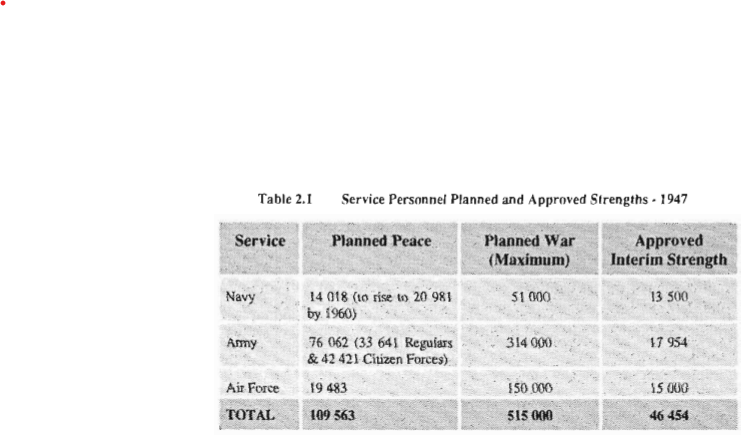
In Empire Defence to Long Haul it states the RAN was to have almost 21,000 personal in 1960/61, though looking at @NOMISYRRUC post about personal numbers the RAN was a long way off there. I wonder if the RAN had the 21,000 personal in 1960/61 how would this affect her
 
In Empire Defence to Long Haul it states the RAN was to have almost 21,000 personal in 1960/61, though looking at @NOMISYRRUC post about personal numbers the RAN was a long way off there. I wonder if the RAN had the 21,000 personal in 1960/61 how would this affect her

What year was that? It sounds like some of the other huge plans that went nowhere, perhaps at the end of a war before a new direction has been started.
 
Say Australia buys Hermes would a good replacement for the A-4 Skyhawks in the 80s would be a navalised Big Wing Jaguar?
 
Say Australia buys Hermes would a good replacement for the A-4 Skyhawks in the 80s would be a navalised Big Wing Jaguar?

The naval Jaguar was cancelled in 1971 and the big-wing Jagaur didn't enter production.

The end of the Skyhawk's service life, which would pretty much coincide with the Melbourne or Hermes service life, would mean the end of conventional fixed wing flying in the RAN. If the RAN was going to retain a carrier and fixed wing capability it would have to change to Harriers, which is fine in capability terms and fits with the RAN's 80s force structure.
 
The naval Jaguar was cancelled in 1971 and the big-wing Jagaur didn't enter production.

The end of the Skyhawk's service life, which would pretty much coincide with the Melbourne or Hermes service life, would mean the end of conventional fixed wing flying in the RAN. If the RAN was going to retain a carrier and fixed wing capability it would have to change to Harriers, which is fine in capability terms and fits with the RAN's 80s force structure.
Legacy Hornets, maybe?

Not a lot of good options for light carrier aircraft that were new-ish. A-7s were beat to crap.

FFS, the closest option for an aircraft in that weight class is the Harrier.
 
The longer this, and the other Australian procurement thread, goes on the more I'm reminded of the British and how the ~53,000t CVA01 was both the minimum acceptable standard and the maximum ship they could handle. In Australia's case this is the Melbourne's 60s upgrade.

For the stated SEATO ASW role some 10 ASW helicopters, 6 fixed wing ASW and 4 'fighters' were the minimum acceptable standard, although obviously more provides greater capability. However given budgets and available manpower the RAN can allocate to a carrier and its CAG the Melbourne, in one form or another, is the maximum that can fit into RAN procurement budgets and crewing limitations.

For mine the optimal RAN carrier path would be to get someone over the the Netherlands in 1958 and get to know the ins and outs of the Karel Doorman and Menas Gerais rebuilds and make all decisions with that full depth of knowledge.

@NOMISYRRUC I notice the RAN and RAAF personnel numbers really climb during the 1964-72 'conscription for overseas service with the Regular Amy' years. The CMF was some 20,000 strong in 1960 after the end of the 1951-57/59 conscription period but grew to some 35,000 in 1968 with about half of these joining the CMF in order to avoid being conscripted to serve in Vietnam. I suspect a reasonable chunk of the RAN and RAAF growth in the same period might be for similar reasons.

The NAA document pp43-45 says that to man an Oriskany with 218 officers and 2073 men the RAN would have to grow to 17,619 men by 1968, but from then current recruiting and retention trends the RAN would only reach 14,300-15,000 men. Conscription likely indirectly pushed the RAN to the high 16,000s - low 17,000s which is close to an Oriskany and likely capable of manning Hermes, but the RAN was also introducing submarines at the time which compete with the FAA for resources.
Some good and realistic points you make Rule of cool - especially:
- the minimum acceptable standard and the maximum ship they could handle, and
- but the RAN was also introducing submarines at the time which compete with the FAA for resources.

You're notion of liaising with 'the Netherlands to know the ins and outs of the Karel Doorman and Menas Gerais rebuilds and make all decisions with that full depth of knowledge', makes a lot of sense., if Australia could kick the idea of being subordinate to the British/Admiralty at the time....
Ideally, in this thread, Australian ship building would have developed the capacity and workforce skill to conduct such a rebuild of Melbourne and for that matter Syndey to such high standards as the Karel Doorman. But failing that, was there scope for the Dutch to conduct such a rebuild for Australia?

I guess the other elephant in the room is the reality that a single carrier in time of threat/war isn't enough - given actual operations, maintenance/refitting and training cycles. For as clearly demonstrated time and time again, in the case of the RAN/Melbourne, each and every time she went into maintenance/refit [or bloody repairs], for all intent and purposes, Australia lost it's 'must have carrier/ASW capabilty' for months on end. Or as apply demonstrated in the case of India, and her single Majestic-class carrier INS Vikrant, she failed to see combat, either in the 1962 Sino-Indian War or 1965 Indo-Pakistani War as she was in drydock maintenance each time....!

So using your "For the stated SEATO ASW role some 10 ASW helicopters, 6 fixed wing ASW and 4 'fighters' were the minimum acceptable standard......", does Australia/RAN need to get real and forgo the notion of emulating the 'big boys and their toys' and be brutality serious in its threat assessment of the region vs a notion of mini power projection capability. And in doing so knuckle down on either building a new purposely designed and built Light Fleet Carrier by either Britain, France, or Netherlands to replace it's Majestic/Colossus-class Light Fleet Carrier's. For as much as acquiring tantalisingly priced used carriers from either Britian or U.S. still comes the reality that they are in fact:
- used - their life span and serviceability is already ticking away.....;
- both British and U.S. options, be it Hermes or a Essex class would require a timely and expensive refit, before they are taken on board by Australia/RAN;
- New and modern aircraft will be needed for such a carrier to be meaniful and fit for purpose.

In designing and building such a 'new' designed Light Fleet Carrier, Australia, intrinsically appreciative of manpower issues within it's ORBAT could ensue that all new carrier technologies are included within its design, from the getgo.
The 'new' design carrier could be designed/compartmitised with jet-powered aircraft in mind.
It could stipulate and incorporate overgrowth within the design, including such things as:
- anticipated growth in aircraft sizes and weights;
- Aircraft lift sizes and capacities;
- more than one aircraft lift;
- more than one catapult.
- longer stroke catapults;
- the degree of the angled flight deck;
- modern defensive weapons and supporting sensors;
- Air Conditioning specifically for the regions hot and humid climate;
- etc...

If Australia was smart, it would offer such a modern Light Fleet Carrier as a joint program, perhaps with Canada and the Netherlands. And, or offer such a design for export to the likes of Argentina, Spain, Brazil, India, etc, do as to replace their own Majestic/Colossus-class, and Independence-class light carrier.....

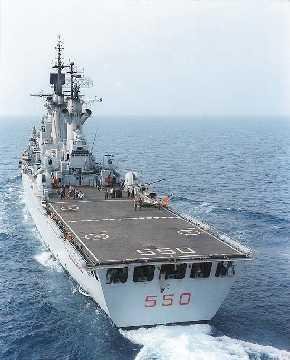
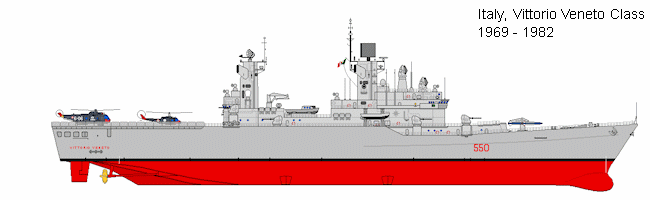
Failing to be able to afford purchasing, maintain and or manning two carriers effectively, should Australia seriously admit it can't stay in the 'carrier-club' and as such give away the romance of having a vessel in which to launch strikes against percieved enemies. If this was the realistic case, then perhaps the Australian government/RAN, which can focus on protecting its strategic sealines, in terms of ASW. As such, should Australia be considering two or three helicopter cruisers? Something the likes of the very capable Italian Vittorio Veneto class:

Laid down 1965
Launched 1967
Commissioned: 1969
Displacement: 7,500 tons standard
9,550 tons full loaded
Complenent 557
Armament (as built):
1 × Mk 19 twin-arm launcher for 40 x RIM-2 Terrier and 20 x ASROC missiles
8OtoOto Melara 76/62mm MMI or Oto Melara 76/62mm Compact guns
2 × 324 mm triple torpedo tubes
Aircraft:
9 x Augusta AB 204
or later
9 x Augusta AB 212
or even later
6 x Augusta AB 61 Sea King helicopters

Importantly, and very relevant to Australia/RAN, Vittorio Veneto class had very comprehensive C3 facilities incorporated into its design.

Incorporate two Ikara launchers and magazines......

Anyhow, just me thinking out loud.......

Regards
Pioneer

 

Attachments

  • 84_big-2735427678.jpg
    84_big-2735427678.jpg
    16.9 KB · Views: 22
  • vittorio-veneto-line1-3304979714.gif
    vittorio-veneto-line1-3304979714.gif
    16.5 KB · Views: 24
Last edited:
@NOMISYRRUC I notice the RAN and RAAF personnel numbers really climb during the 1964-72 'conscription for overseas service with the Regular Amy' years. The CMF was some 20,000 strong in 1960 after the end of the 1951-57/59 conscription period but grew to some 35,000 in 1968 with about half of these joining the CMF in order to avoid being conscripted to serve in Vietnam. I suspect a reasonable chunk of the RAN and RAAF growth in the same period might be for similar reasons.
I have the figures for the CMF, CNF and CAF too for what it's worth.
 
Failing to be able to afford purchasing, maintain and or manning two carriers effectively, should Australia seriously admit it can't stay in the 'carrier-club' and as such give away the romance of having a vessel in which to launch strikes against percieved enemies. If this was the realistic case, then perhaps the Australian government/RAN, which can focus on protecting its strategic sealines, in terms of ASW. As such, should Australia be considering two or three helicopter cruisers? Something the likes of the very capable Italian Vittorio Veneto class:

Laid down 1965
Launched 1967
Commissioned: 1969
Displacement: 7,500 tons standard
9,550 tons full loaded
Complenent 557
Armament (as built):
1 × Mk 19 twin-arm launcher for 40 x RIM-2 Terrier and 20 x ASROC missiles
8OtoOto Melara 76/62mm MMI or Oto Melara 76/62mm Compact guns
2 × 324 mm triple torpedo tubes
Aircraft:
9 x Augusta AB 204
or later
9 x Augusta AB 212
or even later
6 x Augusta AB 61 Sea King helicopters

Importantly, and very relevant to Australia/RAN, Vittorio Veneto class had very comprehensive C3 facilities incorporated into its design.

Incorporate two Ikara launchers and magazines......

Anyhow, just me thinking out loud.......

Regards
Pioneer

A thought I had some time ago was a CVS based on the USN Tarawa class LHA. It was big enough to operate the same aircraft as Melbourne and was steam powered so it could have had cats.

More realistically, there was the Vosper Thornicroft Harrier Carrier. It could have operated Sea Kings, later Harriers, was affordable, and with its smaller crew, three could have been operated for the same crew as Melbourne, four with the retirement of Sydney, with personnel left over. Australia showed early interest in the Harrier and had a decision been made early enough, money could have been saved and the additional Trackers and Skyhawks cancelled. This would have been a win for the submarine force as the seventh and eighth Oberons were sacrificed to pay for them.

Two or more Harrier Carriers and there is no need for Seahawk, Lynx would do nicely, and no need for the expensive FFG upgrade to operate them.

Harrier Carriers would be small enough and simple enough to build at Codoc.
 
The data from NOMI makes it look like it'd be possible to hold the RAN at about 16k, take it up to ~18k during Vietnam.

The problem is they let it draw down to 10k for a decade after Korea.
These are from editions of Jane's from the late 1940s to the middle 1950s that my local libraries had. But most if it's from the 1952-53 edition.

Personnel
Jane's 1946-47 said.
Personnel 13,500 - 1946 approved ad interim
Jane's 1947-48 said.
Personnel (1947) under 10,000, but 14,753 by 1952
The 1947 expansion programme ended in 1952. See above.
Personnel (1952) 13,490 with 17,000 planned to be attained by 1953.
However, 17,000 wasn't attained by 1953 because Jane's 1953-54 says.
1953: 14,541 officers and ratings. The Women's Royal Australian Naval Service has been re-established. WRANS (total 1 Jan. 1953: 271) are employed on clerical, communications, stores and other administrative duties.

Naval Programmes
1947 Programme (1947-48 to 1951-52) 5 years - £A 75,000,000 including Sydney, Melbourne, 4 Darings and 2 Battles
1952 Programme (1952-53 to 1954-55) 3 years - £A 137,000,000
1950 New Construction Programme
In August 1950 it was announced that 6 Type 12 would be built in Australia. 3 at Cockatoo and 3 at Williamstown, but reduced to 2 at each yard. Cost £A 2 million each.
1952 New Construction Programme - 3 Boom Working Vessels, 4 MSC and 4 Seaward Defence Boats

Jane's 1952-53 said that the 1952 Naval Programme was for 36 active and 80 reserve ships, including: 2 CV, 3 cruisers, 9 DD, 11 fast FF, 14 slow FF, 32 minesweepers and 45 other vessels.

The RAN vessels in Jane's 1952-53 were:
  • 2 aircraft carriers Melbourne and Sydney - Vengeance on loan until Melbourne completes - crew 1,343 (war) and 1,100 peace
  • 1 Hobart - in reserve - crew 550
  • 2 County class - Australia is flagship of the RAN and Shropshire is laid up - Australia crew 679 (710 as flagship) and Shropshire crew 650
  • 4 Daring class building - no crew details
  • 2 Battle class cost £2.5m (Anzac) and £2.47 (Tobruk) crew 290
  • 3 Tribal class crew 250
  • 3 T class submarines on loan from RN as 4th Submarine Squadron based on Sydney for AS training
  • 6 fast FF projected to cost £2m each 3 at Cockatoo and 3 at Melbourne
  • 5 Q class being converted to Type 15 at a cost of £A 400,000 each
  • 4 Bay class - crew 177
  • 8 Loch class - one AGS, one on 3-year loan to RNZN and one as training ship for national servicemen - crew 140
  • 2 Grimsby class (Warrego as AGS)
  • 2 MFV with crews of 8 on tender duties to Warrego
  • 28 Bathurst MSO - crews n.a. - one as training ship, 3 with National Service Training Flotilla. Of 60 built, 4 for RAN, 20 for RN (but manned by RAN) and of 36 RAN vessels 4 sunk and 4 to RNZN
  • 4 Sea Defence Boats to be built
  • 4 SDML in reserve
  • 1 Platypus ex Repair Ship crew 357 as accommodation ship
  • 3 Boom Defence Vessels to be built
  • 3 Bar class BDV crew 32 built in WWII
  • 3 LST(3) Lae, Lauban and Tarakan on loan from RN and named after landings the RAN and Australian military forces took par in.
  • 5 Air Sea Rescue Launches operated by RAN Search and Rescue Unit
  • 16 75-foot General Purpose Vessels used for surveying, minesweeping and fleet tender duties
  • 1 AO purchased £2.5 million - ordered through British Admiralty, hoped to join the Australian Fleet by June 1953
  • 2 tugs of 570 tons crew 35
  • 3 tugs of 250 tons no crew
 
Last edited:
For context, below is what the RAN was charged to do in war from 1962.
  1. To provide effective and sustained Naval contribution to the allied forces maintaining command of the seas in our areas of strategic interest.
  2. To contribute to and defence Australian military shipping en route to the areas of operations in Southeast Asia.
  3. To protect, within the Australian station, shipping carrying essential imports and exports.
  4. To co-operate with sister services in general operations of war including the defence of the Australian mainland and Australian island territories.
@Pioneer you espouse a very glass half empty view of capability, that since the RAN doesn't have a carrier for 3-4 months of the year (coinciding with the S.E.A. monsoon season with its bad flying weather) it shouldn't have a carrier for the other 8-9 months of the year.

The fact of the matter is that the Melbourne was bought and paid for and in service, was capable of operating a useful generation of aircraft from the mid 60 for 15 years and was due for a mid-life refit from about 1963. Once this generation of aircraft is purchased and refit undertaken Australia doesn't have to worry about growing aircraft weights etc until 1980 or so, as unlike the USN it only buys aircraft once in a generation and a carrier once in every 2 generations.

As for the Vittorio Venetto or 2, their drastic lack of capability compared to the refitted Melbourne isn't compensated by having one always available. For 8-9 months of the year the RAN had a capability far greater than the VV by having the Melbourne.
 
I'm trying to put together a timeline of events surrounding the RAN carrier replacement from 1959 and keep running into references from July - September 1964 that the Melbourne had a modernisation planned and authorised for 1966, but I cannot find when this refit was authorised. Later documents talk about this refit being changed so that S2 Trackers can operate from Melbourne, but earlier documents from May 1963 talk about extending the Gannets and Sea Venoms out to 1967.

It appears that prior to the Tracker being a proposed option in July 1964, and trials off Subic Bay to prove its (and A4s) practicality a mid-life refit of the Melbourne was already planned and authorised.
 

Similar threads

Back
Top Bottom