The Best 2 Mach Fighter of 1950s & 1960s

hesham

ACCESS: USAP
Senior Member
Joined
26 May 2006
Messages
38,257
Reaction score
20,395
Hi,

I open this topic to debate about what was the best fighter in that
period,which had a superier over all world,and I suggest that the
MiG-21 with or we can consider also Dassault Mirage-III.

I think no other country submitted a proper design,regarding to
their performance, dogfight and capability to operate in any
nation,I am not appreciate the heavy load or numbers of wing
hard point or something like that.

Please oblige by calm discussing,anyway,these are just opinions,
and not to offence to any company or country
 
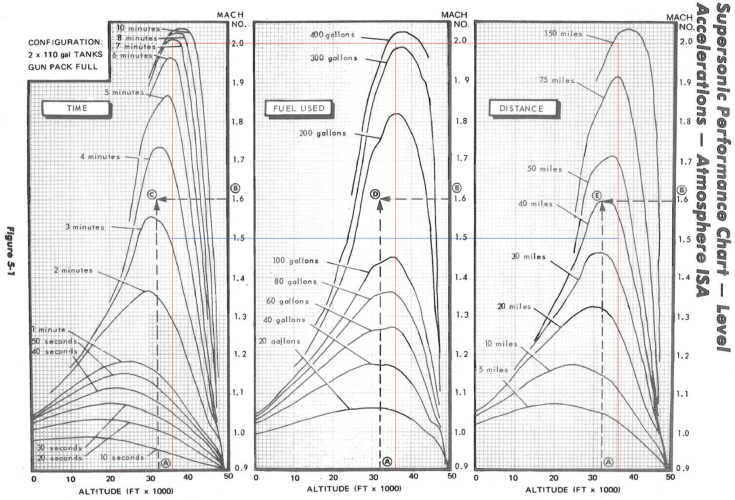
A lot of fighters chased after the "Mach 2" label... the question is, could they do it usefully?

... so what might be interesting would be to compare their acceleration times, how long it took them to get to Mach 2.0, and how much fuel they'd have left. Say with 2-4 AAMs + canon. With most of the flight manuals now being in the public domain, that should be a pretty straightforward exercise.

I could start and find the numbers for the RAAF's Mirage IIIOs. But it's a time consuming exercise so would need help from others to collate the #s for the F-4E, Mig-21, Lightning F6, F-8E Crusader etc.
 
By the late 1950 the USA had a ton of Mach 2 (and close) fighters
-Phantom
-Crusader III
-Skylancer
-Super Tiger
-Starfighter
-Thunderchief
-Delta Dart
-F-107
-Crusader
-Voodoo (the J79 variant)
(Plus Northrop F-5, Boeing BOMARC (just kidding !) Bell F-109 )
Kinda embarassment of riches !

Up to 11 companies could design a Mach 2 fighter !
McDonnell, Douglas, Vought, North American, Grumman, Lockheed, Convair, Republic, Northrop, Bell, Boeing...
 
Well, certainly not the MiG 21. It had a lot of shortcomings starting with it barely being able to do Mach 2 before running out of fuel. The 1950's - 60's versions were very limited day fighters and pretty much proved themselves poor in combat. In Vietnam, the MiG 17 proved more versatile as a fighter for N. Vietnam than the 21 for example.
The MiG had a lot of small negatives that added up to a big one. But it was cheap, easy to maintain, and looked good in any dictator's hangers. I was, technologically a dead end. It was great as a day interceptor if the enemy was stupid enough to fly almost directly over the airfield it was on.

There's a bunch of these from that era, the supersonic day fighter that was marginal for any other role. None of these proved to have the versatility or room for growth that would have kept them in service longer. Some were better fighters than others. Some were more just go fast, go straight, interceptors... so long as the sun was shining and it wasn't too overcast... These were ones like the MiG 21, F-104, F-106 (it was all-weather), or Lightning.

Others were good dogfighters and these proved useful in that singular role. The Mirage III, F-5 Freedom Fighter (mach 1.6), and F-8 Crusader (Mach 1.8) are three that come to mind.

I'd say Saab's F-35 Draken is definitely a top contender here. The D, E, and F models were all exceptionally well designed and equipped. The F had Hughs / Raytheon electronics and missiles equaling what an F-4 at the time had. It also had better handling and did it on a single engine. The F-4 succeeded because it was versatile and had room for improvement, just as the Draken did. The F-105 wasn't as good as the F-4 but it's in this same field. The F-101 had some fatal flaws in handling that really limit it as a fighter and weren't getting fixed because they were too much a part of the design.

One thing here, top speed alone is not a good criterion for measuring aircraft effectiveness. Double Mach doesn't do much if that's all the airplane can do.
 
I could start and find the numbers for the RAAF's Mirage IIIOs. But it's a time consuming exercise so would need help from others to collate the #s for the F-4E, Mig-21, Lightning F6, F-8E Crusader etc.
Mirage IIIE/IIIO (Atar 9C)
Acceleration performance @ 36,000ft in ISA conditions with 2x supersonic 500L tanks (Drag Index = 38).
Results should be similar with 2x AIM-9s (DI=45) or 1x Matra 530 (DI=53) instead of the tanks, maybe just a tad slower.
  • Mach 0.9-1.5 in ~3min (~35nm)
  • Mach 1.5-2.0 in ~3m50s (100nm)
  • Time to Mach 2.0: ~6m50s (135nm)
Fuel used: ~500L (110 imp gallons) from M0.9->1.5 and ~950L (210 imp gallons) from M1.5-2.0. Respectively 17% and 32% of internal fuel capacity, so the Mirage III burns ~50% of its internal fuel capacity to reach Mach 2.0.

Who's next?
 

Attachments

  • Mirage IIIO Mach 2.0 acceleration.png
    Mirage IIIO Mach 2.0 acceleration.png
    1.8 MB · Views: 4
The XF-108A mentioned unfortunately didn't get built and another might have been was the Republic XF-103A interceptor (A pity that the prototypes were cancelled as NACA then NASA could've made good use of them for high-speed flight research).
 
With the F5D, had it been pushed towards all-weather operation it might have been a real contender with the F-4 Phantom. As it was, it was, I think, a better F-8 Crusader. That was its downfall. It was good but not so much better that it was worth producing.
 
Mirage IIIE/IIIO (Atar 9C)
Acceleration performance @ 36,000ft in ISA conditions with 2x supersonic 500L tanks (Drag Index = 38).
Results should be similar with 2x AIM-9s (DI=45) or 1x Matra 530 (DI=53) instead of the tanks, maybe just a tad slower.
  • Mach 0.9-1.5 in ~3min (~35nm)
  • Mach 1.5-2.0 in ~3m50s (100nm)
  • Time to Mach 2.0: ~6m50s (135nm)
Fuel used: ~500L (110 imp gallons) from M0.9->1.5 and ~950L (210 imp gallons) from M1.5-2.0. Respectively 17% and 32% of internal fuel capacity, so the Mirage III burns ~50% of its internal fuel capacity to reach Mach 2.0.

F-4E Phantom
Acceleration performance @ 35,000ft in ISA conditions with 4x AIM-7 (Drag Index = 5, 45,000lbs operating weight).
Results should be similar with 2x AIM-9s (DI=6) instead of the AIM-7s.
  • Mach 0.9-1.5 in ~2min (~23nm)
  • Mach 1.5-2.0 in ~3m15s (~54nm)
  • Time to Mach 2.0: ~5m15s (77nm)
Fuel used: ~1,500lbs from M0.9->1.5 and ~3,700lbs from M1.5-2.0. Respectively 11.5% and 28.5% of internal fuel capacity, so the F-4 burns ~40% of its internal fuel capacity to reach Mach 2.0.
 

Similar threads

Back
Top Bottom