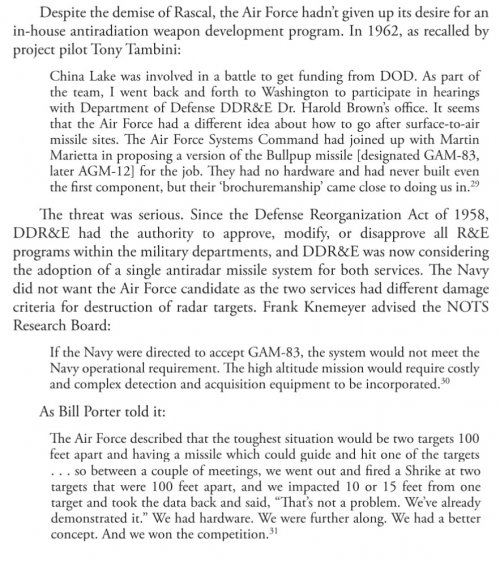
From The Station Comes of Age, pg191: the USAF's attempt to impose a paper-concept ARM variant of Bullpup on both services was defeated by the Navy's actual working hardware.
A couple of other notes from the same document:
The Navy's ARM project was initially christened Cobra, being a lethal snake like Sidewinder, before being renamed as Shrike following a staff competition
The first two ARM testbeds fired from an F3D in 1959 had Corvus seekers, Sidewinder hot-gas servos, Sparrow-based airframe and fourMighty Mouse 2.75-inch rocket motors in an 8-inch-diameter tube
The four-barreled motor remained until quite a late point before Rocketdyne developed a modified Sparrow motor, which enable the structural differences to be minimised
President Kennedy authorised the Emergency Shrike Effort ( Project ESE, pronounced easy ) in May 1963, with 'Brickbat' funding priority. To counter frequencies of Fan Song radars detected in Cuba, 50 each of C-band and S-band Shrikes were to be produced
Texas Instruments was engaged as a partner at this stage but due to the urgency and the constantly-tweaked design, the ESE seekers were all built at China Lake and shipped to TI for airframe integration
The priority of ESE led to some China Lake personnel being reallocated to the project without choice
Real-world testing was conducted by a pair of A-4s with captive Shrike seekers whose China Lake pilots 'trolled' the Cuban defences in July 1963
There was a 1964 study of a nuclear-armed Shrike which would be able to take-out the entire missile battery, rather than just the antenna, but no evidence this went past the study stage
Project ESE completed on-budget in January 1964 with delivery to MCAS Cherry Point. After this TI took over production and started making their own changes which caused some problems. Consequently Sperry were brought into the program as an alternative source and there was an annual procurement competition between the two companies
Over 9,000 of the 22,000 Shrikes produced were fired in combat
This site uses cookies to help personalise content, tailor your experience and to keep you logged in if you register.
By continuing to use this site, you are consenting to our use of cookies.