
You are using an out of date browser. It may not display this or other websites correctly.
You should upgrade or use an alternative browser.
You should upgrade or use an alternative browser.
Sukhoi T-75 LTS (CheckMate)
- Thread starter sublight_
- Start date

EmoBirb
ACCESS: Top Secret
- Joined
- 18 January 2025
- Messages
- 2,701
- Reaction score
- 6,927
Power generation will be a very big differentiator I'd argue, as for VLO characteristics, while the design chosen looks promising, the presence of something like the spherical IRST on the nose will certainly be noticeable even when not in use and the RAM treated side is presented. Not a deal breaker for a fifth Gen, but as the sixth generation is considered an across the board improvement with all aspect stealth characteristics and IR management superior to that of existing design it's probably a exclusion criterion.Just a philosophical question:
How will the Su-75 in the future, as a VLO aircraft (especially if a flat nozzle is used), with an innovative aerodynamic configuration, loaded with AI, optionally piloted (Sukhoi is already testing it on the Su-57), capable of long-range attack on air (with Izd. 810) and ground (including compact hypersonic missiles under development) targets, and the possibility of MUM-T interaction with a variety of drones from the “pocket” S-71 to the large S-70… differ from 6th generation aircraft?
I also wouldn't say it's configuration is innovative, it's unique in combination, but ruddervators were also used by the YF-23, DSI is in use with F-35, J-20 and J-35, the nose intake (while integrating a DSI and layout is unique) has been explored by Boeings ATF and JSF proposals. The arrangement in which these features are combined is unique to the Su-75, but it's not as innovative as moving wingtips or a tailless design with flexing control surfaces for example.
The Su-75 can be considered an advanced 5th generation design from what we know. Probably something people would call "5.5th Gen". But such descriptions are always arbitrary. If the Su-75 fulfills the missions it's tasked with, it doesn't really matter to which generation it belongs because it's characteristics are checking the requirements.
Last edited:
EmoBirb
ACCESS: Top Secret
- Joined
- 18 January 2025
- Messages
- 2,701
- Reaction score
- 6,927
Oh, I really like the looks of the 2-seater.


Null
ACCESS: Secret
- Joined
- 16 December 2024
- Messages
- 274
- Reaction score
- 513
If you brought in like 100 kids that are 6 to 12 year olds and they have no idea about military aircrafts or what country the aircrafts are from they will all point their fingers at the unmanned Su-75 because its physical appearance just appears that cool. Overall, a large unmanned supersonic stealth drone with BVR combat capabilities being slapped with the operational sticker would be enough to rival their introduction of the Mig-31as a sign of aviation excellency that their military achieved.it's a right concept to design in manned:unmanned teaming from the start. But otherwise, problem is it's almost pointless to access LWs from the outside.
GJ-11/S-70 may in fact look more advanced than it, but at the same time - their design largely predate LMs, predate Ukraine-inspired cots shift, and so on and so forth.

Acatomic
ACCESS: Secret
- Joined
- 18 October 2020
- Messages
- 300
- Reaction score
- 861
Haven’t seen this one yet (maybe I missed it).
Side weapons bay:
View: https://x.com/georgen28581/status/1949040352733597764
Side weapons bay:
View: https://x.com/georgen28581/status/1949040352733597764
Attachments

Last edited by a moderator:
Scott Kenny
ACCESS: USAP
- Joined
- 15 May 2023
- Messages
- 19,560
- Reaction score
- 28,018
That missile looks fat to me. 10"/250mm diameter?


PeregrineFalcon
ACCESS: Confidential
- Joined
- 31 January 2023
- Messages
- 67
- Reaction score
- 274
Question, is that really new R-77M which we can saw several times on the Su-35S ?
Definitely not. It is quite a bit shorter, and even the lifting surfaces don't seem to be the same.
Also, the missile seen on the Su-57 doesn't look like it is the same missile seen on the Su-35S

The main difference being the lifting surfaces, and even the back end of the missile doesn't look to be exactly the same.

- Joined
- 3 June 2006
- Messages
- 3,538
- Reaction score
- 6,215
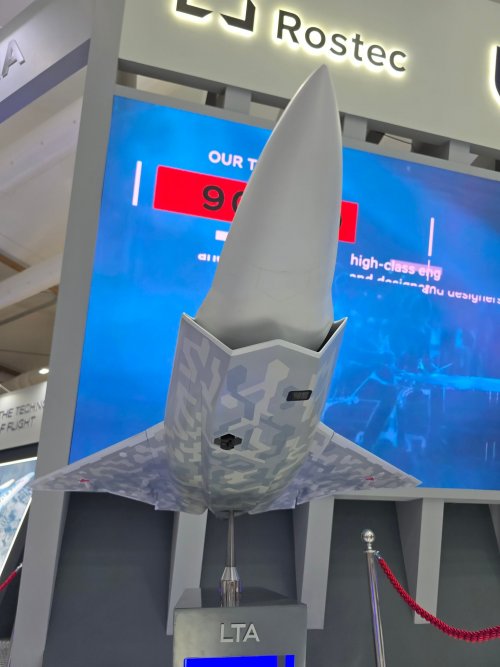
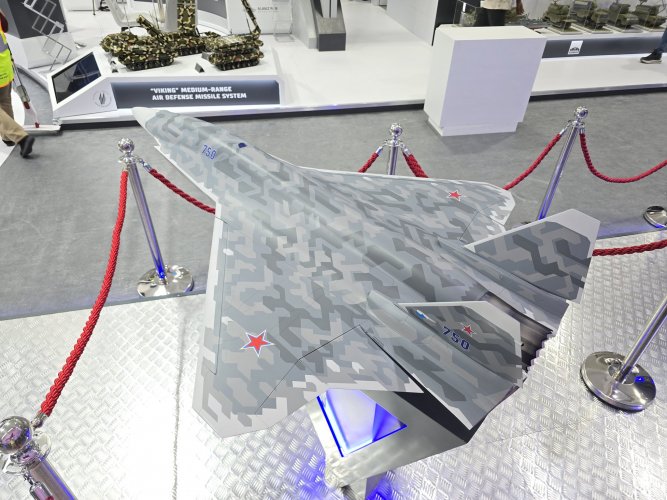
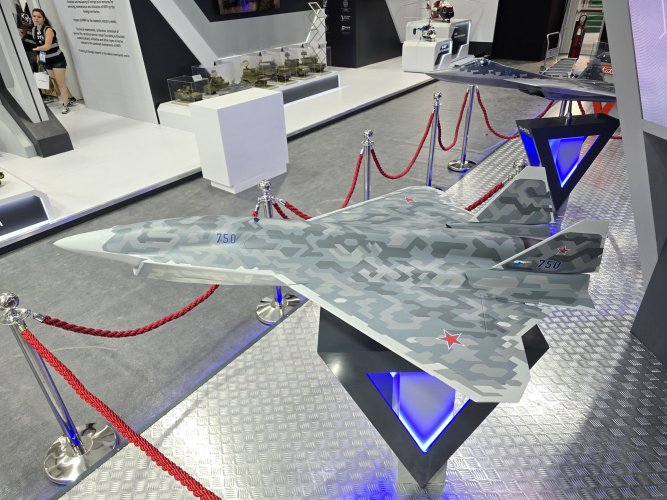
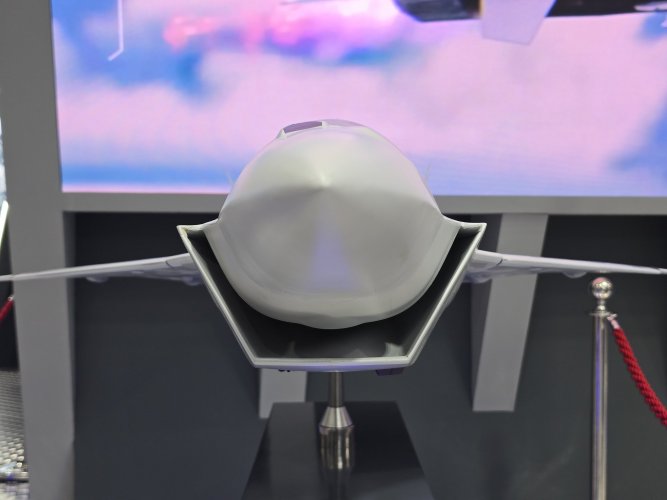
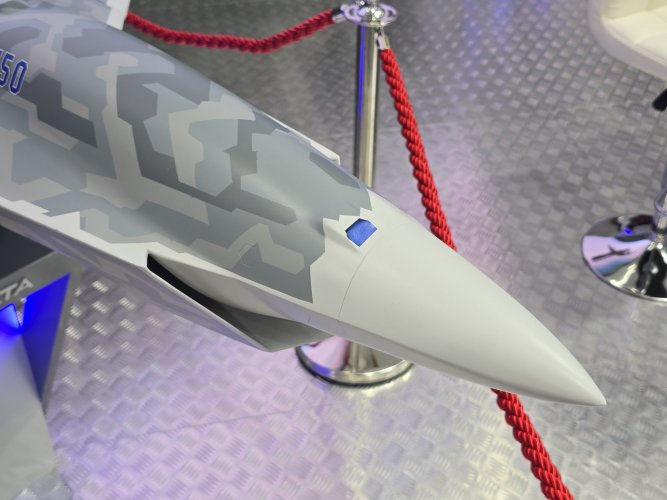
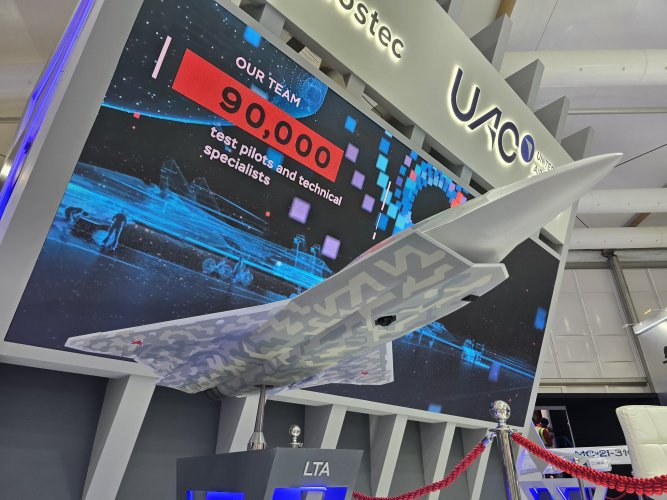
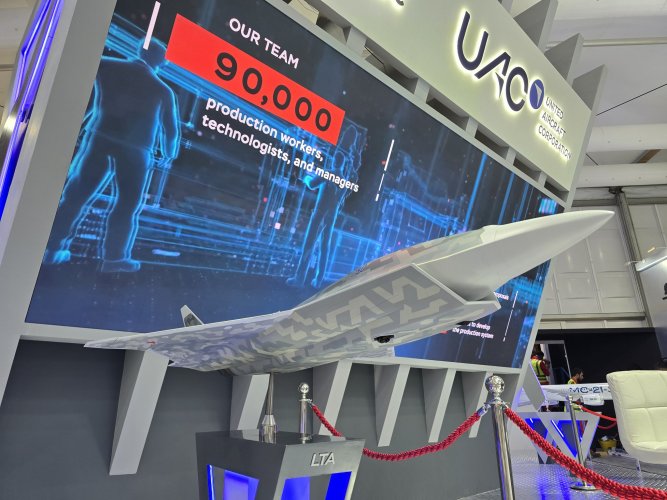
The unfinished Sukhoi LTA UAV model, an unmanned variant of the T-75 Checkmate/LTA, is being showcased at the Dubai Air Show 2025.
Links (X fka twitter):
View: https://x.com/MuxelAero/status/1989700273041027273?s=20
View: https://x.com/MuxelAero/status/1989700606152278269?s=19
Links (X fka twitter):
View: https://x.com/MuxelAero/status/1989700273041027273?s=20
View: https://x.com/MuxelAero/status/1989700606152278269?s=19
Last edited:

targetpractice
ACCESS: Confidential
- Joined
- 30 December 2024
- Messages
- 165
- Reaction score
- 616
(reposting images, as tweets often don't last)
Attachments

- Joined
- 1 April 2006
- Messages
- 12,276
- Reaction score
- 15,090
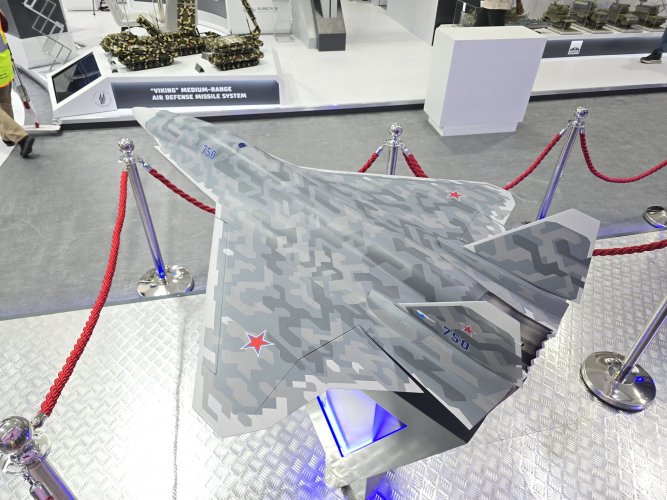
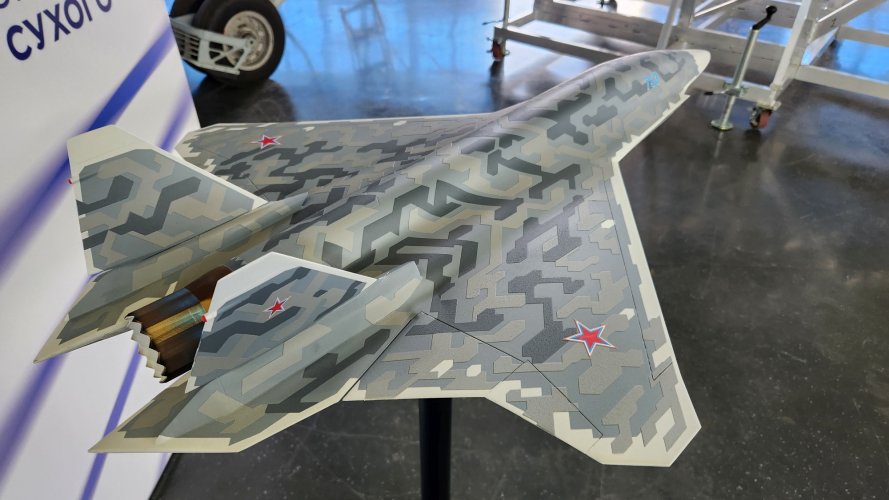
twitter guy said first unit is in assembly, the original poster that took the photos said they are presenting it as unfinished design, maybe it's the tail, maybe this tail is only for unmanned who knowsI think they are still refining the platform, may be sometime until a demonstrator fly's, maybe?
"While KNS(static test) is almost ready, first flying prototype still has a way to go in the assembly."
View: https://x.com/GeorgeN28581/status/1989567981886619835
View: https://x.com/GeorgeN28581/status/1989567981886619835
Huh so if the notional T-75-1 is under assembly then it means the program is well alive. If they fly T-75 and PAK-DA in the relative near future it will be a big milestone for russian aviation. And if the T-75 UAV becomes a reality, not only it will make a great companion to Su-57, but it would be so far the only definite UCAV outthere that offers broadly similar capabilities to the chinese UADFs (supersonic, fighter-like performance).
There is no reason to doubt that the program is running at full speed (just because it is not publicly visible). Rostec/UAC/Rosoboronexport have big plans for the T-75 and the aircraft will change the world market considerably in the next decade, as a "cross-generation" machine will be available that will be able to replace a wide range of types of both Western and Eastern origin at an affordable price.

Acatomic
ACCESS: Secret
- Joined
- 18 October 2020
- Messages
- 300
- Reaction score
- 861
@Null
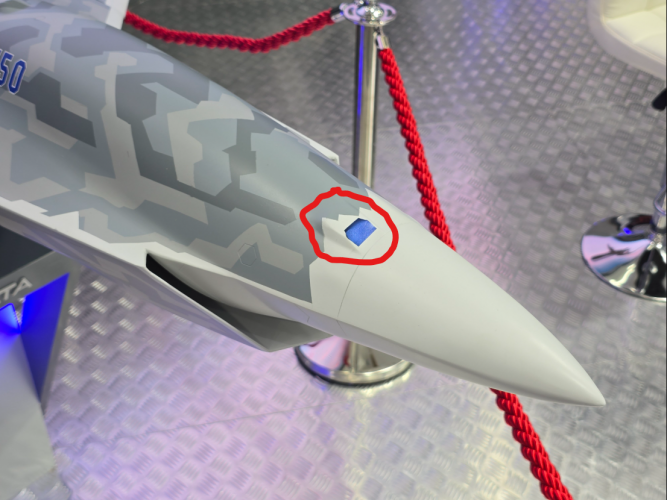
It’s a “IRST”. Will be interesting to see if the manned version gets the same thing.
View: https://x.com/georgen28581/status/1989702836532179151?s=61
It’s a “IRST”. Will be interesting to see if the manned version gets the same thing.
View: https://x.com/georgen28581/status/1989702836532179151?s=61
Null
ACCESS: Secret
- Joined
- 16 December 2024
- Messages
- 274
- Reaction score
- 513
Stealth
- Criticized for round nozzles, not serrated round nozzles or flat nozzles, instead they managed to create flat nozzle design for the Su-57 that don't have that many gaps from past flat nozzle designs in the 80s and 2000s, but are sticking with a round serrated nozzle for the unmanned Su-75.
- Criticized for protruding bulb IRST and not having a protruding polygon shape IRST, instead they managed to create an IRST that blends in with the surface of the unmanned Su-75.
- Removing the canopy for a lower surface profile enhances stealth for the unmanned aircraft.
- 2027 is the date they test a prototype photonic computer https://www.cnews.ru/news/top/2024-...lektronno-fotonnyj?ysclid=mi15qcjflj744447623 In August 2024, scientists at Korolev Samara University, for example, announced the readiness of an experimental sample of a photonic computer that processes video hundreds of times faster than neural networks on semiconductor computers. An optical neural network based on a photonic computer will be able to analyze the video stream entering the system in real time and almost instantly recognize and find objects and images in it specified for search.
- https://aif.ru/techno/rf-razvernet-...a-upravleniya-bpla?ysclid=mi15yu64fc156327411 Russia intends to create a satellite constellation of more than 100 devices to control drones. This was stated by the head of Roscosmos Dmitry Bakanov during the CIPR-2025 conference in Nizhny Novgorod.
Honestly the unmanned Su-75 project is my biggest interest then whatever so called 6th gen projects that have not caught my attention yet from US, China, Europe or Asia probably because they have not disclosed anything significant that seems to have been considered appealing to me yet.
- As CNews has learned, the microwave electronics manufacturer Istok named after Shokin (part of Rostec) plans to establish the country's largest crystal production facility. Its capacity will reach 24,000 wafers annually by 2030. This was announced by Istok Deputy CEO Sergei Shcherbakov at the Microelectronics 2025 forum.
According to Istok's presentation, the monthly production capacity will be 1,000 GaAs (gallium arsenide) wafers and 1,000 GaN ( gallium nitride) ) wafers. The crystals are intended for microwave transistors and monolithic microwave integrated circuits.
The topological standards for GaAs are 0.5 µm, 0.25 µm, 0.2 µm and 0.1 µm. For GaN , the specified standards are 0.25 µm, 0.1 µm, 0.06 µm, and 0.04 µm. The wafer diameter that Istok will work with will be 150 mm.
Representatives of Rostec and Istok did not respond to CNews' request for details of the project."
In his report, Sergei Shcherbakov proposed creating a testing ground for specialized technological equipment, as well as specially and highly pure materials for the production of microwave electronics, on the Istok site.
Istok plans to build such a facility, which will cover 10,000 square meters. The required funding for the site will be 5.8 billion rubles.
If its design begins in the third quarter of 2025, it will be put into operation in the first quarter of 2027, according to the presentation"

Airborne2001
ACCESS: Secret
- Joined
- 19 June 2020
- Messages
- 377
- Reaction score
- 541
If they replace the IRST bulb with this then that is a good decision. Some discussions from the Su-57 thread showed that an exposed bulb is bad for stealth.@Null
It’s a “IRST”. Will be interesting to see if the manned version gets the same thing.
View: https://x.com/georgen28581/status/1989702836532179151?s=61
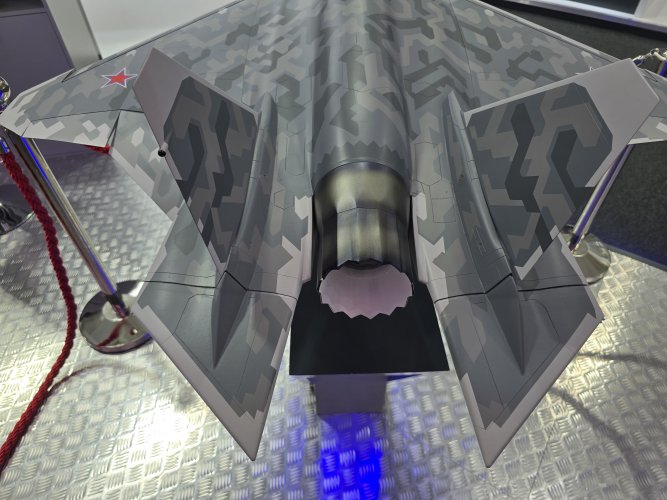
From our good man George, indeed T-75 is being studied with flat nozzle too.
View: https://x.com/GeorgeN28581/status/1989960965253992699

View: https://x.com/GeorgeN28581/status/1989960965253992699
1. The so-called "IRST" on the model on display is not IRST, but MAWS (101KS-U or its derivative with enhanced infrared channel like in "Megspolis"). The unmanned LTS will obviously not have IRST, while the manned one will and it will be again the well-known 101KS-V or its version.
2. The unmanned version of the LTS is displayed in Dubai only so that the manned version does not interfere with the marketing campaign launched to sell the Su-57E for which the unmanned LTS can potentially be a component (part of the campaign).
3. The main effort is now devoted to the manned version, and both prototypes (ground and flight) will be made in the manned version.
2. The unmanned version of the LTS is displayed in Dubai only so that the manned version does not interfere with the marketing campaign launched to sell the Su-57E for which the unmanned LTS can potentially be a component (part of the campaign).
3. The main effort is now devoted to the manned version, and both prototypes (ground and flight) will be made in the manned version.

donnage99
ACCESS: Top Secret
- Joined
- 16 June 2008
- Messages
- 1,584
- Reaction score
- 1,631
1) Idk if anyone knowledgeable really focus on its round nozzles as the central part of their critique of its stealth. F-35, J-20, J-35 all use round nozzles. There are alot of research and technological achievementw in masking both the heat and the radar return of an engine nozzle. All of which are not visible to the naked eyes for both the flat nozzles of the f-22 and the round one of f-35. And I bet most of the stealth improvement of the new su-57 nozzles are not visible either. So I'll be careful with hyperfocusing on aesthetic attributes like "flat vs round" or "gaps".Stealth
- Criticized for round nozzles, not serrated round nozzles or flat nozzles, instead they managed to create flat nozzle design for the Su-57 that don't have that many gaps from past flat nozzle designs in the 80s and 2000s, but are sticking with a round serrated nozzle for the unmanned Su-75.
- Criticized for protruding bulb IRST and not having a protruding polygon shape IRST, instead they managed to create an IRST that blends in with the surface of the unmanned Su-75.
- Removing the canopy for a lower surface profile enhances stealth for the unmanned aircraft.
2) the reason why IRST is in either a ball shaped or faceted housing is so it can go from scanning to tracking, which requires the lens to be able to freely move around without obstruction (tracking allows higher resolution and longer range but suffers from very narrow field of view). An embedded infared sensor is fixed in its field of view. F-35's DAS system is such system with all its lenses fixed in place embedded in the aircraft. To make up, it has multiple sensors to have 360 degrees coverage. However, though it can zoom in it still cannot achieve the performance of a sensor that can move freely. Thus why it still has the EOTS sitting in the faceted housing in its nose (beside provide additional wavelengths coverage). You seem to have a false notion that ball shape < faceted shape < flushed with aircraft skin. It depends on what the mode of operation and function of the sensor. Idk if the aperture window in question here is as capable and versatile as f-35's DAS or just a basic MAWS function similar to the f-22's apertures.
Updated pics of the Dubai model, now apparently fully assembled (so presumably previous pics were lacking a few details). Differences in tail design in comparison to previous models.
View: https://x.com/GeorgeN28581/status/1990003561384788170

View: https://x.com/GeorgeN28581/status/1990003561384788170
EmoBirb
ACCESS: Top Secret
- Joined
- 18 January 2025
- Messages
- 2,701
- Reaction score
- 6,927
It makes sense. I for one think that the VKS models will be powered by the AL-51 anyway, to create commonality with the Su-57M and so it would make sense for both to share the same nozzle.indeed T-75 is being studied with flat nozzle too.
That's just assumptions on my part though m


Avimimus
ACCESS: Top Secret
- Joined
- 15 December 2007
- Messages
- 2,713
- Reaction score
- 1,406
It depends on what the mode of operation and function of the sensor. Idk if the aperture window in question here is as capable and versatile as f-35's DAS or just a basic MAWS function similar to the f-22's apertures.
I find it questionable whether a large forward looking sensor would only be used for MAWS. Presumably there is some utility in at least having some IR/Visual/UV frequency sensors for acquisition, identification, and navigation... rather than only relying on radar frequencies.
Ainen
I really should change my personal text
- Joined
- 25 August 2011
- Messages
- 2,831
- Reaction score
- 4,937
For CCA it's safety first and foremost. Airspace isn't always clean in all directions for kilometers, if you want a wingman.I find it questionable whether a large forward looking sensor would only be used for MAWS. Presumably there is some utility in at least having some IR/Visual/UV frequency sensors for acquisition, identification, and navigation... rather than only relying on radar frequencies.
Has there been a stealthy IRST ever been deployed by any nation? For example, the F-35s EOTS is not an IRST, but an IR camera - which operates on a different physical principle.1. The so-called "IRST" on the model on display is not IRST, but MAWS (101KS-U or its derivative with enhanced infrared channel like in "Megspolis"). The unmanned LTS will obviously not have IRST, while the manned one will and it will be again the well-known 101KS-V or its version.
2. The unmanned version of the LTS is displayed in Dubai only so that the manned version does not interfere with the marketing campaign launched to sell the Su-57E for which the unmanned LTS can potentially be a component (part of the campaign).
3. The main effort is now devoted to the manned version, and both prototypes (ground and flight) will be made in the manned version.
Puzzlingly, George said the full scale demonstrator shown in 2021 doesn't exist anymore, so presumably it was modified/dismantled and used as basis for either a static T-75-0 or the T-75KNS. I would assume the flight article T-75-1 will be completely new (my estimated designations btw based on T-50 practice).
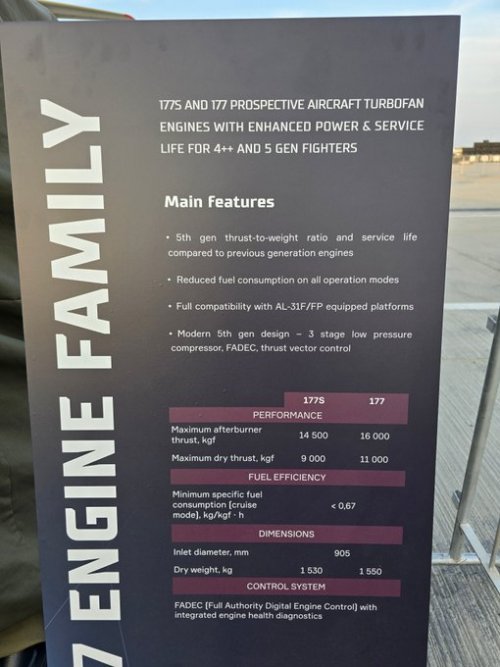
Official data on Izd. 177 engine, 16,000 kgf.
View: https://x.com/MuxelAero/status/1990040663052992794

View: https://x.com/MuxelAero/status/1990040663052992794
Avimimus
ACCESS: Top Secret
- Joined
- 15 December 2007
- Messages
- 2,713
- Reaction score
- 1,406
Has there been a stealthy IRST ever been deployed by any nation? For example, the F-35s EOTS is not an IRST, but an IR camera - which operates on a different physical principle.
How is an IRST different from an IR camera in terms of physical principles? The fact that it not all IRST are imagining infrared search and track doesn't make the physics different. If it can search and track in IR wavelengths then it is an IRST regardless of whether it is imaging or not!?
those are really good numbers on the right, if the service life sacrifice is like 6k to 4k it might be worthOfficial data on Izd. 177 engine, 16,000 kgf.
View: https://x.com/MuxelAero/status/1990040663052992794
View attachment 791755
16000kgf in 905mm diameter. So your Su-27 can transform into P-42. Su-30Sm and Su-34 would benefit significantly from it. And Su-35 too.
BTW, it means that if they could squeeze 11t dry and 16t wet in 905mm, 17-18 ton for izd.30 is not that hard to believe.
BTW, it means that if they could squeeze 11t dry and 16t wet in 905mm, 17-18 ton for izd.30 is not that hard to believe.
More importantly, do we know if 177 is already flight tested, debugged and ready for production, or is it just an offer at the moment with testing/production to happen in the future if there are customers?
Similar threads
-
 Sierra Nevada P-9A "Pale Ale" (Bombardier Q200) drug interdiction aircraft
- Started by Stargazer
- Replies: 9
-
 Pantsir Updates (SA-22 Greyhound ) Developments and Related
- Started by panzerfeist1
- Replies: 159