blaze016
ACCESS: Restricted
- Joined
- 4 April 2020
- Messages
- 7
- Reaction score
- 13
And right after that, the shot from a camera placed between the engines looking at the nozzles, pay close attention to the way the nozzles move before the pilot stops the roll, they seem to be doing pretty quick and small movements. Maybe not quite like what you're saying, but I guess that depends on how much they need to deflect in order to keep everything nice and tidy. Then again that kind of "full nozzle" TVC is fairly slow through the entire range of motion. The other type that only moves the petals seems to be much faster, look at the 0:44 mark. Looks fast enough to me. But it doesn't seem that any of the engines that the LTS may use actually have that type of TVC. It looks like izdeliye 30 was planned to use the petal TVC but the (I think) real engine seems to use the "full nozzle" type.That doesn't actually answer the question. If you watch the first couple of seconds of the video you'll see the Flanker's horizontal tails moving twice as fast in pitch as the nozzle can. It's almost a case of if you can see it move it's too slow. The FCS is assessing what to do to stop the aircraft departing due to instability on processing cycles of probably around 10ms. This is faster than a human pilot can process, and you need to have the controls respond just as fast as the FCS. We're talking very small, fast twitches of the controls on top of any manouevre being commanded.@VTOLicious and @Avimimus
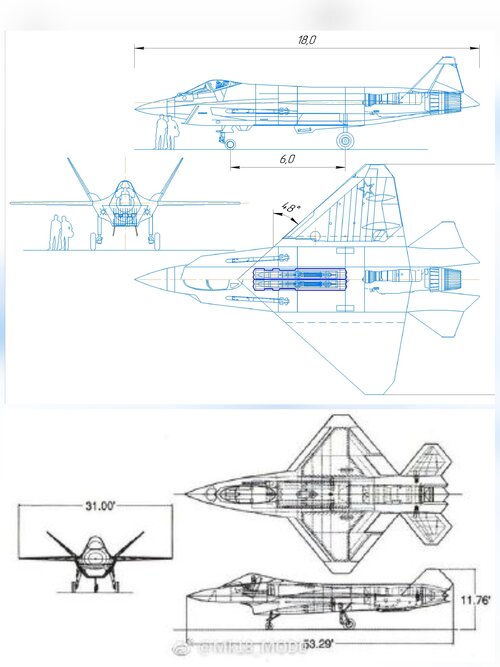
Don't forget that the tail configuration acts as an ejector, drawing a mass flow of air thanks to the nozzle output. So those little trim/elevons are fed with enough airstream in cruise configuration and may even act in-lieu of thrust vectoring.
I was thinking much the same, but also wondering whether thrust vectoring responds fast enough, precisely enough for stabilising an unstable aircraft, as opposed to being used to drive deliberate change in pitch/roll/yaw, which isn't nearly as time sensitive. Anyone know the answer from existing thrust vectoring designs?
Absolutely, on this video, both at the beginning of the video (about 5 seconds in) and between 45 seconds and 1 minute you can see two types of thrust vectoring nozzles work quickly
I do doubt the feasibility of using thrust vectoring for control, and looking at it again you could be right. We'll see in 2023 I guess, I don't think this will be the design that flies anyway.