
You are using an out of date browser. It may not display this or other websites correctly.
You should upgrade or use an alternative browser.
You should upgrade or use an alternative browser.
SpaceX
- Thread starter FutureSpaceTourist
- Start date


- Joined
- 13 August 2007
- Messages
- 9,837
- Reaction score
- 16,314
What happened this time?
Overpressured event in lox tank
COVP rupture again
Bad welding
I bet COVP again…
Overpressured event in lox tank
COVP rupture again
Bad welding
I bet COVP again…
I am not *too* surprised at this. It isn’t Atlas balloon tank–but it isn’t R-7 either.
SLS survived 260% of expected flight loads for *hours* before it split:
Why test?

 www.tensilemillcnc.com
Perhaps Musk was trying to increase Starship’s payload by shaving a tad too much off the booster?
I think it was the radio program "America Asks Bruce" where I heard a story about an business owner who tried to use a decreasing number of welds on a project. That can be hazardous even for consumer grade junk---perhaps the origin of
Holding something by a top rim means no legs and less weight.
Say what you will about SLS–it isn’t limber.
NASA's Space Launch System (SLS) rocket withstood Hurricane Nicole in November 2022, as it was designed to endure strong winds up to 85 mph (74.4 knots) at the 60-foot level, with additional structural margin. Although winds at the pad reached 100 mph (160 kph) gusts, the rocket's design limits were not exceeded and its launch was only delayed by a few days. (from Gemini)
Fully laden, it is supported by two huge solids.
The shuttle ET was even more impressive, having to support the dead weight of a fully laden orbiter off to the side.
I dare Elon and his Bocans to even try to build something like that.
But this is an easy fix--

 comfort-truss.com
Them things hurt...
Mrs. Potter: What is all that stuff?
Fred Garvin: Oh, uh.. that’s my rather elaborate network of trusses. I will need your help with a couple of these. I got the old hernia truss here.. and I got a spleen truss, it opens up with a couple of snaps here in the back...
I think mine is stout enough for five SRBs.
SuperHeavy just needs a few for its hernias.
I challenge Elon to release the psi rating Starship burst at so it can be compared with SLS.
1.4 times is less than 2.6 times flight loads as I recall basic math.
SLS survived 260% of expected flight loads for *hours* before it split:
Why test?
The Role of Tensile Testing for Spacecraft Structural Integrity
Discover how tensile testing guarantees spacecraft structural integrity, preventing failures in extreme conditions and guaranteeing mission safety.
www.tensilemillcnc.com
Perhaps Musk was trying to increase Starship’s payload by shaving a tad too much off the booster?
I think it was the radio program "America Asks Bruce" where I heard a story about an business owner who tried to use a decreasing number of welds on a project. That can be hazardous even for consumer grade junk---perhaps the origin of
Holding something by a top rim means no legs and less weight.
Say what you will about SLS–it isn’t limber.
NASA's Space Launch System (SLS) rocket withstood Hurricane Nicole in November 2022, as it was designed to endure strong winds up to 85 mph (74.4 knots) at the 60-foot level, with additional structural margin. Although winds at the pad reached 100 mph (160 kph) gusts, the rocket's design limits were not exceeded and its launch was only delayed by a few days. (from Gemini)
Fully laden, it is supported by two huge solids.
The shuttle ET was even more impressive, having to support the dead weight of a fully laden orbiter off to the side.
I dare Elon and his Bocans to even try to build something like that.
But this is an easy fix--
Power T Strap for Comfort-Truss Hernia Belt
Purchase a Power T Strap for Comfort Truss hernia support belts. Our Power T strap hernia belt support strap is designed to give you extra support and easily fits over the front belt pad. Don't stop doing what you love, buy a Power T hernia truss support strap at Comfort-Truss.
comfort-truss.com
Them things hurt...
Mrs. Potter: What is all that stuff?
Fred Garvin: Oh, uh.. that’s my rather elaborate network of trusses. I will need your help with a couple of these. I got the old hernia truss here.. and I got a spleen truss, it opens up with a couple of snaps here in the back...
SNL Transcripts: Margot Kidder: 03/17/79: Fred Garvin, Male Prostitute - SNL Transcripts Tonight
Saturday Night Live Transcripts Season 4: Episode 15
snltranscripts.jt.org
I think mine is stout enough for five SRBs.
SuperHeavy just needs a few for its hernias.
I challenge Elon to release the psi rating Starship burst at so it can be compared with SLS.
1.4 times is less than 2.6 times flight loads as I recall basic math.
Last edited:
Not really. An engineer can see that it isn'tThe shuttle ET was even more impressive, having to support the dead weight of a fully laden orbiter off to the side.
Child's play.I dare Elon and his Bocans to even try to build something like that.
Starship and Superbooster are harder to design and build since they have to be recovered and reused. The SLS core and Shuttle ET were disposable.
- Joined
- 13 August 2007
- Messages
- 9,837
- Reaction score
- 16,314

- Joined
- 19 February 2007
- Messages
- 1,601
- Reaction score
- 3,285
Yellow flag for sexist language! Should they not be called hisnias? Or they/themnias? /sarchasmSuperHeavy just needs a few for its hernias.
- Joined
- 13 August 2007
- Messages
- 9,837
- Reaction score
- 16,314
Sniff' Oh, the humanity--I don't see anyone about....the size of that chestburster...it ate them all. In other news, Elon is exited about space cargo, with SS/SH a perfect follow on to MD-11.
It looks like the pointy heads have learned to stop worrying about Earth cooties and love Starship:

 www.nationalacademies.org
 www.nextbigfuture.com
I wonder if anyone ever thought to have a rocket canal and flame trench be the same—rails to either side for stability?
It looks like the pointy heads have learned to stop worrying about Earth cooties and love Starship:
Search for Life Should Be Top Science Priority for First Human Landing on Mars, Says New Report
When astronauts set foot on Mars, it will be one of humanity’s greatest milestones, marking the start of a new era of discovery on another planet. A new National Academies report identifies the highest priority science objectives for the first human missions to Mars and says searching for...
www.nationalacademies.org
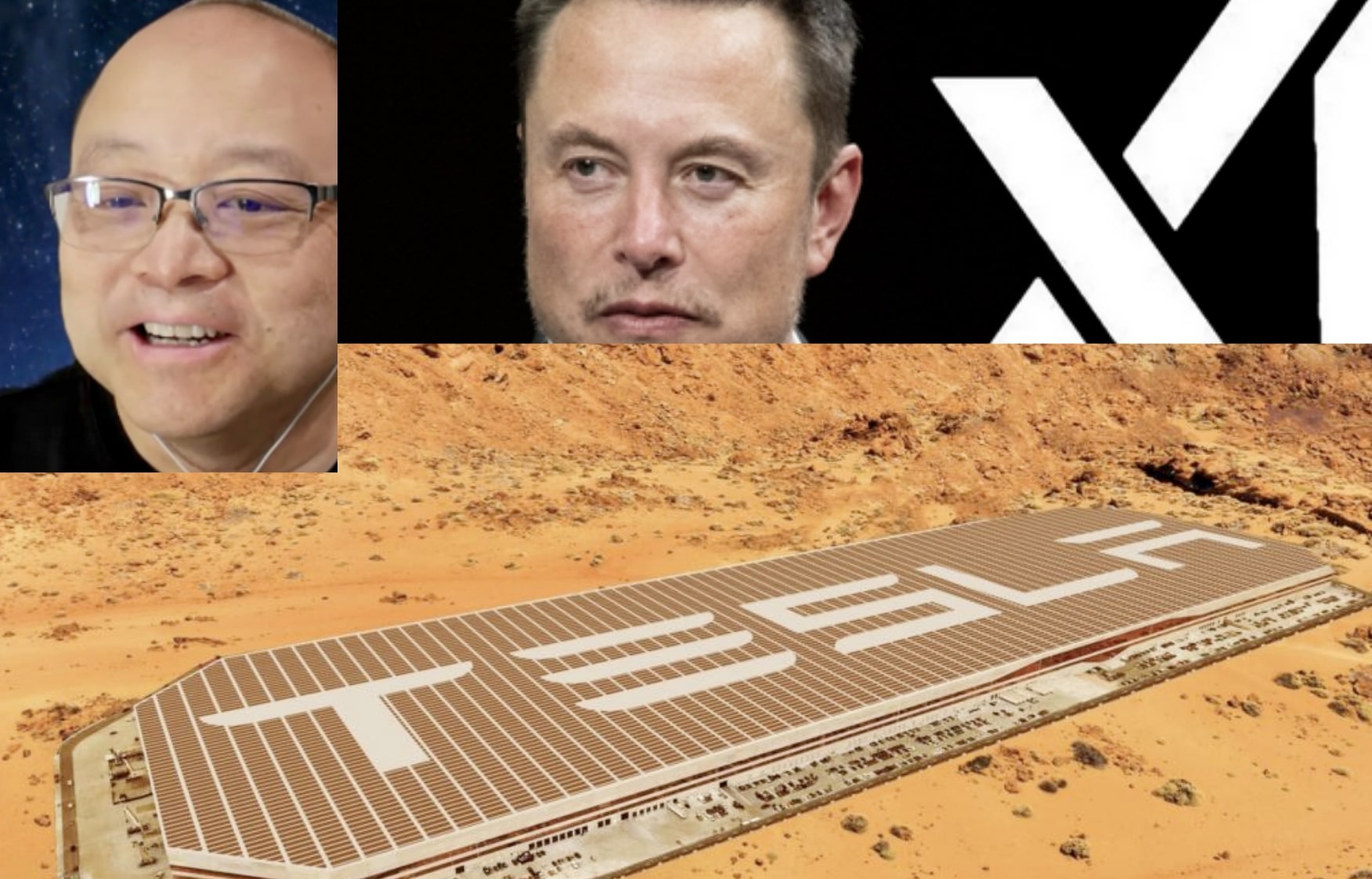
Brian Predicted Elon's Mars Plan One Year Before Reveal | NextBigFuture.com
Elon recently confirmed long-term plans for Mars at an xAI all-hands meeting.
www.nextbigfuture.com
I wonder if anyone ever thought to have a rocket canal and flame trench be the same—rails to either side for stability?
Last edited:
What happened this time?
Overpressured event in lox tank
COVP rupture again
Bad welding
I bet COVP again…
It would appear that the LOX tank was over-pressurised.

Forest Green
ACCESS: USAP
- Joined
- 11 June 2019
- Messages
- 12,795
- Reaction score
- 27,537
No, the main tank wasn't pressurized. After looking at both the video and daylight pictures of the aftermath, I'd bet money that it was a COPV blowing up inside a chine.It would appear that the LOX tank was over-pressurised.

- Joined
- 3 June 2011
- Messages
- 20,033
- Reaction score
- 17,239
Wouldn't that have caved IN the main tank instead of ripping it open?No, the main tank wasn't pressurized. After looking at both the video and daylight pictures of the aftermath, I'd bet money that it was a COPV blowing up inside a chine.
Wouldn't that have caved IN the main tank instead of ripping it open?
It had to have some pressure. the COPV was still the much like the other times.No, the main tank wasn't pressurized. After looking at both the video and daylight pictures of the aftermath, I'd bet money that it was a COPV blowing up inside a chine.
This is an argument for space-based solar power rather than space datacenters.

shin_getter
ACCESS: Top Secret
- Joined
- 1 June 2019
- Messages
- 1,323
- Reaction score
- 1,972
Beaming power down is problematic while GPUs are tiny and light, so shoot them up.This is an argument for space-based solar power rather than space datacenters.
No idea what it'd take to get a receiving array built given enclosed power generation systems already gets all the NIMBYs already.
Forest Green
ACCESS: USAP
- Joined
- 11 June 2019
- Messages
- 12,795
- Reaction score
- 27,537
Forest Green
ACCESS: USAP
- Joined
- 11 June 2019
- Messages
- 12,795
- Reaction score
- 27,537

alberchico
I really should change my personal text
- Joined
- 14 January 2014
- Messages
- 887
- Reaction score
- 2,148
I would imagine that the issue of lunar dust has been factored into the hardware that SpaceX is designing. These two particular lines stood out to me:
"Updating work done in the 1960s, Metzger's calculations using data from the Apollo 16 landing, for example, suggest that the relatively small lunar lander kicked up as much as 24 tonnes of dust. That's four to 10 times what NASA's previous model estimated."
"This has enormous implications, especially as future lunar landers, like Starship, will be far larger and heavier, with correspondingly greater rocket exhaust effects than Apollo generation craft."

- Joined
- 6 June 2006
- Messages
- 14,667
- Reaction score
- 20,612
Holly... cow. That one-third more than the LM weight by itself - a bit less than 16 tons.Metzger's calculations using data from the Apollo 16 landing, for example, suggest that the relatively small lunar lander kicked up as much as 24 tonnes of dust. That's four to 10 times what NASA's previous model estimated."

By this point I wonder whether a gaseous-hydrogen thruster (cold & monopropellant) might be preferable.
https://en.wikipedia.org/wiki/Cold_gas_thruster
Wikipedia tells me specific impulse would be 272 seconds, which by lunar gravity standards ain't too bad (of course on Earth we would say : it sucks).
So - DTAL landers with GH2 cold gas thrusters ?
Would gaseous hydrogen impacting the regolith throw a lot of dust around ? Seems to be much less of a furious blowtorch than a classic rocket engine.
Last edited:
It´s not the temperature (although you have pyroclastic flows), it´s the velocity of the exhaust flow. The only other case is to increase the exhaust surface, something not practical with single engine/single pack (yes, distributed engine/nozzles).
Attentive readers here know already what is the most efficient solution (and read about this particular problem ages ago).
Attentive readers here know already what is the most efficient solution (and read about this particular problem ages ago).
"Updating work done in the 1960s, Metzger's calculations using data from the Apollo 16 landing, for example, suggest that the relatively small lunar lander kicked up as much as 24 tonnes of dust. That's four to 10 times what NASA's previous model estimated."
Moon dust is horribly abrasive stuff that gets EVERYWHERE and turned out to be a major problem for the astronauts when they got to the multi-day Moon-landings especially Apollo 17.
Last edited:
Suitport type lock-outs for the win?
Clamshell a an exterior enclosure to keep suits out of the Sun, and exit through the back.
Something I was thinking about...
SLS is like Batman. Lots of money and prep time. The very soul of *stability*.
Starship is Clayface iterating out of control, like cancer...or THE THING:
No thanks.
Clamshell a an exterior enclosure to keep suits out of the Sun, and exit through the back.
Something I was thinking about...
SLS is like Batman. Lots of money and prep time. The very soul of *stability*.
Starship is Clayface iterating out of control, like cancer...or THE THING:
No thanks.
Last edited:
Wouldn't that have caved IN the main tank instead of ripping it open?
It probably caved in a relatively small hole in the main tank right next to itself. There are shrapnel holes in the downcomer. Then it vented pressure into the main tank, which subsequently ripped open along the already existing hole.
- Joined
- 13 August 2007
- Messages
- 9,837
- Reaction score
- 16,314


6footboy
ACCESS: Restricted
- Joined
- 2 January 2025
- Messages
- 21
- Reaction score
- 50
The issue however is not power as much as it is heat dissipation: "Most spacecraft radiators reject between 100 and 350 W of internally generated electronics waste heat per square meter. Radiators' weight typically varies from almost nothing, if an existing structural panel is used as a radiator, to around 12 kg/m2 for a heavy deployable radiator and its support structure" from what the literature says. It would be great to see how they solve that problem. The quote is from a Wikipedia article quoting the Spacecraft Thermal Control Handbook.

- Joined
- 2 January 2006
- Messages
- 4,147
- Reaction score
- 7,741
Detail on booster 18
Better one:
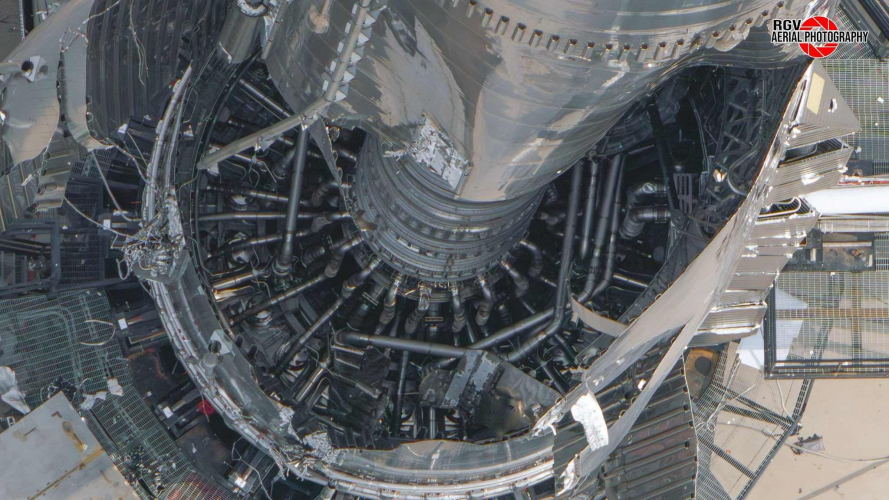
via View: https://twitter.com/eccorca/status/1992661102933782613
and
View: https://twitter.com/RGVaerialphotos/status/1992666940276457746
Last edited:
- Joined
- 13 August 2007
- Messages
- 9,837
- Reaction score
- 16,314
looking on damage interior
i see methane feed line and wondering were is LOX tank for landing ?
i'm not sure was that a separate tank in main LOX tank ?
could a overpressure event destroy that Tank, what led this disaster ?
i see methane feed line and wondering were is LOX tank for landing ?
i'm not sure was that a separate tank in main LOX tank ?
could a overpressure event destroy that Tank, what led this disaster ?
zebra159357
I really should change my personal text
- Joined
- 30 November 2018
- Messages
- 141
- Reaction score
- 481
NASA, Space Force Eyeing Starship Flights From Florida In ’26 | Aviation Week Network
The Eastern Range is working with NASA to be able to host SpaceX Starship-Super Heavy flights from the Kennedy Space Center (KSC) in early- to mid-2026.
 aviationweek.com
- Joined
- 13 August 2007
- Messages
- 9,837
- Reaction score
- 16,314
i just realisedAccelerating battery charged on the moon via solar array to earth orbit and capture via Starship?
A magnetic rail (as mass accelerator) would makes sense, the way the US administration/GA initiated a research project for adapting Magnetic Catapult from GA to Lunar environment.
Elon Musk support Hyperloop a magnetic rail in vacuum tube.
On the moon you don't need the tube, Hyperloop would perfect as mass accelerator !
like Boring company could drill tunnels on Moon or Mars
Supported by Tesla Robots
Everything Musk support or work on, can be use for space colonisation !!!
Forest Green
ACCESS: USAP
- Joined
- 11 June 2019
- Messages
- 12,795
- Reaction score
- 27,537
- Joined
- 13 August 2007
- Messages
- 9,837
- Reaction score
- 16,314
progress on Gigabay at Starbase

- Joined
- 13 August 2007
- Messages
- 9,837
- Reaction score
- 16,314
Progress at Starbase
View: https://www.youtube.com/watch?v=9nUYN_7z8kA
Seems one COVP exploded on Booster 18
Seems one COVP exploded on Booster 18
Forest Green
ACCESS: USAP
- Joined
- 11 June 2019
- Messages
- 12,795
- Reaction score
- 27,537
- Joined
- 13 August 2007
- Messages
- 9,837
- Reaction score
- 16,314

- Joined
- 6 November 2010
- Messages
- 6,025
- Reaction score
- 7,577


BlueAbyssal
ACCESS: Secret
- Joined
- 14 January 2024
- Messages
- 406
- Reaction score
- 763
While the number of pads they're building is not, itself, a guarantee that Starship will be successful, it's at least an indication that SpaceX thinks Starship has plenty of room to grow and is likely to bear fruit. If they do even half of what Musk plans, there's plenty of internal demand for launches, doing everything from Starlink, to orbital factories, lunar mining, manufacturing, and quantum computing, to Martian cities, and beyond.So five Starship pads total. For now. I wonder if they'll put any at Vandenburg.
- Joined
- 13 August 2007
- Messages
- 9,837
- Reaction score
- 16,314
Forest Green
ACCESS: USAP
- Joined
- 11 June 2019
- Messages
- 12,795
- Reaction score
- 27,537
Similar threads
-

-

-
 McDonnell Douglas X-33 SSTO Reusable Launch Vehicle
- Started by athpilot
- Replies: 10
-

-
