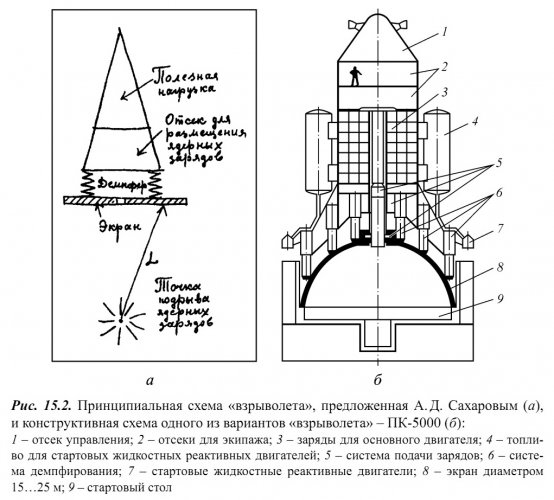
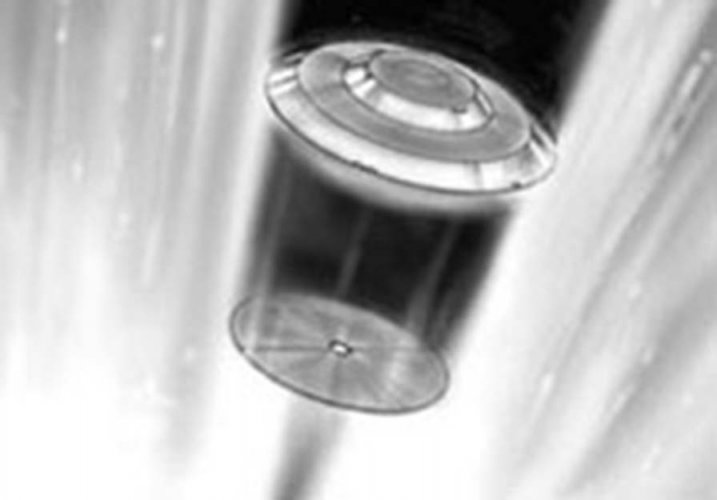
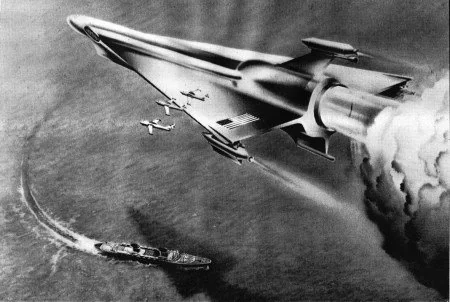
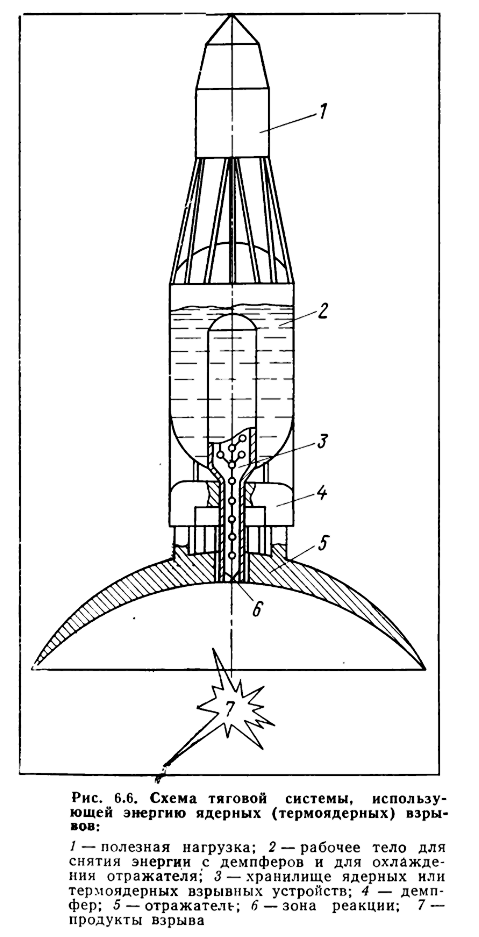
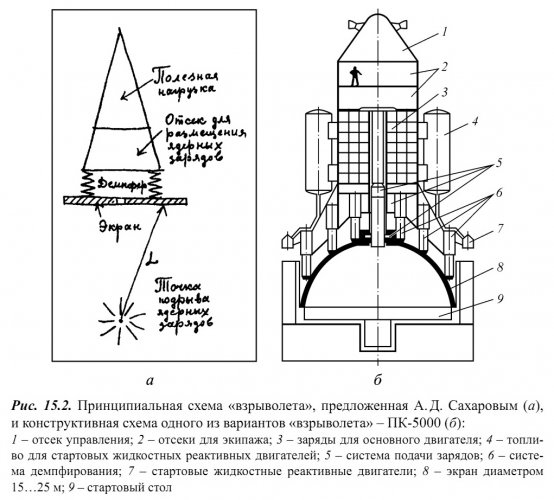
That is a "design" supposedly attributed to Sakharov (sic?), a Soviet response to Orion. Unlike Orion, which was a big program, this was a one-man effort, that clearly did not include any real engineering study.
Yes, it says of it as of Sakharov's idea offered in Sarov (now Federal Nuclear Center) in 1962. At the left seems to be reproduction of his original 'napkin' sketch, to the right - one of family designs, dubbed PK-5000 (5000 is a TOW), with a take-off rocket engines. Well, an interesting find anyway - seems that we still had some sources in Los Alamos or General Atomics.
Yes, it says of it as of Sakharov's idea offered in Sarov (now Federal Nuclear Center) in 1962. At the left seems to be reproduction of his original 'napkin' sketch, to the right - one of family designs, dubbed PK-5000 (5000 is a TOW), with a take-off rocket engines. Well, an interesting find anyway - seems that we still had some sources in Los Alamos or General Atomics.
Actually, the drawing at left looks a lot like a great many published generic schematics of the Orion concept, obtainable in numerous technical journals. The "PK-5000" design looks like something that somebody who *didn't* have access to the General Atomics work might have come up with. The PK-5000 is just plain *bad.* The curved pusher plate is a disastrous idea. The rest of the "design" looks cartoonish at best.
The PK-5000 has been shown publicly for a few years: http://spacebombardment.blogspot.com/2005/08/lunar-landing-verison-of-project-orion.html
Well, PK-5000 just could be a schematics invented by dumb magazine illustrator. Anyway, I agree that GA Orion was million light years ahead of this in terms of engineering development.
Yes. I don't have my references here, but Orion was referenced in the press (Av Week, Missiles & Rockets, newspapaers, etc) in 1959 or 1960. Martin cranked out a lot of nuclear pulse artwork (mostly featuring internal detonations) in the same time period.
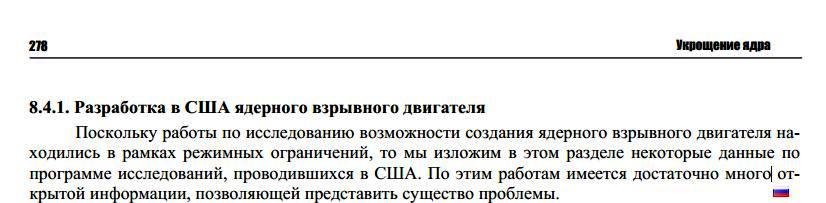
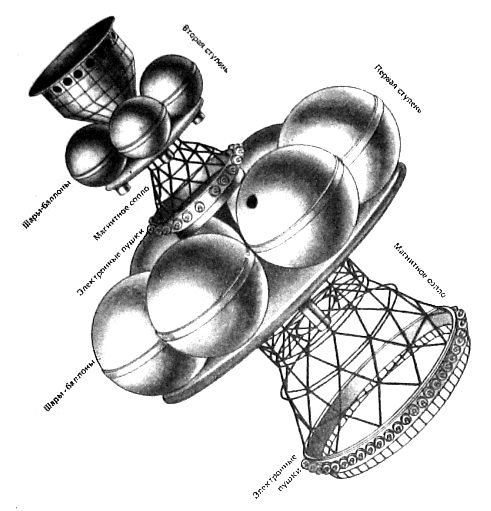
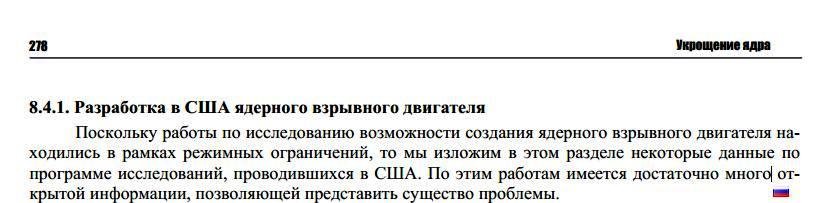
So, here's what the "bible" says about the Soviet version of Orion (see the first attached figure):
стр. 278.
8.4.1. Разработка в США ядерного взрывого двигателя.
Поскольку работы по исследованию возможности создания ядерного взрывного двигателя находились в рамках режимных ограничений, то мы изложим в этом разделе некоторые данные по программе исследований, проводившихся в США. По этим работам имеется достаточно много открытой информации, позволяющей представить существо проблемы.
8.4.1. Development of a Nuclear Explosive Engine in the United States.
Since research into the feasibility of creating a nuclear explosive engine was within the scope of sicret restrictions, in this section we will present some data on the research program conducted in the United States. A considerable amount of publicly available information on this work allows us to understand the essence of the problem.
So. I'm translating from the official language into normal language. Fuck you, not the details of our developments! Everything is still classified. The Americans have already said enough, so we'll use their open chatter to piece together the overall picture. And what else we have—you don't need to know!
That's exactly how it translates. And that's alarming. What did the Russians dream up that still hasn't been declassified? Or was there really nothing to show, and knowledgeable historians are just throwing smoke and mirrors?
Judging by what's shown in the well-known drawings (the source of the information is again unclear), this is indeed the case. In fact, there are serious doubts that the PK-5000 is a modern replica, a fake! And the only truly original plan for a Russian bomber-flight is a rather sketchy sketch, supposedly drawn by Sakharov himself.
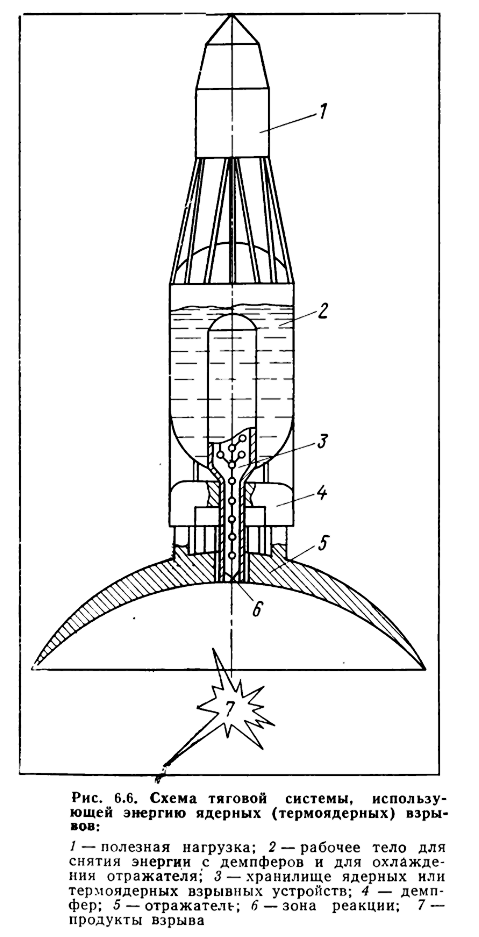
Much more authentic is the bomber-flight diagram (resembling a mix of Dandridge Cole's concept and Orion) from Valery Burdakov's 1975 book "External Resources" (this diagram is definitely included in this year's book):
But these are all just drawings, just like schoolchildren's imaginations.
What is actually known about Sakharov's bomb-spaceship? A few tales are circulating. The most famous story (retold many times by different people) is about how, during a banquet hosted by Khrushchev in the Kremlin for his nuclear scientists in the summer of 1961 (before the moratorium on nuclear testing was lifted), Sakharov proposed to Khrushchev, during a toast, to build a bomb-spaceship the kind they'd been working on at Arzamas-16 for, apparently, a year already—or to detonate a 100-megaton superbomb. Khrushchev (was he a bit dense?) didn't understand the part about the bomb-spaceship or ignored it, saying, "There's no point in nuclear scientists getting into space; he has Korolev and Chelomei for that..." But a 100-megaton bomb—that's what interested Khrushchev. Thus, the "Tsar Bomba" project was born. Before that, physicists, forced to sit idle for several years due to the moratorium on nuclear testing, were actively working on the flying bomb-spaceflight. The second story involves lost plans. One day in 1959 or 1960, after heated group discussions on production issues, secret blueprints were left on a windowsill in an abandoned classroom at the closed Arzamas-16. They fell into the hands of the officer responsible for secrecy, and a scandal erupted. The young physicist responsible faced inevitable punishment for violating regulations. Sakharov intervened, accepting full responsibility, knowing he would not be punished. It is claimed that the forgotten secret documents pertained specifically to the bomb-spaceship project.
That's essentially all that's widely known. But I accidentally found something else.
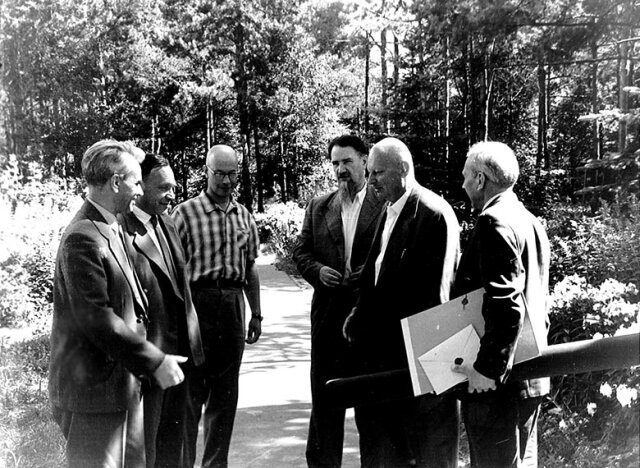
A brief introduction. In the USSR, as in the USA, they were actively working on a nuclear thermal engine. In the USSR, this research was overseen by Keldysh himself, the head of the USSR Academy of Sciences. And he had a favorite student, a young man in the late 1950s, who essentially dedicated his entire life to creating a gas-phase nuclear thermal engine, which was never realized. Here he is, bald, in the photo, the youngest of the leading figures in Soviet nuclear science. The photo was taken in the late 1950s.
And so, in his memoirs and recollections about him, I was surprised to discover the following paragraph.
quote from...
РАКЕТНО-КОСМИЧЕСКИЕ ДВИГАТЕЛИ И ЭНЕРГЕТИЧЕСКИЕ УСТАНОВКИ НАУЧНО-ТЕХНИЧЕСКИЙ СБОРНИК ВЫПУСК 1 (146)
ВИТАЛИЙ МИХАЙЛОВИЧ ИЕВЛЕВ В НАУКЕ И ЖИЗНИ
Центр Келдыша
1996 стр. 72-74
И еще. После того как у нас окончательно выкристаллизовалось решение двигателя схемы В в виде газового реактора с почти не смешивающимися тепловыделяющей и теплопоглощающей струями газа, Виталий Михайлович доложил об этом варианте А. П. Ваничеву и М. В. Келдышу. Расчеты показывали, что решение это теоретически обосновано, хотя возможности практической реализации такой схемы вызывали, естественно, множество вопросов. М. В. Келдыш одобрил продолжение работы по этому направлению.
Незадолго до этого академик А. Д. Сахаров предложил использовать для разгона космических кораблей взрывы небольших атомных бомб за кормой корабля, выполненной в виде массивной металлической плиты.
Не знаю, по каким соображениям, но М. В. Келдыш пришел к выводу, что В. М. Иевлеву и А. Д. Сахарову пора обменяться идеями относительно возможных путей использования ядерной энергии в двигателях, в которых температура рабочего тела не ограничивается температурой стойкости материала конструкции твэлов. И вот Виталий Михайлович и я на служебном самолете прибыли к А. Д. Сахарову в его городок, названия которого мы тогда по известным причинам не знали и не пытались узнать.
Встретил нас Андрей Дмитриевич очень радушно, проводил в гостиницу (в номер, в котором обычно останавливались приезжавшие к А. Д. Сахарову министры), а потом пригласил на семинар, где и состоялся основной обмен информацией.
Семинар этот проходил в сравнительно небольшой комнате с большой доской из линолеума для записей мелом. Присутствовало в комнате человек 15-20 сотрудников Андрея Дмитриевича, и было достаточно тесно. Что нас с Виталием Михайловичем поразило сначала, так это то, что почти все присутствовавшие были достаточно молодыми людьми, в большинстве своем до тридцати лет (правда, и самому А. Д. Сахарову не было тогда еще и сорока). Работавших с A. Д. Сахаровым в то время известных корифеев на семинаре не было (одного из них, известного физикохимика А. И. Бродского, Виталий Михайлович тихонько показал мне на следующий день утром в столовой).
Сообщение Виталия Михайловича было выслушано с большим вниманием. Вопросы задавались толковые, по существу затрагиваемых физических и газодинамических процессов. А. Д. Сахаров очень кратко рассказал у доски с мелом в руках о способах уменьшения критической массы заряда и, в частности, о рассматриваемом им в то время методе обжатия заряда с помощью резкого повышения напряженности электромагнитного поля, созданного предварительно в специальном соленоиде.
I'm not translating intentionally. Translate and read for yourself.
The underlining in the text is mine. Thus, between the lines, quite incidentally from memoirs, we learn that during the development of the Russian version of Orion, the option of creating microexplosions of very small critical masses, highly compressed by a pulsed magnetic field, was considered. And this fits very well with what we know. One of Sakharov's few unclassified publications from the mid-1960s was precisely about explosive magnetic effects and generators (super-strong fields and currents generated during explosions).
And now it's obvious that they were planning to somehow use this in the Russian version of a pulsed nuclear engine. At the same time, Sakharov argued to Ievlev that they would consume less fissile material, making it more economical than if he were to implement his favored gas-phase nuclear rocket engine, in which the fissile material would inevitably be lost to the hydrogen working fluid.
One last thing remains to be said.
Из статьи...
НАУКА БУДУЩЕГО (ПРОГНОЗ ПЕРСПЕКТИВ РАЗВИТИЯ НАУКИ)*
А.Д. Сахаров.
*Ежегодник "Будущее наука", Москва, 1966, с. 42-51. Издание ГКНТ с грифом "для сулжебного пользования". На шмуцтитуле напечатано: "Вариант для предварительного обсуждения". Всего размножено 120 пронумерованных экземпляров с датой 28.06.1966. Экземпляр А.Д. Сахарова имеет № 118. На нем имеются множетвенные карандашные правки, учтенные в настоящем издании.
. . .
e. Ракета, приводимая в движение ядерными и термоядерными взрывами ("взрывлет", соответствует американскому проекту "Орион"). Отличительная особенность взрыволета - наличие прочной взрывной камеры с соплом или "платформы", которая принимает на себя импульс продуктов взрыва и подмешанного к ним "рабочего тела". с малым молекулярным весом, а также наличие устройства, демпфирующего удары. Массы этих вспомогательных устройств зависят от мощности взрывов, поэтому выгодно максимально "дробить" процесс ускорения, приближая его к непрерывному.
Взрыволет экономически и технически целесообразен (массы камеры и демпфера не очень велики) при изменении скорости от одного взрыва на величину порядка 1 м/с и менее. По-видимому, это обстоятельство исключает применение этого принципа для старта с поверхности Земли (десятки взрывов в секунду), а также в машинах, меньших по весу, чем несколько тысяч тонн (после вывода на орбиту). Впрочем прогресс в экономических зарядах малой мощности и прочных веществах для взрывной камеры может изменить эти оценки.1 Для крупных грузовых перевозом между спутниками далеких планет, а также для выхода за орбиту Плутона, что может иметь значение для установления связи с внеземными цивилизациями, взрыволет может быть полезен уже при теперешнем уровне техники.
. . .
1 Очень интересны варианты взрыволета, в которых термоядерные микровзрывы осуществляются лазерным лучом. Для питания лазеров при этом используется магнитно-гидродинамический генератор на ракетном сопле. По нашему мнению, осуществление такой схемы должно стать технически возможным к 1975-80 годам, а может быть и раньше.
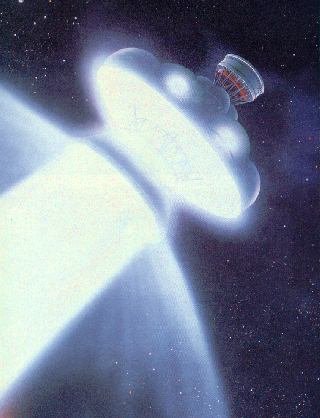
By 1966, Sakharov's imaginary pulsed explosive spacecraft had essentially degenerated into the concept of... "Daedalus." And the date of physical implementation predicted in his fantasies coincided precisely with the release of the British project.
Actually, the drawing at left looks a lot like a great many published generic schematics of the Orion concept, obtainable in numerous technical journals. The "PK-5000" design looks like something that somebody who *didn't* have access to the General Atomics work might have come up with. The PK-5000 is just plain *bad.* The curved pusher plate is a disastrous idea. The rest of the "design" looks cartoonish at best.
A hemispherical plate seems to suggest an isotropic plasma expansion due to the explosion. This is an overly simplistic solution and understanding of the concept of external combustion. In fact, it's a "camouflage" idea, I think initially slipped to the public to protect the project's main secret.
The key idea was to generate a directed plasma jet in two directions (conservation of momentum), one of which was directed toward a FLAT plate.
Even Ulam's original 1955 concept no longer involved isotropic plasma expansion. The radiation from the explosion expanded isotropically. But the apparatus was already propelled by the directed evaporation of an "intermediate disk of matter," which was evaporated by the energy of the explosion and moved toward the plate in a directed manner.
This initial idea from 1955 was still crude. But it essentially reveals the mechanism. Ted Taylor took it to its logical conclusion. Firstly (and this is obvious to everyone), he added a PENDULUM-TYPE converter of impulses into continuous motion. The second idea was the key one, and, as I understand it, it still remains a "secret" for the vast majority of people. This concerns the mechanism for generating a bidirectional explosion-jet. Ted Taylor realized that there was no point in separating the explosion charge itself and the "thin disk" of fuel and ejecting them separately. They needed to be combined into a single unitary charge. This was easier to implement and the result would be much better. But in any case, the mirror plate would be flat during a directed explosion.
The Orion design is deceptively simple. Almost everything about it is misunderstood "at first glance."
Generally speaking, the interaction of the plasma charge with the plate promises to be such a complex problem that I wouldn't be surprised if, after some complex modeling, the designers conclude that it's better to make the plate slightly concave. My intuition tells me that this would help the directed plasma flow reflect off the plate more efficiently. But the Orion team believed that a flat disk (thicker in the center, thinner towards the edges, according to the plasma density distribution) was the best solution in the case of a directed explosion.
I don't think so. The idea of a Russian pulse-propelled spaceship powered by bombs is a very specific one. Incidentally, you were wrong to conflate Orion with Daedalus. They're actually two different concepts, although Alan Bond's Daedalus evolved from Orion. Historically. But conceptually, it's a different system. After all, laser-powered controlled thermonuclear fusion, in its problems and bottlenecks, is much closer to magnetic confinement than to bombs.
But since you've combined them there, I took advantage of it to ask a question that's been bothering me for a long time.
Regarding the Russian Orion, I think Dyson's 1965 article "Death of the Project" was so brilliant that the USSR clearly understood that the US wouldn't build such a spaceship. And if that's the case, neither would we. That was already the Brezhnev era. We tried not to get ahead of you, the US. But I think Sakharov's work on explosive magnetic minimization of critical mass was not in vain.
There's a legend about a miracle driver-initiator called "Sinus," which leaves almost no radioactive fallout. In the USSR, this was used for ultra-pure deuterium industrial thermonuclear charges. Perhaps that's why any "memoirs" on this topic in Russia are still classified.
Just one thing. In this case, you'll have poor specific impulse.It's the same problem as with thermal nuclear rocket engines. Too many problems for a very small gain in specific impulse.
Just one thing. In this case, you'll have poor specific impulse.It's the same problem as with thermal nuclear rocket engines. Too many problems for a very small gain in specific impulse.
As noted it was a design suggestion based on "general rumors" of the Orion drive but no clear understanding of how that would work. It really didn't have ANY advantages but was thought to have initially.
Most of the thrust was supposed to come from vaporizing a water blanket released along the inner surface of the sphere just prior to detonation. Or you could use atmospheric air in a "nuclear pulse jet" fashion:
As noted, not well thought out but aimed at a general idea of how Orion worked without access to how Orion actually worked
Dandridge McFarlan Cole (hopefully I got the spelling right) had no classified access to Orion so he designed nuclear pulse spaceships his own way. See Aldebaran as an example of how not doing a nuclear pulse rocket.
A hemispherical plate seems to suggest an isotropic plasma expansion due to the explosion. This is an overly simplistic solution and understanding of the concept of external combustion. In fact, it's a "camouflage" idea, I think initially slipped to the public to protect the project's main secret.
The key idea was to generate a directed plasma jet in two directions (conservation of momentum), one of which was directed toward a FLAT plate.
Even Ulam's original 1955 concept no longer involved isotropic plasma expansion. The radiation from the explosion expanded isotropically. But the apparatus was already propelled by the directed evaporation of an "intermediate disk of matter," which was evaporated by the energy of the explosion and moved toward the plate in a directed manner. View attachment 792967
This initial idea from 1955 was still crude. But it essentially reveals the mechanism. Ted Taylor took it to its logical conclusion. Firstly (and this is obvious to everyone), he added a PENDULUM-TYPE converter of impulses into continuous motion. The second idea was the key one, and, as I understand it, it still remains a "secret" for the vast majority of people. This concerns the mechanism for generating a bidirectional explosion-jet. Ted Taylor realized that there was no point in separating the explosion charge itself and the "thin disk" of fuel and ejecting them separately. They needed to be combined into a single unitary charge. This was easier to implement and the result would be much better. But in any case, the mirror plate would be flat during a directed explosion.
The Orion design is deceptively simple. Almost everything about it is misunderstood "at first glance."
Generally speaking, the interaction of the plasma charge with the plate promises to be such a complex problem that I wouldn't be surprised if, after some complex modeling, the designers conclude that it's better to make the plate slightly concave. My intuition tells me that this would help the directed plasma flow reflect off the plate more efficiently. But the Orion team believed that a flat disk (thicker in the center, thinner towards the edges, according to the plasma density distribution) was the best solution in the case of a directed explosion.
It's always been my understanding that the curve of the pusher plate was actually a parabolic curve , such that when the bomb was detonated at the focus of the parabola , the plasma , debris , and energy , etc. , would be directed along the vehicle's axis , such that the reaction force was generated in the desired direction of motion .
It's always been my understanding that the curve of the pusher plate was actually a parabolic curve , such that when the bomb was detonated at the focus of the parabola , the plasma , debris , and energy , etc. , would be directed along the vehicle's axis , such that the reaction force was generated in the desired direction of motion .
In fact, in the case of a mirror collimating an isotropic expansion, the difference between a hemisphere and a parabola would be so insignificant that it's pointless to consider it. That's why Dyson used a simplified form—a hemisphere—in "Interstellar Transport." In Daedalus, it's unclear why there's a hemisphere at all. The mirror is magnetic. That's why there are pictures of Daedalus that don't have a hemisphere at all. Here, for example.
The only screen that covers anything is the "hyperbolic" one, which is located just under the fuel tanks. And here's how this "hyperbolic" screen works. "It glows":
This site uses cookies to help personalise content, tailor your experience and to keep you logged in if you register.
By continuing to use this site, you are consenting to our use of cookies.