Soviet night fighters
In late 1940 the Soviet Air Force Research Institute developed the requirement for an airborne interception radar with 4.5 km range, 120-degree horizontal and 90-degree vertical detection zones.
One prototype designated
Gneys-1 was completed early in 1941, but the development of the production version was terminated in July 1941 due to a shortage of
Klystron tubes.
The 500 kg
Gneys-1 radar set operated at 2,000MHz and 16 cm. wavelength.
In summer of 1941 some Pe-2s, operating as night fighters in the defense of Moscow, were fitted with two underwing searchlights.
The
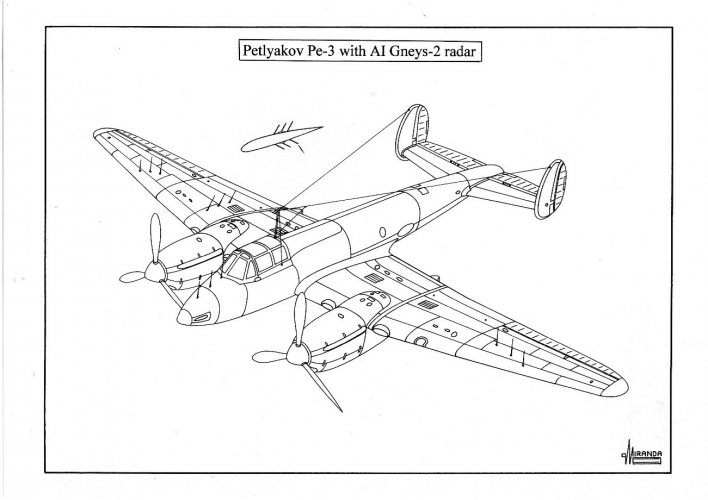
Gneys-2 prototype was completed at the end of 1941. The new radar, with 3,500 m range, which operated at 200 Mhz and 1.5 m. wavelength, was very similar to the British AI Mark 6.
In January 1942 it was installed on a Petlyakov Pe-2 fast bomber, with three nose mounted transmitting dipoles, three vertically polarized azimuth dipoles mounted above the top surface of each wing and six elevation dipoles (with 45 degrees of inclination) installed on the starboard wing, three on the upper face and three on the lower.
As AI equipment was urgently needed, the first fifteen sets of
Gneys-2 that were built were installed on several Pe-2 and Pe-3 night-fighters, before the radar finished the State acceptance tests in 1942.
These aircraft were used in numerous night missions over Moscow, Stalingrad and Leningrad (operating with help of RUS-2
Redut-K ground radars to vector the fighters into attack position) but the complicated GCI interception system did not work properly, and they were evacuated from the front line in early 1944.
Paint scheme: Dark Green (FS 34102) upper surfaces, Pale Blue (FS 35550) under surfaces and Red Stars in fuselage and tailfin.
Petlyakov Pe-2MV night fighter- Technical data
Wingspan: 56 ft. (17.11 m), length: 41.9 ft. (12.78 m), height: 11.2 ft. (3.42 m), wing area: 450 sq. ft. (40.5 sq. m), max weight: 18,744 lb. (8,520 kg), max speed: 278 mph (449 km/h), range: 815 miles (1,315 km/h), service ceiling: 28,900 ft. (8,800 m), power plant: two M-105 RA twelve-cylinder, Vee, liquid-cooled radial engines, each rated at 1,100 hp, armament: one 20-mm ShVAK cannon in the nose and two 12.7-mm UBK heavy machine guns housed in a ventral tray.
Petlyakov Pe-3 night fighter- Technical data
Wingspan: 56.1 ft. (17.13 m), length: 41.5 ft. (12.66 m), height: 11.2 ft. (3.42 m), wing area: 450 sq. ft. (40.5 sq. m), max weight: 17,637 lb. (8,000 kg), max speed: 330 mph (530 km/h), range: 930 miles (1,500 km), service ceiling: 29,900 ft. (9,100 m), power plant: two M-105 RA twelve-cylinder, Vee, liquid-cooled radial engines, each rated at 1,100 hp, armament: one 20-mm ShVAK cannon in the nose and two 12.7-mm UBK heavy machine guns housed in a ventral tray.
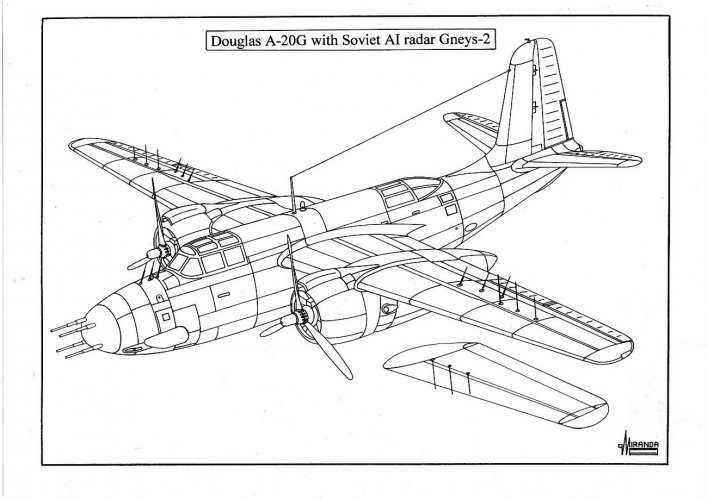
In August 1944 the Soviet night fighters Petlyakov Pe-2 and Pe-3 were replaced by Lend-Lease Douglas A-20G-1 American planes, slower than the Pe-2 but with more powerful armament.
These aircraft were modified in Factory No. 81 with
Gneys-2 radars, three nose mounted transmitting dipoles, three vertically polarized azimuth dipoles mounted above the top surface of each wing, and six elevation dipoles (with 45 degrees of inclination) installed on the starboard wing, three on the upper face and three on the lower, SCR-695 IFF transponders, and SCR-718 radio-altimeters.
The transmitting dipoles generated a cone-shaped detection blind zone with 7 degrees of amplitude in front of the plane, a defect that could not be corrected and that affected the radar effectiveness.
Between August 1944 and April 1945, the Douglas night fighters carried out 246 combat missions with air division
Breslavlskaya, but only managed to shoot down two glider tug Heinkel He-111 bombers.
Paint scheme: Dark Green (FS 34102) upper surfaces, Pale Blue (FS 35550) undersurfaces and Red Stars in six positions.
Douglas P-70 (first series) - Technical Data
Wingspan: 61.3 ft. (18.69 m); length: 47.6 ft. (14.5 m); height: 17.6 ft. (5.36 m); wing area: 465 sq. ft. (43.18 sq. m); max weight: 21,264 lb. (9,645 kg); max speed: 329 mph (529 km/h); power plant: two Wright R-2600-11 air-cooled radial engines each rated at 1,600 hp.
BIBLIOGRAPHY
BOOKS
Khazanov, D., Le Petlyakov Pe-2, Lela Presse, 2007.
Khazanov, D., Pe-2 Guards Units of World War 2, Osprey, 2013.
Musialkowski, L., Petlyakov Pe-2 & UPe-2, Stratus, 2019.
Passingham, M., Petlyakov Pe-2 and Variants, Profile Number 216, 1971.
Pomoshnikov, O., The Soviet Light Bomber Petlyakov Pe-2, Kagero, 2002.
Smith, P., The Petlyakov Pe-2: Stalin’s Successful Red Air Force Light Bomber, Air World, 2020.
Smith, P., Petlyakov Pe-2 Peshka, Crowood, 2003.
Stapfer, H., Petlyakov Pe-2 In Action, Squadron/Signal No. 1181, 2002.
Stapfer, H., Petlyakov Pe-2 a Pe-3, HT Model Special No. 911, Magnet Press, 2005.
PUBLICATIONS
Cance, H., Petlyakov Pe-2, Aviation News, September 1990.
Edit., From Sotka to Peshka:The Story of Petlyakov's Pe-2, Its Origins and its Derivatives, Air International, August 1979.
Khazanov, D., Pe-2 un bombardier avec l’âme d’un chasseur, Le Fana de l’Aviation Nos. 420 to 422.
Rynkowski, W., Scale Aviation Modeller International, 1997.