Siebel/DFS 346
In 1942 the
Deutschen Forschungsinstitut für Segelflug (DFS) initiated a series of design studies for high-altitude and high-speed research aircraft.
In 1943 the DFS-Ainring design team, under the leadership of Dr. Alexander Lippisch and the Dipl.-Ing. Felix Kracht started the DFS 346
Mach-Projekt research program for supersonic speeds above 932 mph (1,500 km/h).
Wind tunnel tests began in August 1944 and the design work being finished on November 30.
Early in 1945 the construction of three prototypes started at Siebel-Halle Flugzeugwerke.
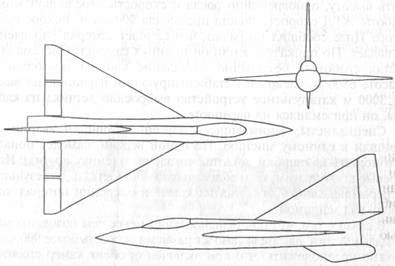
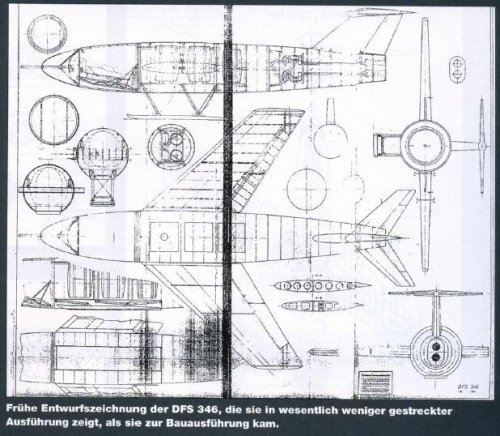
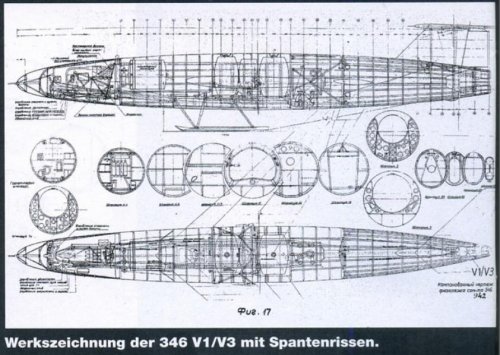
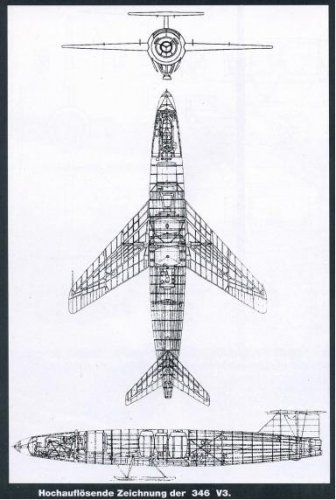
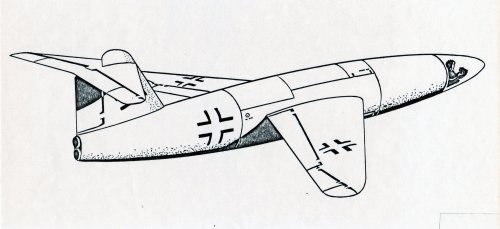
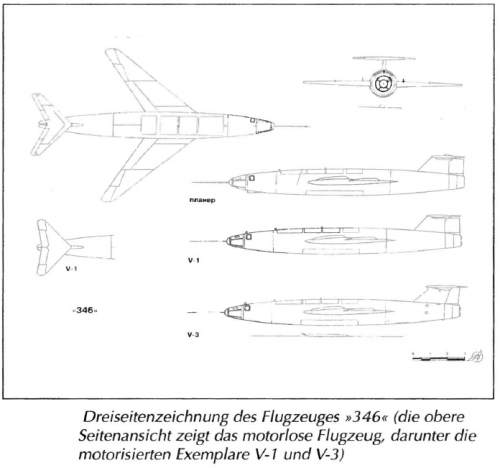
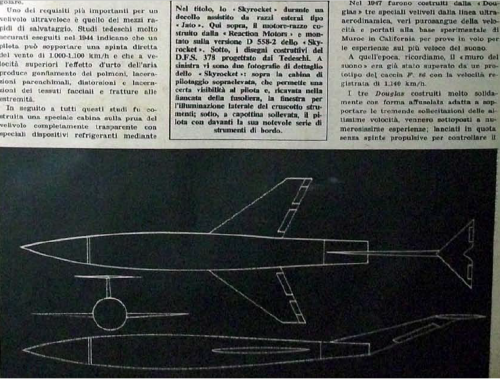
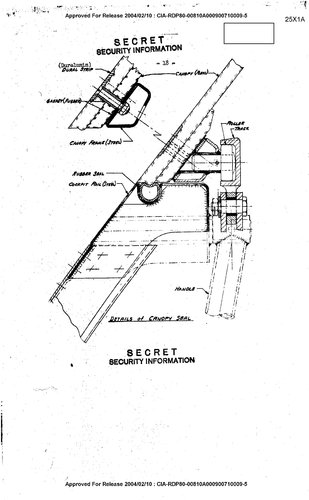
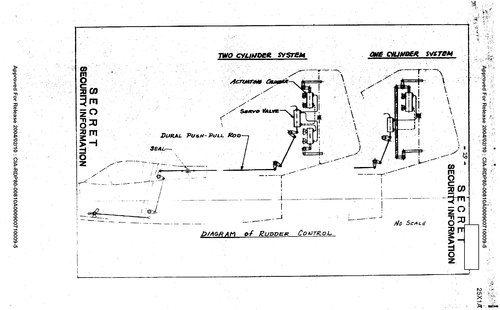
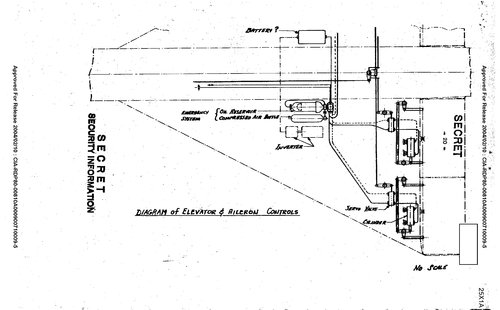
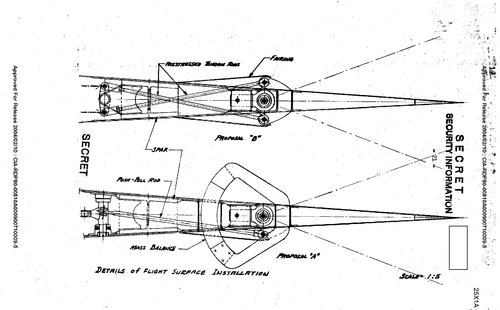
The basic DFS 346 configuration had cigar shaped fuselage, with pressurized cabin, prone pilot and landing skid, mid wing with 45-degrees swept, 9.2/7.5 per cent thickness and T-tail plane.
The DFS 346 (V1) was a glider with water ballast, the DFS 346 (V2) was to be powered by one HWK 109-509 C-1 dual chamber rocket motor with 2,000 kg + 400 kg thrust, the DFS 346 (V3) was powered by two throttleable HWK 109-509 B-1 superimposed rocket motors with 2,000 kg peak thrust each.
The V2 was designed to reach 1,250 mph (Mach 1.9) at 66,000 ft. (20,120 m) and the V3 was designed to reach 1,718 mph (Mach 2.65) at 114,830 ft. (35,000 m).
To save propellants, the DFS 346 (V2) was carried aloft atop a Dornier Do 217 or one Heinkel He 274 modified bombers, prior to launch at 32,800 ft. (10,000 m).
Siebel/DFS 346 (V2) technical data
Type: transonic research rocket-airplane, wingspan: 29.2 ft. (8.9 m), length (without nose probe): 38.9 ft. (11.85 m), height: 11.86 ft. (3.53 m), wing area: 221 sq. ft. (19.86 sq. m), maximum launch weight (V1): 4,812 lbs (2,180 kg), maximum launch weight (V2): 11,611 lbs (5,260 kg), range: 31 miles (50 km).
Siebel/DFS 346 (V3) technical data
Type: supersonic research rocket-airplane, wingspan: 29.5 ft. (9 m), length (without nose probe): 44 ft. (13.45 m), height: 9.7 ft. (2.97 m), wing area: 222 sq. ft. (20 sq. m), maximum launch weight: 15,232 lbs (6,900 kg).
When US troops seized the Siebel-Halle facilities in April 1945 they found the
Mach-Projekt DFS 346 V1 prototype under construction.
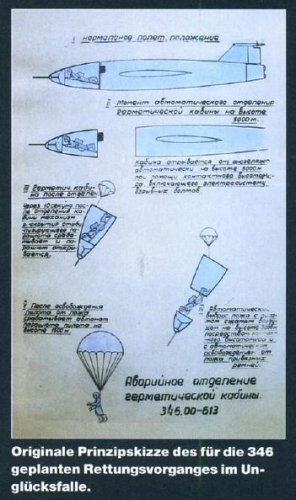
It was built throughout Duralumin alloy with 45-degrees swept back wings, T-tail plane and ejection nose cockpit.
In July 1945 the Siebel factory was transferred to Soviet control and moved entirely by train to the USSR, along with technical crews, to complete the DFS 346 development.
When US troops seized the Siebel-Halle facilities in April 1945 they found the
Mach-Projekt DFS 346 V1 prototype under construction.
It was built throughout Duralumin alloy with 45-degree swept back wings, T-tail plane and ejection nose cockpit.
In July 1945 the Siebel factory was transferred to Soviet control and moved entirely by train to the USSR, along with technical crews, to complete the DFS 346 development.
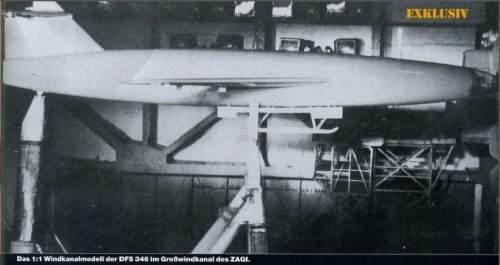
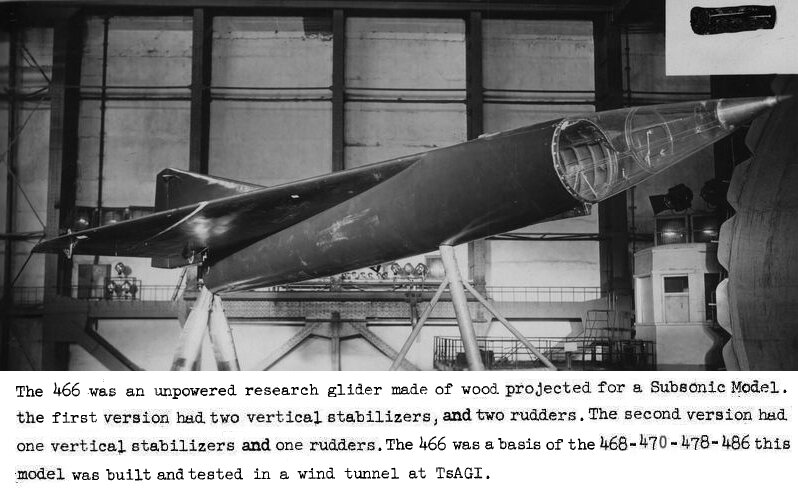
On October 22, 1946, the project was moved at Podberezhye, under the OKB-2 codename, and the prototype was completed. In autumn 1946 it was transferred to TsAGI and used for wind tunnel tests.
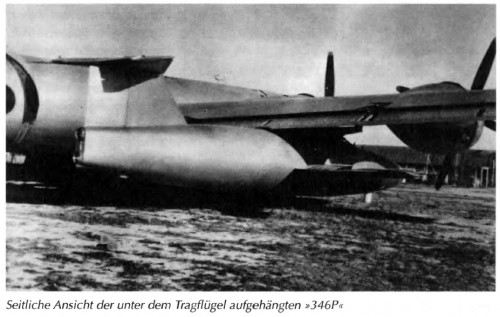
One glider prototype named DFS 346 P (Planer) was completed in 1947 incorporating several modifications suggested by the TsAGI: The fuselage was lengthened by 1.6 m, the moving top of the tailfin was removed, the wing tips were modified, and wing fences were installed to delay the rearwards migration of the center of pressure during the transonic acceleration.
Although not outfitted with the rocket motor, water ballast was added to simulate the weight of the propellants.
The prototype was successfully flown in several slow-speed gliding tests which led to the construction of three rocket-powered research airplanes.
DFS 346 P technical data
Wingspan: 29.52 ft. (9 m), length (without nose probe): 44 ft. (13.45 m), height: 11.6 ft. (3.54 m), wing surface: 211 sq. ft. (19.86 sq. m), launch weight: 4,812 lb (2,179 kg).
In the spring of 1947, the DFS 346 P was released at 30,500 ft. from under the starboard wing of the Boeing B-29-5-BW (42-6256)
Ramp Tramp that had been captured by the Soviets near Vladivostok on July 29, 1944.
During the War, the VVS only used 93 Petlyakov Pe-8 heavy bombers, but Stalin understood that in a future confrontation with the United States it would be necessary to use long-range strategic bombers and made formal request for Lend-Lease B-29s, without success.
The Tupolev OKB was tasked with developing its own comparable Tu-10, under the Project 64 codename, but in 1944 three Boeing B-29 bombers from 462 and 468 BG, based around Chengtu-China, were damaged by flak over Anshan, Omura and Kyushu. Their crews decided to divert to Vladivostok and the aircraft were interned by the Soviets. Early in 1945 a full-scale reverse-engineering program was started to produce B-29 copies powered by Soviet Shvetsov Ash-73 engines.
The first Tupolev Tu-4 strategic bomber was flown on May 19, 1947, and its existence was discovered that same year when an RB-29 spy plane on a reconnaissance mission overflew a Soviet airfield.
By 1952, 847 Soviet copies had been built.
Engine and propellers failures were encountered throughout the bomber service life.
On May 5, 1949, the DFS 346-1 prototype was completed, with a dummy engine installed.
It was flown, on September 30, launched from 32,000 ft. in glider configuration and damaged when landing at 193 mph (310 km/h).
The DFS 346-3 rocket powered research plane was completed by mid-1951.
Meanwhile the Junkers crews, who had worked on the OKB-1 at Uprawlentscheski Gorodok, had begun reconstructing one Walter HWK 109-509 C (called ZhRD-109-510 in the USSR) out of salvaged components.
On August 13, 1951, DFS 346-3 performed the first powered flight launched from 30,500 ft. over Lukovici airfield.
The two combustion chambers worked as expected and the prototype quickly accelerated reaching Mach 0.93.
During the second flight performed on September 14, flying at 590 mph and 39,360 ft, the airplane was not responding to the controls and the pilot ejected at 21,000 ft.
The crash of the prototype put an end to the program, after spending 55 million rubles.
DFS 346-3 technical data
Wingspan: 29.52 ft. (9 m), length (without nose probe): 44 ft. (13.45 m), height: 11.6 ft. (3.54 m), wing surface: 211 sq. ft. (19.86 sq. m), launch weight: 11,611 lb (5,260 kg).
In late 1946 TsAGI theorists concluded that, with the Jumo 004 turbojets available at the time, it would be necessary to use wings with 45 degrees swept to reach Mach 1, but the T-106 wind tunnel only allowed to test the new designs up to Mach 0.9.