TSR2: Britain's Lost Cold War Strike Aircraft: Revised and Updated Edition
https://www.amazon.com/TSR2-Britain..._n_publication_date:1250228011&s=books&sr=1-3


As much as I'm looking forward to this book, I feel like the overall production quality of Naval Institute Press titles has taken an absolute nosedive over the last decade, especially when compared with what Seaforth has been pumping out recently. I've owned the reprint edition of his US Battleships, Cruisers, and Submarines since 1945 design histories, and they all look worse than the original editions, and no attempt was made to incorporate the new data organically in the revised edition of the submarine book.Norman Friedman's forthcoming book Cold War Anti-Submarine Warfare is now shown on the Naval Institute Press website, with a publication date of mid-August 2025; see < https://www.usni.org/press/books/cold-war-anti-submarine-warfare >.

Cover shot:.
Book listed on Amazon.co,uk ;
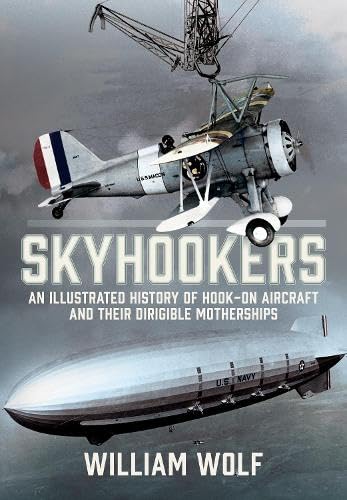
Skyhookers: An Illustrated History of Hook-on Aircraft and Their Dirigible Motherships
Hardcover
– 30 Sept. 2025
by William Wolf (Author)
https://www.amazon.co.uk/Skyhookers...p_27:William+Wolf&s=books&sr=1-1&unfiltered=1
From the First World War's Zeppelins to the Second World War's large bombers, military aircraft were vulnerable to fast, manoeuvrable interceptors. To address this, fighter escorts were used, but their limited range often left bombers exposed. A solution was the use of Composite aircraft, where larger bombers carried smaller, short-range fighters, which could be launched and retrieved as needed. Zeppelins, particularly vulnerable to interceptors, were ideal for this concept. During the First World War, Germany briefly experimented with carrying parasite aircraft, while the British conducted post-war trials using airships like His Majesty’s Airship R-23 and R-33, carrying fighters such as the Sopwith Camel and de Havilland DH.53 Humming Bird. However, successful hook-on/retrievals were only achieved with the Humming Bird. The US Navy and Army further developed this concept. In 1918, the Navy launched a Curtiss JN ‘Jenny’ from a C-1 Blimp, and in 1924, the Army successfully flew a Sperry Messenger from a TC-Class airship. The US perfected the carry/launch/retrieval method for airship defence and scouting, notably with the USS Los Angeles, which carried aircraft on a ‘trapeze’ device. The Akron and Macon airships, with internal storage for aircraft, further advanced this technique, making them some of the most remarkable aircraft of their time.
Cover shot:.
Book listed on Amazon.co,uk ;
Hitler's and Hirohito's 'Kamikaze' Flying Bombs: The Axis’ Manned Suicide Attack Aircraft of WW2
Hardcover
– 30 July 2025
by William Wolf (Author)
https://www.amazon.co.uk/Hitlers-Hi...p_27:William+Wolf&s=books&sr=1-2&unfiltered=1
On 1 April 1945, US troops launched the largest amphibious assault of the Pacific War on the heavily-defended island of Okinawa. Supporting the invasion, the USS West Virginia participated in the bombardment of entrenched Japanese defenders. That evening, a Japanese aircraft launched a Yokosuka MXY-7 Ohka, a rocket-powered kamikaze plane. West Virginia was hit by an Ohka, becoming the first ship damaged by such a weapon. Twelve days later, the USS Mannert L. Able became the first ship sunk by an Ohka. The deployment of the Ohka was a desperate measure by Japan as the war turned against them. This manned flying bomb evolved from earlier kamikaze tactics. However, the Germans had also considered similar weapons. As early as 1944, figures close to Hitler, such as Otto Skorzeny and Hanna Reitsch, advocated for kamikaze missions. Hitler authorized the creation of the Leonidas Staffel to prepare for these attacks, leading to the development of the Messerschmitt Me 328 and Fieseler Fi 103R, also known as the Reichenberg. Though the Fi 103R began production in October 1944, the changing dynamics of the war rendered it obsolete by the time it was ready for use. The project was formally abandoned in March 1945. This book details the development of both the Ohka and Reichenberg.


Gotta pay for that AI training somehow.£35.00 from Crecy....£100.00 frm Amazon.......give or take a penny.
I am more than disappointed by this author in all of his earlier publications. A lot of stuff simply copied from manuals and very little, if any, new research making its way to the pages of the book. I'll wait 'til I see a copy and decide then if it is worth.Cover shot:

Looking forward to this one.

Justo Miranda already has a book about the subject. See post #62 from this threadCover shot:
I'm seeing $48.38 on Amazon US....£35.00 from Crecy....£100.00 from Amazon.......give or take a penny.
Another book by forum member @Hood. Looks good.https://www.crecy.co.uk/wings-over-the-fleet?osCsid=6893e87guc3odffe09vb3nv4l1
Available from July 2025
"All the major types are covered, from all-weather fighters, interceptors, strike aircraft, anti-submarine helicopters and airborne early warning aircraft.
as are many design studies and proposals that remained on the drawing board. Guided missiles during the post-war period and the evolution of the Royal Navy's aircraft carriers and the new technologies required to operate jet aircraft from ships are also analysed."
Promising...
Seaforth is an imprint of Pen & Sword.
Blurb was wrong. Originally it was a single volume, now it is to be two of them. So in this volume you get the story to the end of WW II; there will be a second volume on the story since.
These are primarily about the carriers, but they have to take into account the impact of the aircraft. For example, the RN felt compelled to modernize carriers (they wanted more than Victorious) because based on what was being developed, by 1952 surviving WW 2 carriers would have been unable to operate current aircraft. There is no way to divorce the development of STOVL carriers from that of STOVL aircraft -- and so on. And of course it is impossible to talk about the carriers without the developments which made them jet-capable and then VSTOL-capable. Nor is it possible to divorce either the aircraft or the carriers from perceived RN missions and threats.
Skyhookers: An Illustrated History of Hook-on Aircraft and Their Dirigible Motherships
Cover shot:
Looking forward to this one.
I am more than disappointed by this author in all of his earlier publications. A lot of stuff simply copied from manuals and very little, if any, new research making its way to the pages of the book. I'll wait 'til I see a copy and decide then if it is worth.
As much as I'm looking forward to this book, I feel like the overall production quality of Naval Institute Press titles has taken an absolute nosedive over the last decade, especially when compared with what Seaforth has been pumping out recently. I've owned the reprint edition of his US Battleships, Cruisers, and Submarines since 1945 design histories, and they all look worse than the original editions, and no attempt was made to incorporate the new data organically in the revised edition of the submarine book.
I'm sure it'll be an absolute goldmine, and while I've bought most of Friedman's books the same month they were published, I'm having a hard time justifying spending $125 (or even $75...) on something printed by a publisher who clearly doesn't care anymore.

Well, it won't be May 2025!.
I hope this hasn't been listed before ;
Hawker Siddeley HS.801 Nimrod: Outstanding in the Role
Hardcover
– 31 May 2025
by Chris Gibson (Author)
https://www.amazon.co.uk/Hawker-Sid...books&sr=1-85&unfiltered=1&xpid=2JMkmPkjKldlx
.
A potentially interesting subject, especially to airship fans like me; thanks for the notice. But I am unfamiliar with this author William Wolf, and Mark, your message worries me. Like you, I think I will wait to see what readers think of it after this book's publication, before making a decision.
Another £99.99 one from Amazon....I sense a pattern here..
I hope this hasn't been listed before ;
Hawker Siddeley HS.801 Nimrod: Outstanding in the Role
Hardcover
– 31 May 2025
by Chris Gibson (Author)
https://www.amazon.co.uk/Hawker-Sid...books&sr=1-85&unfiltered=1&xpid=2JMkmPkjKldlx
.
Very excited for this book - it's a good year for those of us interested in the FAA!Wings Over the Fleet is very similar to other titles within the Hikoki Since 1945 series with thematic chapters in a broadly chronological order. It starts with the Vampire jet trials, moving on the Sea Hawk and Attacker (I'm not covering the late war piston aircraft, Tony Buttler's Propeller Twilight should cover your needs for sleek, powerful piston jobs). Then the experiments with rubber decks, angled decks and steam catapults before examining the day fighters, all-weather fighters, strike aircraft, ASW, helicopters, Commando helicopters, AEW, V/STOL and all the way to the current day. It obviously covers aircraft carrier technologies etc. to put the aircraft into their context and at its heart it is a projects book as well as looking at the in service types. But its not an operational history - you won't find detailed accounts of Shar combats over the Falklands for example. There is a good deal of procurement politics involved and it covers a lot of ground as the RN carrier fleet fluctuates in size over the post-war decades. It doesn't dwell too heavily on wider defence politics, this is an aircraft book after all. It offers basic info on carrier studies etc., but again this isn't a naval reference book. Hobbs and others have covered this area and Friedman's forthcoming two-volume set will (hopefully) be a fairly definitive work on the subject (British Carrier Aviation being long overdue a refresh).

Many thanks.Very excited for this book - it's a good year for those of us interested in the FAA!
Do you expect to be able to cover the development of the support roles (i.e. photographic reconnaissance, in-flight refuelling, electronic warfare, COD, target towing, etc.) at all, or will it purely focus on the front line ones? Most of those roles seem to have received a fair bit of investment from the RN over the years, but I've yet to see them get more than a passing mention in any book - it would be great to finally get to hear some of the story behind them!

Thanks for the reply - sounds like the book will be as thorough as is viable at present then. I'll look forward to it!The RN was very adept at electronic warfare in various forms (especially passive listening), not enough has really come up in the archives for me to give a through examination; I've talked to another researcher and author in this area and even he has very little material on the RN's aerial EW activities.
It will focus mainly on the main frontline roles, with a detailed look at AEW, ASW and amphibious helicopter assault as separate roles. Recon kit is looked at where relevant, the buddy Scimitar tankers for Bucc S.1 are covered. The ECM and COD conversions are covered in the text, but not in any depth (ECM training and FRADU were part of Teach for the Sky), so still passing mentions sadly given the space available and the lack of detail to really flesh out chapters on some of these subjects.
The RN was very adept at electronic warfare in various forms (especially passive listening), not enough has really come up in the archives for me to give a through examination; I've talked to another researcher and author in this area and even he has very little material on the RN's aerial EW activities.
Pre-Ordered all ready Hood, I cannot wait.
Thanks for the reply - sounds like the book will be as thorough as is viable at present then. I'll look forward to it!
I wonder if more material on EW will become available in the archives in future, or if it's lurking somewhere else?

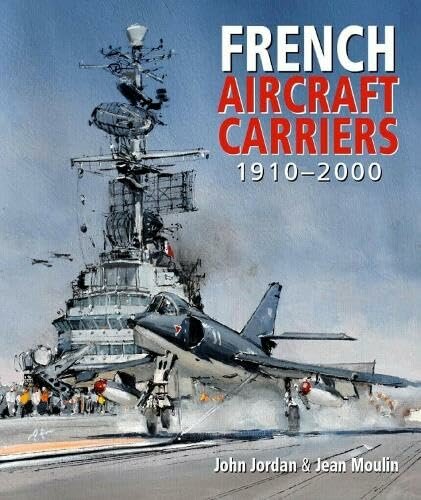
French carrier aviation traces its origins to the Foudre, a highly original ship initially designed to carry torpedo boats into action but later converted into a seaplane carrier. During the First World War this was supplemented by a number of merchant ships requisitioned to support aircraft and the former sloop Bapaume became the first French ship to launch wheeled aircraft while underway. The Washington Treaty of 1922 prevented the completion of traditional capital ships, so France, like the other major naval powers, decided to convert an incomplete battleship, the Béarn, to an experimental carrier. Between 1929 and 1936 there were fifteen ‘paper designs’, all covered in this book, but the only aviation ship added to the inter-war French navy was the highly unusual Commandant Teste, whose tactical rationale and service history is explored at length. France’s first purpose-designed carriers, Joffre and Painlevé were ordered just before the outbreak of the Second World War but the Armistice of 1940 meant that neither was ever completed. Some design work continued during the war, which culminated in the projected PA28 Clemenceau of 1948, but the ship proved too expensive and was cancelled in 1949. Instead, France acquired four second-hand ships from Britain and the USA which, as Dixmude, Arromanches, Lafayette and Bois Belleau, played a significant role in the postwar conflict in French Indochina. After budgeting and planning delays, the Marine National finally obtained its first modern indigenously built carriers with Clemenceau (1961) and Foch (1963). These important ships enjoyed long and successful careers, and their evolution and service histories form a major focus of this book. The final chapters cover developments up to the nuclear-powered Charles de Gaulle and an epilogue looks at the French Navy’s plans for future naval aviation, making this a complete history from the earliest days to the present.
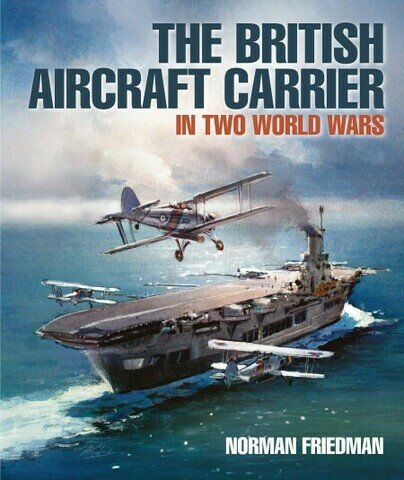
The Royal Navy invented the aircraft carrier and most of the key innovations which have enabled carriers to remain effective, exploiting continuing changes in aircraft technology, from biplanes to supersonic jets. This work, in two volumes, tells (and explains) how that happened over more than a century of British carrier development, based largely on declassified official documents, both British and US.
Major themes include British domination of the early years of carrier development, and the audacious and highly original plans for their use during World War I, which inspired later naval thinking on the potential of carrier aviation. The introduction of armoured flight decks in the 1930s was only the first of a sequence of British innovations, the most important of which made it possible for carriers to operate jet aircraft (the angled deck, the steam catapult, and the mirror landing sight). These British developments, particularly the steam catapult, were crucial to the survival of the US carrier force in the postwar era, to an extent often forgotten, and covered in the next volume (subtitled 'in the Cold War Era and Beyond' is to be published June 2025.)
This book covers all British-built carriers, including those in Commonwealth and foreign service, with the historical context, both operational and technical, explained in detail, as is the connection to larger British national concerns. The book is heavily illustrated with photographs, but also reproduces official plans from the National Maritime Museum, many of which have never previously been published.
Japanese Aircraft Carriers: 1920 - 1945 -
Hardcover – 30 Sept. 2025
ISBN: 9781800352971
Binding: Hardback
Dimensions: 280mm x 216mm
Pages: 280
Photos/Illus: Over 150 photographs
Finally to be available on Amazon.com as of 31 March 2024! (Also applies to "Wings of Argentina".)
Two interesting books gatoraptor.
Also slipped to 31 May.
A couple of new books in Crecy's Hikoki range coming up this year:
Wings of Argentina by Santiago Rivas and Fernando Benedetto due in June
Finally to be available on Amazon.com as of 31 March 2024! (Also applies to "Wings of Argentina".)
Wings of Argentina: Argentina's Aircraft Industry Since 1927