Nuclear accidents worldwide - INES scale| Statista
The nuclear accident that occurred in Fukushima in 2011 received a score of seven on the INES scale, and was thus rated as a major accident.
No VVR reactor affected
![]()
Nuclear accidents worldwide - INES scale| Statista
The nuclear accident that occurred in Fukushima in 2011 received a score of seven on the INES scale, and was thus rated as a major accident.www.statista.com
No VVR reactor affected
Yes, that's a very good use case for a fast reactor.The thing with fast-reactors, Scott, is that they can be used to burnup transuranic* waste from spent fuel-rods along with pesky long-lived fission products greatly simplifying the handling and disposal of them also the refuelling intervals are longer for fast-reactors making more efficient use of their fuel.
*Except for Plutonium as that is useful as reactor-fuel.
You can make a pretty big reactor that runs at full power on natural circulation. 1970s math got you ~160MWt in the Ohio class, though I don't think you'd get above about 50% of that. IIRC the Seawolf reactor 10 years later got more power than the Ohios before you needed to start the cooling pumps. The big A1Bs out of the Ford class are supposedly all NC, even at full power, and they're ~700MWt.P.S.: Nuescale is a conventional light water reactor which is built so small, that natural convection can be used instead of water pumps. Other than that, it works exactly as any other light water reactor.
That and the 40 year cores was a very big push in the Columbia and Ford plants.Intresting, didn't know that other LWR reactors have been built without cooling pumps
Generally a powerplant would not be offline for weeks/months like a ship would be while in refit, no.The freezing of a lead reactor is surly a bigger issue in a sub than in a powerplant. So bigger the reactor so larger is the decay heat to surface ratio.
Despite this, I also believe that the hughe mass of lead can store a large amount of decay heat without boiling or building up pressure. So far, it is said, that in fact all the decay heat can be adsobed until we have a equilibrium with the heat flow to the enviroment.
Oh, heck no.In addition to Bismuth/Lead alloy cooling there's also Potassium/Sodium liquid cooling and that has a significantly lower freezing point.
I don't mean working inside the reactor vessel where the fuel is.I doubt, that working inside a reactor vessel has ever been concidered as normal for civil reactors. I remember, how much effort it was for India to replace a valve of a BWR with a robotic arm (in the US, a similar reactor was decomissined because of the same problem). If people could have worked from the inside, it would shurly have been easier....
Molten Salt secondary? So what gets boiled to spin turbines?The natrium cooled BN 600 is in operation since about 40 years, and after having some teething issues with small fires, it worked flawlessly over the past 20or 30 years. Natrium prevents corrosion by the way, because it consumes all the oxygen so that the vessel and pipes will never corrode on the inside (for Youtuber, Natrium and NaCl is the same....).
As said, Terra power uses molten salt for the second loop and heat storage, a clever approach to eliminate any danger of Natrium getting in Contact withwater.r
I doubt, that working inside a reactor vessel has ever been concidered as normal for civil reactors.
All natrium cooled reactors have three loops for safety reasons usually two natrium loops and the final steam loop. The middle loop is here replaced with molten salt.I don't mean working inside the reactor vessel where the fuel is.
I mean inside the room/building that holds the reactor vessel and the steam generators, pressurizer, reactor cooling pumps, etc. The entire Primary loop.
Molten Salt secondary? So what gets boiled to spin turbines?
Ah, that makes more sense.All natrium cooled reactors have three loops for safety reasons usually two natrium loops and the final steam loop. The middle loop is here replaced with molten salt.
There's still a 500degF/250degC reactor vessel dumping heat into the room.There is no issue beeing in the same room like the reaktor, in case of lead, I would expect the radioactivity to be very low.
The problem though with Lead/Bismuth cooling (It's a eutectic alloy with a significantly lower MP than Lead or Bismuth on their own) is that the Bismuth (Specifically Bi-209) is turned into Bi-210 by neutron-activation and that decays into Po-210 (Which in turn decays into Pb-26 by alpha-particle emission).
I feel much safer with lead or salt as coolant. Both don't require pressurisation and can adsorb a lot of heat before boiling.IIRC you can't use water (Light or heavy) as a coolant for fast reactors as Hydrogen (Or Deuterium) thermalises the neutron-flux in the reactor's core.
The difference is that the PWR cools a lot quicker. ~50,000lbs of water in the primary versus ~550,000lbs of lead.@Scott Kenny PWR reactor are operating at similar temperatures with people beeing in the room regulary.
Pump motors might be replaceable without getting into the primary containment building, depends on how it was built.In an ideal world, there are not many reasons to shut down a metal cooled fast reactor. Shure, you sometimes have to check something or replace something, but these are (to my knowledge) all designed for continous operation without having to stop for refuling. I'm quite sure, that moving components like Natriumpumps can be replaced from the outside without opening the reactor.
Anglesey was where the aluminum smelting facility was located and reason why it was high on the list for a nuclear power station.Three RR SMR's to begin construction at Wylfa next year at a cost of £2.5bn, the site has capacity for 8.
![]()
Anglesey chosen as site for UK's first small nuclear power station
Work on the site is due to start in 2026, and is expected to support 3,000 jobs in the local economy at the height of construction.news.sky.com
Aluminum smelting takes so much electrical power that they relocate the factory to wherever the cheapest electricity is. For a long time, that was the Columbia River gorge and all the hydroelectric power there.Anglesey was where the aluminum smelting facility was located and reason why it was high on the list for a nuclear power station.
I think the facility might still be there but was shut down years ago.
But this might be the signal for it's resurrection.
Edited in correction.
Just checked Wikipedia and it seems the aluminium smelter has been completely removed.
Just awful and stupid.
Pump motors might be replaceable without getting into the primary containment building, depends on how it was built.
But replacing the actual pump means getting into the reactor compartment, since the primary loop has to stay inside the primary containment building.
Why? Reusing the same facility means, the grid connection is allready there and all the geological examinations have allready been done. There might even been some remaining of nuclear industry around.Anglesey was where the aluminum smelting facility was located and reason why it was high on the list for a nuclear power station.
I think the facility might still be there but was shut down years ago.
But this might be the signal for it's resurrection.
Edited in correction.
Just checked Wikipedia and it seems the aluminium smelter has been completely removed.
Just awful and stupid.
You'd still need to cut or unbolt the primary loop to remove the pump. And when you installed the new pump you'd need to do something to burp the air out of the pump...The pumps are usually in vertical position with the electric part on the top (outside of the reactor and the shaft with it's sealing leading vertically downwards). There pumps can be pulled out vertically by a crane (there is always a crane on the roof in any commercial reactor). When this pumps are removed, only a relative small circular cross section will be temporarily opened towards the reactor. This might somehow be secured with inert gases to prevent the Na coming into contact with the air before closing it.
It might be, that there are internally some closing devices in the reactor to shut the opening before the pumps are completely pulled out (with the shaft sealing still functioning).
The stupid part was scrapping the smelter entirely.Why? Reusing the same facility means, the grid connection is allready there and all the geological examinations have allready been done. There might even been some remaining of nuclear industry around.
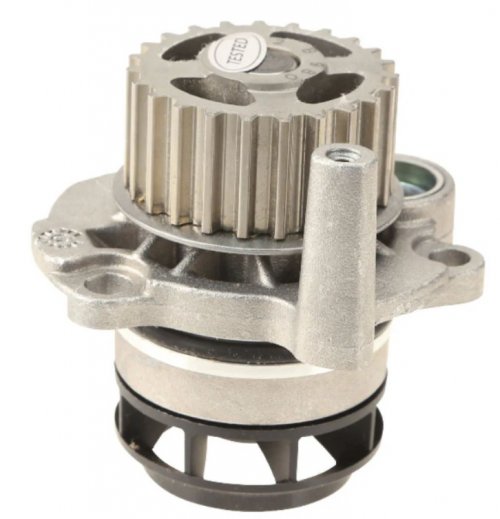
No, everything can (and probably will be) done with sealings gliding into the shaft housing. You just have to unlock the flange on the very top and than you can pull the pumps out. I guess, water cooled reactors have a similar arrangement. Take a look at the water pumps from Volkswagen vehicles, you can also replace them without loosening a hose. I think, even the heat exchanger can be lifted out in the same way (pool type natrium cooled reactor)You'd still need to cut or unbolt the primary loop to remove the pump. And when you installed the new pump you'd need to do something to burp the air out of the pump...
Molten salt reactors do the same thing, the reaction stops when they get to hot.
For Na cooled (I guess the same is true foe lead cooled reactors) a similar safety behavior is not inherent, but can be archieved by design:
'
You have any indications for that beeing a problem? The BN600 is operating for 40 years and I never heard of specific problems in respect to stability and power regulatiin.Appreciate the article, but you miss the point. Said article talks to the void effect during accident scenario, whereas what I am referring to is stability during operation. Emergency response is important, but operational factors are also important. This is one of those things that is generally missed by media hype and folks who get their news from popular mechanics. Light water works very very well in a number of ways, and one of the key factors in reactor safety is simplicity and reliability.