Shuttle / Buran Autonomous flight option discussion

Byeman

ACCESS: Top Secret
Senior Member
Joined
8 January 2010
Messages
3,289
Reaction score
2,772
Really enjoyed reading through this! it's always fascinating to revisit how ahead of its time the program was. The fact that Buran pulled off a fully autonomous mission with such precision in 1988 is still impressive today IMO. It wasn’t just a Shuttle clone; the level of automation and systems integration
Not really. The shuttle could have done similar. But much like Apollo vs Soyuz, the US preferred to have the crew more in the loop. For example, post Columbia all that was needed was for a cable to be installed and a Shuttle orbiter could undock from the ISS and remotely reenter and land.

The Buran landing was done with open loop guidance. They ran many simulations of the entry profile and even configured a MIG-25 to fly approaches to model the trajectory and then programmed the vehicle to fly it.
 
Not really. The shuttle could have done similar. But much like Apollo vs Soyuz, the US preferred to have the crew more in the loop. For example, post Columbia all that was needed was for a cable to be installed and a Shuttle orbiter could undock from the ISS and remotely reenter and land.
Don't tell me fairy tales - the shuttle was fundamentally unable to fly without a crew and perform a fully automatic landing, including a run along the runway to a stop
 
Don't tell me fairy tales - the shuttle was fundamentally unable to fly without a crew and perform a fully automatic landing, including a run along the runway to a stop

And it was intentionally designed that way too.
 
And it was intentionally designed that way too.
Nonsense—the shuttle couldn't perform a fully automated, unmanned spaceflight. An automated, unmanned flight, including an automated landing, requires a different architecture (the degree of integration of all onboard systems) and control system algorithms.
During the Buran automatic landing testing process, more than 150 landings were performed using the Tu-154 testbed aircraft and the BTS-02 OK-GLI aircraft. Please answer the question: how many unmanned landings were performed, on which aircraft, where, and when, to practice the shuttle's automatic landing?
 
Nonsense—the shuttle couldn't perform a fully automated, unmanned spaceflight. An automated, unmanned flight, including an automated landing, requires a different architecture (the degree of integration of all onboard systems) and control system algorithms.
Wrong. The Shuttle had capability, it just was not chosen.
 
Don't tell me fairy tales - the shuttle was fundamentally unable to fly without a crew and perform a fully automatic landing, including a run along the runway to a stop
How would you know?
 
How would you know?
Because it's a fact. You cannot prove to me that the shuttle could land automatically without the crew's involvement. And not because it has never been done in any of the 130 flights. But because the automatic landing system is first developed, then tested, including in flights. After that, several certified, fully automatic landings are performed (there were 8 for BTS-0.02 OK-GLI), following which a written conclusion is issued on the possibility of using automatic landing - a document confirming/authorising automatic landing. The USSR needed two years, several simulators, 23 versions of software and 150 flights on laboratory aircraft to achieve this.

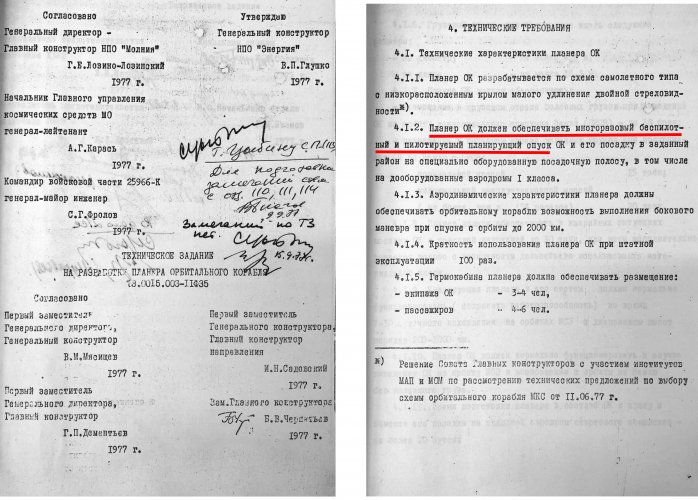
In order for the shuttle to perform an automatic landing, this requirement had to be included at the very beginning of development (as with the Buran, see the 1977 document) — the shuttle did not have this.
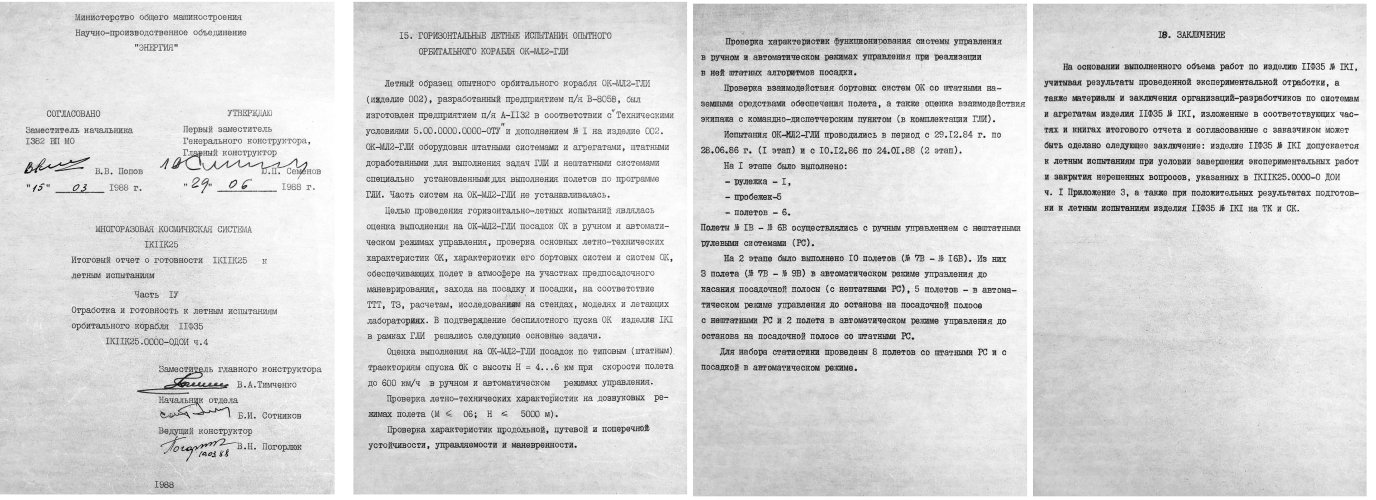
In addition, permission to perform such a landing is required based on the results of tests (as with Buran, see the 1988 document) — the shuttle does not have this.
You will never be able to confirm your words with documents about the shuttle, because they do not exist.
11f35-PlanerTZ77-6.jpg 1l-11F35-FRR290688-1.jpg
 
Last edited:
Because it's a fact. You cannot prove to me that the shuttle could land automatically without the crew's involvement. And not because it has never been done in any of the 130 flights. But because the automatic landing system is first developed, then tested, including in flights. After that, several certified, fully automatic landings are performed (there were 8 for BTS-0.02 OK-GLI), following which a written conclusion is issued on the possibility of using automatic landing - a document confirming/authorising automatic landing. The USSR needed two years, several simulators, 23 versions of software and 150 flights on laboratory aircraft to achieve this.

In order for the shuttle to perform an automatic landing, this requirement had to be included at the very beginning of development (as with the Buran, see the 1977 document) — the shuttle did not have this.
In addition, permission to perform such a landing is required based on the results of tests (as with Buran, see the 1988 document) — the shuttle does not have this.
You will never be able to confirm your words with documents about the shuttle, because they do not exist.
 

Attachments

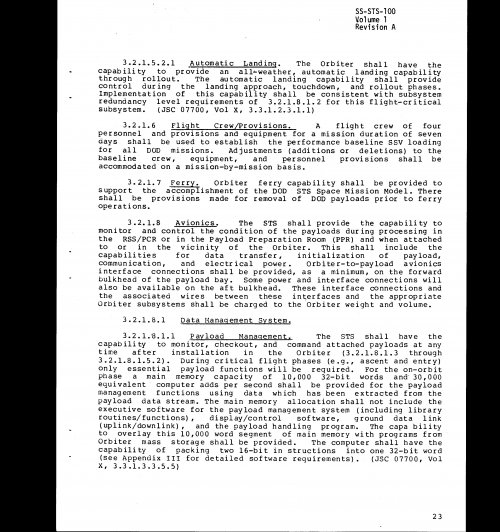
  • Pages from SS-STS-100.jpg
    Pages from SS-STS-100.jpg
    1.5 MB · Views: 26
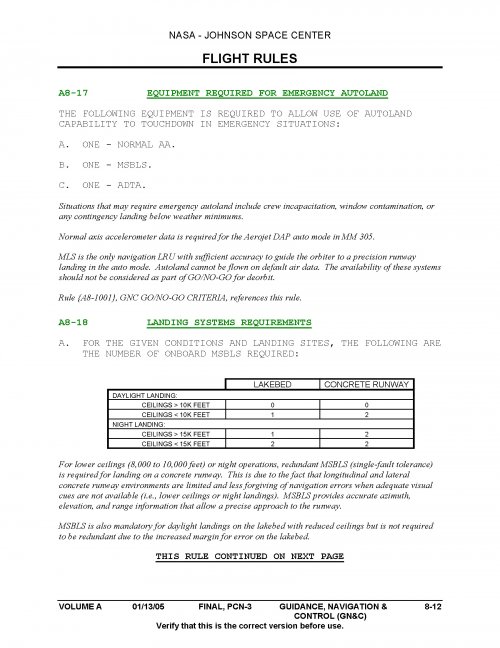
  • Pages from Space-Shuttle-Flight-Rules-PCN-8.jpg
    Pages from Space-Shuttle-Flight-Rules-PCN-8.jpg
    584.7 KB · Views: 21
  • NASA Lessons Learned- Space Shuttle Automatic Landing Capabilities # 0194 - SpaceRef.jpeg
    NASA Lessons Learned- Space Shuttle Automatic Landing Capabilities # 0194 - SpaceRef.jpeg
    768.5 KB · Views: 33
But because the automatic landing system is first developed, then tested, including in flights. After that, several certified, fully automatic landings are performed (there were 8 for BTS-0.02 OK-GLI), following which a written conclusion is issued on the possibility of using automatic landing - a document confirming/authorising automatic landing. The USSR needed two years, several simulators, 23 versions of software and 150 flights on laboratory aircraft to achieve this.
No, it really doesn't take that much work.
 

Attachments

  • unnamed.jpg
    unnamed.jpg
    23.5 KB · Views: 29
No, it really doesn't take that much work.
Not for manned launch and not in the 1980s.
It's no coincidence that Boeing offered to buy an automatic landing system for its products from the USSR.
Not for a manned launch and not in the 1980s.
It's no coincidence that Boeing offered to buy an automatic landing system for its products from the USSR.
Thanks for the materials – I'll take a close look.
 
Last edited:
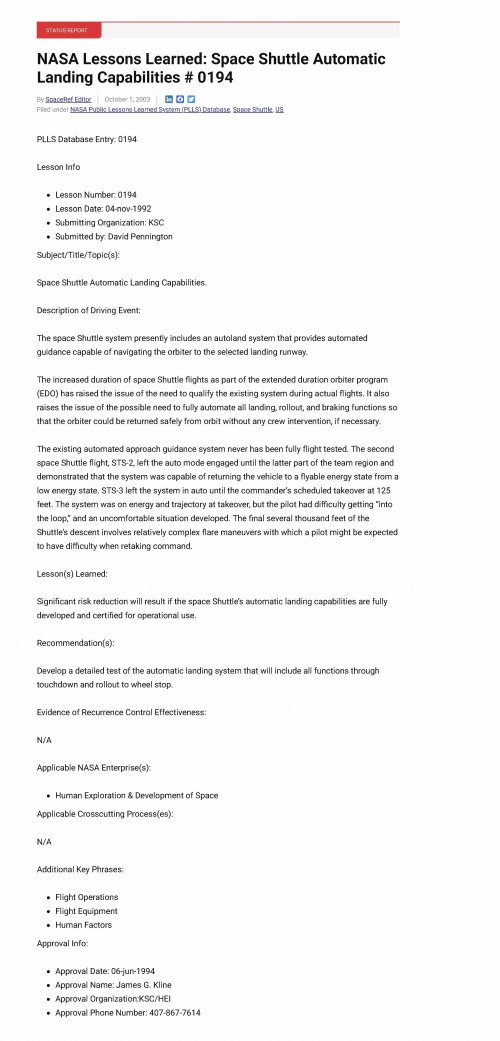
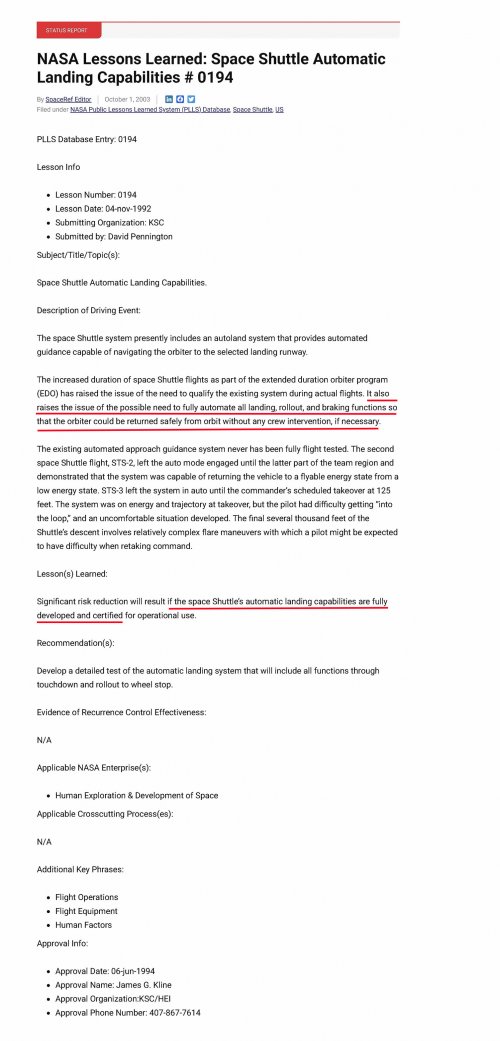
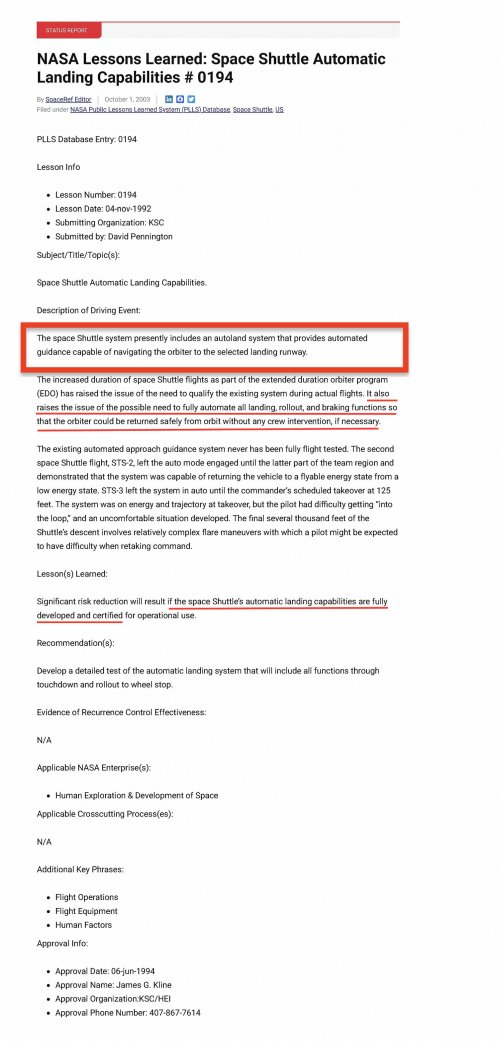
Your document confirms this: "The existing automated approach system has NEVER BEEN FULLY TESTED", - that's exactly what I'm saying: no completed/successful tests mean - no automatic landing. The shuttle couldn't land automatically because it didn't have a fully tested, fully functional automatic landing system..
Wrong.
You said: "An automated, unmanned flight, including an automated landing, requires a different architecture (the degree of integration of all onboard systems) and control system algorithms."
And
"Don't tell me fairy tales - the shuttle was fundamentally unable to fly without a crew and perform a fully automatic landing, including a run along the runway to a stop"

You said nothing about testing. This was about systems and software for automatic landing, which did exists and hence were an ability and capability. The fact it wasn't fully tested doesn't change things.
 
Last edited:
Here we go !

 
I don't have that habit.
I was shown a request to the NGO ‘Molniya’.

and
"Several leading global airlines wanted to buy our unique landing system at the time. Boeing offered us a lot of money for it", - Vyacheslav Filin, Deputy Chief Designer, Energia Rocket and Space Corporation, https://www.kommersant.ru/doc/208740
Boeing is not monolithic. Boeing airliner is not the same as Boeing space.
 
Inappropriate Language
Wrong.
You said: "An automated, unmanned flight, including an automated landing, requires a different architecture (the degree of integration of all onboard systems) and control system algorithms."
And
"Don't tell me fairy tales - the shuttle was fundamentally unable to fly without a crew and perform a fully automatic landing, including a run along the runway to a stop"

You said nothing about testing. This was about systems and software for automatic landing, which did exists and hence were an ability and capability. The fact it wasn't fully tested doesn't change things.
You did not read me carefully.
First, I asked you a question: ‘Please answer the question: how many unmanned landings were performed, on which aircraft, where, and when, to practise the shuttle's automatic landing?’ — because without successful tests, there is no functioning system.
Then I said that ‘In order for the shuttle to perform an automatic landing, ... permission to perform such a landing is required based on the results of tests (as with Buran, see the 1988 document) — the shuttle does not have this.’

The lack of tests changes everything, because the possibility of an unmanned landing is conditioned by the presence of a functioning automatic landing system, and its functionality is confirmed by flight tests, including qualifying flights, on the basis of which a conclusion is issued on the readiness of the system.
The shuttle did not have a functional automatic landing system, which means that automatic landing of the shuttle was impossible. It is pointless to talk about the existence/capabilities of a system that does not work.
The statement that all that was needed was to add one cable and the shuttle could land automatically is a fairy tale.
 
Last edited by a moderator:
You said nothing about testing. This was about systems and software for automatic landing, which did exists and hence were an ability and capability. The fact it wasn't fully tested doesn't change things.
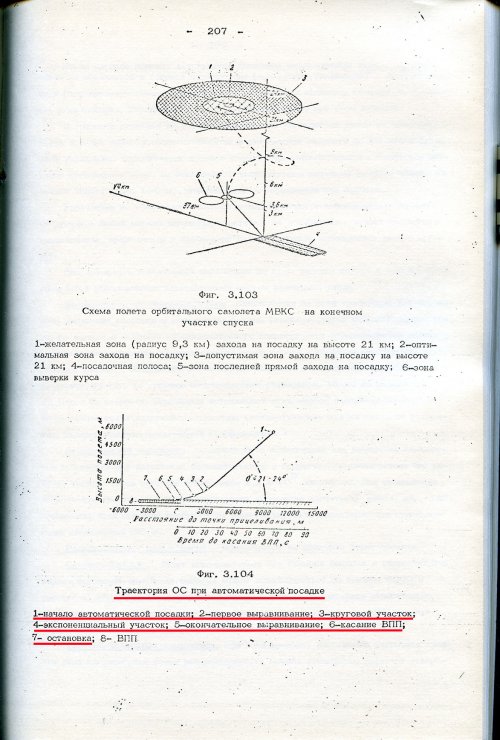
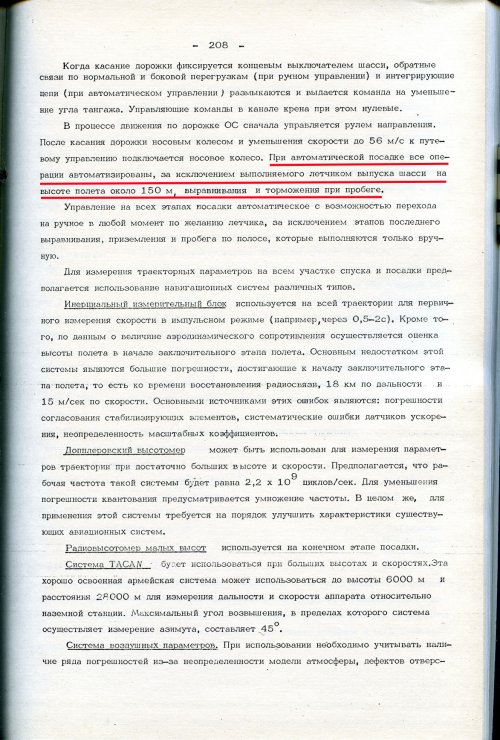
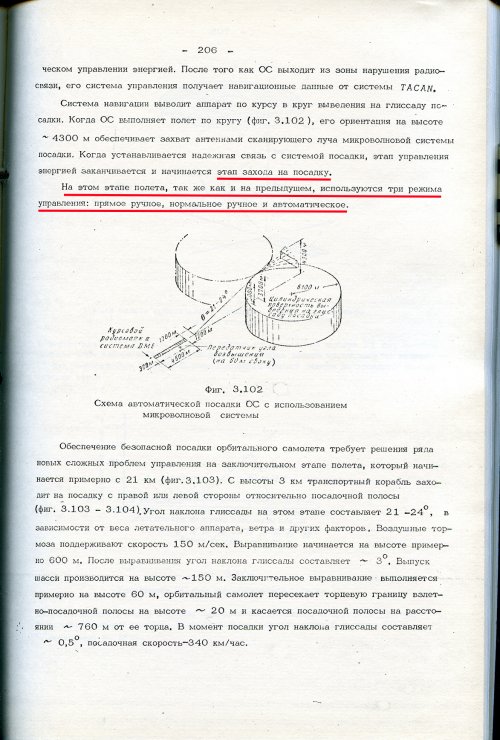
This is a secret 367-page document from TsAGI that has never been published anywhere.
Chapter: ‘Navigation, Guidance and Control System’.
Let's look at the section on control during the landing phase. I will translate the most important points:

Page 206:
Approach phase. During this phase of the flight, as in the previous one, three control modes are used: direct manual, normal manual and automatic.

Figure 3.104 on page 207:
Orbital aircraft trajectory during automatic landing. 1-start of automatic landing; 2-first levelling; 3-circular section; 4-exponential section; 5-final levelling; 6-touchdown; 7-stop.

Page 208:
During automatic landing, all operations are automated, except for the pilot's actions of lowering the landing gear at a flight altitude of about 150 m, levelling and braking during the run.

Conclusion: it is impossible to land the shuttle without crew involvement.
This is confirmed in your document, which refers to fully automatic landing as a possible future task: ‘It also raises the issue of the possible to fully automate landing, rollout, and braking function so that the orbiter could be returned safety from orbit without any crew intervention, if necessary.’
These are plans that have never been implemented: ‘...if the space Shuttle's automatic landing capabilities are fully developed and certified for operational use.’
207.jpg 208.jpg 206.jpg
NASA Lessons Learned- Space Shuttle Automatic Landing Capabilities # 0194 - SpaceRef.jpeg
 
Last edited by a moderator:
You did not read me carefully.
First, I asked you a question: ‘Please answer the question: how many unmanned landings were performed, on which aircraft, where, and when, to practise the shuttle's automatic landing?’ — because without successful tests, there is no functioning system.
Not true. Testing is not necessary for a capability to exist or for a system to be able to function.. Launch vehicles can fly successfully on their first launch and they don't have successful "test' flights. Just because they haven't flown doesn't mean they don't have the capability to fly.
The statement that all that was needed was to add one cable and the shuttle could land automatically is a fairy tale.
Wrong again.

I know what I know from many first hand sources.
a. I was in the Air Force Shuttle program office
b. I was on an Air Force study of the shuttle capability to meet Air Force requirements.
C. I received intel reports on Buran's development.
d. It isn't all that complex, the cable was ALL that was needed be added to allow the shuttle to land without crew. The rest of the software and systems were there. The shuttle flew every mission from deorbit to the landing area autonomously. The crew always took over at the heading alignment circle because they wanted to and not because they had to. Autoland could have finished the landing except for lowering the gear. Again my attachment.

.
 

Attachments

  • NASA Lessons Learned- Space Shuttle Automatic Landing Capabilities # 0194 - SpaceRef.jpeg
    NASA Lessons Learned- Space Shuttle Automatic Landing Capabilities # 0194 - SpaceRef.jpeg
    638.4 KB · Views: 15
Last edited by a moderator:
Many of those Items, Buran couldn't do either.
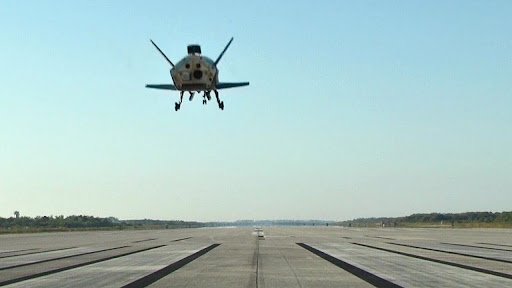
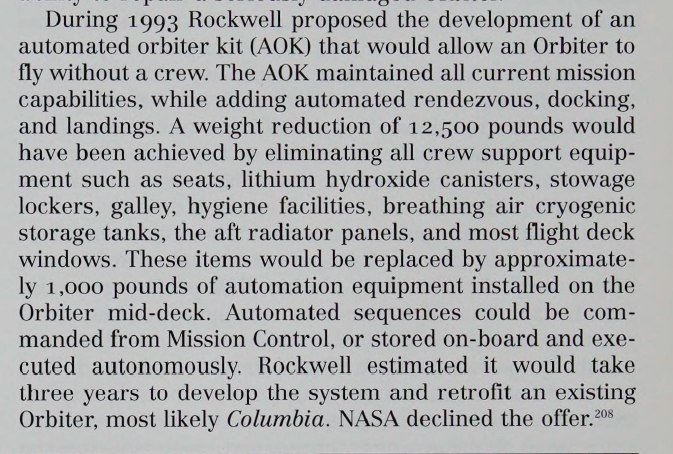
This is not the question I've asked. I see that ULA people in 2004 write that zillion things should be done to transfer to autonomous ops. Can you describe in common words what mysterious "single cable" should Orbiter have installed to perform undocking, deorbiting and landing and where to read about it (and why no mention of such an easy procedure in ULA text)? Too many "ifs" in your papers.

All I know is Buran could perform unmanned maiden space flight. None of the shuttle fleet could as built. Talking of implemented ability is like talking that both could go circumlunar but 'didnt choose that option'.
 
Last edited:
This is not the question I've asked. I see that ULA people in 2004 write that zillion things should be done to transfer to autonomous ops. Can you describe in common words what mysterious "single cable" should Orbiter have installed to perform undocking, deorbiting and landing and where to read about it (and why no mention of such an easy procedure in ULA text)? Too many "ifs" in your papers.
Because ULA had nothing to do with the shuttle
 
This is not the question I've asked. I see that ULA NASA people in 2004 write that zillion things should be done to transfer to autonomous ops. Can you describe in common words what mysterious "single cable" should Orbiter have installed to perform undocking, deorbiting and landing and where to read about it (and why no mention of such an easy procedure in ULA text)? Too many "ifs" in your papers.
 

Attachments

  • 20070019347.pdf
    541.5 KB · Views: 9

Similar threads

Back
Top Bottom