Shenyang / Chengdu "6th Gen" Aircraft - General Discussion and Speculation

A podcast released at the end of 2024 claimed that the J-36 features electronic warfare capabilities between those of the J-16D and large electronic warfare aircraft, undertaking a major role within the system.
I mean, the generators on the 3rd engine gotta be used for something!


He also stated that the J-20S was developed primarily for electronic warfare. It was not designated J-20D because it retains the full combat capabilities of the standard J-20. He drew an analogy to the cancelled U.S. EF-35 program, claiming the J-20S has electronic warfare performance on par with the J-16D. Personally, I find this unlikely. What do you all think?
Aren't the J-16D wingtip pods larger than whatever missile would normally hang there if it was a standard J-16?

That would mean that the J-20S would have to have enough space for systems to be added to provide the EW capabilities, without reaching into the bays.

I will note that an EW pod you could stick into the side bays will be limited to whatever the size of the missile fins, but I don't think that the trapeze is designed for keeping the side bays open and trapeze extended for long periods. So the J-20S jammer antennas might be installed into the doors of the side bays instead. Or, if the Chinese read the patent, there's antenna arrays in the leading edge flaps/slats of the wings just like the Growler.

Also, if the EW thing is true, the J-20S will need additional electrical generation built in, to make up for a lack of external ram-air turbines powering jammer pods.
 
does a random conjecture from an internet podcast warrant any opinion?
Depending on who is involved, yes. The Guancha Trio is one such example. PLA watching hinges on factors you wouldn't usually consider important when following US projects for example. As PLA watching hinges on a handful of people with connections in the political, industrial or military realm which share the information in a manner vague enough so they and their sources don't get in trouble and they continue to be a trusted source. There are people who are seen as very reliable sources which have a proven track record, there are a multitude of frauds and, to quote one of the favorite forum euphemism for such people, fanboys which are not reliable sources. Russian defence is moving into a similar direction with people like Fighterbomber or George N.

While western developments hinge on public announcements, conferences, spending bills and all of these things that get widely publicized. You also have enthusiasts with a deep understanding of ongoing projects, like our precious local quellish, but those people are generally more rare and in many ways more vague than their Chinese or Russian counterparts.

So yes, in PLA watching a podcast can genuinely be a viable source, sounds silly, I know.
 
Now though, why isn't the J-20S and it's electronic warfare suite discussed in the J-20 thread? This thread is after all reserved for the CAC and SAC next gen aircraft.
 
does a random conjecture from an internet podcast warrant any opinion?
Those and satellite photos are basically all we have as information sources in the PLA-watching community, so we've even developed a tier list for "insider" credibility based on how often what they say ends up being true (and they have their ways of "leaking" information without alerting the MSS - these are usually controlled leaks by the PLA itself). The PLA is certainly the most secretive military on the planet, after all...

Spotter reports and JSDF intercepts and tracking (except for CV sortie generation on the JSDF side) also don't provide much in the way of new or valuable information. Simply spotting and leaking a clear photo of a plane still in trials will, at the very least, earn you an invitation to a tea party with the MSS...
 
I mean, the generators on the 3rd engine gotta be used for something!
I've noticed that a lot of people seem to have gotten this wrong. Maybe they were misled by that infographic summarizing the podcast's key points. The real issue isn't about adding an extra engine just to generate power. Rather, the routing of the electronic warfare (EW) systems requires significant spacing. This means that to meet the required EW capabilities, the J-36 has to be so large that it actually needs three engines just to maintain adequate thrust.
 
I've noticed that a lot of people seem to have gotten this wrong. Maybe they were misled by that infographic summarizing the podcast's key points. The real issue isn't about adding an extra engine just to generate power. Rather, the routing of the electronic warfare (EW) systems requires significant spacing. This means that to meet the required EW capabilities, the J-36 has to be so large that it actually needs three engines just to maintain adequate thrust.
The priority of electronic warfare capability is quite high. What I mean is that the primary reason why the J-36 is designed to be so large is not the payload and range, but the requirement for electronic warfare capability. Similarly, the primary reason why the J-20S and J-36 are twin-seat is also for electronic warfare rather than controlling drones.
 
A podcast released at the end of 2024 claimed that the J-36 features electronic warfare capabilities between those of the J-16D and large electronic warfare aircraft, undertaking a major role within the system.

He also stated that the J-20S was developed primarily for electronic warfare. It was not designated J-20D because it retains the full combat capabilities of the standard J-20. He drew an analogy to the cancelled U.S. EF-35 program, claiming the J-20S has electronic warfare performance on par with the J-16D. Personally, I find this unlikely. What do you all think?
EW means basically means putting as much radio emitters on a plane as you can get away with. Which kind of defeats the purpose of a low-observable platform.
 
EW means basically means putting as much radio emitters on a plane as you can get away with. Which kind of defeats the purpose of a low-observable platform.
The two performance requirements sound contradictory, and the podcast actually pointed this out. I assume there must be technology available now to ensure they don't conflict with each other. A good example is the US PEA program, the design requirements for the J-36 are roughly equivalent to a combination of PCA and PEA.
 
I've noticed that a lot of people seem to have gotten this wrong. Maybe they were misled by that infographic summarizing the podcast's key points. The real issue isn't about adding an extra engine just to generate power. Rather, the routing of the electronic warfare (EW) systems requires significant spacing. This means that to meet the required EW capabilities, the J-36 has to be so large that it actually needs three engines just to maintain adequate thrust.
Okay, fair point.


EW means basically means putting as much radio emitters on a plane as you can get away with. Which kind of defeats the purpose of a low-observable platform.
EW doesn't only mean "blasting enough static to gray out half a hemisphere."
 
EW means basically means putting as much radio emitters on a plane as you can get away with. Which kind of defeats the purpose of a low-observable platform.

To be fair though - the J-20 may soon be the fourth stealthiest manned platform in the PLAAF (and that is assuming that the H-20 doesn't exist). Furthermore the J-36 will likely have the highest power generating capability of any platform (maybe 200 percent more effective power for antennas?) So there are rationales for using either design as an EW platform.
 
On j-20 series we just don't see arrays associated with EW aircraft; j-20s isn't different from j-20a in this regard. In all likelihood, unless we see pods at some point in the future, j-20s is exactly what it's name implies; 双, not 电.
Which doesn't mean it doesn't have excellent EW attack capabilities; it likely does. But if there's a difference, it's a second human onboard who will get to oversee automatic work.

For J-36 - quite probably it's the case(real estate, antennas and other inputs are most certainly there), though I frankly doubt the order of priority is as described (with range as a byproduct).
 
To be fair though - the J-20 may soon be the fourth stealthiest manned platform in the PLAAF (and that is assuming that the H-20 doesn't exist). Furthermore the J-36 will likely have the highest power generating capability of any platform (maybe 200 percent more effective power for antennas?) So there are rationales for using either design as an EW platform.
Agreed.


On j-20 series we just don't see arrays associated with EW aircraft; j-20s isn't different from j-20a in this regard. In all likelihood, unless we see pods at some point in the future, j-20s is exactly what it's name implies; 双, not 电.
Don't forget that the Growler has (iirc jammer) antenna arrays in the wing leading edge flap/slats (thank you Boeing for publishing that patent), so it's entirely possible to add AESA arrays to every edge on the J-20.


Which doesn't mean [J-20S] doesn't have excellent EW attack capabilities; it likely does. But if there's a difference, it's a second human onboard who will get to oversee automatic work.
This is the point I agree on. The main point for J-20S versus J-20A is the second crew. Call them a WSO for now. I'm sure there's a fun acronym for their Chinese title.


For J-36 - quite probably it's the case(real estate, antennas and other inputs are most certainly there), though I frankly doubt the order of priority is as described (with range as a byproduct).
I'm pretty sure the first priority in the J-36 design was range. Then bay size. And only then big antennas with sufficient spread.


Maybe we're looking for volume and antenna space on the airframe - when real we should be looking for it on a pair of EW CCAs?
Possibly. China does have some pretty big CCAs that could be EW. Or EW+SEAD/DEAD (my mission preference).
 
Don't forget that the Growler has (iirc jammer) antenna arrays in the wing leading edge flap/slats (thank you Boeing for publishing that patent), so it's entirely possible to add AESA arrays to every edge on the J-20.
All 5th gens have antennas in their leading edges. The question is what they do, and if they're originally passive/low power, how feasible is it to update them to high power emission role.

J-20/35 are rather enigmatic in this regard, I don't remember a single Chinese open publication on subject matter. The most obvious one is Su-57, as they're known to be high-power emitters, we saw them, and we know they're part of the EW suite and even their role.
American fighters are in-between; we know general details.
 
Last edited:
All 5th gens have antennas in their leading edges. The question is what they do, and if they're originally passive/low power, how feasible is it to update them to high power emission role.

J-20/35 are rather enigmatic in this regard, I don't remember a single Chinese open publication on subject matter. The most obvious one is Su-57, as they're known to be high-power emitters, we saw them, and we know they're part of the EW suite and even their role.
American fighters are in-between; we know general details.
It's safest to assume that they're all high-power emitters.
 
It's safest to assume that they're all high-power emitters.
There were rebutting materials as well.
My understanding is that full antennas come into direct conflict with leading edge rcs structures. Su-57 has large, obvious (and marked! service crew don't deserve fried brains) fairings; others, not so much. Even on B-21(and J-36), large emitting array fairings remain obvious.

Basically, we don't know, but I, for now, consider only su-57 case confirmed/likely within 5th gen. Maybe future will prove me wrong.
 
Last edited:
You guys realize that while NGJ doesn’t define a Growler there isn’t much to a NGJ besides two GaN AESA arrays and the requisite power/cooling systems, right? EW is now a hardware enabled but software defined set of missions.

My point being the J-36 was explicitly designed for power generation and management and the planform has ample space for lots of arrays. Put enough compute on the airframe and it becomes a EW leviathan with the right software.
 
EW doesn't only mean "blasting enough static to gray out half a hemisphere."

In addition to various types of noise-jamming there are MANY types of deception-jamming with the oldest and simplest method being range-gate pull-off (There's also velocity-gate pull-off too).

(thank you Boeing for publishing that patent)

Do you have a link to the patent or at the very its' number and/or title please?
 
Training AI how to navigate & manipulate the electromagnetic spectrum, and then being able to field that capability across a dispersed network would be a complete game changer. I wonder how far along the Chinese are with that and if the J-36 is intended to be a EW quarterback of sorts. Assign 2-6 unmanned EW escorts for each J-36, all networked. I imagine you could do some creative things with just that small group.
 
Training AI how to navigate & manipulate the electromagnetic spectrum, and then being able to field that capability across a dispersed network would be a complete game changer. I wonder how far along the Chinese are with that and if the J-36 is intended to be a EW quarterback of sorts. Assign 2-6 unmanned EW escorts for each J-36, all networked. I imagine you could do some creative things with just that small group.

There is a really great darpa cognitive ew paper from ages ago that speaks to this.

Also I’m sure I’m not the only one who has imagined an EM native military AI sitting behind tens of thousands of high eV TRMs with lots of power going up against another EM native military AI sitting behind a comparable arsenal…. Given these systems generally exhibit highly escalatory behavior when pitted against each other in other wargaming scenarios….
 
Last edited:
IIRC a Boeing exec made a comment during the initial LRS-B days that CLAS type conformal arrays would be one of the big challenges of the program…
Well, Northrop on B-21 appear to have avoided doing it even on the 2020s tech stack, and Northrop are perhaps the design house in modern world when it comes to practical stealth.

I think it's likely it was one of design choices Sukhoi had to make with their stated 0.1m value. Either L band or second zero. We know that Su-75 (with higher stealth requirements) lost half of the array (Russia can't drop it altogether without designing new radars, IFF is there).

Is it already engineered around for US/Chinese ~2030 tech stack? We'll know eventually.
Maybe yes, maybe edges are still mostly"silent". Especially since progress allows to make them even less reflective than in the past, so there's probably still an engineering choice involved.
 
Last edited:
Back in 2017, there were reports suggesting that the PEA would be unveiled earlier than the PCA. The PEA is also expected to be highly stealthy. Therefore, I believe the conflict between stealth performance and electronic warfare capabilities is not unsolvable—at least, that's what the US military seems to think.

Below is a speculation from Bill Sweetman a few months ago about PEA.
https://www.aspistrategist.org.au/weve-probably-just-seen-the-usafs-secret-electromagnetic-attacker/

I think the design requirements for the J-36 are basically to integrate both the PCA and the PEA. However, given the demands of symmetrical warfare, China is highly likely to also have an independent PEA drone. After all, the J-50 simply can't possess the same level of electronic warfare capabilities as the J-36. Of course, there will also be various auxiliary CCAs equipped with electronic warfare capabilities, though their individual EW performance won't be comparable to that of the J-36 or the PEA.
 
Back in 2017, there were reports suggesting that the PEA would be unveiled earlier than the PCA. The PEA is also expected to be highly stealthy. Therefore, I believe the conflict between stealth performance and electronic warfare capabilities is not unsolvable—at least, that's what the US military seems to think.
It likely isn't physically impossible (patent means something). The question is rather costs and engineering trade offs, especially in a smaller, supersonic combat plane.

Though if PEA is subsonic "not an A-12" as Sweetman suggests, in a thicker wing/body (or larger, or more specialist plane, which neither has to carry WVRAAMs not pull Gs) it shouldn't be a problem: you move arrays below the edge, like in B-21.
This way you are neither restricted by wing thickness, nor you have to compromise with the edge.

I think the design requirements for the J-36 are basically to integrate both the PCA and the PEA. However, given the demands of symmetrical warfare, China is highly likely to also have an independent PEA drone. After all, the J-50 simply can't possess the same level of electronic warfare capabilities as the J-36.
Pretty much, yes. J-36 has simply more real estate and power to work with. Though, to be fair, J-50 isn't exactly a slouch either; it's a 2020s design with two F119 class engines. That's a lot of right inputs.
 
It likely isn't physically impossible (patent means something). The question is rather costs and engineering trade offs, especially in a smaller, supersonic combat plane.

Though if PEA is subsonic "not an A-12" as Sweetman suggests, in a thicker wing/body (or larger, or more specialist plane, which neither has to carry WVRAAMs not pull Gs) it shouldn't be a problem: you move arrays below the edge, like in B-21.
This way you are neither restricted by wing thickness, nor you have to compromise with the edge.


Pretty much, yes. J-36 has simply more real estate and power to work with. Though, to be fair, J-50 isn't exactly a slouch either; it's a 2020s design with two F119 class engines. That's a lot of right inputs.
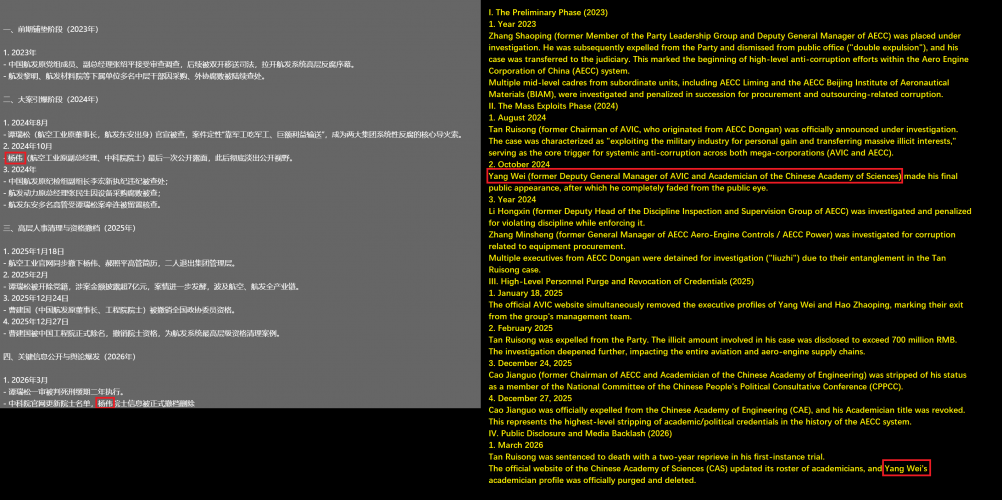
China does not possess an engine at the F119 level; in fact, it is still far from even reaching the level of the AL-31F-M2. The JH-36 was created to compensate for the J-20's virtually non-existent air-to-ground and air-to-sea strike capabilities. The three-engine layout was clearly designed this way because it was anticipated that engine technology would still fail to achieve a breakthrough even 15 to 25 years from now. In fact, the top leader of the Aero Engine Corporation of China (AECC) was just recently arrested.The chief designer of the J-20 was also arrested along with them.These individuals are all 'Academicians' of China, meaning they are the personnel who command the most resources and power within the entire scientific system.
 
China does not possess an engine at the F119 level; in fact, it is still far from even reaching the level of the AL-31F-M2. The JH-36 was created to compensate for the J-20's virtually non-existent air-to-ground and air-to-sea strike capabilities. The three-engine layout was clearly designed this way because it was anticipated that engine technology would still fail to achieve a breakthrough even 15 to 25 years from now. In fact, the top leader of the Aero Engine Corporation of China (AECC) was just recently arrested.The chief designer of the J-20 was also arrested along with them.These individuals are all 'Academicians' of China, meaning they are the personnel who command the most resources and power within the entire scientific system.
WS-15, WS-19: Hello? We also know from several credible insiders/sources that Shenyang is already developing a ACE while Wang Haifeng did also confirm that J-36 is meant to receive ACEs.

Also, seriously atleast read up on actual information before posting garbage.
 
Last edited:
WS-15, WS-19: Hello? We also know from several credible insiders/sources that Shenyang is already developing a ACE while Wang Haifeng did also confirm that J-36 is meant to receive ACEs.

Also, seriously atleast read up on actual information before posting garbage.
Ignore him lol, he believes WS-15 is a R-79 variant. You can't convince someone who is not open to believe anyone else but himself.
 
WS-15、WS-19:喂?我们还从几位可靠的内部人士/消息来源得知,沈阳已经在研发ACE,而王海峰也证实歼-36将配备ACE。

还有,说真的,至少在发布垃圾信息之前先查阅一下实际信息吧。
老兄,我第一次看到“WS-15即将交付”的新闻标题,大概是2005年左右。那时候我还在上学——那可是20多年前的事了。想想看:那时候AL-41F1S都还没问世,苏-35(也就是我们现在说的苏-37)还装着鸭翼呢。真是遥远的过去了!
 

Attachments

  • WS-15.jpg
    WS-15.jpg
    120.2 KB · Views: 44
Sigh, I am quite certain that the chief engineer was not arrested, sir, and this news is from a long time ago. Almost two years ago.

By scraping the following news using Chinese browsers and Chinese AI, the facts have become glaringly obvious. Everyone—from the chief designer of the J-20 to the engine suppliers and manufacturers—has been swept up in this crackdown, with some even receiving death sentences. This event is still unfolding. As for the chief designer in the narrow sense, Yang Wei, current records from March 2026 show him as 'dismissed' and 'stripped of his Academician status.' In practice, this means he has been arrested and is facing trial. In China, an individual is officially considered 'detained' only after a final court conviction; however, both the trial and detention processes are actively underway. The most critical point is that a massive segment of the team that designed the J-20 has fallen. At this stage, focusing solely on the chief designer loses its meaning.
 

Attachments

  • 0E632329CD9F2212CAF3E6BAC6B2D8AC.png
    0E632329CD9F2212CAF3E6BAC6B2D8AC.png
    309.8 KB · Views: 38
My goodness, it turns out you are a seasoned observer who has studied the People's Liberation Army of China for decades. I should express my deep respect to you, while your profound and sharp insights constantly remind me of how little I truly know. However, in your brilliant argument, I noticed a small shortcoming. In the so-called WS15 image you listed from over a decade ago, it says 'WS15 forging successfully delivered.' In other words, this might only indicate that some minor step in the engine has made a trivial progress? Oh, please forgive my doubt. Although I don't understand much in other areas, I do understand a little bit of Chinese. Nevertheless, I believe this small flaw does not affect your overall viewpoint.
 
My goodness, it turns out you are a seasoned observer who has studied the People's Liberation Army of China for decades. I should express my deep respect to you, while your profound and sharp insights constantly remind me of how little I truly know. However, in your brilliant argument, I noticed a small shortcoming. In the so-called WS15 image you listed from over a decade ago, it says 'WS15 forging successfully delivered.' In other words, this might only indicate that some minor step in the engine has made a trivial progress? Oh, please forgive my doubt. Although I don't understand much in other areas, I do understand a little bit of Chinese. Nevertheless, I believe this small flaw does not affect your overall viewpoint.
The WS-10 program was officially initiated in 1984, entered small-scale low-rate initial production in 2003, and did not pass full final acceptance until 2017—achieving its rated service life and reliability certification only by operating at 700 kilograms below its target thrust. The entire process spanned 33 years and went through three generations of chief designers; in fact, the first chief designer, Zhang Enhe, passed away without ever seeing the day it passed final acceptance. By comparison, the WS-15 has only been under development for a little over 20 years. Going by historical precedent, we can probably expect to wait quite a bit longer.
 
My goodness, it turns out you are a seasoned observer who has studied the People's Liberation Army of China for decades. I should express my deep respect to you, while your profound and sharp insights constantly remind me of how little I truly know. However, in your brilliant argument, I noticed a small shortcoming. In the so-called WS15 image you listed from over a decade ago, it says 'WS15 forging successfully delivered.' In other words, this might only indicate that some minor step in the engine has made a trivial progress? Oh, please forgive my doubt. Although I don't understand much in other areas, I do understand a little bit of Chinese. Nevertheless, I believe this small flaw does not affect your overall viewpoint.

There is actually some value in having PLA watchers with longitudinal exposure, if one has the ability to critically assess evidence, keep track of discourse, and conduct ongoing hypothesis testing.

There is value in knowing the 2000s and 2010s era of BBS watching as the primary avenue of PLA rumours/grapevine information, and tracking what rumours back then emerged into fruition and which ones did not, and identifying new sources of credible rumours and information.


But if one is unable to keep up to date and unable to identify the actual correct and to keep up with leading edge discourse, it leads to continued bleating talking points reminiscent of the early 2010s era if not the mid 2000s era.
 
There is actually some value in having PLA watchers with longitudinal exposure, if one has the ability to critically assess evidence, keep track of discourse, and conduct ongoing hypothesis testing.

There is value in knowing the 2000s and 2010s era of BBS watching as the primary avenue of PLA rumours/grapevine information, and tracking what rumours back then emerged into fruition and which ones did not, and identifying new sources of credible rumours and information.


But if one is unable to keep up to date and unable to identify the actual correct and to keep up with leading edge discourse, it leads to continued bleating talking points reminiscent of the early 2010s era if not the mid 2000s era.
History merely repeats itself over and over again. Simply maintaining past glories is an immense struggle; how can one expect to constantly surpass who they once were? It is even highly likely that those past triumphs were nothing more than a stroke of good fortune. This is a sinking, multipolar world. No one is the chosen protagonist.
If we can't even make sense of yesterday, we have no hope of understanding today. It's just like those people who rock out on a moving train and genuinely believe the train is moving forward because of their dancing.
 
Looking back at the whole topic, you'll notice that a lot of people are discussing the usage of sixth-generation fighters using the combat style of fourth-generation jets and the design of fifth-generation jets.

For me, stealth might just be one pretty ordinary feature on a sixth-generation fighter.

Let me indulge in some irresponsible speculation: the J36 is a fighter designed to win air battles. And my first assumption is that its air-to-air missile strike range will be between 200 and 500 kilometers. Don't be surprised by that engagement range, because there are already studies exploring the combat effectiveness of certain air-to-air missiles at 500 kilometers. So if you dare to believe it, 500 km might still be a relatively conservative range.

Additionally, I lean toward the idea that the drones accompanying the J36 would be AI-autonomous fighters. They might be able to identify and attack enemy aircraft on their own, and work with other drones to autonomously choose the best attack strategy based on the movement of enemy planes, then relay it back to the J36's co-pilot commander for real-time adjustments. Even if enemy planes break through the AI drone swarm, the J36 could still carry some more flexible drones to coordinate interception. Similarly, the J36 doesn’t need to carry any ground-attack weapons at all; it could just coordinate with a drone bomber deployed from a base for ground strikes. From these ideas, whether it's for processing data in the drone swarm or the extra power needed for the AI, they would all require a larger platform as a central hub, which we call the 'J-36'.

Furthermore, if you think along these lines, you’d see that the J-XD would probably be a carrier-based naval aircraft. Thanks to the conditions on an aircraft carrier, the J-XD will strictly limit its weight and size. Also, the types of AI drones available on a carrier are more limited, which means the J-XD wouldn’t need to handle as much information as the J36, nor would it need as much power generation. This also means the J-XD might not be able to control as many drones as the J36, and it won’t have as many different types of drones to protect it, so it naturally needs to be more maneuverable.

Of course, all of this is just me letting my imagination run wild, and it might not be realistic. But I still believe you can’t think about sixth-generation fighters using the combat mindset of fourth-generation jets. Sixth-generation fighters can completely solve the same problems using an entirely different way of thinking and approach.
 
Looking back at the whole topic, you'll notice that a lot of people are discussing the usage of sixth-generation fighters using the combat style of fourth-generation jets and the design of fifth-generation jets.

For me, stealth might just be one pretty ordinary feature on a sixth-generation fighter.

Let me indulge in some irresponsible speculation: [...]

Of course, all of this is just me letting my imagination run wild, and it might not be realistic. But I still believe you can’t think about sixth-generation fighters using the combat mindset of fourth-generation jets. Sixth-generation fighters can completely solve the same problems using an entirely different way of thinking and approach.
I generally agree with your "wild imagination."


Additionally, I lean toward the idea that the drones accompanying the J36 would be AI-autonomous fighters. They might be able to identify and attack enemy aircraft on their own, and work with other drones to autonomously choose the best attack strategy based on the movement of enemy planes, then relay it back to the J36's co-pilot commander for real-time adjustments.
In full war and with un-mixed forces, I think that the current state of AI is able to do that. But I don't think that AI-autonomous fighters are there for combat with mixed forces unless your tolerances for friendly-fire are a lot higher than historically tolerated.
 

Similar threads

Back
Top Bottom