- Joined
- 2 January 2006
- Messages
- 4,235
- Reaction score
- 8,279
Neat
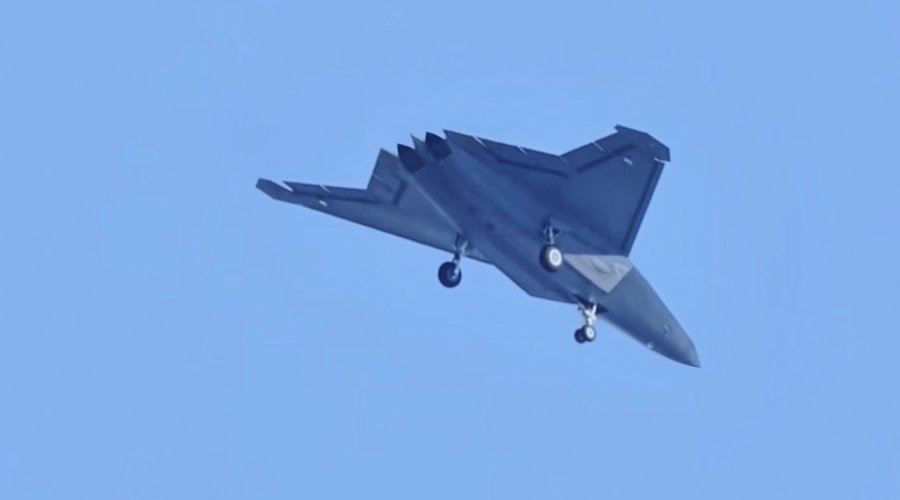
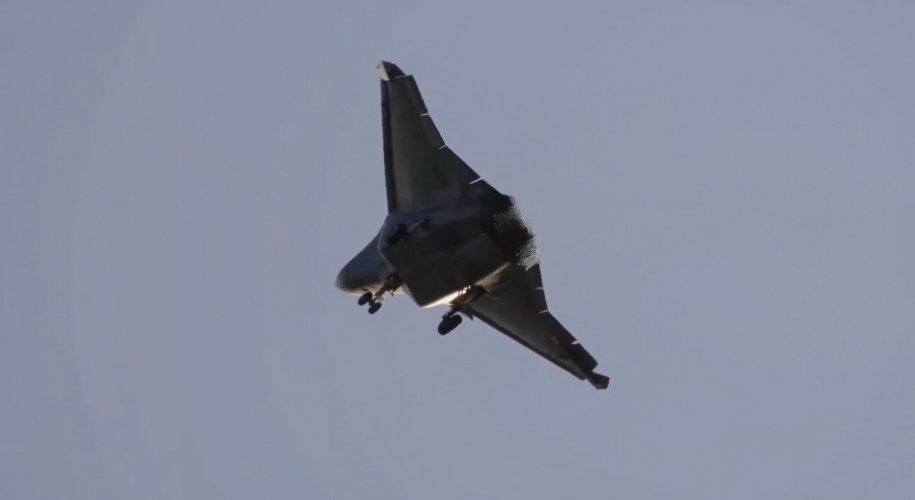
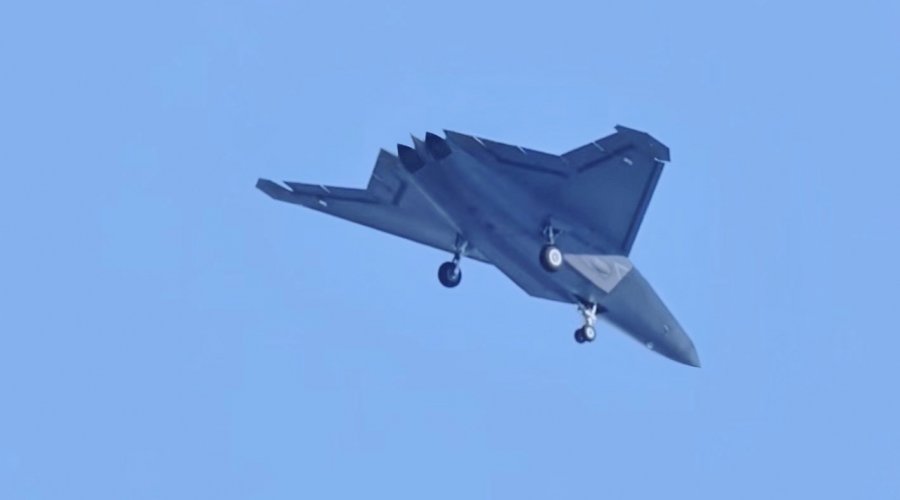
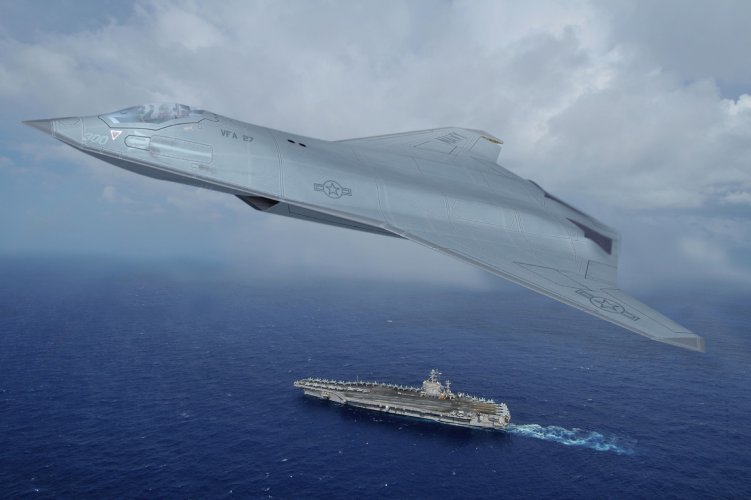
Here is the clear original one ... and please, at least make it clear, it is not real!!
Attachments

Last edited by a moderator:

Neat


I'm no expert but this feels off to me. I think it can be generally assumed the center of gravity for all aircraft is somewhere in the geometric midpoint of the 3 landing gears (and certainly forward of the rear 2, since otherwise it would sit on its ass). For me, it feels like the aircraft in the picture has far too much mass behind the rear 2 gears.Those main gear wheels seemed too small. Was it ever determined if this was real?
View attachment 800774
Are you looking at it through the lens of a traditional fighter jet? The nose on this aircraft is far larger, and thus far heavier than how it appears from this angle. From the side i suppose, the nose is deceptively small.I'm no expert but this feels off to me. I think it can be generally assumed the center of gravity for all aircraft is somewhere in the geometric midpoint of the 3 landing gears (and certainly forward of the rear 2, since otherwise it would sit on its ass). For me, it feels like the aircraft in the picture has far too much mass behind the rear 2 gears.
I might be completely wrong though.
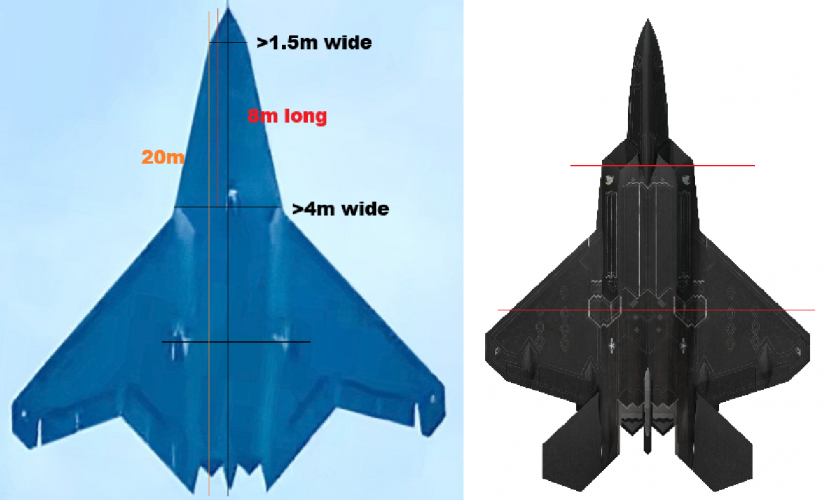
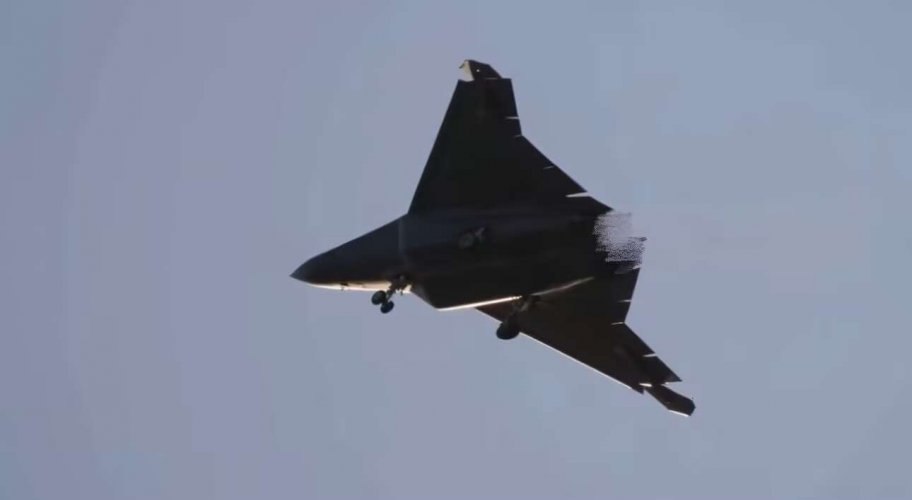
Seems a new vedio of J36 shows up...
I am wondering will 611 change their base in the future
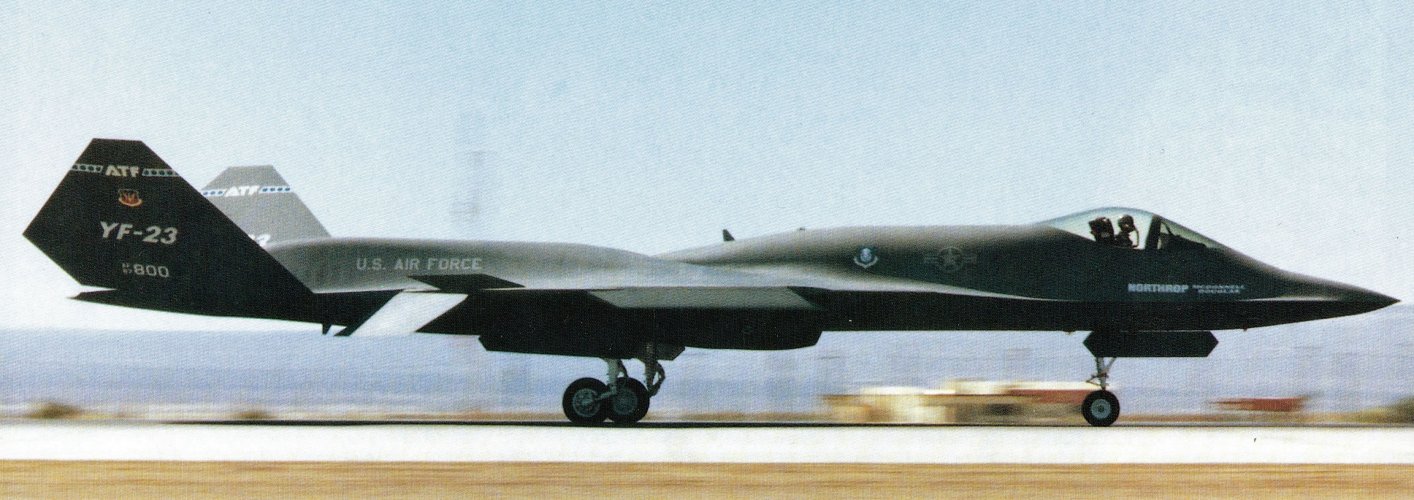
Yeah, even the 1/72 plastic models required something like 2oz of weight in the nose.If you want to see an example of trippy looking gear placement, see YF-23 below:
View attachment 800851
That ass extends way far back.
You can usually assume that the main gear are basically under the center of gravity.I'm no expert but this feels off to me. I think it can be generally assumed the center of gravity for all aircraft is somewhere in the geometric midpoint of the 3 landing gears (and certainly forward of the rear 2, since otherwise it would sit on its ass). For me, it feels like the aircraft in the picture has far too much mass behind the rear 2 gears.
I might be completely wrong though.

Based. At minimum, third engine implies a huge amount of power generation, and in combination with the dual operators I think its safe to assume they're planning to incorporate mass amounts of radars, comms, and primarily EW.That's a impossible timeline, It'll take until 2027 optimistically to even get out of the prototype phase and then a few extra years of LRIP and operational testing before being inducted.
Definitely in agreement with this line of thinking. If they're aiming for the quickest way to verify the airframe performance (both kinematically and aerodynamically), then choosing to implement simpler features can get you in the air faster while you spend time building and developing the features you're actually desiring. Probably isn't cheap tho.We won't know for years. We also won't know for certainty that the troughs won't come back later. They seem to be developing the aircraft rapidly (aiming for the earliest IOC), so features could be chosen because they are technically or tactically more desirable or because they involve less development risk, more established technologies or more commonality with other programs (e.g. sharing systems which are being matured for the J-50/J-XDS). There are many possible explanations.

That's pretty much the definition of a prototype. Think YF-22/23.Definitely in agreement with this line of thinking. If they're aiming for the quickest way to verify the airframe performance (both kinematically and aerodynamically), then choosing to implement simpler features can get you in the air faster while you spend time building and developing the features you're actually desiring. Probably isn't cheap tho.
I understand that. Where I'm diverging from the "prototype" train is that if you were truly only trying to evaluate the airframe design itself (OML, S&C logic, propulsion), then you typically wont bother with combat-related apertures and systems since it would be a waste of your time and resources. Those are already designed, integrated, tested, and analyzed with great accuracy on the digital front, so there's no need for them on a traditional "prototype". I'm sure there's exceptions, but I digress.That's pretty much the definition of a prototype. Think YF-22/23.

Sorry for the yap-fest, but yeah... 2027 is a pipe dream for a combat-ready variant unless they use J-20/J-35 mission systems, which means the only thing "6th gen" about it would be the OML.
That's pretty much the definition of a prototype. Think YF-22/23.
In short, their iterative approach to developing the J-36 is different that the traditional demonstrator/prototype - EMD - LRIP path (at least at face value). They seem to be blurring the first two phases into one.
When I say surrogate I meant more of a non-functional surrogate panel, which are used in applications like this. If you have radar built into the OML of an aircraft, blank surrogates are used (sometimes/usually with weights added for proper mass properties/flight dynamics since the MS are usually still in development at this point. So from the outside it looks no different than the real thing.Unless the surrogates work... or you have immediate surrogate, interim, and final systems planned... and being developed and prototyped simultaneously.
Thinking about surrogate systems... what happens if you scale the Type 1475 / KLJ-5 with more T/R modules?
Yes. . .just like the YF-22/23. They had stuff like this for that:I understand that. Where I'm diverging from the "prototype" train is that if you were truly only trying to evaluate the airframe design itself (OML, S&C logic, propulsion), then you typically wont bother with combat-related apertures and systems since it would be a waste of your time and resources. Those are already designed, integrated, tested, and analyzed with great accuracy on the digital front, so there's no need for them on a traditional "prototype". I'm sure there's exceptions, but I digress.
In short, their iterative approach to developing the J-36 is different that the traditional demonstrator/prototype - EMD - LRIP path (at least at face value). They seem to be blurring the first two phases into one.
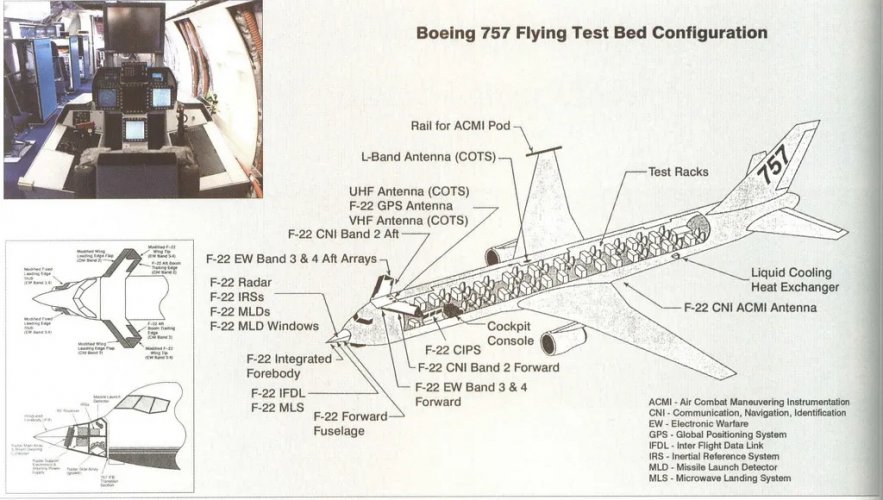
That is for systems that were in development for the F-22 (production) variant. The YF-22/23 didn't have provisions for them on the prototype aircraft because its exactly that, a prototype. You wouldn't even need surrogates in the OML for apertures because there's no intention of putting any on the demonstrator/prototype. I was saying its a waste of time/resources to put it on a demonstrator, not to have them in development at all.
The point I was trying to make is that the J-36 must be more than a simple demonstrator since it has aperatures for mission systems that would otherwise not be required for a simple proof of concept prototype, meaning there's an intention to swap real ones in later if they didn't already have them produced. But given that they've already made big changes to nozzles and inlets, it can't be full blown EMD either, so it's a weird in between.
There is also the very real possibility that there were potential merits to more than one option (e.g. LO trough vs. thrust vector nozzles) and the decision was simply to build both in parallel so they could be tested. The same goes with the landing-gear configuration - it could be the case that both were approved simultaneously.
We can't even rule out that the first prototype we say isn't actually a testbed for a potential follow-on variant, and the other prototypes are closer being LRIP for an interim design. In other words, we could have everything backwards.
There is just too little information to be absolutely certain either way.
That is technically "possible" but imo not "probable" simply on the basis that subsequent prototypes after the initial airframe seem to have been consistent in their design features.
If we see a subsequent prototype with similar features to the first airframe, then the likelihood of your suggestion certainly shoots up a fair bit.


They got their requirements and program management in order and pressed ahead aggressively, assuming they were still playing catch-up and that the US was still ahead of them in 6th gen fighter efforts like it had been with the F-22; when in reality the Americans were initially not as serious, and half a decade later were reevaluating not only their requirements but also their industrial and fiscal capabilities since everything had changed so quickly... This is why these birds will begin entering official service around the same time real F-47 prototypes (not subscale X-planes!) start flying...The test flight regime, simply based on what we see (and there's possibly much more we don't see) is just incredibly impressive. CAC and SAC are really putting a lot of effort into keeping the development timeline tight.
New image.
Doesn't hurt to have something to look at. Ten years ago.They got their requirements and program management in order and pressed ahead aggressively, assuming they were still playing catch-up and that the US was still ahead of them in 6th gen fighter efforts like it had been with the F-22; when in reality the Americans were initially not as serious, and half a decade later were reevaluating not only their requirements but also their industrial and fiscal capabilities since everything had changed so quickly... This is why these birds will begin entering official service around the same time real F-47 prototypes (not subscale X-planes!) start flying...
4th gen in the US was pretty much what you got is what was being talked about. ATF. . not so much.Would be interesting if 4th and 5th generation situation will repeat itself, and US will roll out something else entirely.
In terms of general capabilities I think what the 6th generation needs to have are pretty consistent.Would be interesting if 4th and 5th generation situation will repeat itself, and US will roll out something else entirely.
If I understand the story correctly, it can be summarized as Lockheed Martin convincing US DOD that instead of reasonable signature reduction you can go all the way to LO without sacrificing too much... and US happily keeping that knowledge for themselves for long enough to screw over everyone else.In terms of general capabilities I think what the 6th generation needs to have are pretty consistent.
Not like how most people thought 5gen was going to be "much greater maneuverability" (Typhoon/Rafale) and not stealth (F-22)
I'm not sure there's another flip of the chessboard possible.Basically, Chinese 6th are very obvious direction of going forward, we knew it for decades. But US overturned the chessboard, twice.
Well, that's the point.I'm not sure there's another flip of the chessboard possible.
The only really big surprise that's come out of F-47 has been that it is only the size of an F-22 MTOW, not a battlecruiser like J-36 or like I was expecting F-47 and FAXX to be.
ATF versus Eurocanard supermaneuverability relied on someone recognizing Ufimstev's equations as important. The only group that has openly admitted how much those equations mattered was Lockheed.Well, that's the point.
if it's obvious, you can't overturn the board.
Basically, Chinese 6th are very obvious direction of going forward, we knew it for decades. But US overturned the chessboard, twice.
GaN in itself might not stay for as long as people think with Ga2O3 radars combined with diamond heat sinks(to solve the heat issue of Ga2O3) and a PIC based back end would make an insanely strong radar. We alr have significant research and prototyping into GA2O3 and PICs in isolation so might see such a radar at least enter prototyping by the end of the decade.The problem with overmatch is that it forces an arms race.
I am thinking that the board might have been genuinely overturned once again though.
The major trends:
1. Gallium nitride and networked sensors allowing long range shots (satellites are also part of this picture).
2. All aspect broad band stealth trying to deny those shots.
3. Considerations around volume (more platforms mean more distributed sensors, more targets, over more space) vs. price (more survivable platforms).
We don't exactly know how these will balance out.
However, it is enough to think that the F-22 may not be sufficiently networked and may have an older radar, and the F-35 may provide more volume but might not provide enough volume or survivability (i.e. might fall between the two), while 4th gen platforms may be even more vulnerable to long range shots (even if they can provide volume).
I don't think we can rule out the possibility of 6th gen platforms gaining a significant edge over 5th gen platforms. The F-35 design first flew over a quarter century ago... its design has been largely fixed since then (and just refined). The J-35 is only a dozen years old and the J-XDS... well, maybe two years old.
does a random conjecture from an internet podcast warrant any opinion?