Shenyang / Chengdu "6th Gen" Aircraft - General Discussion and Speculation

Wonderful strawman arguments you have there, @Nx4eu, watch out they don't blow away in a light breeze. I get this is the discussion and speculation topic but still -


China did an excellent job with speedy development of the J-20 ahead of Western estimates. The weaponry and avionics look good on paper. China does, however, lack experience in warfare and active use of their equipment in real world engagements.

Low probability of intercept radar design is complex, and algorithms for TWS, NTCR, ECCM etc are closely guarded secrets and evolved and refined in the US (and UK, France..) over many years and generations of radar designs. Counting the number of AESA elements, or reading placard range on a radar display at Zhuhai, doesn't speak to these essential characteristics, so its hard to conclude the J-20 is competitive. Maybe China will hit it out the park on first try, but history suggests real world experience is a great teacher.

Additionally, they have had challenges getting up to speed with engine development, and J-20 still hasn't reached parity in this area. As @F119Doctor has noted in other topics, supercruise requires a specifically optimised engine design. WS-15 may be such an engine. WS-10 is not. We don't at this stage know how much fuel the J-20 carries, so its hard to be certain of its range. We can make estimates, but we don't know.

Rough RCS analysis tools such as we have show J-35 does not appear to be shaped with all-aspect VLO in mind. The basic configuration is not optimal for stealth, and there's only so much you can do with materials. It is likely the stealth requirements for J-20 were notably lesser than F-22, especially in the side and rear aspect.

It's still likely that its better in this respect than any fighter in service outside F-22 and F-35. But that doesn't mean we can conclude its 'competitive in stealth' with the F-22, which seems to be your conclusion.

When you make statements like


it comes across a bit "China Stronk". If you want sound more credible, cite the sources that lead you to this opinion. The specific source cited above is much more about redirecting Congress from funding costly upgrades to near-obsolete early F-22 Blocks to spending in more useful areas than anything else.

US Air Force sources have generally been surprised by the rapid pace of China's developments, but still reasonably confident an American pilot in the F-22 Block 35 could still handle the J-20. However the margin of superiority has been significantly eroded and this is a pretty awesome achievement for China.

Back to topic....

The J-36 represents a possible turning point here, and the USAF needs to pick a path forward pretty soon or get left behind.
All of your conclusions are still based on the notion of China's inexperience in the field compared to western counterparts that allude you to believe the equipment is inferior. Saying China is competitive with American fighters comes off as much as "China Stronk" as it does when you say they aren't competitive as China isn't a peer adversary. Of course from your own bias, it is logical to conclude that given the lack of information, it should be assumed to be inferior to it's western counterparts. I'm not straw manning your arguments I'm simply pointing out the ridiculousness of the conversation.

I'm not arguing that the J-20's stealth is as good as the F-22, clearly like you said it has some drawbacks in it's overall configuration. You're still assuming that the J-20 had less rigorous stealth requirements however, there is no way we can be sure of this as a fact.

It's the pace of the Chinese aviation industry that constantly seems to be underestimated. This however will always be the case moving forward, due to the secrecy of all their projects. Nothing concrete about the J-20 is known, therefore it cannot be logically compared to any fighter in the world, so I agree we can't say it is competitive to the F-22, but we can't say it is definitively inferior either.

Given that we're in the speculation and discussion thread for 6th generation fighters, how many Western Analysts believed China already had prototypes ready for flight testing, or had already undergone potential flight testing for prototype "6th gen" aircraft. Many believed China to be 10-20 years still behind. With the potential rumors on the Chinese internet, to being false fanboy-ism. Even after flight testing spread across the internet, many online journalists "cope" about it being a 5th gen strike bomber, it can't possibly be a 6th gen. And they partially could be right, we have zero information on it's potential capabilities, based on the lack of information it isn't any more wrong to call it 5th gen than to call it a 6th gen.

A lot of information then has to be inferred right? This applies to the J-20. Based on your assumptions, You believe that the J-20 isn't up to the task with competing with the F-22. However other people have their own assumptions as well. Some lean more on anecdotes, while some lean more on testimonies from PLA analysts and insiders. None can be ever proven to be accurate in any case.

This argument is stupid, and I do not wish to continue. We can never conclude any argument if it's all based on assumptions.
 
Last edited:
Even after flight testing spread across the internet, many online journalists "cope" about it being a 5th gen strike bomber, it can't possibly be a 6th gen. And they partially could be right, we have zero information on it's potential capabilities, based on the lack of information it isn't any more wrong to call it 5th gen than to call it a 6th gen.
People usually forget the other aircraft that flew, if their argument for J-36 being a fighter-bomber is due to its large size and 3 engines then what would be the argument for the Shenyang aircraft, that thing looks like a fighter through and through. Although we do have even more limited info on that
 
People usually forget the other aircraft that flew, if their argument for J-36 being a fighter-bomber than what would be the argument for the Shenyang aircraft, that thing looks like a fighter through and through. Although we do have even more limited info on that
It's the preconceived notion that a fighter must be within a certain range of size that limits their perspective. If it's too large it must be something else, ie a bomber.

Everything modern has been growing in both size and capabilities, it's unwise for them to use standards set in decades past to judge equipment for the future.

In WW2, destroyers displaced 2,000 tons, in modern times, many new destroyers and planned future destroyers will displace over 15,000 tons. With that type of thinking, it must mean all future destroyers are actually cruisers. Modern tanks are heavier than old gen tanks. Modern fighters are larger than old gen aircraft.

Old Air superiority was achieved through dogfights, so with their train of logic, that must mean new fighters also need to be extremely agile to win air superiority.

These men seem to be stuck in the past. It's also just straight prejudice against the Chinese, and the "evil communists". They like to equate China to the Soviet Union. Everything is a facade, nothing in China is real.

If NGAD came out to be a 50-60 ton beast, it would be praised as the most capable fighter in the world. There won't be many "it's just a reskinned fb-22" comments, or it's just a bomber.
 
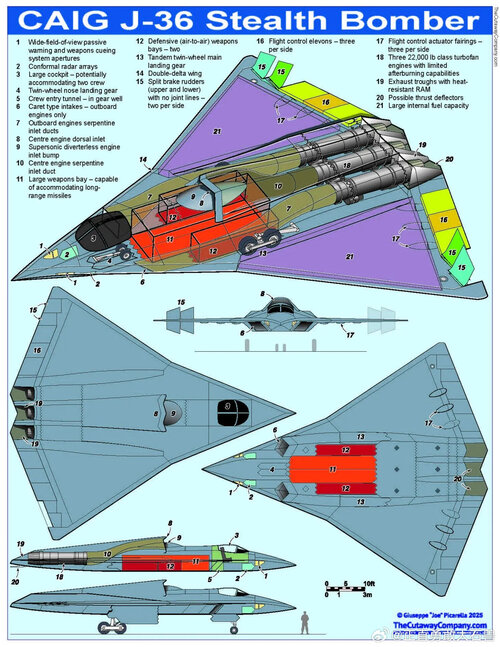
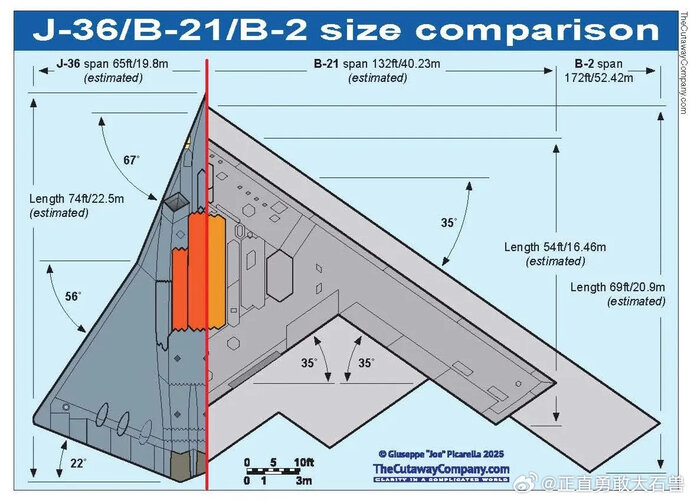
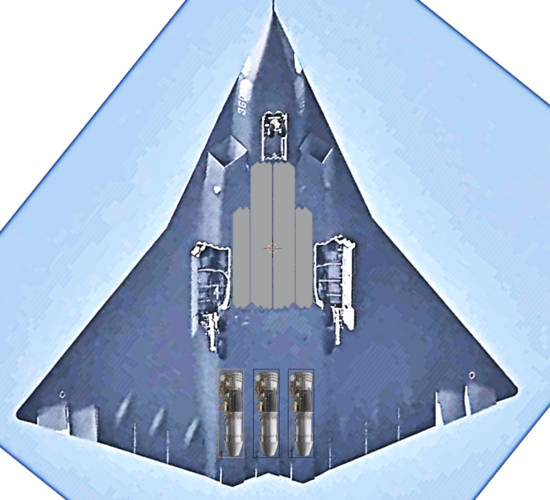
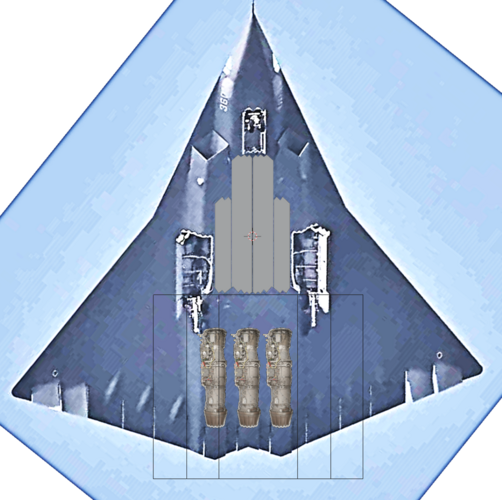
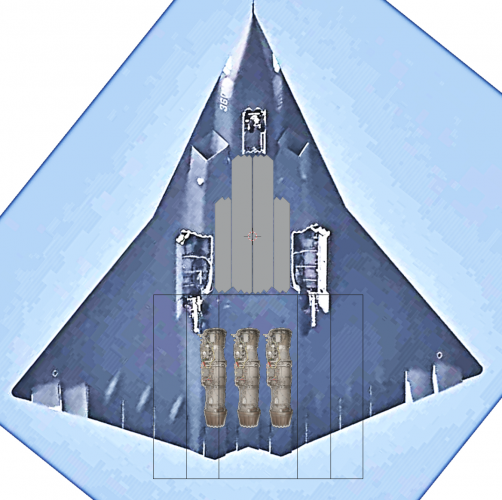
Can I comment how ridiculous this graphic is, it ties in basically with what I just stated above. 3x 22,000lbf class engines really? I've scaled 3x GE414 engines versus 3x F119 engines with the J-36. These are the western analysts, really? They must really think Chinese engine tech is in the gutters and this is just a subsonic bomber if they believe its 3x 22,000lbf engines.

"J-36 stealth bomber"
1741512826369.jpeg 1741512832215.jpeg

22,000lbf class engines x3 . J-36 in my comparison is scaled to 22m, so it's actually smaller than their graphic.
1741628269136.png

Versus 3x 35,000lb class engines ie F119 in the J-36.
1741628323739.png

Where did they even get the notion of 3x 22,000lbf engines? Not to mention the horrendous symmetrical nozzles in the asymmetrical trench they made up.. This is really bugging me that these graphics are being passed around. Some sick joke perhaps, they probably think the J-20 is also equipped with 2x 22,000lbf class engines.
I'm baffled, I'm appalled, I'm dumbfounded. I really can't put it into words.
 
Last edited:
Laser with any energy to speak of almost certainly will not work well through such window; it's already a type of weapon system built around rather delicate balance of heat at both ends.

Also needs a way to clean bugs, etc off itself in flight.
 
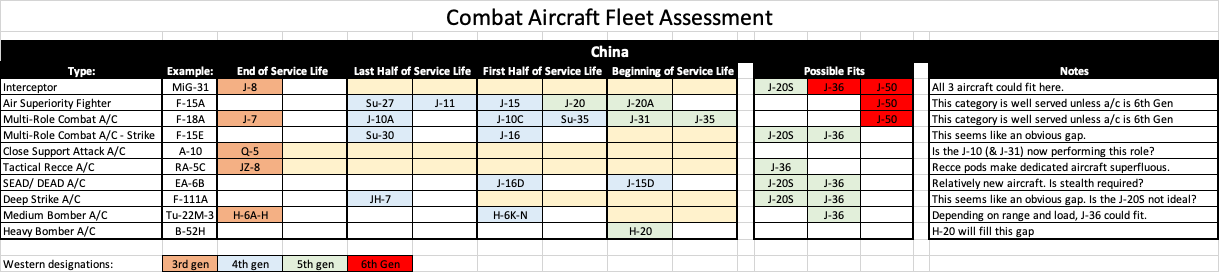
An (very) amateur attempt at assessing motivations. Keeping in mind some caveats;

1/ The USAF general has stated his opinion that the Chinese aircraft are fighters and are 6th gen. but the US military has, in the past, purposefully misrepresented foreign technologies to get the equipment they want. So I think a degree of caution here.
2/ If we assume that the J-36 is a demonstrator and look at the Incompatibility of the dorsal intake in relation to the lateral intakes along with the mold line of the aircraft trailing edge we could come to the conclusion that the aircraft is in fact intended to be a twin engine design waiting for it's engines. If you imagine the a/c without that dorsal intake it sure makes a big difference.
3/ My little graph tries to shoehorn new concepts into old thinking which may very well be impossible and just cloud the whole thing more. You'll also notice I just dump the new aircraft in the previous generation if there's no reason for it to be 6th gen. other than we wish it to be.
4/ Lots of mistakes and wrong assumptions. It's just for fun after all.

1741634351352.png
 
Can I comment how ridiculous this graphic is, it ties in basically with what I just stated above. 3x 22,000lbf class engines really? I've scaled 3x GE414 engines versus 3x F119 engines with the J-36. These are the western analysts, really? They must really think Chinese engine tech is in the gutters and this is just a subsonic bomber if they believe its 3x 22,000lbf engines.

"J-36 stealth bomber"
View attachment 762402View attachment 762403

22,000lbf class engines x3 . J-36 in my comparison is scaled to 22m, so it's actually smaller than their graphic.
View attachment 762404

Versus 3x 35,000lb class engines ie F119 in the J-36.
View attachment 762405

Where did they even get the notion of 3x 22,000lbf engines? Not to mention the horrendous symmetrical nozzles in the asymmetrical trench they made up.. This is really bugging me that these graphics are being passed around. Some sick joke perhaps, they probably think the J-20 is also equipped with 2x 22,000lbf class engines.
I'm baffled, I'm appalled, I'm dumbfounded. I really can't put it into words.

If it is non-afterburning WS-10B it would be a perfect fit. Basically CAC went all the troubles with exotic nozzles and intakes to support three non afterburning engines.
 
2/ If we assume that the J-36 is a demonstrator and look at the Incompatibility of the dorsal intake in relation to the lateral intakes along with the mold line of the aircraft trailing edge we could come to the conclusion that the aircraft is in fact intended to be a twin engine design waiting for it's engines. If you imagine the a/c without that dorsal intake it sure makes a big difference.
Not a demonstrator but with good reasoning it's a late stage prototype, also it's ridiculous to say that it is a twin engine design with 3 engine as a placeholder people who are saying this has little to no engineering knowledge, how is the dorsal intake incompatible in the first place?? Looking out of place or no fighter ever had 3 engines isnt a good excuse...
 
Not a demonstrator but with good reasoning it's a late stage prototype, also it's ridiculous to say that it is a twin engine design with 3 engine as a placeholder people who are saying this has little to no engineering knowledge, how is the dorsal intake incompatible in the first place?? Looking out of place or no fighter ever had 3 engines isnt a good excuse...
Like I said, lot's of mistakes and wrong assumptions, I'm not as sure of myself as you clearly are. If it's a late stage prototype we'll soon be seeing them in production and on exercise and it'll clear up many the unknowns.
 
Re the J-36 cockpit - I was reviewing some of the conclusions from the US FATE/ICE studies and one discussed departing from the bubble canopy to a much more aerodynamically friendly form for a tailless a/c, or even departing from a canopy completely to go with a sensor fused virtual reality display. Perhaps the J-36 cockpit design integrates some of these considerations.


An older Bring_it_on post
 
Last edited:
People usually forget the other aircraft that flew, if their argument for J-36 being a fighter-bomber is due to its large size and 3 engines then what would be the argument for the Shenyang aircraft, that thing looks like a fighter through and through. Although we do have even more limited info on that
Actually, you're still too constrained by past experience, imagine if the next generation of air superiority combat platforms weren't just made up of a single aircraft...;)
 
Just giving this a bump (so people don't forget it exists and post speculations in the main thread).

Assuming typical inlet diametres... how much volume could the J-50 have for its weapon bays? Also, any sense of the length? I gather that the idea of a very long central weapons bay for one or two extra long weapons has now been ruled out.
 
Just giving this a bump (so people don't forget it exists and post speculations in the main thread).

Assuming typical inlet diametres... how much volume could the J-50 have for its weapon bays? Also, any sense of the length? I gather that the idea of a very long central weapons bay for one or two extra long weapons has now been ruled out.
I think it will fit at least pl-17's in "height", my doubt is if it's capable of 6 or 8 pl-15's or equivalents in width
 
This explains why J-36 was camera shy the last few months until J-36 no. 2 flew, while the steady footage from J-50 factory test flights implies the J-50 no. 2 prototype flew a few months ago (maybe summer?).
 
This explains why J-36 was camera shy the last few months until J-36 no. 2 flew, while the steady footage from J-50 factory test flights implies the J-50 no. 2 prototype flew a few months ago (maybe summer?).
J-50 no.2 doesn't seem to have changed much while J-36 no.2 had large changes, would this mean J-50 would be in front of J-36 in overall progress?
 
J-50 no.2 doesn't seem to have changed much while J-36 no.2 had large changes, would this mean J-50 would be in front of J-36 in overall progress?
I recall some discussions few months ago about the J-50 program being aggressively pursued to ensure IOC by the end of the decade, while another recent hint from chinese insiders that you probably read too imply that they might want the first LRIP machines (not sure which, J-36 or J-50 or both) by the end of 2027. I think the view on J-50 is that it will use somewhat more conventional constructive solutions to ensure the fastest possible entry into production (if one can call conventional a tailless, supersonic, TVC fighter), while the J-36 being more complex might take a bit longer to reach production.
 
2/ If we assume that the J-36 is a demonstrator and look at the Incompatibility of the dorsal intake in relation to the lateral intakes along with the mold line of the aircraft trailing edge we could come to the conclusion that the aircraft is in fact intended to be a twin engine design waiting for it's engines. If you imagine the a/c without that dorsal intake it sure makes a big difference.

It seems pretty mature for a design which is waiting for an entirely new class of engine to finish development (something that has a very uncertain timeline). Also, if they want these aircraft in service by the early 2030s they would need to be able to use an existing engine as a fall-back in case the new generation of engines is delayed... so it makes a lot of sense to use three engines in that case.

Also, if they are planning on something like 400 J-50 and 150 J-36, then it might be cheaper to actually go with a third engine but have logistics/production commonality (it is only an additional 50 engines add to a fleet of 1000 engines)!

I'm also not convinced that the dorsal intake prevents air-to-air use. If we assume this is a BVR platform with a very low wing-loading and lots of excess power once it has burned fuel... and it uses standard tactics for kinematic defense (i.e. course changes while maintain as high a speed as possible), then the actual angle of attack should be extremely low to avoid an over-gee...

Air-pressure would increase, but it would be gradual, and I suspect the disruption of airflow should be minimal under those conditions given the low angle of attack (although I admit to not knowing much about supersonic inlet design, especially supersonic overwing inlet design).
 
Disagree, there's been a whole heck of a lot posted here from the various China watchers about what the PLAAF was talking about for their big new fighter.

And it reads a lot like what the USAF was talking about wanting out of NGAD before CCAs were a big thing. Very large, at least 50 tonnes, and mostly to hold enough fuel to travel the distances to the Second or Third Island Chains.


Sure it can. We could start with adopting a CFM-56 or clone. IIRC China has been license-producing those since the 1990s. Or you could take some of the new high-performance turbofans and remove the afterburners, like how the US F118 is basically an F110 sans afterburner.
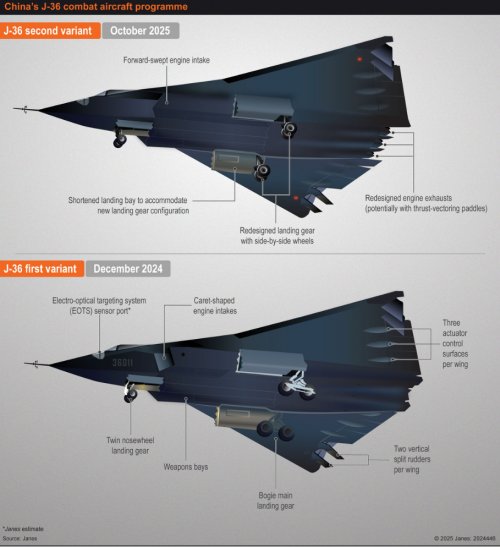
I disagree, based on the configuration and size of the J-36 along with it's control surface configuration, I see constant, high-mach trimming configuration (similar to XB-70) and two-stage/secondary propulsion with the second stage being the 3rd engine (with the dorsal inlet) for dash or high-speed cruise. This is not fighter. The split surfaces are definitely seem to be rudders/speed brakes (similar to the B-2) They did simplify the main gears (smart) to a standard two-wheel bogie configuration. B-21 has a simple, two wheel config. For fighters, they have the J-20, J-50 and whatever other tailless designs. Everyone's comments are still speculation just like mine are.
 
I don't know why we are still having a discussion about what J-36 is, the designers spelled it all out in the released paper. It's a new kind of fighter, as i like to call it a fightercruiser, or as others call it an airborne cruiser. Incidentally, at least one russian insider i follow said the J-36 is the closest thing to what the PAK-DP should/would be, a big, huge fuel capacity, very long range, huge bays (for assorted large A-A and A-G munitions), perfect aircraft for patrolling the vast Arctic areas, or as in China's case, vast Pacific areas.
 
I disagree, based on the configuration and size of the J-36 along with it's control surface configuration, I see constant, high-mach trimming configuration (similar to XB-70) and two-stage/secondary propulsion with the second stage being the 3rd engine (with the dorsal inlet) for dash or high-speed cruise. This is not fighter. The split surfaces are definitely seem to be rudders/speed brakes (similar to the B-2) They did simplify the main gears (smart) to a standard two-wheel bogie configuration. B-21 has a simple, two wheel config. For fighters, they have the J-20, J-50 and whatever other tailless designs. Everyone's comments are still speculation just like mine are.
I’m curious what you think is the reason why they swapped the trough like asymmetric nozzle for what appears to be 2D TVC for the stage 2 prototype.
 
I don't know why we are still having a discussion about what J-36 is, the designers spelled it all out in the released paper. It's a new kind of fighter, as i like to call it a fightercruiser, or as others call it an airborne cruiser. Incidentally, at least one russian insider i follow said the J-36 is the closest thing to what the PAK-DP should/would be, a big, huge fuel capacity, very long range, huge bays (for assorted large A-A and A-G munitions), perfect aircraft for patrolling the vast Arctic areas, or as in China's case, vast Pacific areas.
It's definitely not a fighter in the traditional sense. It won't be dogfighting with anything (not well at least). The F-14 would go out and control a region of airspace. A Backfire would go out and hit surface targets. This aircraft can do both. Some people appear to feel insulted that others are saying it's not a fighter. Why? It can kill aircraft, and kill ships. It's not just not going to be gunning down enemy aircraft. There's nothing wrong with that. Come to think of it, the closest analog might be what Kelly Johnson envisioned for the Blackbird: something that could react quickly and attack either aircraft (AIM-47) or ships (that "tool steel" munition he mentioned). It (the J-36) might also form a node in a targeting network.
 
It's definitely not a fighter in the traditional sense. It won't be dogfighting with anything (not well at least). The F-14 would go out and control a region of airspace. A Backfire would go out and hit surface targets. This aircraft can do both. Some people appear to feel insulted that others are saying it's not a fighter. Why? It can kill aircraft, and kill ships. It's not just not going to be gunning down enemy aircraft. There's nothing wrong with that. Come to think of it, the closest analog might be what Kelly Johnson envisioned for the Blackbird: something that could react quickly and attack either aircraft (AIM-47) or ships (that "tool steel" munition he mentioned). It (the J-36) might also form a node in a targeting network.
It’s just tiring and fatigue carried over from the J-20. Whereas from the lead designer himself, said the J-20 from the ground up was developed as an air superiority fighter. However foreign media and analysts kept on calling the J-20 an interceptor.

A sort of no we are right and the aircraft designer himself is wrong is sort of triggering don’t you think so? The we know better than you just rubs off the wrong way.
 
It’s just tiring and fatigue carried over from the J-20. Whereas from the lead designer himself, said the J-20 from the ground up was developed as an air superiority fighter. However foreign media and analysts kept on calling the J-20 an interceptor.

A sort of no we are right and the aircraft designer himself is wrong is sort of triggering don’t you think so? The we know better than you just rubs off the wrong way.
The J-36s designer is actually on record saying this thing is a dogfighter? Any chance you could post a link?
 
The J-36s designer is actually on record saying this thing is a dogfighter? Any chance you could post a link?
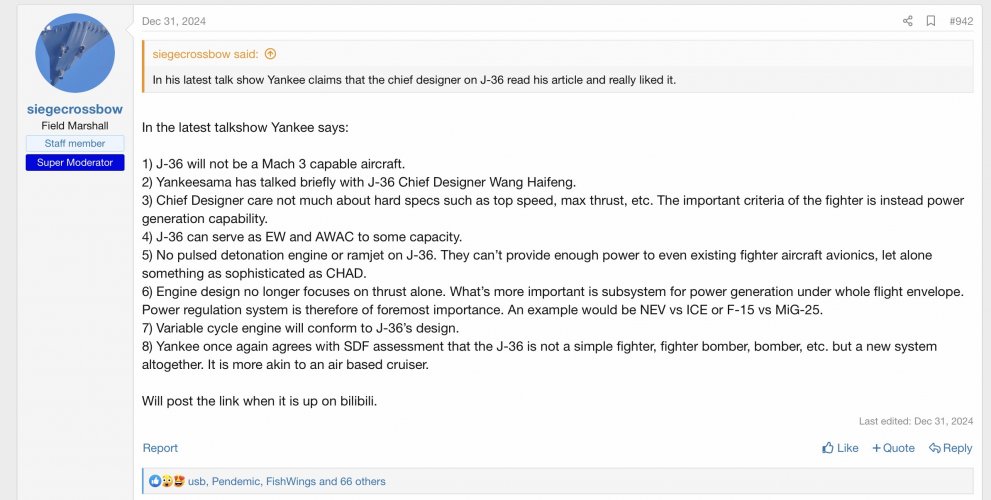
There’s no video interview of the conversation, so the usual suspects can claim it’s fake news. But Yankee, a huge military influencer from China has mutuals with Wang Haifeng. And had a conversation with him, the chief designer at chengdu and the J-36.

What was concluded was that “J-36 is not a simple fighter, fighter bomber, bomber, etc. but a new system altogether. It is more akin to an air based cruiser.”

Wang Haifeng himself has also written research papers in china on high performance 6th gen fighter technologies.

Also Air superiority =/= dogfighting. An air cruiser, a sort of multirole command node. This for some reason makes people laugh. It however is decisively not a bomber in role.

Does the J-36 not seem reminiscent of the J-20 and the J-20A/S, I’m not sure if it’s just me but the J-36 in role seems like a super J-20S. Both in controversy and methodology.

IMG_0112.jpeg
 
There’s no video interview of the conversation, so the usual suspects can claim it’s fake news. But Yankee, a huge military influencer from China has mutuals with Wang Haifeng. And had a conversation with him, the chief designer at chengdu and the J-36.

What was concluded was that “J-36 is not a simple fighter, fighter bomber, bomber, etc. but a new system altogether. It is more akin to an air based cruiser.”

Wang Haifeng himself has also written research papers in china on high performance 6th gen fighter technologies.

Also Air superiority =/= dogfighting. An air cruiser, a sort of multirole command node. This for some reason makes people laugh. It however is decisively not a bomber in role.

Does the J-36 not seem reminiscent of the J-20 and the J-20A/S, I’m not sure if it’s just me but the J-36 in role seems like a super J-20S. Both in controversy and methodology.

View attachment 793475
Yeah, that's basically what I said. It's designed to control a grid space, be it air or surface threat. It's not a dogfighter or interceptor. It needs to be quick, for reaction time, but it's not necessarily going to be cruising at high speed for extended periods of time.
 
The J-36s designer is actually on record saying this thing is a dogfighter? Any chance you could post a link?
A dogfighter doesn't constitute a fighter. Dogfights are completely irrelevant to essentially every fighter developed and deployed since the 80s. The capability has been kept on some as a back up. Not to mention that WVR nowadays is also simply slinging missiles, something the J-36 shouldn't have a problem with, although it's unlikely anything would ever come into visual range.
 
Last edited by a moderator:
A dogfighter doesn't constitute a fighter. Dogfights are completely irrelevant to essentially every fighter developed and deployed since the 80s.
So dogfighting is irrelevant to the J-20, J-35, J-16, J-50? Uhm, okay.
 
So dogfighting is irrelevant to the J-20, J-35, J-16, J-50? Uhm, okay.
Quite literally, yes. The J-20 carries short range AAMs for the unlikely scenario of something having to be shot down WVR. The PL-15s are the main armament. It doesn't even have a gun. And yet it's by far the most thoroughbred air superiority fighter currently in service.

Even the J-16, a descendant of the Su-27 all things considered, isn't inherently meant to dogfight. It can do it, probably quite well. But it's by far not one of the big concerns of the type.

And the J-36 and J-50 are developed in such a way that a WVR engagement is considered an extraordinary exception. And exception which would be resolved with a PL-15 or successor missile to the face of whatever managed to miraculously get within visual range. Dogfighting is totally irrelevant to their design.
 
Yeah, that's basically what I said. It's designed to control a grid space, be it air or surface threat. It's not a dogfighter or interceptor. It needs to be quick, for reaction time, but it's not necessarily going to be cruising at high speed for extended periods of time.
(Sticking head over parapet) I agree, loiter seems something it could do very well. Holding grid squares and acting as a sweeper if necessary to manage CCAs and seek out B-21s.
 
(Sticking head over parapet) I agree, loiter seems something it could do very well. Holding grid squares and acting as a sweeper if necessary to manage CCAs and seek out B-21s.
With that big wing, I'm kinda wondering if that 3rd engine might be to help it get to higher altitudes to see further.
 

Similar threads

Back
Top Bottom