
You are using an out of date browser. It may not display this or other websites correctly.
You should upgrade or use an alternative browser.
You should upgrade or use an alternative browser.
SAAB L-12
- Thread starter Justo Miranda
- Start date
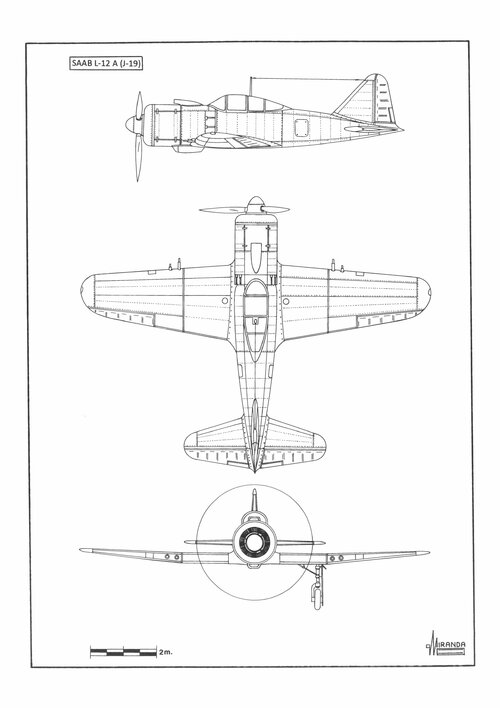
Additional info hereit looks like an A6M I wonder if there is more info on this plane?
Attachments




- Joined
- 25 July 2007
- Messages
- 4,919
- Reaction score
- 5,547
SAAB L-12
There really never was a "SAAB L-12".
The L 12 (or L12, or L.12, or L-12) was developed at ASJA under Erik Wilkensson to replace in-service J 8 Gladiators. The L 12 concept was submitted to the Flygvapnet which assigned it the projekt series designation P 9. As the P 9 design firmed up, the Flygvapnet committed itself, assigning the jaktflygplan designation J 19. However, by then, the Linköping firm had been merged into Svenska Aeroplan Aktiebolaget. The latter preferred to use Flygvapnet numbers for types, so the L 12 became the SAAB 19.
Alas, the SAAB 19/J 19 didn't get very far. Another design originating with ASJA - the L 10 aka P 7A - took priority. The P 7A was accepted for service as the B 17 (thereby becoming the SAAB 17) and the J 19 dropped from priority with both SAAB and the Flygvapnet - which had managed an emergency procurement of Regianne Re.2000s in the meantime.

- Joined
- 26 May 2006
- Messages
- 38,289
- Reaction score
- 20,430
From old site on Net,
the outbreak of war in Europe in September 1939 found the Swedish Air Force—Svenska Flygvapnet—completely unprepared to secure the country's neutrality and face a potential attacker. At the time, the Flygvapnet possessed only about 140 combat aircraft, of which only a few could be considered modern. The basic fighter aircraft were the obsolete J 7 (British Bristol "Bulldog" Mk II/Mk IIA) and J 8 (also British Gloster "Gladiator" Mk I) and J 8A ( "Gladiator" Mk II). Efforts were then made to purchase aircraft from the United States and other countries, and intensive work was undertaken to develop their own fighter aircraft.
As early as April 1939, the Air Force sent a request for proposals to SAAB and AB Götaverken (GV) for the development of a new fighter. The initial work schedule called for project completion by September 15, 1939, the prototype's first flight on July 1, 1941, and deliveries to units on July 1, 1943. Renowned aircraft designer Bo Lundberg of GV soon submitted a preliminary design for the GP 9 fighter, and after that company withdrew from aviation operations, further work was taken over by a new factory, AB Flygplanverken (AFV), founded by Lundberg. Flygvapnet assigned the GP 9 the preliminary military designation P 9B (P for Prov = test).
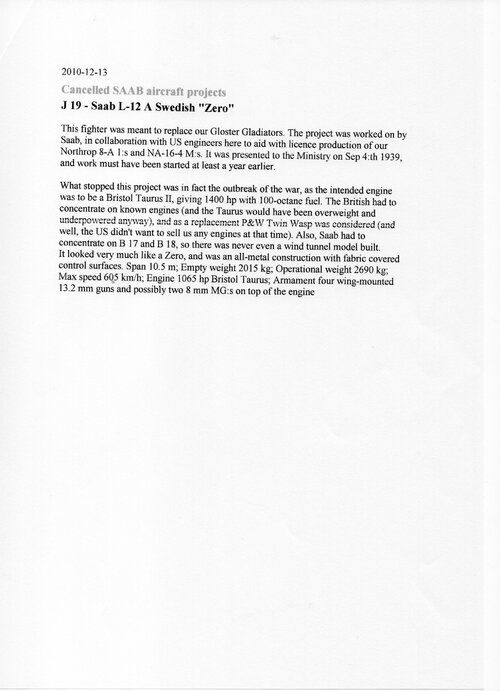
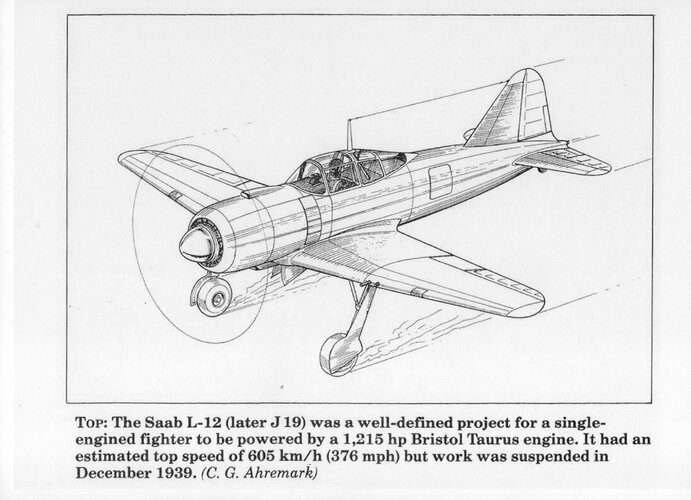
Meanwhile, on September 4, 1939, SAAB (by then merged with ASJA) presented the Ministry of Aviation with a preliminary design for its fighter aircraft, designated L-12. It was developed by engineer Frid Wänström in the incredibly short timeframe of just a few days in the summer of 1939. The aircraft was conceived as a successor to the J-8 fighters and was to be a modern, cantilever, low-wing monoplane of metal construction with retractable landing gear and an enclosed cockpit. American specialists who were then stationed at ASJA and SAAB also participated in its development, helping to introduce license-built Douglas Model 8A-1 bombers (Swedish military designation B 5 ) and North American NA-16-4M trainer aircraft (Swedish designation Sk 14).
The aircraft was planned to be powered by a British Bristol "Taurus" II radial engine, with an expected power output of as much as 1,400 hp. However, Bristol's cancellation of this engine and the lower-than-expected power output of the Swedish designers cast doubt on the aircraft's calculated performance. Although Flygvapnet expressed initial interest in the L-12, preferring it over the nearly one-third more expensive GP 9, the project was not further developed. The aircraft received the military designation P 9A , which was changed to P 19 in 1940 due to a change in the designation system for Swedish military aircraft , and ultimately to J 19 (J for Jakt = fighter), but not even a model of the aircraft was built for tunnel testing. SAAB focused on design work on the B 17 and B 18 bombers and the much more technologically advanced J 21 and J 23 fighters .
The critical equipment situation of Flygvapnet meant that, in order to temporarily strengthen the air force, 72 obsolete FIAT CR-42bis "Falco" biplane fighters (Swedish military designation J 11) were purchased from Italy, and in November 1940 also 60 slightly more modern Reggiane Re-2000 monoplanes (Swedish designation J 12, and later J 20). Furthermore, the air force - regardless of industry - started its own fighter aircraft development program, which led in 1941 to the development of the quite successful light aircraft FFVS J 22 .
the outbreak of war in Europe in September 1939 found the Swedish Air Force—Svenska Flygvapnet—completely unprepared to secure the country's neutrality and face a potential attacker. At the time, the Flygvapnet possessed only about 140 combat aircraft, of which only a few could be considered modern. The basic fighter aircraft were the obsolete J 7 (British Bristol "Bulldog" Mk II/Mk IIA) and J 8 (also British Gloster "Gladiator" Mk I) and J 8A ( "Gladiator" Mk II). Efforts were then made to purchase aircraft from the United States and other countries, and intensive work was undertaken to develop their own fighter aircraft.
As early as April 1939, the Air Force sent a request for proposals to SAAB and AB Götaverken (GV) for the development of a new fighter. The initial work schedule called for project completion by September 15, 1939, the prototype's first flight on July 1, 1941, and deliveries to units on July 1, 1943. Renowned aircraft designer Bo Lundberg of GV soon submitted a preliminary design for the GP 9 fighter, and after that company withdrew from aviation operations, further work was taken over by a new factory, AB Flygplanverken (AFV), founded by Lundberg. Flygvapnet assigned the GP 9 the preliminary military designation P 9B (P for Prov = test).
Meanwhile, on September 4, 1939, SAAB (by then merged with ASJA) presented the Ministry of Aviation with a preliminary design for its fighter aircraft, designated L-12. It was developed by engineer Frid Wänström in the incredibly short timeframe of just a few days in the summer of 1939. The aircraft was conceived as a successor to the J-8 fighters and was to be a modern, cantilever, low-wing monoplane of metal construction with retractable landing gear and an enclosed cockpit. American specialists who were then stationed at ASJA and SAAB also participated in its development, helping to introduce license-built Douglas Model 8A-1 bombers (Swedish military designation B 5 ) and North American NA-16-4M trainer aircraft (Swedish designation Sk 14).
The aircraft was planned to be powered by a British Bristol "Taurus" II radial engine, with an expected power output of as much as 1,400 hp. However, Bristol's cancellation of this engine and the lower-than-expected power output of the Swedish designers cast doubt on the aircraft's calculated performance. Although Flygvapnet expressed initial interest in the L-12, preferring it over the nearly one-third more expensive GP 9, the project was not further developed. The aircraft received the military designation P 9A , which was changed to P 19 in 1940 due to a change in the designation system for Swedish military aircraft , and ultimately to J 19 (J for Jakt = fighter), but not even a model of the aircraft was built for tunnel testing. SAAB focused on design work on the B 17 and B 18 bombers and the much more technologically advanced J 21 and J 23 fighters .
The critical equipment situation of Flygvapnet meant that, in order to temporarily strengthen the air force, 72 obsolete FIAT CR-42bis "Falco" biplane fighters (Swedish military designation J 11) were purchased from Italy, and in November 1940 also 60 slightly more modern Reggiane Re-2000 monoplanes (Swedish designation J 12, and later J 20). Furthermore, the air force - regardless of industry - started its own fighter aircraft development program, which led in 1941 to the development of the quite successful light aircraft FFVS J 22 .
Similar threads
-

-

-
SAAB, Svenska Aeroplanaktiebolaget, Svenska Aeroplan AB, Saab AB aircraft list.
- Started by blockhaj
- Replies: 41
-

-
