Canada Future fighter capability project (ex-Next Generation Fighter Capability)

This remains a bit of a wildcard:

https://www.saab.com/markets/canada/gripen-for-canada
SAAB said:
Gripen for Canada

The "no compromise" choice for Canada's new fighter. Gripen offers advanced capabilities, the best economic benefits and budget stability - a once in a generation opportunity.

Made, maintained and upgraded in Canada

Gripen is the only remaining competitor offering a guaranteed price and economic benefits. The newest and fastest fighter on offer, Gripen was built for Canada's climate conditions and strategic requirements. It has the longest range and best fuel efficiency. Best of all, Gripen is a revolutionary breakthrough in fighter design that makes technological upgrades fast and easy - a critical feature for military equipment intended to serve for decades.

Gripen and Aerospace R&D Centers

Saab has teamed with leading Canadian companies such as CAE, IMP Aerospace and Defence, Peraton and GE on the Gripen offer. As part of the industrial package for Canada Saab will establish two new aerospace centers in the Greater Montreal Region. These centers will help support a resurgent aerospace industry in Canada, building on domestic excellence, while spurring development in new areas of research and giving the next generation of talented Canadians a career route and future.

A recent article going over the same considerations debated here, from a Canadian perspective (May 27, 2025):

https://thewalrus.ca/what-would-it-take-for-canada-to-build-its-own-fighter-jets-again/
But as fighter plane and other defense salesfolk go around, they also come around (slightly dated, April 15, 2025):

https://www.cbc.ca/news/politics/south-korea-fighter-jet-f-35-contract-1.7510220
 
Well, Canada is indeed a political opportunity for Saab (in a same way one German AF Commander lost his job mentioning F-35 too much...at least anecdotally), opened by last election.

But CAF will fight bitterly against it.

Though, if successful, this will of course outdo any opportunities gripen had before this point.
 
On the "bit of a wildcard" scenario:

https://www.flightglobal.com/fixed-...ition-costs-will-nearly-double/163296.article
Ryan Finnerty said:
...

A report from the office of the Canadian Auditor General finds the Royal Canadian Air Force (RCAF) will ultimately pay nearly twice the 2022 estimate of C$19 billion ($13.8 billion) to field 88 Lockheed Martin F-35As.

...

Notably, that projection does not include an additional C$5.5 billion in spending on munitions and infrastructure upgrades that will be required to reach full operational capability on the F-35 fleet.

...

The RCAF is in the process of fielding an entirely new fleet of training aircraft, but has notably not yet identified an advanced jet trainer to prepare aviators to operate the complex F-35A.

...

Canadian Prime Minister Mark Carney, who was swept into office riding a wave of anti-Trump sentiment in Canada, has directed the Department of National Defence to review the planned F-35 acquisition, including looking at alternative options.

However, the RCAF will field at least a portion of the 88 F-35s currently planned, for which Ottawa is already contractually committed.

“We’re taking delivery of a number of F-35s already under the existing contract,” Carney said in April.

“What we’re reviewing, in effect, is the back end of the contract to ensure that we’re getting value for money, that we’re sure that we’re maximising not just our ability to protect Canada, but the economic benefits here in Canada — and we are considering it in the context of alternatives,” he added.

...

In a March editorial, retired General Tom Lawson argued that abandoning the F-35 would harm Canada far more than it would the USA, both in terms of military capability and in the likely loss of lucrative supply contracts that dozens of Canadian aerospace firms won under the F-35 programme.

...

By contrast, former Canadian air force chief Lieutenant General Yvon Blondin has urged caution, describing the current F-35-only solution to fighter modernisation as “irresponsible” and likening it to “hoping for the best”.

...

Both officers acknowledge the financial and logistical challenge that a small force like the RCAF would face in operating a mixed-fleet of multiple fighter types, should Ottawa opt to reduce its F-35 buy and also procure Dassault Aviation Rafales or Saab Gripen E/Fs.

A very clarifying article. SAAB is apparently trying to offset any F-35 supply contract losses Canada might face with their "made in Canada" offer. Undoubtedly Gripen doesn't require nearly the kind of infrastructure investment the F-35 does, being designed for easy maintenance and dispersed operations by conscripts and reservists from the get go. I'm also half seriously wondering whether Gripens (at least two seaters) could somehow be classified as "advanced trainers"; this also raises the possibility that Canada will end up with far less than 88 F-35s but a whole heap of "KAI FA-50C" advanced trainer/light combat jets. In any case Canada could get ~1.5 times Gripens and ~2 times FA-50Cs for the price of every F-35, perhaps even more, considering infrastructure and maintenance.
 
That is just substituting one U.S. platform for another. This is a political decision, not a practical one.
yeah that's pretty much what I felt too..

F-15 (even back in the 80s/90s) would have been the best choice for Canada...
but with today, Canadians haven't forgotten about the Boeing scandals, and many Canadians have soured over cross border relations.
While the Gripen has US parts, its all a perception thing, and it'll be perceived as the government diversifying its fleet.
 
Why look only at Gripen and not other alternatives? Eurofighter, Rafale, KF-21…

With a properly structured RFP Canada could ask for pricing on different fleet sizes (e.g. 18 vs 24 vs 30 vs 36), and determine whether it prefers a larger number of Gripen vs a smaller number of more capable fighters.
 
Last edited:
Why look only at Gripen and not other alternatives? Eurofighter, Rafale, KF-21…

With a properly structured RFP Canada could ask for pricing on different fleet sizes (e.g. 18 vs 24 vs 30 vs 36), and determine whether it prefers a larger number of Gripen vs a smaller number of more capable fighters.
While the choice may be political, once a U.S. company is ruled out actual cost and availability becomes a thing again. KF-21 is not in production, euro fighter is over priced, and Rafael is…French.
 
Why look only at Gripen and not other alternatives? Eurofighter, Rafale, KF-21…

With a properly structured RFP Canada could ask for pricing on different fleet sizes (e.g. 18 vs 24 vs 30 vs 36), and determine whether it prefers a larger number of Gripen vs a smaller number of more capable fighters.
Dassault and Eurofighter dropped out on their own. Boeing was asked to close the door, from the outside.
SAAB, while complaining about unfair competition, is in most need, and kept in the room.
Plus they're the cheapest bid, i.e. one with best chances for Canadians to somehow explain their behaviour.

No one else entered.
 
Eurofighter and Dassault dropped out due to the NORAD and/or five eyes requirements (Dassault for both, Eurofighter for NORAD).
However assuming this now changes to a joint F-35 plus Other design, and that the Other aircraft does not need to meet NORAD or five eyes requirements..
Then I think Typhoon, Rafale, Gripen, could all be reconsidered, as the F-35 meets those requirements.
It also depends on deliveries (of either the F-35 or the other planes), as the Canadian Hornets are long in the tooth.
 
Also the last competition was 6-7 years ago. Before Trump, before Ukraine, before delays to Gripen E’s rollout, before upgrade programs for Rafale and Eurofighter… so selection criteria and each company’s appetite for the deal have likely changed.
 
I am Canadian and have followed the F-35 saga on and off since before this thread was created.

Canada signed onto the program in the 1990s under a Liberal government for industrial participation reasons, though I imagine it was also more or less presumed we would eventually buy the resulting aircraft to replace our Hornets.

Fast forward to 2010 when the F-35 program was having major issues. The Conservative government of the day announced they were going to do a sole source contract for sixty five F-35s with delivery starting in 2017 at cost figures that were very optimistic especially in light of how the program was faring at the time. The Parliamentary Budget Officer disputed those figures, taking a very pessimistic stance at least partly on the basis that the F-35 had more in common with the F-22 the F-16. It turned into a political controversy with the Conservatives doubling down on sole sourcing the F-35 while the Liberals promised to hold a competition. Then the value of the Canadian dollar relative to the US dollar dropped significantly and the government kicked the can down the road and didn't actually go through with the sole source purchase.

Fast forward to 2015. There's an election and the leader of the Liberals got carried away and said they would buy a cheaper aircraft instead of the F-35 but post election that kind of got glossed over/walked back to holding a open competition that the F-35 could participate in. Though the government also tried to make a sole source purchase of IIRC 18 Super Hornets, supposedly on the grounds that the existing Hornet fleet wasn't big enough to be able to simultaneously fulfill commitments to both NORAD and NATO. The actually rather hefty price tag of adding Super Hornets to a fleet that operates legacy Hornets might have killed that even had Boeing not decided to cash in on the new president's trade war shenanigans and got some massive (IIRC something like 200 or 300%) tariffs put on regional jets made by Canadian manufacturer Bombardier. But Boeing's involvement in making that happen definitely made the Super Hornet deal a no go even if the costs hadn't and the government purchased some used Hornets from Australia instead.

Anyway the Liberals did stick to the requirement for more jets so when the competition was held it was for 88 jets rather then 65. But the competition took a long time. I suspect the Liberals might have wanted to delay the selection til after they had won re-election though given our genuine issues with running military procurements I can't entirely dismiss the claim that the agency managing the competition couldn't handle it at the same time as the competition for new surface combatants for the Navy (I think it was for the surface combatants anyway -IIRC the new surface combatants are still considered the largest military procurement in Canadian history). The government actually did make changes to how military procurement was done to try to make it run better.

Anyway since the initial controversy the F-35 program had experienced leadership change and had spent several years aggressively righting its ship and getting costs under control. Costs were down to a reasonable level and technical maturity was up and when the competition was held the F-35 won. Things dragged a bit with negotiations to finalize the details on the initial batch of F-35s but eventually that was signed and things seemed more or less a done deal. At least until more tariffs and the president's comments about how Canada never made sense as an independent country and will be made into the 51st state made a lot of Canadians really upset...
 
Last edited:
https://en.defence-ua.com/weapon_an...the_answer_requires_a_broader_view-16311.html
A good argument for Ukraine investing more in a partnership with SAAB wrt development of UCAVs aimed at augment the role of Gripen E fighters. Instead of say F15EXs or F35s to complete the requirements for an airforce with full spectrum air operations capabilities. As those are the two that offer a considerable advantage over the Rafale. And UCAVs armed with a myriad of sensors could fulfill that gap.

https://defence-ua.com/news/vzhe_zj...ashkoditi_lokalizatsiji_v_ukrajini-20719.html
Another argument for supporting Canadian Gripen manufacturing line. Canada already has defence partnerships with SAAB wrt the Global Eye system. This could be an expansion of such an initiative which would greatly enhance the amount of Gripen fighters available.
 
Some further reporting about JAS Gripen's prospects in Canada just from the last 24 hours. In a different era, some three or four years ago, I was somewhat idly musing about fmr. U.S. Air Force chief of staff (CQ Brown) raising the prospect of an affordable clean sheet "4.5/5- Gen." fighter and how the Gripen E actually fit the bill pretty well. Sic transit and all of that jazz but Nordic Canadian integration certainly makes a lot of practical sense as well.

On CTV News

Genevieve Beauchemin on CTV News said:
SAAB President and CEO Micael Johansson confirmed to CTV News during an interview at the company’s headquarters in Stockholm that he has talked to Ottawa about making Gripens on Canadian soil. He says companies including Bombardier and CAE, which are both headquartered in Montreal, as well as Nova Scotia-based IMP Aerospace and Defence, could be part of a deal.

The Globe and Mail's write-up

And Ottawa Citizen for good measure

Edit 1:

Avro Canada once almost made "Arrow" happen, perhaps this more diminutive delta could be called the "Bolt" in its localized RCAF guise.

Edit 2:

Et en français aussi

Daniel Leblanc sur Radio-Canada INFO said:
...

Le politologue Philippe Lagassé affirme que la Suède est un modèle pour le Canada.

"On a beaucoup de leçons à apprendre de la part de la Suède, non seulement au niveau militaire, mais également au niveau de l'industrie de la défense. C'est un pays qui a bâti une industrie autonome qui a un grand succès à l'échelle internationale", affirme le professeur à la Norman Patterson School of International Affairs.

...

Justin Massie croit que la volonté suédoise de partager ses technologies offre un avantage à long terme au Canada, surtout si le Canada participe à la création des prochaines générations d’avions de chasse.

"Il faut arrêter de penser qu'une acquisition, c'est juste acheter quelque chose. Il faudra utiliser de manière stratégique les développements que l'on fait avec certains pays, via des acquisitions, pour développer ces partenariats et investissements à long terme pour développer chez nous une plus grande autonomie stratégique", dit-il.
 
Last edited:
https://www.cbc.ca/news/politics/f-35-gripen-dnd-competition-9.6992167?__vfz=medium=sharebar

F-35 beat Gripen fighter jet 'by a mile' in 2021 Defence Department competition​

Data obtained by Radio-Canada shows Lockheed Martin jet was clear winner

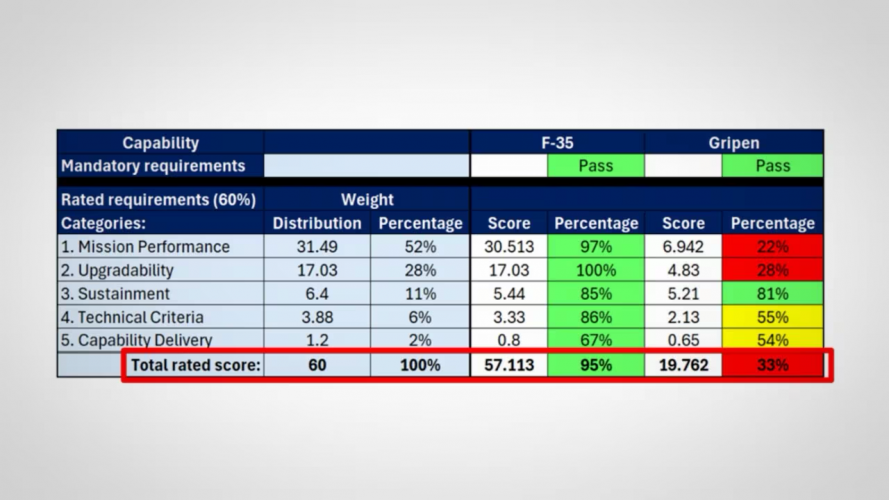
The F-35 got a score of 95 per cent on military capabilities, with a total of 57.1 points out of 60.

By contrast, the Gripen-E finished with a score of 33 per cent, netting 19.8 points out of 60, according to the Department of National Defence (DND) ranking obtained by Radio-Canada.

image.png
 
Former Gripen pilot Mikael Grev discussing the merits of the E and F-35 in the context of Canada. His idea is not to offer a head to head comparison but a more nuanced discussion about capabilities (mainly in terms of airframes). This was published a couple of months back but it holds up well and is pretty even handed despite the writer's obvious familiarity with the jet he used to fly.

https://nordicdefencesector.com/en/article/gripen-e-vs-f-35-the-wrong-question-to-ask
 
Former Gripen pilot Mikael Grev discussing the merits of the E and F-35 in the context of Canada. His idea is not to offer a head to head comparison but a more nuanced discussion about capabilities (mainly in terms of airframes). This was published a couple of months back but it holds up well and is pretty even handed despite the writer's obvious familiarity with the jet he used to fly.

https://nordicdefencesector.com/en/article/gripen-e-vs-f-35-the-wrong-question-to-ask
Disagree on his objectiveness and his assessment is way off in a number of areas. The Canadian evaluation far and away gives the real difference in capability between the platforms and that is supported by the Finnish result, and every other result which has pitted the two aircraft against each other under evaluation criteria.
 
Disagree on his objectiveness and his assessment is way off in a number of areas. The Canadian evaluation far and away gives the real difference in capability between the platforms and that is supported by the Finnish result, and every other result which has pitted the two aircraft against each other under evaluation criteria.

Mikael Grev said:
Full disclaimer: I'm a former Gripen pilot. That probably makes me biased, but I’ll try to be as objective as possible, even if that’s not entirely achievable. And for the record, I haven’t been asked by Saab to write this, nor have I asked them to approve it.

Since the last Canadian evaluation their criteria may have changed somewhat due to developments. For the sake of global stability in terms of middle powers, an increased, distributed capability to produce fighters in not a bad thing at all. In my highly insignificant opinion there is currently no good fit in terms of airframe capability apart from projects that may all be too far into the future to bridge the gap, i.e. the likes of GCAP. In this regard though, a Gripen E/SAAB FCAS combo is intriguing as well and may not be too far off.

Meanwhile, it seems that Canada has now committed to a minimum of 30 F-35, instead of the initial 16. Whether this cannibalizes the possibility of a future mixed fleet w/Gripen into effective oblivion remains to be seen.

https://www.cbc.ca/news/politics/canada-f35-purchase-components-9.7081240
 
Meanwhile, it seems that Canada has now committed to a minimum of 30 F-35, instead of the initial 16. Whether this cannibalizes the possibility of a future mixed fleet w/Gripen into effective oblivion remains to be seen.
30 F-35 and 60 Gripen E may be viable and potent.

Sole weakness (but already there in case of a full F-35 fleet ) : single engine for such a big country is regrettable. But is was already the Brazil choice.
 
30 F-35 and 60 Gripen E may be viable and potent.

Sole weakness (but already there in case of a full F-35 fleet ) : single engine for such a big country is regrettable. But is was already the Brazil choice.
Modern engine reliability is orders of magnitude better than when Canada made that requirement.

F110/CFM56s basically don't come off the airframe for the life of the airframe. Airline pilots go entire careers without having a real engine-out emergency.
 
Modern engine reliability is orders of magnitude better than when Canada made that requirement.

F110/CFM56s basically don't come off the airframe for the life of the airframe. Airline pilots go entire careers without having a real engine-out emergency.
I agree re engine reliability and the CFM56 but will challenge you re F110s or any other military fighter engine.
 
People need to recognise that Saab is pushing hard to make a sale of the Gripen E/F to Canada. They feel that the current political situation between Canada and the USA gives them an opening. However it is not realistic that the Gripen , despite being a good aircraft, can provide a serious alternative in capability to the F-35 for the RCAF. If the Canadians seriously want something to provide an alternative (and one that reduces dependence upon the USA since that is one of the underlying themes here), they would be better off looking at the Typhoon or Rafale. Remember also that Canada has been participating in the F-35 program since 1997 so that is not something easily thrown away.

Don't get fooled by the marketing push.
 
People need to recognise that Saab is pushing hard to make a sale of the Gripen E/F to Canada. They feel that the current political situation between Canada and the USA gives them an opening. However it is not realistic that the Gripen , despite being a good aircraft, can provide a serious alternative in capability to the F-35 for the RCAF. If the Canadians seriously want something to provide an alternative (and one that reduces dependence upon the USA since that is one of the underlying themes here), they would be better off looking at the Typhoon or Rafale. Remember also that Canada has been participating in the F-35 program since 1997 so that is not something easily thrown away.

Don't get fooled by the marketing push.
Further to this, note the latest news re Canada and the F-35 here:

https://www.secretprojects.co.uk/th...strike-fighter-jsf.17732/page-187#post-878537
 
If the Canadians seriously want something to provide an alternative (and one that reduces dependence upon the USA since that is one of the underlying themes here), they would be better off looking at the Typhoon or Rafale. Remember also that Canada has been participating in the F-35 program since 1997 so that is not something easily thrown away.
They're looking for sensible supplement and affordable alternative, rather than just (worse) alternative.
Rafale and Eurofighter fail in that one way or another.

Neither Rafale nor Eurofighter propose something Canada really needs. Gripen does, it (substantially) reduces costs - and F-35 costs were a subject of controversy for well over a decade.
Rafale and Eurofighter do deliver secondary benefits (interceptor performance/independence), but so does Gripen.
Former Gripen pilot Mikael Grev discussing the merits of the E and F-35 in the context of Canada. His idea is not to offer a head to head comparison but a more nuanced discussion about capabilities (mainly in terms of airframes). This was published a couple of months back but it holds up well and is pretty even handed despite the writer's obvious familiarity with the jet he used to fly.

https://nordicdefencesector.com/en/article/gripen-e-vs-f-35-the-wrong-question-to-ask
I sometimes can't help but wonder, whether SwAF have political education classes with SAAB comissars in NKVD uniform, ready to shot someone who can't recite that.
 
Last edited:
Modern engine reliability is orders of magnitude better than when Canada made that requirement.

F110/CFM56s basically don't come off the airframe for the life of the airframe. Airline pilots go entire careers without having a real engine-out emergency.
Agree 100%, in the US context the single engine is in most cases as or more reliable than two. The F-15 and F-16 engine statistics have proven this out over the last twenty years of operation as the F-15 fleet has had more engine out issues than the F-16.
I agree re engine reliability and the CFM56 but will challenge you re F110s or any other military fighter engine.
For the F100 you can see the stats here which clearly favours the F-16 for inflight issues even though it is the same engine.

F-16:
https://www.safety.af.mil/Portals/71/do ... PW-229.pdf

F-15
https://www.safety.af.mil/Portals/71/do ... PW-229.pdf

The F-15 has had multiple Class A mishaps related to the engine, while the F-16 has zero.

Since the last Canadian evaluation their criteria may have changed somewhat due to developments. For the sake of global stability in terms of middle powers, an increased, distributed capability to produce fighters in not a bad thing at all. In my highly insignificant opinion there is currently no good fit in terms of airframe capability apart from projects that may all be too far into the future to bridge the gap, i.e. the likes of GCAP. In this regard though, a Gripen E/SAAB FCAS combo is intriguing as well and may not be too far off.
The strategic landscape hasn't changed on what Canada want, just their appetite for where they source the item has.

Can't see Canada going FCAS no matter who the partners are.
They're looking for sensible supplement and affordable alternative, rather than just (worse) alternative.
Rafale and Eurofighter fail in that one way or another.
Are they looking for affordable, I haven't seen that or any other actual criteria for what they now want other than the US not being the supplier. Given the US content on Gripen that should actually exclude it from serious consideration.
Neither Rafale nor Eurofighter propose something Canada really needs. Gripen does, it (substantially) reduces costs - and F-35 costs were a subject of controversy for well over a decade.
All well and good to buy something that purportedly has lower costs but the intent of buying military equipment is to use it to win a conflict. Gripen is not that aircraft when the F-35 is available.
 
Agree 100%, in the US context the single engine is in most cases as or more reliable than two. The F-15 and F-16 engine statistics have proven this out over the last twenty years of operation as the F-15 fleet has had more engine out issues than the F-16.

For the F100 you can see the stats here which clearly favours the F-16 for inflight issues even though it is the same engine.

F-16:
https://www.safety.af.mil/Portals/71/do ... PW-229.pdf

F-15
https://www.safety.af.mil/Portals/71/do ... PW-229.pdf

The F-15 has had multiple Class A mishaps related to the engine, while the F-16 has zero.


The strategic landscape hasn't changed on what Canada want, just their appetite for where they source the item has.

Can't see Canada going FCAS no matter who the partners are.

Are they looking for affordable, I haven't seen that or any other actual criteria for what they now want other than the US not being the supplier. Given the US content on Gripen that should actually exclude it from serious consideration.

All well and good to buy something that purportedly has lower costs but the intent of buying military equipment is to use it to win a conflict. Gripen is not that aircraft when the F-35 is available.
Hasn't it been shown repeatedly that the f-35 is not any more expensive then the gripin in all these competitions (Canada, Finland, swisserland) ,the benefits of building 3000+ of the things.
 
Last edited:
Gripen E for Canada, as part of a mixed fleet with F-35s, probably causes more cost issues due on the additional logistics, despite having a lower operational cost than F-35s. Not sure if NORAD compliance will be pushed but it could add to costs as well. it also doesn't really give content independence either due to parts from the US. But politically.. the general public doesn't really know or care too much. All they will see is "our leaders are sticking it to the US by buying Swedish", and that increases political support.

If it were me, I'd get the FA-50 instead to serve as a lead in fighter trainer to replace the Hawk, and to do light policing, leaving the remaining F/A-18s and F-35s to do the front line work, as well as giving pilots more flying hours. Long term, invest in GCAP if they still want to reduce dependency on the US.
 
Back
Top Bottom