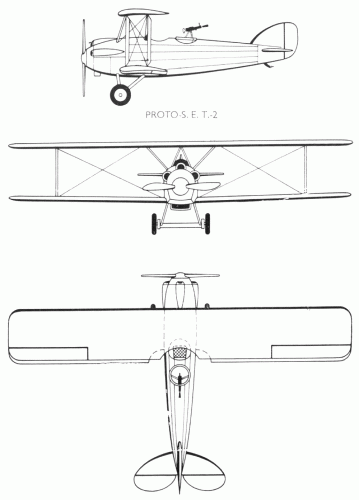
From old site on the Net,
the SET Aircraft manufacturer was founded in Bucharest in 1923 and for many years specialized in the production of single-engine biplane multi-role and training aircraft. In 1934, in response to requirements formulated by the Romanian Air Force, Aeronautica Militara Românã, SET designers began work on a fighter aircraft design to replace the obsolete French Dewoitine D-27 fighters, built in Romania under license at the IAR plant.
Engineer Grigore C. Zamfirescu was the chief designer of the new aircraft, designated SET XV (sometimes also seen as SET 15 or SET-15 ). It was a single-engine, single-seat biplane (or more accurately, due to the significant difference in the wingspan of the upper and lower wings, a so-called sesquiplane) with braced wings, of metal construction and fabric covering, armed with two 7.62 mm machine guns. It was powered by a Gnôme-Rhône 9Krsd radial engine in a NACA cowling. The aircraft had a covered cockpit and fixed landing gear with a tailwheel. The main wheels were covered with aerodynamic fairings. The aircraft was also equipped with an oxygen system and a radio station.
In 1934, a single SET XV prototype was built and first flew the same year. In addition, one airframe was completed for static testing (according to [2], a dozen or so production examples were built, but this is incorrect). The aircraft underwent comparative flight tests with competing IAR-15 and IAR-16 monoplane fighters, built by IAR to meet the same military requirements. As a result of these tests, the SET XV biplane was deemed obsolete and unsuitable for further development, and therefore further development was abandoned. The prototype flew for some time (probably until the early 1940s) at the Escadrila de Experiente experimental facility in Pipera, after which it was scrapped.
The IAR-15 also did not enter mass production, although several examples were built. The IAR-16, the most modern of the three and characterized by all-metal construction, remained only a prototype and, until the development of the IAR-80, was the last indigenously designed fighter aircraft built in Romania. Romania, however, purchased a license to produce the Polish PZL P.11f version, which became the primary combat aircraft of the country's fighter units for many years.