Rotating Detonation Engines

At least for typical Nickel alloys, 3d printing gives much better mechanical properties than casting. Nickel alloys tend to have an uniform composite distribution when being casted.
That may be changing.

Professor Young Seop Kim of POSTECH claims that (through "core-shell" structure) a new such alloy has been made-soley through casting--with a yield strength 1,029 MPa, a tensile strength of 1,271 MPa, and an elongation of 31.1% as per today's phys.org reporting on an upcoming article from Vol. 242 of the Journal of Materials Science & Technology:

Fingers crossed. Vol. 242 also has other articles of interest. Here's to hoping that casting method replicates and is real.
 
Last edited:
That may be changing.

Professor Young Seop Kim of POSTECH claims that (through "core-shell" structure) a new such alloy has been made-soley through casting--with a yield strength 1,029 MPa, a tensile strength of 1,271 MPa, and an elongation of 31.1% as per today's phys.org reporting on an upcoming article from Vol. 242 of the Journal of Materials Science & Technology:

Fingers crossed. Vol. 242 also has other articles of interest. Here's to hoping that casting method replicates and is real.

If you add a link, you should read and understand the text before. Here is writen:

''The integral core–shell structure originates from localized bulging at the grain boundaries during hot rolling. Subsequent heat treatment leads to the simultaneous formation of both core and shell regions within a single grain. To elucidate the underlying mechanism, we characterize the microstructural evolution of the hot-rolled and heat-treated samples.''

So how do we cast a complex aerospyke with a network of cooling channels inside and perform a hot rolling process with it after the casting???
 
Last edited:
This is where 3D printed channel "sprue" may be of use. Some plastic supports are made to dissolve. I am thinking you could use ultrasonics to shatter a print you want to be crumbly that a stronger casting can form around.

There should be some approaches to allow openings. Dissolve some structures, etc. In general, folks want 3D prints stronger. It may be that having some a bit weaker could be of use.

Vibration may shatter a print, not a casting--just ream it out good.

For aerospace
 
Last edited:
Yeah, but show me the way you can do a fancy complex castig of a large part with that properties you describes.

Printed parts out of nickel alloys tend to have more strength and less impurities than cast parts. You have a wrong idea about castings, especially about casting nickel alloys. Casted parts are not stronger nor less risky and failures are more likely to appear, especially with large and complex structures
 
Last edited:
Venus Aerospace: "We flew the first ever high-thrust RDRE," Duggleby said. "I don't know that there's an actual comparison right now."

It is not a rocket engine but merely a ramjet, so not an RDRE but merely an RDE.

And what do they mean by "high-thrust"?
How much thrust did that engine in the video actually produce?
That absolutely is a rocket engine; many students build and fly similar conventional liquid rockets in undergrad, you just daisy chain some scuba tanks then bolt some fins to it. This is a lot easier with kerosene and peroxide too as compared to the dual cryos some teams are running. RDREs are actually easier to get running than RDEs as the excess nitrogen in air is (mostly) inert and just sap energy, complicating detonation mechanics. pure oxidizers make reactions far more energetic, meaning it's pretty easy to sustain a detonation mode (or at least something resembling detonation).

"High thrust" is absolutely just marketing jargon trying to differentiate themselves from the polish team that flew an RDRE a few years back with a far simpler (and presumably cheaper) system. I'd recon they made on the order of 1000-2000 lbf based on how the rocket flew
 
That absolutely is a rocket engine; many students build and fly similar conventional liquid rockets in undergrad, you just daisy chain some scuba tanks then bolt some fins to it. This is a lot easier with kerosene and peroxide too as compared to the dual cryos some teams are running. RDREs are actually easier to get running than RDEs as the excess nitrogen in air is (mostly) inert and just sap energy, complicating detonation mechanics. pure oxidizers make reactions far more energetic, meaning it's pretty easy to sustain a detonation mode (or at least something resembling detonation).

"High thrust" is absolutely just marketing jargon trying to differentiate themselves from the polish team that flew an RDRE a few years back with a far simpler (and presumably cheaper) system. I'd recon they made on the order of 1000-2000 lbf based on how the rocket flew
I thought it would be air breathing ...:(

Without air breathing, RDRE I don't see how it will bring any substantial advantages over conventional rockets.
 
I thought it would be air breathing ...:(

Without air breathing, RDRE I don't see how it will bring any substantial advantages over conventional rockets.

From memory, a hydrogen oxygen PDR has an ISP of 1200. The advantage can be substantial because the propellants are not burned (deflagration) they are detonated. More energy is released, faster.
 
From memory, a hydrogen oxygen PDR has an ISP of 1200. The advantage can be substantial because the propellants are not burned (deflagration) they are detonated. More energy is released, faster.

You can't change the specific impulse limitations, no matter how you burn it. Imagine an ideal world, in which all the fuel would burn with a given peak pressure in a conventional rocket and with the same peak pressure in a RDE, this would result in exactly the same specific impulse and thrust (with no other losses).

It is debatable, weather a RDRE or a conventional rocket will be closer to the ideal process, but I see high chances, that the continuous combustion will be more efficient. The RDRE might need less power to drive the pumps, which is an advantage and it is a nice combination with an aerospike nozzle.
 
While looking for something completely different, I came across several mentions of how Greeks, Romans etc 'tuned' their halls' acoustics by embedding open-mouthed vases in the walls.
Helmholtz resonators, IIRC.

There's some interesting modern applications, such as replacing reed valve on two-stroke engine...
By extrapolation, a 'trad' pulse-jet, so no flapper valve-set required ??

Seems to me a linked ring of such resonators would could stabilize rotating detonation...

By analogy with 'strapping' a cavity magnetron...
 
You can't change the specific impulse limitations, no matter how you burn it. ...........................
Exactly!
........ The RDRE might need less power to drive the pumps ......
That is not relevant.
The power of the pumps is not lost in a closed cycle engine. It does not leave the engine. The energy simply flows with the propellants into the combustion chamber.

Image a black box with some sort of rocket engine in it. The black box has two openings at the top through which the propellants enter (for example LH2 and LOx) and one opening at the bottom through which the exhaust leaves.
You can't see exactly what kind of engine is inside the box: does it have turbopumps, or rotating detonation, or whatever new invention? It that does not matter because thermodynamics does not care what kind of gadget is inside the box.
The energy content of the exhaust (enthalpy, including enthalpy of formation, and kinetic energy) will always equal that of the propellants (enthalpy, including enthalpy of formation). Potential energy and kinetic energy of propellants are negligible.

Overlooking the overall energy balance seems to be a common mistake by RD "scientists" and their fanboys.
I have written about this several times before on this forum. One of those "scientists" used to portray himself on twitter with laser eyes. Maybe you remember now. What a clown that was.

RD can result in cheaper and/or lighter rocket engines but will hardly improve the Isp of say an RL10.
RD can be beneficial for turboprop or turbofan engines or gasturbines that drive industrial equipment such as compressors or electric generators, because in those cases there is a shaft that exports energy.
In a rocket engine or turbojet or (sc)ramjet all the energy leaves with the exhaust and the way the combustion took place is irrelevant.
 
You can't change the specific impulse limitations, no matter how you burn it. Imagine an ideal world, in which all the fuel would burn with a given peak pressure in a conventional rocket and with the same peak pressure in a RDE, this would result in exactly the same specific impulse and thrust (with no other losses).

Again, detonation and deflagration are two different things. Detonation liberates more energy from the same propellant. More work per unit of fuel. It's that simple.
 
Exactly!

That is not relevant.
The power of the pumps is not lost in a closed cycle engine. It does not leave the engine. The energy simply flows with the propellants into the combustion chamber.

Image a black box with some sort of rocket engine in it. The black box has two openings at the top through which the propellants enter (for example LH2 and LOx) and one opening at the bottom through which the exhaust leaves.
You can't see exactly what kind of engine is inside the box: does it have turbopumps, or rotating detonation, or whatever new invention? It that does not matter because thermodynamics does not care what kind of gadget is inside the box.
The energy content of the exhaust (enthalpy, including enthalpy of formation, and kinetic energy) will always equal that of the propellants (enthalpy, including enthalpy of formation). Potential energy and kinetic energy of propellants are negligible.

Overlooking the overall energy balance seems to be a common mistake by RD "scientists" and their fanboys.
I have written about this several times before on this forum. One of those "scientists" used to portray himself on twitter with laser eyes. Maybe you remember now. What a clown that was.

RD can result in cheaper and/or lighter rocket engines but will hardly improve the Isp of say an RL10.
RD can be beneficial for turboprop or turbofan engines or gasturbines that drive industrial equipment such as compressors or electric generators, because in those cases there is a shaft that exports energy.
In a rocket engine or turbojet or (sc)ramjet all the energy leaves with the exhaust and the way the combustion took place is irrelevant.

Well, I totally agree in all aspects. Of course, close cycle pumps are still not standard, but at least with Methan or Hydrogen as fuel, they do work.

To be fair, when we consider the same peak pressure for the conventional rocket and the RDER, one can argue if we take the pre- combustion chamber for the closed cycle pumps as reference or the main combustion chamber.

A detonation will usually imply, that not all fuel is being burned at the same peak pressure, which means a lower expansion ratio and less efficiency compared to a constant combustion at the same max. peak pressure. While the heat load in a RDRE is surly lower than in a conventional combustion chamber, the pulsating pressure is mechanically much more difficult to handle.

Also note, that in a rotation detonation engine, not all of the gas will take part in the combustion process and unavoidably much of itwill just pass without being compressed significantly.

The maximum amount of energy which will be released from the combustion process is of course independent from the type of process (detonation, deflagration, what ever...).
 
Detonation liberates more energy from the same propellant. More work per unit of fuel. It's that simple.
No.
The maximum amount of energy which will be released from the combustion process is of course independent from the type of process (detonation, deflagration, what ever...).
Correct.

The exhaust of the rocket engine in my black box contains all the energy (in all its forms) that entered the black box with the propellants. The actual design of the rocket engine determines what part of that exhaust energy is in the form of thermal energy (enthalpy) and what part is in the form of kinetic energy (characterised by velocity).
To maximise kinetic versus thermal energy a conventional rocket engine uses a relatively long expanding nozzle to increase exhaust velocity at expense of temperature.

The difference between deflagration and detonation in a rocket engine is that in an RDRE it is easier to maximise kinetic energy at the expense of thermal energy than in a conventional rocket engine like RS25 or RL10 or Raptor. An RDRE will in the far future likely be lighter and cheaper, but its Isp will at best be only slightly higher than that of the conventional engines mentioned. Thermodynamics limits the maximum achievable Isp of any rocket engine as it only cares about what enters and leaves the black box, not what kind of gadget is inside.

In the mean time I found back a couple of posts that I made almost three years ago (tempus fugit) in another topic.
That topic was really about Pulse Detonation Wave engines but at some point it became about RDE and RDRE so in response to what others posted I posted following, in case anybody cares:
About laser eyes Combs: https://www.secretprojects.co.uk/threads/pulse-detonation-wave-engines-pde.6372/post-577868
About an article: https://www.secretprojects.co.uk/threads/pulse-detonation-wave-engines-pde.6372/post-578993
 
The exhaust of the rocket engine in my black box contains all the energy (in all its forms) that entered the black box with the propellants. The actual design of the rocket engine determines what part of that exhaust energy is in the form of thermal energy (enthalpy) and what part is in the form of kinetic energy (characterised by velocity).
To maximise kinetic versus thermal energy a conventional rocket engine uses a relatively long expanding nozzle to increase exhaust velocity at expense of temperature.

The difference between deflagration and detonation in a rocket engine is that in an RDRE it is easier to maximise kinetic energy at the expense of thermal energy than in a conventional rocket engine like RS25 or RL10 or Raptor. An RDRE will in the far future likely be lighter and cheaper, but its Isp will at best be only slightly higher than that of the conventional engines mentioned. Thermodynamics limits the maximum achievable Isp of any rocket engine as it only cares about what enters and leaves the black box, not what kind of gadget is inside.


Again, detonation liberates more energy from the fuel than deflagration does.
A real world example of this is Composition 4 (C4) plastic explosives. When ignited it burns for a few minutes. When detonated it releases considerably more energy than when burned.

Your "black box" of specific impulse is built on a set of assumptions that only apply to conventional rocket engines. Some of these assumptions that all of the propellants are completely turned into a subsonic gas, the engine is perfectly efficient at turning that exhaust gas into thrust, it assumes a simplified model of exhaust velocity, the exhaust is an ideal gas, etc. These assumptions do not apply to unconventional rocket engines. For example:

Nuclear thermal rockets have an isp of (typically) of 800 and up, about twice that of conventional hydrogen-oxygen rocket engines.

An ion thruster has an isp of (typically) 1500 and up.

It's the same with detonation engines. They operate on principles very different from conventional rocket engines and these assumptions do not apply here. "What kind of gadget is inside" matters very much.

A detonation engine, unlike a conventional rocket engine, produces a supersonic detonation wave which compress the propellants at a constant volume and produce a supersonic exhaust. This is thermodynamically more efficient at producing work than a conventional rocket engine. The "maximum achievable Isp" is different because it operates on different thermodynamic principles than a conventional rocket engine.

A detonation engine also liberates more energy (and produces more work) from a given unit of propellant due just to detonation vs. deflagration.

Your "black box" model does not account for any of these things.
 
Last edited:
Again, detonation liberates more energy from the fuel than deflagration does.
A real world example of this is Composition 4 (C4) plastic explosives. When ignited it burns for a few minutes. When detonated it releases considerably more energy than when burned.

Your "black box" of specific impulse is built on a set of assumptions that only apply to conventional rocket engines. Some of these assumptions that all of the propellants are completely turned into a subsonic gas, the engine is perfectly efficient at turning that exhaust gas into thrust, it assumes a simplified model of exhaust velocity, the exhaust is an ideal gas, etc. These assumptions do not apply to unconventional rocket engines. For example:

Nuclear thermal rockets have an isp of (typically) of 800 and up, about twice that of conventional hydrogen-oxygen rocket engines.

An ion thruster has an isp of (typically) 1500 and up.

It's the same with detonation engines. They operate on principles very different from conventional rocket engines and these assumptions do not apply here. "What kind of gadget is inside" matters very much.

A detonation engine, unlike a conventional rocket engine, produces a supersonic detonation wave which compress the propellants at a constant volume and produce a supersonic exhaust. This is thermodynamically more efficient at producing work than a conventional rocket engine. The "maximum achievable Isp" is different because it operates on different thermodynamic principles than a conventional rocket engine.

A detonation engine also liberates more energy (and produces more work) from a given unit of propellant due just to detonation vs. deflagration.

Your "black box" model does not account for any of these things.
We are talking about chemical rockets with the same fuel. No matter what kind of Rocket or combustion process is used, with the same fuel it will allways be the same chemical reaction with the same amount of heat beeing released.

Same educts, same products, same delta Enthalpie.

I'm suprised by how many people agree to this nonsense that a detonation would produce more energy (with the same fuel and burn rate) than a combustion.

A perfect rocket would burn all the fuel completly and without heat losses and than expend it infinitly in one single direction to archieve the max exhaust speed. In this case, the max specific impulse would be archieved. For understandable reasons, conventional rockets are quite close to this cycle.
 
Last edited:
We are talking about chemical rockets with the sane fuel. No matter what kind of Rocket or combustion process is used, with the same fuel it will allways be the same chemical reaction with the same amount of heat beeing released.

No, it will not.
Deflagration and detonation produce differing amounts of energy from the same propellant. Detonation also releases energy faster, increasing pressure in the system rather than a constant or decreasing pressure.
 
Thats completly against the thermodynamic 1. Law.

Why not builing a perpetum mobile which produces fuel with low energy consumption e.g. by electrolysis and uses the same fuel in a detonation with surplus energy production?

Sound great, right?
 
Thats completly against the thermodynamic 1. Law.

No, it doesn’t.
Different chemical and physical processes can liberate different amounts of energy from a propellant.

Neither a conventional rocket nor a pulse detonation rocket liberate 100% of the energy In the propellant.
 
You try to gaslight what you said before, lets stay on topic and keep things simple. Lets assume we burn:

2H2 + O2 = 2H2O

How much bigger will be the energy release by detonation compared to a steady combustion?
 
No, it will not.
Deflagration and detonation produce differing amounts of energy from the same propellant. Detonation also releases energy faster, increasing pressure in the system rather than a constant or decreasing pressure.
Just to keep this message...
 
It's not exactly about the energy released per se. It's about the gas velocity, hence, potential velocity of the ship.
If you imagine a detonation as a point event then you would have many going off at different location in the case of continuous burning.
Their detonation waves would interact with each other and cancel out to different degrees. As a result the gas velocity is purely dependent of the resulting chamber pressure.
If you have single detonation then the gas expands unobstructed with as high a velocity as possible. The walls could be used to redirect, shape, focus or lense the rest energy toward the exhaust increasing efficiency further. Ofc this takes time as the waves need to travel the distances. Having them "rotate" is one way to buy time. But also to allow follow-on detonations to travel in the wake of the previous one, hence, "no drag" in the rotation direction. So timing is key for this to work and be better. There shoud be a limit to size, too, though.
Edit: Given sufficient room the difference in wave velocity (as the previous slows down) could be used to stack up wave front pulse energy.
 
Last edited:
So we do agree, that the energy release is independent from the type of rocket engine and we might also agree, that the theoretical maximum is defined by the specific impulse?

Conventional rockets are already very close to the theoretical maximum:


There is simply not much room for improvement on the thermodynamic side. It could be, that a RDRE in combination with an aerospike nozzle is lighter and more adaptive to atmospheric conditions, so that one day a three stage rocket might be replaced by a two stage rocket, but I wouldn't bet on that. All the other claims about higher exhaust velocity and higher energy release rate are all BS.
 
So we do agree, that the energy release is independent from the type of rocket engine and we might also agree, that the theoretical maximum is defined by the specific impulse?

No.

There is simply not much room for improvement on the thermodynamic side. It could be, that a RDRE in combination with an aerospike nozzle is lighter and more adaptive to atmospheric conditions, so that one day a three stage rocket might be replaced by a two stage rocket, but I wouldn't bet on that. All the other claims about higher exhaust velocity and higher energy release rate are all BS.

No.

I suggest you do the reading before you call something BS.

I’ve worked with engines and things that go boom and still have all my fingers. I did the reading.
 
If you deny fundamentel principles of thermodynamic and chemestry, I can't help you.

I work in engine development for about 30 years and I know you need to accept the law of nature....
 
Again, detonation liberates more energy from the fuel than deflagration does.
A real world example of this is Composition 4 (C4) plastic explosives. When ignited it burns for a few minutes. When detonated it releases considerably more energy than when burned.
Now you are comparing an amount of C4 that explodes in a fraction of a second with the same amount of C4 that burns over long period of time. Obviously the energy released per unit of time is then completely different and consequently the ratio between released thermal energy and released kinetic energy is then also different.

Whether in a conventional rocket engine the combustion speed is supersonic or subsonic is not so important.
It is the exhaust velocity that matters as that sets the Isp.
In a conventional rocket engine like RS25 or RL10 the exhaust velocity is hypersonic.

Your "black box" of specific impulse is built on a set of assumptions that only apply to conventional rocket engines.
It applies to every chemical rocket engine in which the propellants provide all the energy by reacting with each other.
It even applies to chemical rocket engines that will be invented in the future.
The type of chemical rocket engine inside the black box is irrelevant for thermodynamics.
Whether the chemical reaction is combustion (meaning: one of the propellants is oxygen) or whether it is a hypergolic propellant combination is also irrelevant.

Nuclear thermal rockets have an isp of (typically) of 800 and up, about twice that of conventional hydrogen-oxygen rocket engines.

An ion thruster has an isp of (typically) 1500 and up.
In those engines the energy is not provided by the propellants (which is what this topic is about) but by an independent energy source (nuclear or electric) that is not limited by the propellant flow rate. The energy provided to a kg of propellant is then not limited by the energy content (if any) of that propellant, and therefore the Isp can be almost unlimited.

However in a chemical rocket engine the energy content of the exhaust (thermal plus kinetic energy) is always equal to the energy content of the propellants (thermal plus chemical energy) as there is no external nuclear or electric energy supplied. It is this limit of released energy per kg of propellants that also limits the maximum possible exhaust Isp, no matter whether there is rotating detonation or deflagration or whatever happening in the gadget inside the black box. The type of gadget is irrelevant from a chemical thermodynamics point of view.

I’ve worked with engines and things that go boom and still have all my fingers. I did the reading.
Glad to hear. Now start reading the right textbook: one on Chemical Thermodynamics.
 
You might take the word from the people who are making rotating detonation engines work.
Conservatively speaking, a rotating detonation combustor, or RDC, should reduce specific fuel consumption by about 5 percent compared to a conventional engine. This measure of fuel efficiency is calculated by dividing fuel consumption by power output. A rotating detonation engine generates more power, which drives down specific fuel consumption. A reduction on the order of 5 percent would be a breakthrough, given that designers of conventional engines “try to eke out fractions of a percent,” says Scott Claflin, director of advanced concepts at the Rocket Shop, Aerojet Rocketdyne’s innovation organization.

The key advantage of detonation combustion is that it generates pressure gain in the system, compared to the pressure loss produced by deflagration combustion. RDC designers aim to capture as much of that gain as possible, so that more energy is wrung out of a given amount of fuel, Claflin says.
 
Last edited:
Comprehensive scientific summary of the technology:
Research progress in rotating detonation propulsion technology / DOI:10.1016/j.actaastro.2025.06.064

1. Introduction​

Hypersonic vehicles hold significant importance for national defense [1], thus the pursuit of higher engine performance has become a primary objective. However, traditional isobaric combustion (deflagration) technology has reached a high level of maturity, making it difficult to achieve substantial breakthroughs. Consequently, there is a need to explore new methods of combustion organization. Detonation, different from deflagration, exhibits characteristics, such as rapid heat release and minimal entropy increase [2], [3], [4]. It approximates isochoric combustion, and its thermodynamic cycle efficiency is significantly higher than that of traditional isobaric combustion cycles [5], [6], [7], [8]. As shown in Fig. 1, isochoric combustion (corresponding to the Humphrey cycle) exhibits a smaller increase in entropy and performs more work compared to isobaric combustion (corresponding to the Brayton cycle), thereby resulting in a higher cycle thermal efficiency. This improvement can substantially enhance the specific impulse of engines. A detonation wave is a combustion wave strongly coupled with shock waves and exothermic reactions, with a propagation speed on the order of kilometers per second [9].
 
You might take the word from the people who are making rotating detonation engines work.

I don't think anybody would take umbrage at an improvement claim on the order of 5%. Which, as other low-hanging fruit get progressively scarcer, is indeed a major benefit in something like a turbofan engine. It does not, however, take a LOx/LH2 rocket engine from the current state of the art of ~460s ISP (high chamber pressure expander cycle with high ratio nozzle like Vinci) to the earlier assertion of 1200s.
 
the earlier assertion of 1200s.
That applies to a hydrogen oxygen PDR:
From memory, a hydrogen oxygen PDR has an ISP of 1200.
I keep seeing replies in this thread that refer to both RD and PD engines.
I admit to being confused - maybe I am not alone in that - this is the thread about rotating detonation engines?
 
@Arjen You are looking in the right direction. An airbreathing RDE or a combustion chamber RDE in a gas turbine would be a big step forward and incease the efficiency. In both cases, air would be compressed by a kind of isochor combustion just like in a piston engine (Using the more efficient Otto cycle instead of the Bryton cycle)

In a rocket, no air needs to be compressed and pumping the fuel requiers much less energy than compressing gases. Still, this could be an advantage as less energy is required for the fuel pumps (see #169), but for Hydrolox and Methalox engines the pumping doesn't reduce the thrust by using a staged combustion (#171). Conventional rockets archieve abou 95 % of the maximum theoretical efficiency, there is not much room for improvment.
 
Last edited:
Interesting thread that I forgot about. Some notes:
Max Isp is achieved for a stoichiometric mixture. Lean or rich will both reduce achievable Isp.
You are assuming complete combustion. That is not something that happens with stoichiometric rocket engines in reality. When you run stoichiometric, combustion efficiency hovers below 95%, while if you push sufficiently fuel-rich you can get it above 99.5%. It doesn't matter how much energy you have in your propellants if you cannot extract it all before it's past the nozzle. Also, what would you rather have in your exhaust, O2 or H2?

This is an example where the theoretical peak efficiency diverges greatly from what works in practice, including in where in the fuel mixture graph it is achieved. Methane works mostly the same as hydrolox, except that the primary effect of making it more fuel-rich is not raising H2 fraction but reducing CO2 and raising CO.

That isp-upper-limits.pdf file is wrong. The maximum theoretical Isp for methalox is way lower than 458.7 s.

The author's simplistic calculation method is only valid for stoichiometric combustion of gaseous CH4 with gaseous O2, both at 25 oC which is the basis for the heat of combustion that one can find in various tables.
That would however be impractical in real rockets.
Raptor is gas-gas, because it is a full-flow staged combustion rocket engine. The fuel and oxidizer are both 700-800K when they enter the main combustion chamber.

Add an SSME-style hand-buikt regeneratively cooled nozzle onto RS-68, suddenly it's not nearly as cheap. Today, you could (in theory) design an additive-manufactured channel wall nozzle which wouldn't be AS cheap as the ablative nozzle but still be enormously less expensive than an SSME.
Or be sane and crib the notes of the company that's winning at rocket engines. CNC mill cooling channels on the outer edge of a solid chunk of copper for the inner wall, and then thermally shrink an explosion-formed jacket on top of it for the outer wall. Cheap regenerative nozzles have been solved, and you can tell which companies will still be around in a decade by whether they have adopted them.
 
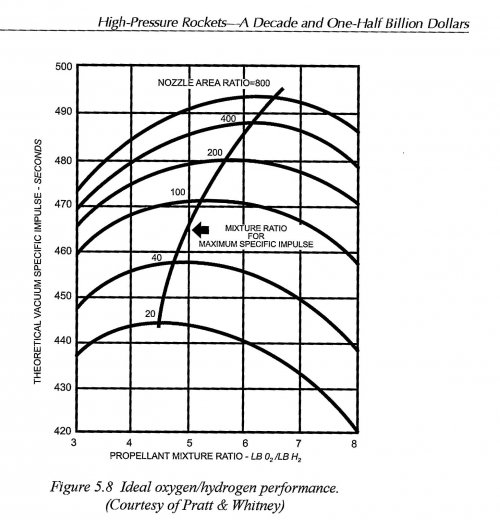
Per this figure from "Advanced Engine Development at Pratt & Whitney" by Dick Mulready, the maximum ISP mixture from Oxygen / Hydrogen is always on the rich side of 8:1 stoichiometric, but moves leaner from 4.5:1 to 6.5:1 as chamber pressure and expansion ratio increases. The denser oxygen also reduces the size and weight of the tankage necessary as the mixture moves leaner.
Ideal oxygen-Hydrogen Performane.jpg
 
As Dagger fully correctly wrote, the max. ISP it the theoretical upper limit and this will be achieved by stoichiometric combustion (of any kind). We all should be aware, that it is a theoretical limit of what can be achieved by any possible rocket in the universe.

This doesn't change, when real world rockets operate slightly rich or lean, they will never achieve or even surpass the max. ISP, no matter which kind of combustion is used. Please don't try to bluer this simple fact by opening side topics which have nothing to do with the key question.
 
An increase in the expansion ratio is the sign of an increase in the reaction time, hence a raise in temperature for the reactants. This simple kinetic indicative rule help to explain the decrease in optimum observed stochiometric ratio.

@Tuna : the increase in CO output (something that will react with ozone layer negatively) is almost always a sign of an uncompleted combustion. In complement to the stochiometric ratio, the flame temperature is driving this effect, mainly by the heat absorption from the excess of fuel.
 
Raptor is gas-gas, because it is a full-flow staged combustion rocket engine. The fuel and oxidizer are both 700-800K when they enter the main combustion chamber.
No, Raptor is NOT gas-gas, but LNG - LOX . What happens inside the "black box" is irrelevant.

Raptor converts LNG and LOX into exhaust. Both have a lower enthalpy than gaseous methane and gaseous hydrogen so the exhaust will also have less energy and therefor a lower Isp.

What one reads about the benefits of RD in a rocket engine is mainly BS.
The RDRE scientists need to keep the money flowing in their direction.
Some of these "scientists" make Isp claims that are thermodynamically impossible.

Per this figure from "Advanced Engine Development at Pratt & Whitney" by Dick Mulready, the maximum ISP mixture from Oxygen / Hydrogen is always on the rich side of 8:1 stoichiometric, but moves leaner from 4.5:1 to 6.5:1 as chamber pressure and expansion ratio increases.
That figure is from a 1963 brochure (appendix B) with no explanation whatsoever why the optimal propellant mixture ratio for maximum Isp would be well below the stoichiometric ratio.

A low O2/H2 ratio may be required for metallurgical reasons, but that has nothing to do with optimal Isp.
 
I think the primary advantage of RDE rockets is being able to generate high combustion pressures without the need for high pressure turbo pumps, which are heavy, complex, and a real challenge to get working correctly. And the donut shaped combustion chamber lends itself to a plug nozzle which is lighter than a bell nozzle and automatically adjusts to varying expansion ratios.

Rotating detonation combustion in an air breathing jet engine is where the big difference is possible, where compressing air is difficult and detonation can increase the peak chamber pressures well above what can be achieved with current constant pressure burning Brayton cycle, significantly increasing the thermal efficiency.
 
i wonder if RDE can be combine with P111 engine ?
This german High pressure Rocket engine used circular ring combustion chamber
since the drive shaft for Turbopump went true the combustion chamber to a Turbine that power by exhaust of combustion chamber !
This construction eliminate the Pre Burner and more compact engine with high performance
 
What sort of new capabilities could rotating detonation engines endow missiles? Could we get missiles with intercontinental range but small and light enough to be carried by a fighter jet?
 

Similar threads

Back
Top Bottom