Squadrons of Delta Darts and Voodoos cross the sky in formation.
01:04 An F-101 Voodoo spirals out of control, diving towards the ground.
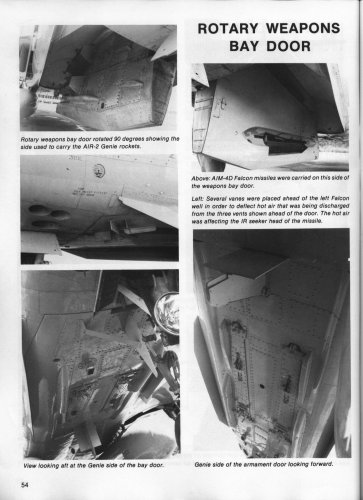
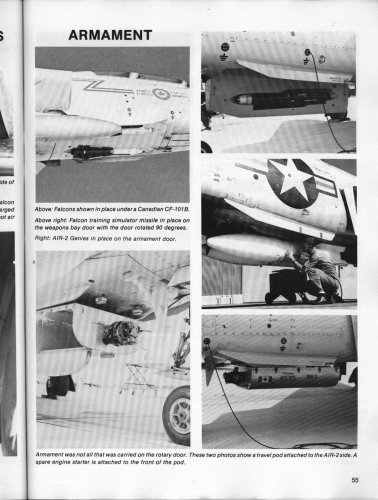
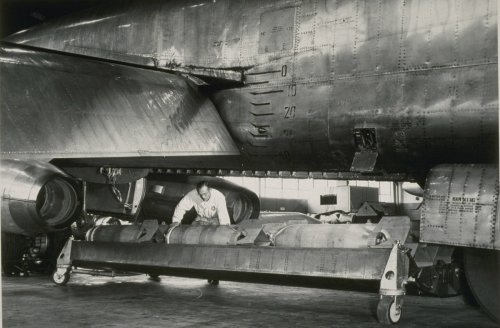
01:22 An F-101B in flight. Its rotary bomb bay opens and fires an AIR-2 Genie rocket.
01:46 The Voodoo scorches the sky just above the ground and pitches up and climbs high.
02:06 An F-101B in flight and performs a slow, descending barrel roll.
02:29 Animation of an F-101 demonstrating why pitch-up occurs. The nose of the aircraft pitches up increasing its angle of attack. Motion lines representing wind push against the plane, over the wing, and push down on the tail demonstrating action called “tucking,” “stick lightening,” “dig in,” “stick reversal,” or “pitching moment.”
03:21 Animation of the Voodoo. The plane pitches up and the vortex from the wing tip rises and falls, pushing down on the tail.
03:46 An F-101B begins pitch-up.
03:56 Barrels down a desert runway and takes off.
04:06 Comes in for a landing.
04:12 Begins pitch-up.
04:17 Animation of an F-101 showing a dramatic angle of attack.
04:38 Animation showing how angle of attack is affected by gross weight, indicated air speed, and ‘G’ loading. The animation demonstrates varying weight in stabilized flight. The airplane lifting and then dropping as its weight decreases from fuel consumption.
05:53 Animation of airplane instruments showing change in air speed, the nose high attitude increasing and decreasing as the aircraft slows or speeds.
06:37 Animation demonstrating ‘G’ loading, showing a 40,000 lbs aircraft needing 40,000 lbs of lift at 1G flight. The plane goes into a 3G turn requiring 3 times the lift.
07:15 Ground crew work on a Voodoo.
07:27 A Voodoo taxis on the tarmac.
07:41 Voodoo in flight.
07:55 A team operates a ground-based tracking camera.
08:06 Voodoo demonstrates recovery from pitch-up. It deploys a chute to recover. The same action is shown from inside the cockpit.
09:35 A sequence of tests in which the chute is not deployed, showing prolonged out-of-control time, spinning, and recovery.
10:48 The pilot pushes the stick forward and recovers the aircraft.
11:19 Voodoo pitches up; the pilot deploys the drag chute.
11:34 Voodoo pitches up; the pilot maintains neutral ailerons and ruder to aid the craft in recovery. Intercut between pilot at the controls and the plane as seen from the ground showing how the pilot returns control and stick to neutral as the aircraft rolls and falls into a recovery dive.
12:41 Voodoo uses the drag chute in a full scale pitch-up.
13:04 Voodoo uses immediate full forward stick, and neutral ailerons and rudder.
13:55 Voodoo yaws and rolls while diving.
14:30 Voodoo in extended recovery time.
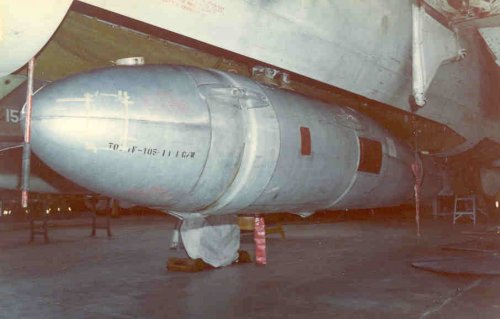
14:49 Voodoo in flight with external tanks.
15:42 Graphics showing various factors involved with altitude loss, and fundamentals and facts about altitude loss.
16:52 Voodoo in flight and graphics comparing pitch-up altitude to altitude lost in recovery.
17:13 Illustration of a Voodoo demonstrating the ways to avoid a pitch-up.
17:46 Voodoo in flight and a graph of a knee pad card showing the number of Gs a pilot can pull for a given indicated airspeed.
18:13 Animation of a Voodoo in flight and a pilot harshly, then smoothly pulling back on the stick.
18:38 Voodoo in flight demonstrating airspeed bleed off.
19:33 END.