- Joined
- 21 January 2015
- Messages
- 15,073
- Reaction score
- 24,402

U.S. Space Force’s (USSF) Space Systems Command (SSC) has demonstrated a Tactically Responsive Space (TacRS) launch capability with the liftoff of Rocket Lab’s Electron launch vehicle from the company’s Launch Complex-1 (LC-1) in New Zealand on June 19, 2026, as part of the TacRS VICTUS HAZE mission. The mission will now transition into an on-orbit focus placing operationally relevant systems through realistic rendezvous and proximity operations (RPO) threat response scenarios.
With launch complete, the team will now complete on-orbit checkout and vehicle commissioning, after which RPO operations begin. During these operations, the teams operating both the Rocket Lab and the True Anomaly space vehicles will conduct a variety of scenarios, demonstrating Space Domain Awareness (SDA) and characterization capabilities, each in dynamic engagements with the other.
SSC’s System Delta 89 (SYD 89) Space Safari office, under Space Force Program Executive Officer (SFPEO) for Space Combat Power (SCP), is the lead organization executing TacRS missions.
“We are excited to demonstrate advanced TacRS capabilities on orbit,” said USSF Lt. Col. Lincoln Miller, Space Safari system program manager. “VICTUS HAZE culminates the TacRS ‘crawl, walk, run’ phase of on-orbit demonstrations. We are confident in the technology and space operations expertise of our teams who have paved the way for rapid capability delivery to orbit in support of urgent operational needs.”
VICTUS HAZE is a multi-launch, multi-vehicle mission designed to demonstrate the Nation’s capability to rapidly acquire, launch, and operate space vehicles on operationally relevant timelines in response to urgent on-orbit threats. Additionally, VICTUS HAZE leverages commercially developed products to provide highly capable options for future TacRS missions.
“VICTUS HAZE set out to demonstrate our ability to respond to irresponsible behavior on orbit under operationally realistic conditions, and we are doing just that, leveraging commercial partnerships to maximize flexibility and minimize cost,” said USSF Col. Bryon McClain, acting Space Force portfolio acquisition executive (PAE) for Space Combat Power.
This was the second of two launches within the VICTUS HAZE mission, delivering Rocket Lab’s company-built response space vehicle to low-Earth orbit (LEO), which will now rendezvous with another VICTUS HAZE space vehicle already on orbit. This second space vehicle is True Anomaly’s Jackal, which was launched as part of a rideshare on a SpaceX Falcon 9 rocket from Vandenberg Space Force Base, Calif., on May 3, 2026.
Prior to this launch, the Space Safari office placed the Rocket Lab team into a heightened state of readiness before directing them to activate into an alert status. The activation process took less than 48 hours. After a period of time, Rocket Lab was issued the Notice-to-Launch (NTL) order which required them to posture for launch to a previously unknown orbit within their performance ability with only a 24-hour notice.
“Not only does this mission open the door for acquisition of follow-on vehicles that allow our warfighters to close critical gaps and seams in a conflict scenario, it also presents a more immediate value by giving our current operators a crucial opportunity to exercise and improve LEO RPO tactics, techniques, and procedures,” Miller said.
Space Safari’s acquisition efforts for this mission established a groundwork that enables rapid production and fielding of follow-on vehicles from either Rocket Lab or True Anomaly. The success of these efforts bolsters the defense industrial base with two providers that are now capable of responsive RPO missions and postures the USSF and U.S. Space Command (USSPACECOM) with additional options that may be necessary to deter adversary aggression on orbit and maintain security of National interests at all times.
“The United States has the most innovative space industry in the world,” McClain said. “VICTUS HAZE is primed to further demonstrate our readiness to lean on our commercial partners to deny, disrupt, and counter any adversarial advantage—no matter where they try to operate in space.”
The VICTUS HAZE mission is the result of multi-organization efforts across federal agencies and the defense industrial base. Some of these partnerships include:
A DIU partnership on the Rocket Lab effort to leverage their commercial market expertise alongside their Commercial Solutions Opening (CSO) and Other Transaction Authority to rapidly award.
A SpaceWERX partnership on the True Anomaly effort to award a Strategic Funds Increase (STRATFI) allowing for a second end-to-end system that improved overall mission utility and benefit.
An advanced Lawrence Livermore National Laboratory (LLNL) optical payload hosted on the Rocket Lab space vehicle.
A partnership with the Space Domain Awareness (SDA) Tools, Application, and Processing (TAP) Lab under SSC’s System Delta 85 (SYD 85).
A partnership with the Aerospace Corporation.
Historic Speed: Rocket Lab launched the VICTUS HAZE mission just 16 hours and 42 minutes after receiving the U.S. Space Force’s Notice to Launch, beating the previous record by more than 10 hours and setting a new global standard in responsive space access.
End-to-End Space Capability: Marking a major capability milestone for the Department of War, Rocket Lab delivered a complete turnkey solution for space-as-a-service: design, build, launch, and now 24/7 on orbit operations.
Rapid Operational Capability: The spacecraft is now fully commissioned and conducting complex orbital maneuvers to chase down another spacecraft on orbit and conduct Rendezvous and Proximity Operations (RPO).
Long Beach, Calif. 22 June 2026: Rocket Lab Corporation (Nasdaq: RKLB), a global leader in launch services and space systems, today announced it has successfully launched its Electron rocket and deployed its own Pioneer spacecraft for the U.S. Space Force (USSF) Space Systems Command’s (SSC) VICTUS HAZE Tactically Responsive Space (TacRS) mission led by the SSC’s Space Safari Program Office.
Lifting off from Rocket Lab Launch Complex 1 in New Zealand at 10:19 pm NZT on June 19th, the mission shattered the previous TacRS record set by VICTUS NOX by more than 10 hours. The feat establishes a new global benchmark for rapid call-up space capabilities.
Beyond this historic launch turnaround, VICTUS HAZE marks the first time a single prime contractor has provided an entire all-in-one mission as a complete package for a TacRS mission. Rocket Lab vertically engineered, built, and tested the highly maneuverable Pioneer spacecraft, executed the rapid launch, and is now managing on-orbit operations for VICTUS HAZE. Rocketr Lab’s Pioneer spacecraft is now conducting Rendezvous and Proximity Operations (RPO) in low Earth orbit, simulating a rapid threat-response scenario alongside a non-compliant satellite. With space an increasingly contested domain, the ability to rapidly launch a spacecraft, pursue an object in space, photograph it, and monitor its behavior in real time, gives the U.S. and its allies the Space Domain Awareness capability and the vital intelligence it needs to maintain U.S. superiority in space.
Key VICTUS HAZE Mission Achievements:
16 Hours, 42 Minutes (Notice-to-Launch): The length of time between Rocket Lab receiving the Notice To Launch from the SSC’s Space Safari Program Office and Electron’s launch from Launch Complex 1.
4 Hours (Trajectory Calculation): Rocket Lab’s Guidance, Navigation, and Control (GNC) team took just ~4 hours to calculate final trajectories, update flight software, and coordinate global ground stations in preparation for launch.
37 Hours, 36 Minutes (Spacecraft Commissioning): Rocket Lab fully activated and readied the Pioneer spacecraft for its first orbital maneuver, beating VICTUS HAZE’s strict 72-hour deadline by more than 34 hours.
Rocket Lab founder and CEO, Sir Peter Beck, says: "Our launch-plus-spacecraft integrated mission capability is transformative for responsive space. By launching on demand with spacecraft at-the-ready we've shown we can secure and defend the nation's space interests rapidly, and that’s a powerful capability for the United States and its allies. This is what modern space power looks like: the ability to reinforce and reimagine national security space architecture at will, and we’re proud to be providing the nation with those next-generation space capabilities, today.”
“We are excited to demonstrate advanced TacRS capabilities on orbit,” said USSF Lt. Col. Lincoln Miller, Space Safari system program manager. “VICTUS HAZE culminates the TacRS ‘crawl, walk, run’ phase of on-orbit demonstrations. We are confident in the technology and space operations expertise of our teams who have paved the way for rapid capability delivery to orbit in support of urgent operational needs. Rendezvous and Proximity Operations on such short timelines are certainly not trivial, especially in a crisis or conflict scenario, but this demonstration of our ability to commission a complex and capable space vehicle within less than 72 hours, and immediately begin an RPO scenario thereafter, shows that we can field capability to deny adversaries first-mover advantage into novel orbits.”
The successful launch of VICTUS HAZE builds on Rocket Lab’s extensive history of delivering responsive space missions, including a previous launch record in 2024 when Rocket Lab launched two Electron missions from two different hemispheres in less than 24 hours. This rapid and reliable launch cadence is unmatched by any other small launch provider globally.
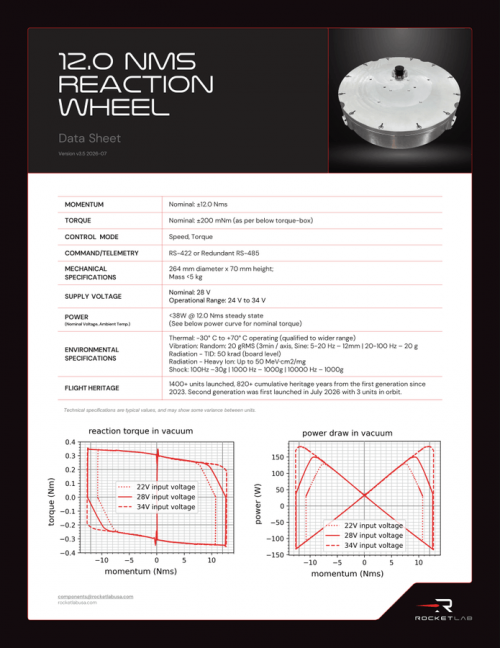
Rocket Lab’s ability to rapidly compress what is typically a multi-year defense acquisition timeline was made possible through the company’s extensive vertical integration. The Pioneer spacecraft incorporates Rocket Lab’s own in-house manufactured subsystems, including propulsion, solar arrays, reaction wheels, radio, star trackers, structures, propellant tanks, and flight software. This internal supply chain eliminates third-party delays, ensuring seamless compatibility and unmatched operational speed for the Department of War and its allies.
ENDS
Rocket Lab Media Contact
Murielle Baker
Today, True Anomaly’s JACKAL-0004 spacecraft officially begins VICTUS HAZE mission operations. Alongside Rocket Lab and partners from the United States Space Force, True Anomaly will operate the Jackal spacecraft as part of the USSF’s most advanced demonstration of Tactically Responsive Space (TacRS) to date.
Following the successful Mission X-3 flight test program and commissioning of JACKAL-0004 and Mosaic, the True Anomaly spacecraft operations team is fully operational and ready to execute rendezvous and proximity operations (RPO).

Meet our Pioneer spacecraft bringing commercial RPO capability to space for @USSpaceForce and @USSF_SSC.
A highly configurable medium delta-V spacecraft that can carry up to 120kg of payload, Pioneer can approach and inspect other satellites with pinpoint precision.
Autonomous navigation

LONG BEACH, Calif. and MCLEAN, Va., June 29, 2026 (GLOBE NEWSWIRE) -- Rocket Lab Corporation (Nasdaq: RKLB) (“Rocket Lab”), a global leader in launch and space systems and Iridium Communications Inc. (Nasdaq: IRDM) (“Iridium”), a leading provider of global voice, data, and positioning, navigation, and timing (PNT) satellite services, today announced they have entered into a definitive agreement under which Rocket Lab will acquire Iridium. Rocket Lab will acquire all the outstanding shares of Iridium common stock for $54 per share in a cash and stock transaction. This represents an enterprise value for Iridium of approximately $8.0 billion.
View: https://twitter.com/SciGuySpace/status/2071619354827866584Sir Pete the Bold strikes again.
Rocket Lab - Responsive Launch
View: https://youtu.be/1cqNlZQFw4Q
Rocket Lab - Responsive Satellites For Responsive Space
View: https://youtu.be/P2njrIKM5_8
Satellites Maneuver Around Each Other on Rapid Timelines for Victus Haze Mission
https://www.airandspaceforces.com/victus-haze-mission-rapid-maneuvers-satellites/
According to Rocket Lab, within 37 hours and 36 minutes of launch, Puma was fully activated and ready for its first orbital maneuver around Jackal. That timeline, the company said, was 34 hours ahead of the mission’s target of 72 hours.

Rocket Lab USA Inc., Long Beach, California, has been awarded a $266,000,000 firm-fixed-price completion contract for suborbital launch. This contract provides for the launch of 12 suborbital launch vehicles, with six optional launches. Work will be performed at Pacific Spaceport Complex, Alaska, and is expected to be completed by Dec.31, 2028. This contract was a competitive acquisition, and three offers were received. Fiscal 2025 research, development, test and evaluation funds in the amount of $112,000,000 are being obligated at the time or award. The Space Systems Command, Kirtland Air Force Base, Albuquerque, New Mexico, is the contracting activity (FA8818-26-C-B003)
GHOST (Global Hypersonic & Orbital Spaceport Technology) is our containerized, deployable launch site technology that makes it easier to deploy Electron & HASTE wherever they're needed most.
Rockets, launch infrastructure, ground support, and range control systems – all delivered in shipping containers and ready to launch on rapid timelines.

I'm kinda scratching my head on this one. What is the purpose of this capability? (GHOST)Rocket Lab released their earnings report today (10-Aug-2026), among their announcements is they are "targeting delivery of Neutron to the launch pad" by Q4 2026, which would seem to suggest aspirations of integration and possibly on the pad testing for the new rocket before the end of the year and (without explicitly stating as much) no Neutron maiden launch until sometime in 2027.
They also revealed GHOST:

Berger suggested more than a year ago IIRC that Rocket Lab would be lucky to get to first launch in 2027. I hope they make it.Rocket Lab released their earnings report today (10-Aug-2026), among their announcements is they are "targeting delivery of Neutron to the launch pad" by Q4 2026, which would seem to suggest aspirations of integration and possibly on the pad testing for the new rocket before the end of the year and (without explicitly stating as much) no Neutron maiden launch until sometime in 2027.
Hypersonics related?I'm kinda scratching my head on this one. What is the purpose of this capability? (GHOST)
Sure, but why the need for short-notice pad launch site setup? I suppose if they wanted to use it to support missile defense testing.Hypersonics related?
Sure, but why the need for short-notice pad launch site setup? I suppose if they wanted to use it to support missile defense testing.
Missile offence 'testing'? Cheaper than Dark Eagle at $7.5-8.4m/flight.Sure, but why the need for short-notice pad launch site setup? I suppose if they wanted to use it to support missile defense testing.
Rapid orbital insertion. Insert "what" is the question. Remember RASCAL.Sure, but why the need for short-notice pad launch site setup? I suppose if they wanted to use it to support missile defense testing.
to launch something fast, from anywhere.I'm kinda scratching my head on this one. What is the purpose of this capability? (GHOST)
I think there is also a program (or two) for rapid airdrop cargo delivery via rocket.to launch something fast, from anywhere.
This something can be mostly fast reconnaissance, Anti satellite operation, emergency communication for battlefield.
Also test article launch for ABM test or prototypes of military satellite.
also fast launch under GHOST make interception and ghosting by Enemy satellite difficult.
and DoD can launch there own ghosting Satellite to stalk Enemy satellite
In 2012, the company demonstrated a rocket propelled by a viscous liquid monopropellant (VLM) developed via DARPA and Office of Naval Research (NRL) work.[189][190] The VLM was reported to be thixotropic, so that it behaves as a pseudo-solid until a shear force is applied, after which it flows like a liquid. The VLM density was reported to be comparable to solid-rocket propellant.[190] The VLM reportedly required no special handling, was non-toxic, water-soluble, had low sensitivity to shock, a high ignition point, and was barely flammable in the atmosphere.[191] The company earned a US patent[192] on the system.[193]
"This something can be mostly fast reconnaissance, Anti satellite operation, emergency communication for battlefield."to launch something fast, from anywhere.
This something can be mostly fast reconnaissance, Anti satellite operation, emergency communication for battlefield.
Also test article launch for ABM test or prototypes of military satellite.
Cryongenic propellant might not be the only option, see my previous post just above yours.They gloss over the fact that Electron uses cryogenic propellant. Where does that come from?
I wonder what kind of ISP it has.Cryongenic propellant might not be the only option, see my previous post just above yours.
https://www.secretprojects.co.uk/threads/rocket-lab-launcher.29021/post-933149
Reduced ISP is probably compensated for by higher density, so more SRB-like performance at this relatively small size scale. So payload capability was probably the same or better.I wonder what kind of ISP it has.
Monopropellants typically have low ISP out of the gate compared even to solid propellants.Reduced ISP is probably compensated for by higher density, so more SRB-like performance at relatively small size scale.
200+s range, similar to solid.Monopropellants typically have low ISP out of the gate compared even to solid propellants.
Adding in the weight and complexity of an electrical system powerful enough to keep your engine at 600C while actively being cooled by fuel doesn't seem like a bargain. And 200 seconds is vastly different than 265-285s.200+s range, similar to solid.
https://www.space-propulsion.com/sp...drazine-thrusters/20n-hydrazine-thruster.html
Alledgedly 50% better than hydrazine.
View: https://www.youtube.com/watch?v=SCLnEnpe9hY
https://www.google.com/search?q=monopropellant+isp&newwindow=1&sca_esv=29bc699f92e89c34&sxsrf=APpeQnv7NroRmnsMoZwOFmwvytxum3qkGg:1786607990598&ei=dnl9as6PJKyOhbIPq93b2Aw&biw=2560&bih=1271&ved=0ahUKEwjOooe1kZ2WAxUsR0EAHavuFssQ4dUDCBA&uact=5&oq=monopropellant+isp&gs_lp=Egxnd3Mtd2l6LXNlcnAiEm1vbm9wcm9wZWxsYW50IGlzcDIGEAAYFhgeMgYQABgWGB4yBhAAGBYYHjIGEAAYFhgeMgYQABgWGB4yBhAAGBYYHjILEAAYgAQYigUYhgMyCxAAGIAEGIoFGIYDMgsQABiABBiKBRiGAzILEAAYgAQYigUYhgNImBVQiQhYyxFwAXgBkAEAmAFdoAHCAqoBATS4AQPIAQD4AQGYAgWgAt4CwgIKEAAYRxjWBBiwA8ICDRAAGIAEGIoFGEMYsAPCAg4QABjkAhjWBBiwA9gBAcICFxAuGNwGGLgGGNoGGNgCGMgDGLAD2AEBwgIKEAAYgAQYigUYQ8ICBRAAGIAEmAMAiAYBkAYTugYGCAEQARgJkgcBNaAHkxmyBwE0uAfWAsIHBTAuMS40yAcSgAgB&sclient=gws-wiz-serp
Well it's 230s for Hydrazine and ADN/LMP-103S and HAN/ASCENT offer 240-260s and higher density relative to Hydrazine.Adding in the weight and complexity of an electrical system powerful enough to keep your engine at 600C while actively being cooled by fuel doesn't seem like a bargain. And 200 seconds is vastly different than 265-285s.