
pathology_doc
ACCESS: Top Secret
- Joined
- 6 June 2008
- Messages
- 1,895
- Reaction score
- 2,116
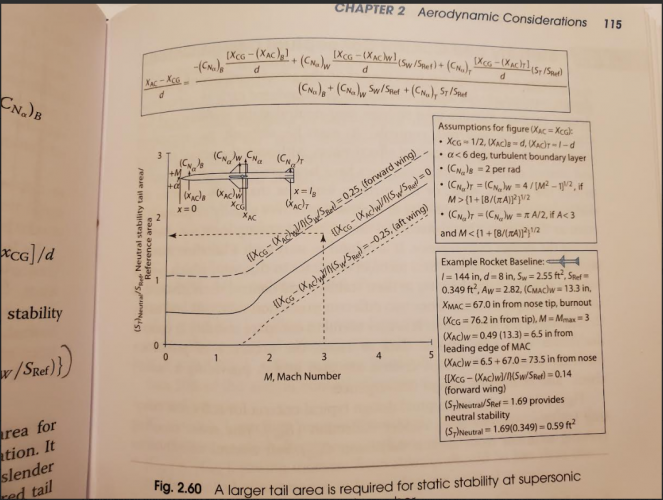
Image source: Missile Design and Systems Engineering, by Gene Fleeman, AIAA Press 2012. Fair use claimed for posting of limited amount of source text for discussion and/or analysis.
Question/discussion below the image.

So, the equation in the box at the top is for the missile static margin. As I understand it, the aerodynamic centre should be behind the centre of pressure for inherent stability - i.e. measured from the tip of the nose, Xac should be greater and Xac - Xcg should be positive. By those lights, a tail which is larger in area and/or has a higher Cn slope should give greater stability.
However, the (Xcg - Xac) term for the tail is intrinsically negative, since the position of the tail Xac is always going to be greater than that of the CG, and thus the term will always exert a destabilizing effect. Which it shouldn't.
I can understand why the coefficient on the body term is negative, since the body lift exerted at the nose is always destabilizing (magnifies any inadvertent pitch). But the tail term? This mystifies me. I feel like there should be an absolute value bar around it, or it should be Xac - Xcg, which is still the moment arm, but reflects in its sign the effect on stability.
Compounding my confusion are the graph and the text box labelled "Example rocket baseline". These show (Xcg - Xac) divided not by the diameter of the rocket but by its LENGTH, a completely different state of affairs.
Every other example of centre of pressure calculation that I've found online so far is calculated from the rocket's nose as datum, so comparison is impossible.
I've been in communication with the author, but while he's helpful, he's also a busy man and can take a while to get back to me. Thought I would bring it here and see if anyone could help.
What am I missing/overlooking?
Question/discussion below the image.
So, the equation in the box at the top is for the missile static margin. As I understand it, the aerodynamic centre should be behind the centre of pressure for inherent stability - i.e. measured from the tip of the nose, Xac should be greater and Xac - Xcg should be positive. By those lights, a tail which is larger in area and/or has a higher Cn slope should give greater stability.
However, the (Xcg - Xac) term for the tail is intrinsically negative, since the position of the tail Xac is always going to be greater than that of the CG, and thus the term will always exert a destabilizing effect. Which it shouldn't.
I can understand why the coefficient on the body term is negative, since the body lift exerted at the nose is always destabilizing (magnifies any inadvertent pitch). But the tail term? This mystifies me. I feel like there should be an absolute value bar around it, or it should be Xac - Xcg, which is still the moment arm, but reflects in its sign the effect on stability.
Compounding my confusion are the graph and the text box labelled "Example rocket baseline". These show (Xcg - Xac) divided not by the diameter of the rocket but by its LENGTH, a completely different state of affairs.
Every other example of centre of pressure calculation that I've found online so far is calculated from the rocket's nose as datum, so comparison is impossible.
I've been in communication with the author, but while he's helpful, he's also a busy man and can take a while to get back to me. Thought I would bring it here and see if anyone could help.
What am I missing/overlooking?


