If the 2,000lb JDAM-LR in QuickStrike form has a range of 200nm....you could mine the channel that leads to Murmansk, Polyarny, Olenya Guba and Severomorsk from Norwegian airspace, well outside of Russian defences, with 2 x P-8 sorties......bottle up the majority of the Russian Northern Fleet....and they only have 1 'modern' minehunter up there...(well they could just drive the last few ancient ones into the minefield I guess and clear a few mines, any ship can be a minesweeper once)....
I thought quick strike mine only work against submarine?
 
But given that it has a turbojet propulsion system that makes it a cruise-missile not a GBU, In the USN with the addition of the Mk-78 rocket-motor (Used by the AGM-45 Shrike) the GBU-16 became the AGM-123 Skipper II.
I agree, but I think their reasoning is that it's a bolt-on to a bomb.


I thought quick strike mine only work against submarine?
Oh, no, the US dropped thousands of them in Haiphong Harbor, and they blew the hell out of anything.
 
I thought quick strike mine only work against submarine?

Thats 98% of the combat power of the Russian Northern Fleet...Olenya Guba and Polyarny (and the other small bases nearby) are the Northern Fleet sub bases...
 
I thought quick strike mine only work against submarine?

It can be programmed for any target, though submerged subs are more vulnerable at much greater emplacement depths.
 
Oh, no, the US dropped thousands of them in Haiphong Harbor, and they blew the hell out of anything.

<Mr Picky>Technically those were Destructor series mines, which preceded the Quickstrike series, though the principle of using aircraft delivered bombs as the mine warhead was the same. One of the reasons Quickstrike was necessary was that the Destructor series was compromised by widespread use off Haiphong.</Mr Picky>.
 
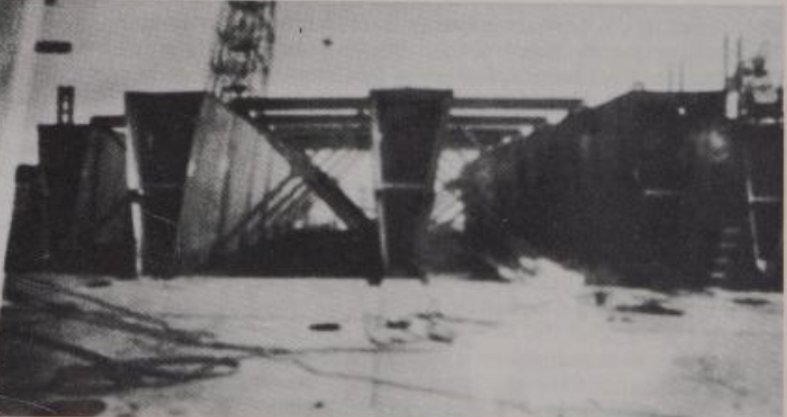
There was a UK remote controlled one in 1944 as well, quite an unusual frame based 'ship'...used against German pressure mines...used off Normandy, was Top Secret, no photo's I've ever found though...
Sounds like Cybele and Cyrus, aka the 'Stirling Craft', there's a picture of part of the framework in Ian Buxton's 'Diary of a Wartime Navy Constructor', but it doesn't really give you an impression of their overall structure. Goodall was very obviously not a fan of either them or Director of Torpedo and Mining.

"German pressure mines laid in shallow water were a threat that could not be countered with conventional minesweeping gear. The Stirling craft was developed in great secrecy as a counter, 360ft long, 60ft broad and 30ft deep. This lattice structure with buoyancy chambers was to be towed over suspected mines, which if detonated would dissipate much of their force through the open structure. Denny erected Cybele seen here at Dumbarton from material fabricated by Arrol and Motherwell Bridge, launching on 16 November 1943. She and her sister Cyrus from Swan Hunter were deployed in Seine Bay after the D-Day landings. (© National Maritime Museum, London G11240)

Buxton, Ian. Diary of a Wartime Naval Constructor: Sir Stanley Goodall (p. 156). Seaforth Publishing. Kindle Edition. "

 
It can be programmed for any target, though submerged subs are more vulnerable at much greater emplacement depths.
Given that quick strike mine are bottom mine, I feel like they are pretty useless against surface ship unless the water is super shallow, like a 2-3 meters deep. It such a shame that CAPTOR isn’t more popular
 
Given that quick strike mine are bottom mine, I feel like they are pretty useless against surface ship unless the water is super shallow, like a 2-3 meters deep. It such a shame that CAPTOR isn’t more popular

Bottom mines are effective against ships at depths of dozens of meters or more. The gas bubble rapidly expands, then contracts because water is a high density fluid that does not compress. It continues to go through compress/expand cycles until it breaches the surface, so depth does not mitigate the explosion at anything like the way open air does.

Conversely CAPTOR used a mk46 torpedo that was, to the best of my knowledge, ASW only. A modern version called “Hammerhead” using an acoustic modem and mk54 was to enter service nowish but like most of more recent weapons programs, there is scant information. The CDM mine was to enter service in 2021 but all mentions of it dried up circa 2020.
 
Does anyone have an educated guess on the weight of GBU-75? Given the range and warhead size, it seems to me this must be a 2000# class weapon.
 
Does anyone have an educated guess on the weight of GBU-75? Given the range and warhead size, it seems to me this must be a 2000# class weapon.
500lb warhead weight plus the tail kit, I think it's only a 1000lb weapon.
 
500lb warhead weight plus the tail kit, I think it's only a 1000lb weapon.

We’ll just looking at Harpoon as a 500# warhead equivalent, it has much shorter range. For a weapon well over 1000#. Though GBU-75 might be significantly more efficient with higher lift and lower top speed.
 
Does anyone have an educated guess on the weight of GBU-75? Given the range and warhead size, it seems to me this must be a 2000# class weapon.

4 variants are planned apparently.

500lb with Mk.82 warhead >350nm range
Decoy with Mk.82 shape >805nm range (presumably this will have some sort of MALD-J jamming package)

2,000lb Mk.84 QuickStrike . Believed to have 200nm range...
2,000lb Mk.84 Maritime Strike Weapon (i.e. QuickSink). Believed to have 200nm range...

Clearly there are some other easy to make variants....a 2,000lb with standard Mk.84 warhead or BLU Bunker Buster.
 
4 variants are planned apparently.

500lb with Mk.82 warhead >350nm range
Decoy with Mk.82 shape >805nm range (presumably this will have some sort of MALD-J jamming package)

2,000lb Mk.84 QuickStrike . Believed to have 200nm range...
2,000lb Mk.84 Maritime Strike Weapon (i.e. QuickSink). Believed to have 200nm range...

Clearly there are some other easy to make variants....a 2,000lb with standard Mk.84 warhead or BLU Bunker Buster.

I do not think any mk84 are planned.
 
I do not think any mk84 are planned.

That's correct. Quickstrike LR is based on a Mk 82 500lb bomb with the powered JDAM kit and a mine TDD (target detection device) in place of a normal fuze.

It gets confusing because there is a Quickstrike ER that is a 2000-lb Mk 84 with a wing kit but no engine.
 
Last edited:
Yes, pre GBU-75 there were Skipjack and Flounder mines using Quickstrike TDD and JDAM placement. I think there were winged versions of both, though initially the mk84 version was just a JDAM kit with a TDD.

I think JDAM LR is exclusively mk 82 based, and it would take a huge kit to make mk84 a stand off munition. I suspect that will never be cost effective to do.
 
I'll believe it when I see JDAM-LR 2000 lb.
At the moment the 500 lb version has almost the same box size as a Mk84 while having the full length of the Mk84. A 2000 lb JDAM-LR has to be at least as large as French's AASM Hammer XLR. But it has a range of only 140 km which is 37% of the 200 mni. It gotta be much bigger for the necessary fuel.

As for the weight of the 500 lb based on rack requirement I think it's less than 1500 lb.
 
Sounds like Cybele and Cyrus, aka the 'Stirling Craft', there's a picture of part of the framework in Ian Buxton's 'Diary of a Wartime Navy Constructor', but it doesn't really give you an impression of their overall structure. Goodall was very obviously not a fan of either them or Director of Torpedo and Mining.

"German pressure mines laid in shallow water were a threat that could not be countered with conventional minesweeping gear. The Stirling craft was developed in great secrecy as a counter, 360ft long, 60ft broad and 30ft deep. This lattice structure with buoyancy chambers was to be towed over suspected mines, which if detonated would dissipate much of their force through the open structure. Denny erected Cybele seen here at Dumbarton from material fabricated by Arrol and Motherwell Bridge, launching on 16 November 1943. She and her sister Cyrus from Swan Hunter were deployed in Seine Bay after the D-Day landings. (© National Maritime Museum, London G11240)

Buxton, Ian. Diary of a Wartime Naval Constructor: Sir Stanley Goodall (p. 156). Seaforth Publishing. Kindle Edition. "
Allied Minesweeping in World War 2 includes this photograph of "Cybele" at the Denny yard, and I don't know whether or not it's the same one you're referring to (though I assume it is.) The author (Peter Elliot) states that he believes it is the only one to exist, though it only shows the buoyancy chambers and parts of the bottom and bracing structure. IMG_0567.jpeg
 
Allied Minesweeping in World War 2 includes this photograph of "Cybele" at the Denny yard, and I don't know whether or not it's the same one you're referring to (though I assume it is.) The author (Peter Elliot) states that he believes it is the only one to exist, though it only shows the buoyancy chambers and parts of the bottom and bracing structure.
Pretty sure that's the same pic.
 
Is powered JDAM still a thing then, or did ERAM take its place?

ERAM is the program to sell Ukraine low cost cruise missiles, and was down selected to RAACM and Rusty Dagger. Powered JDAM was a Boing self funded project that appears to taken the form of GBU-75 and appears to be in integration testing with the USN, though I am unaware of a program of record. It might be some kind of OTA/RCO buy, if it is in fact being purchased.
 
https://boeing.mediaroom.com/news-releases-statements?item=131704
ST. CHARLES, Mo., Aug. 5, 2026 – The U.S. Air Force has awarded Boeing [NYSE:BA] a $75 million Undefinitized Contract Action (UCA) to acquire the BSU-111/B Payload Delivery Unit (PDU) Joint Direct Attack Munition Long Range (JDAM LR), a precision-guided munition that can travel over 300 nautical miles with a 500-pound class (226-kilogram) payload. The UCA follows Boeing’s nearly $100 million internal investment in the program and clears it for initial production of PDUs for the U.S. Navy.
 

Long-Range JDAM Deal Gives Air Force New Standoff Strike Option​

https://www.airandspaceforces.com/long-range-jdam-air-force-new-standoff-strike-option/
The long-range variant adds a Kratos TDI-J85 turbojet providing 200 pounds of thrust to enable jets to attack from a much safer distance. Improvements in adversaries’ air defenses have made penetrating strikes by non-stealthy aircraft increasingly risky.
The 2027 National Defense Authorization Act includes about $277 million for 1,150 upgraded JDAM guidance tail kits with M-Code GPS for the legacy munitions.
 
Was being facetious. If we've learned anything over the last three years it's that we've VASTLY underestimated how many munitions we'll need in a real war.
Oh, agreed.

I'd want to get back to WW2 levels of artillery consumption as the minimum requirement. So production lines only running at like 10% capacity building up stockpiles, but able to feed half the world with shells within a couple of months.
 
Oh, agreed.

I'd want to get back to WW2 levels of artillery consumption as the minimum requirement. So production lines only running at like 10% capacity building up stockpiles, but able to feed half the world with shells within a couple of months.
Thing is you have to have people who are trainable. I'd bet, going into WW2, that the average level of education in the US was quite a bit higher than today. (Being able to play a game on a smartphone does not equate to intelligence.)
 
A thousand seems very modest compared to efforts like ERAM, FAMM-L/P, and LCCM, but it is a fairly respectable buy over all and presumably not the end of all production. My guess is that there might be a component bottleneck, perhaps the engine. JDAM-LR probably is not WOSA compliant, in which case supply chain substitutions are more difficult.
 

Weapon Open System Architecture. The government gets a complete digital twin of the system and all of the specifications, software, and interfaces of its major sub assemblies such that alternate commercial components or software can be substituted. Since JDAM-LR was self funded and Boeing is the Prime, it would not surprise me if they did not adopt the standard for this project. Things like RAACM, Baracuda, and Rusty Dagger do.
 
Weapon Open System Architecture. The government gets a complete digital twin of the system and all of the specifications and interfaces of its major sub assemblies such that alternate commercial components with the right SWAPC and connections can be substituted.

In that case the US DoD needs to ensure that the JDAM-LR is WOSA compliant.
 
Thing is you have to have people who are trainable. I'd bet, going into WW2, that the average level of education in the US was quite a bit higher than today. (Being able to play a game on a smartphone does not equate to intelligence.)


Ok, so equating education and intelligence is just not a good idea.
But this was definitely not true either way. On education: going into WW2, the average American had about 9 years of education. So junior high level. There were certainly a fair number who were vaguely competent small engine mechanics from farm life. But many more were not. Heck, the WW2 military had to deal with a significant fraction of draftees who were functionally illiterate. By 1942, that made up 10% of draftees; by the end of the war it was even higher because they started drafting Black men who had been systematically denied access to education.

In terms of intelligence, well, that basically doesn't change much,* although the specific topics you are intelligent about do. Today, I think I'm pretty happy to have tech literate folks who know how to troubleshoot a computer and pilot a UAV. Especially since that's a sizable portion of fixing even a small vehicle engine (to roll back around to the WW2 example).

* Though the fact that most of the population hasn't just lived through a depression and dust bowl famine probably helps. Likewise the fact that they aren't inhaling lead paint dust or leaded gasoline fumes on the regular has to be an improvement.
 
Ok, so equating education and intelligence is just not a good idea.
But this was definitely not true either way. On education: going into WW2, the average American had about 9 years of education. So junior high level. There were certainly a fair number who were vaguely competent small engine mechanics from farm life. But many more were not. Heck, the WW2 military had to deal with a significant fraction of draftees who were functionally illiterate. By 1942, that made up 10% of draftees; by the end of the war it was even higher because they started drafting Black men who had been systematically denied access to education.

In terms of intelligence, well, that basically doesn't change much,* although the specific topics you are intelligent about do. Today, I think I'm pretty happy to have tech literate folks who know how to troubleshoot a computer and pilot a UAV. Especially since that's a sizable portion of fixing even a small vehicle engine (to roll back around to the WW2 example).

* Though the fact that most of the population hasn't just lived through a depression and dust bowl famine probably helps. Likewise the fact that they aren't inhaling lead paint dust or leaded gasoline fumes on the regular has to be an improvement.
I meant education, trainability, usefulness, willingness to work, etc. "IQ"? Nobody cares, if you can't produce.
 
Back
Top Bottom