Postwar CASA transport projects

Antonio

Moderator
Staff member
Senior Member
Joined
22 January 2006
Messages
4,436
Reaction score
2,801
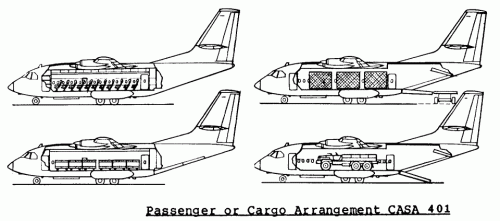
CASA C-401

From Spanish aerospace magazine FLAPS. A very nice publication now desapeared. Today we have no publications interested in the preservation of our Aerospace Design History in Spain.

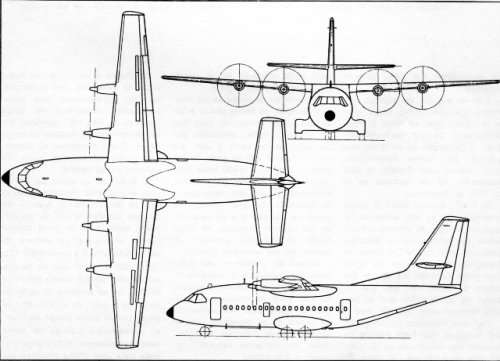
This aircraft was intended for series production by 1976 but for reasons I don't know was cancelled. According to information in Flaps conversations with French AMD were advanced for a possible collaborative project.
 

Attachments

  • CASA C-401.jpg
    CASA C-401.jpg
    190.8 KB · Views: 1,462
Firstly I would like to say hello to everyone on the site, as I have just joined and this is my maiden post.

I am particularly interested in finding out more about the CASA transport aircraft projects from the late 1940's and 1950's.

Any details and or drawings of the C.203, C.204, C.208 and C.210 would be greatly appreciated.

By way of paymentfor any help, can I offer the following link for those who are interested in Spanish aviation history.
http://www.ultraligero.net/Revistas/revista_aeroplano_1.htm

This takes you to PDF downloads of the Spanish Aeroplano magazine which provides info on many interesting subjects.
 
Thanks for the link.

You can find the C-401 military transport here:

http://www.secretprojects.co.uk/forum/index.php/topic,171.0.html

(reply#5)

but I have nothing more

Antonio
 
Bailey,

I'm not sure if this helps but José Antonio Martínez from EADS CASA delivered a lecture on the Oficina de Proyectos that included the CASA C-208 project. This was in May 2008 to FACV (Fundacion Aerea de la Comunidad Valenciana)

Finding Martínez's email address would probably be a nightmare but you could try FACV:
[email protected]
 
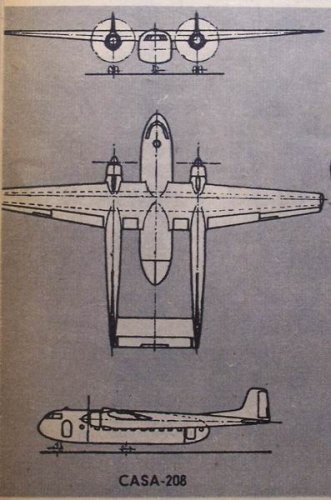
From "Der Flieger", .12.1952, the CASA 208.
Looks like a Nord Noratlas clone ...
 

Attachments

  • CASA-208.jpg
    CASA-208.jpg
    48.7 KB · Views: 1,112
Firstly, just to say thanks for the comments posted so far. The drawings of the C.208 and C.401 are both very interesting and I'm still following up on Apophenia's suggestion.

For my part, this is information that I've managed to glean from various sources.

Code:
CASA Project update:

INTA-20 A twin engine transport Design by Pedro Huarte-Mendicoa for the Instituto Nacional de Técnica Aeronáutica, which provided the basis for the CASA projects.

C.201 Alcotan.

C.202 Halcon.

C.203 Proposal for a twin engined transport, powered by 1,300 Hp Hispano-Suiza motors, with a range of 1,700 Km.

C.204 Projected twin engined air taxi powered by 145 Hp Elizalde Tigre motors.

C.205 Unknown.

C.206 Unknown. Possibly this or C.205 referred to a proposed fast aerobatic twin for multi-engine training.

C.207 Azor.

C.208 Proposed twin engine freighter, similar to the Noratlas, powered by 1,800 Hp Pratt & Whitneys or Hercules 738's.

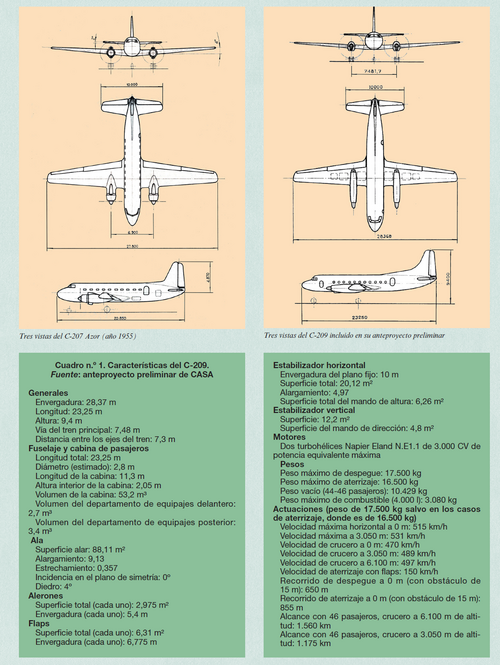
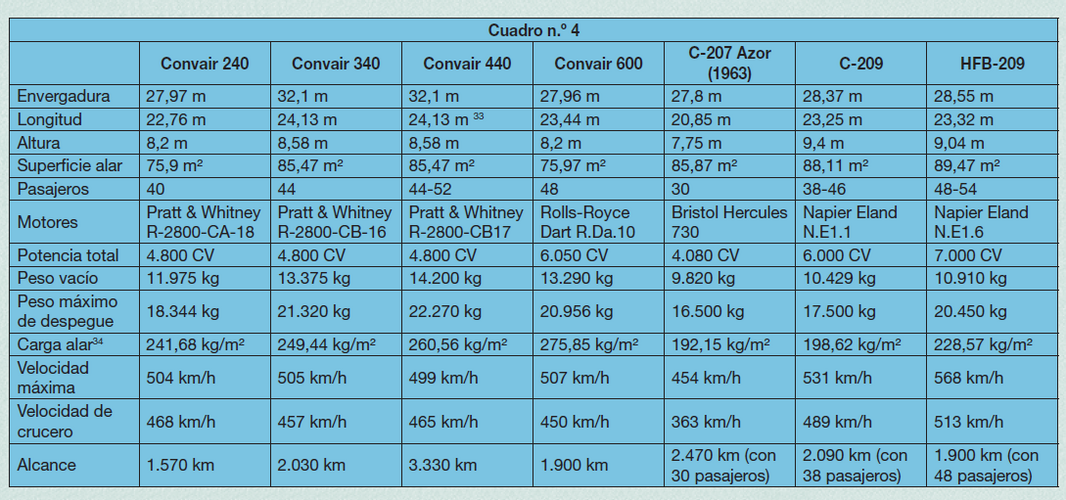
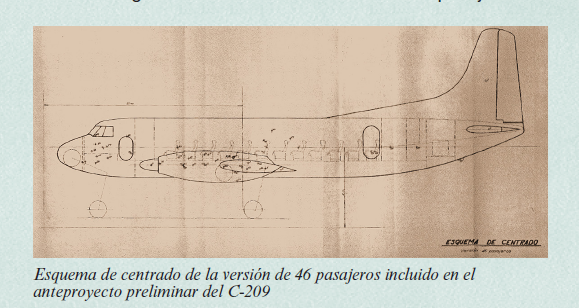
C.209 Proposed Super Azor with pressurized cabin and Napier Eland turboprops. See also HFB 209.

C.210 Projected business jet with two rear mounted Bristol Siddeley Viper ASV.11's.

C.401 Four engined heavy transport originally proposed with 1,300 Hp Hispano-Suiza's or 1,600 Hp Pratt & Whitneys.

Regards Bailey.
 
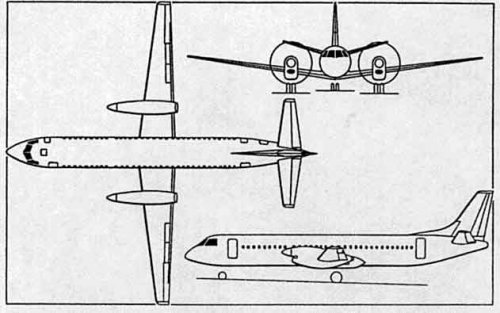
Some information on the CASA 3000

Quote from Gorka L Martinez Mezo
CASA at the time was working in a civilian short haul turboprop named CASA 3000 which was also axed not long after due to the fact the market was nil.

http://www.forecastinternational.com/Archive/ca/ca11277.htm

http://www.soton.ac.uk/~jps7/Aircraft%20Design%20Resources/Turbo%20prop%20data/CASA%203000/CASA%203000-74PASS.txt

http://www.flightglobal.com/pdfarchive/view/1991/1991%20-%202552.html

Regards Bailey.
 

Attachments

  • CASA 3000.jpg
    CASA 3000.jpg
    19.7 KB · Views: 493
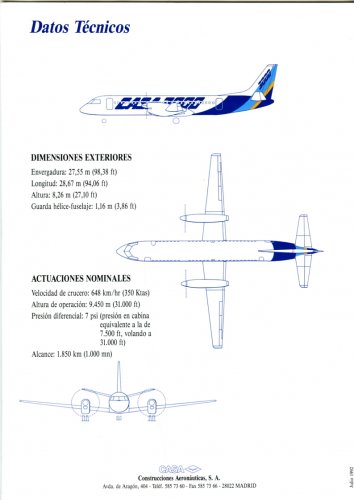
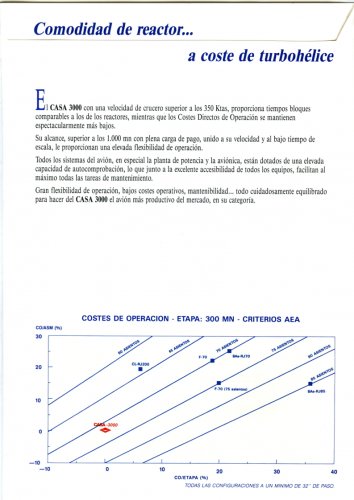
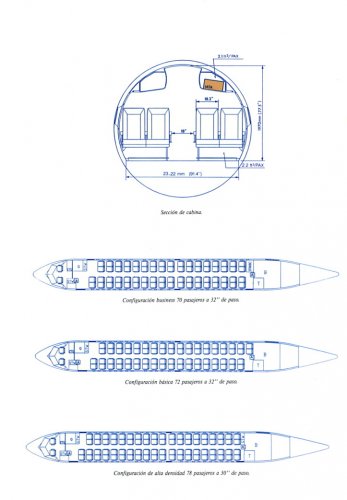
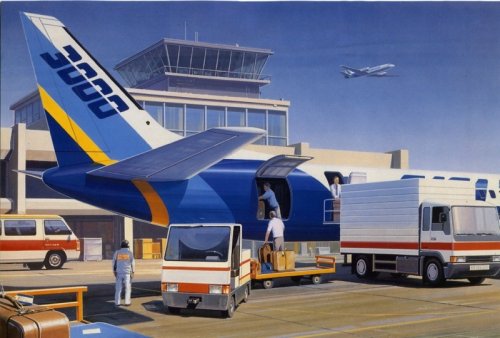
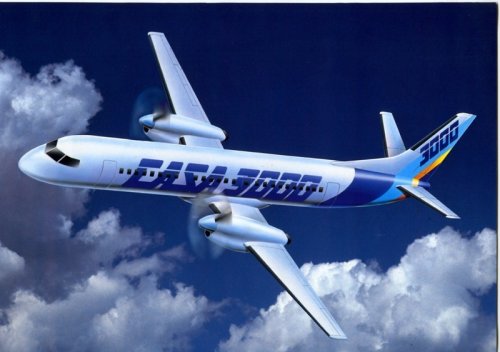
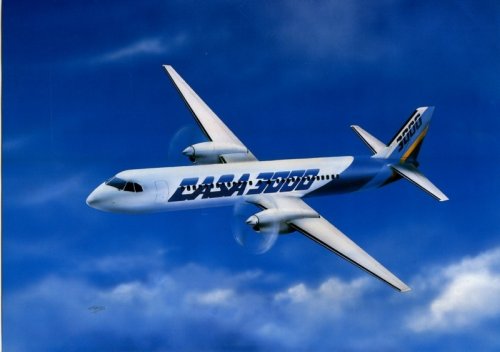
I have an original brochure received directly from CASA about the 3000, I'll post it later from the deeps of my basement archive.
 
As promised:

CASA 3000 brochure post 1
 

Attachments

  • CASA 3000 Brochure 1.jpg
    CASA 3000 Brochure 1.jpg
    244.2 KB · Views: 506
  • CASA 3000 Brochure 2.jpg
    CASA 3000 Brochure 2.jpg
    378.7 KB · Views: 443
  • CASA 3000 Brochure 3.jpg
    CASA 3000 Brochure 3.jpg
    132.4 KB · Views: 236
CASA 3000 brochure post 2
 

Attachments

  • CASA 3000 Brochure 4.jpg
    CASA 3000 Brochure 4.jpg
    139.1 KB · Views: 396
  • CASA 3000 Brochure 5.jpg
    CASA 3000 Brochure 5.jpg
    115.4 KB · Views: 379
  • CASA 3000 Brochure 6.jpg
    CASA 3000 Brochure 6.jpg
    89.8 KB · Views: 390
Very many thanks for posting these, it's always good to see some original documentation.

Regards Bailey.
 
pometablava said:
CASA C-401

From Spanish aerospace magazine FLAPS. A very nice publication now desapeared. Today we have no publications interested in the preservation of our Aerospace Design History in Spain.

This aircraft was intended for series production by 1976 but for reasons I don't know was cancelled. According to information in Flaps conversations with French AMD were advanced for a possible collaborative project.

At http://www.real-academia-de-ingenieria.org/docs/2010/05/31/16360001_4_8_0.pdf there is a document titled "LA INNOVACIÓN COMO MOTOR DE LA INGENIERÍA AERONÁUTICA EN ESPAÑA", which contains a section on the CASA C-401 project (page 15). You may find there some information (in Spanish, obviously) as well as drawings and a photo of a C-401 model.

Unfortunately, the document says nothing about the dimensions of the airplane. Does anybody know more about this?

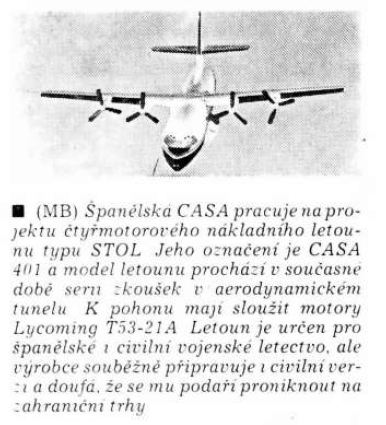
Browsing through the Flight magazine archives (http://www.flightglobal.com/pdfarchive/) I have found information on the C-401's engines. The aircraft was to have Lycoming T53-21A engines 1,868 e.h.p. each.

Best regards,
Piotr
 
Span: 28.16m Length : 24.76m Empty 13,0 t Loaded 24.5 t ; 470km/h cruising speed .Cabine 11x3.5x2.4m .55 passengers (civil)
 
richard said:
Span: 28.16m Length : 24.76m Empty 13,0 t Loaded 24.5 t ; 470km/h cruising speed .Cabine 11x3.5x2.4m .55 passengers (civil)

Thank you, Richard.

P.
 
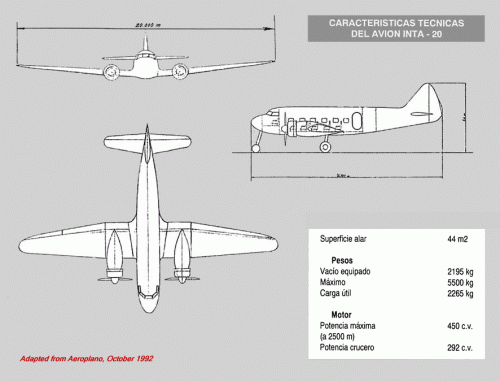
A three-view arrangement of the INTA-20 project, which eventually spawned the CASA C.201 Alcotán and C.202 Halcón.
 

Attachments

  • INTA-20.gif
    INTA-20.gif
    70.7 KB · Views: 1,037
Hi,


the CASA C.213 and C.214 was a pressurized cabin turboprop engined projects,
developed from C.212 in 1971,but I have no drawings to them.
 
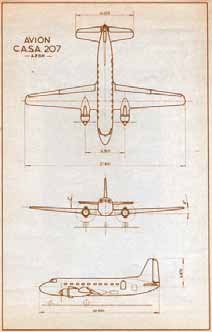
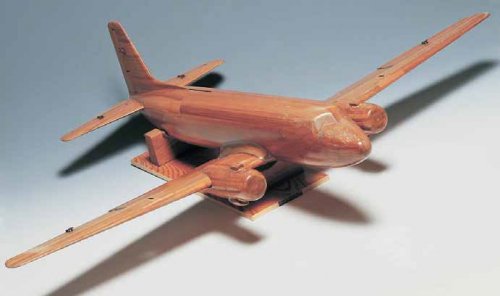
The Casa C.207 (later known as Azor) in plan and wind-tunnel model form (from Aeroplano #23):
 

Attachments

  • C.207 plan.jpg
    C.207 plan.jpg
    9.6 KB · Views: 508
  • C.207 model.jpg
    C.207 model.jpg
    19.1 KB · Views: 481
Topic augmented with various posts from the old "Postwar Spanish projects" thread.
 
C.212-300P with PT6A-65B engines was apparently certificated in Spain in early 1989; presumably converted back to TPE331? Seems to be entirely missing from the Web other than oblique references to the fact that it existed.
 
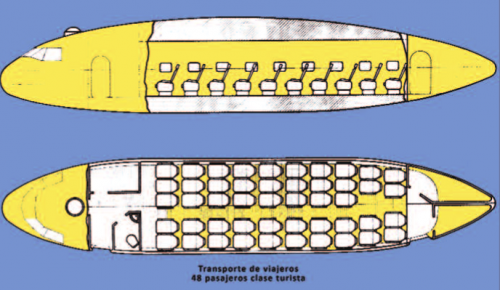
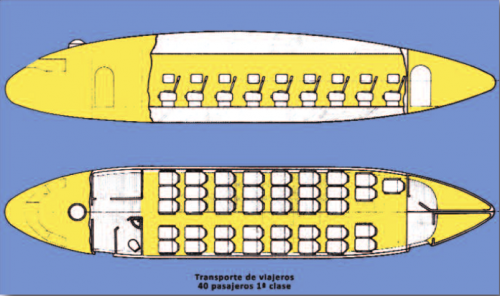
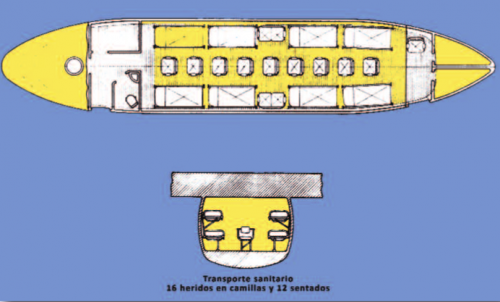
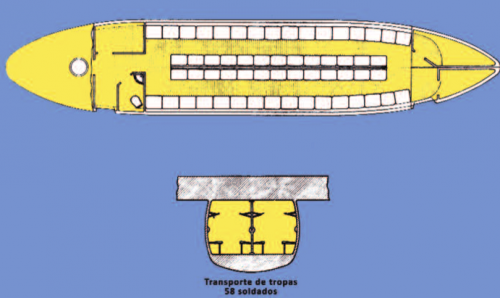
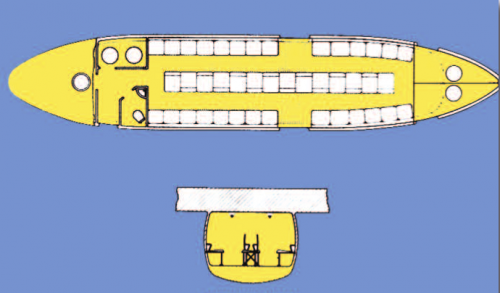
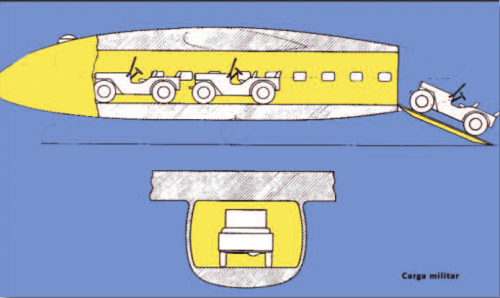
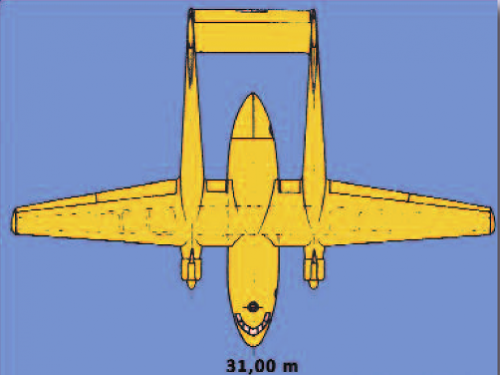
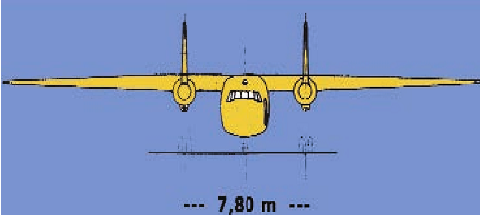
In the "Boletín del Museo de Aeronáutica y Astronáutica" No. 75 (you may download it for free from EdA website: http://www.ejercitodelaire.mde.es/ea/pag?idDoc=D08F873A571A5F19C1257DEA0046F425) there is an article on the CASA C-208 project.
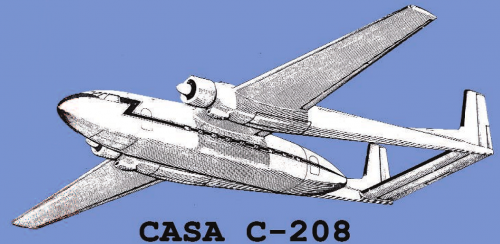
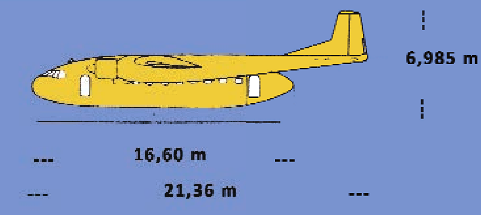
Below you'll find drawings of the airplane as well as of variant of how it may have been loaded.

Specs:
Wingspan 31 m
Length 21.16 m
Lenght of fuselage 16.60 m
Height 6.985 m
Width of cabin 3 m
Height of cabin 1.85 m
2 x 2435 hp P&W R-2800 CB-16 engines
Take-off weight 19995 kg
Cargo weight (military version) 8355 kg
Take-off distance 875 m
Landing distance 925 m

Piotr
 

Attachments

  • 48 Pasajeros clase turista.png
    48 Pasajeros clase turista.png
    399.7 KB · Views: 163
  • 40 Pasajeros 1. clase.png
    40 Pasajeros 1. clase.png
    376.8 KB · Views: 146
  • Transporte sanitario.png
    Transporte sanitario.png
    292.2 KB · Views: 139
  • 58 Tropas.png
    58 Tropas.png
    271 KB · Views: 138
  • 42 Paracaidistas.png
    42 Paracaidistas.png
    243 KB · Views: 130
  • Carga militar (3 jeeps).png
    Carga militar (3 jeeps).png
    283.1 KB · Views: 134
  • C-208 Top.png
    C-208 Top.png
    170.7 KB · Views: 144
  • C-208 Front.png
    C-208 Front.png
    59.6 KB · Views: 140
  • C-208 Side.png
    C-208 Side.png
    51 KB · Views: 163
  • CASA C-208.png
    CASA C-208.png
    830.2 KB · Views: 288
From L+K 1974/23,

so weird,the engines for CASA-401 was from Lycoming ?.
 

Attachments

  • 2   23-1974.png
    2 23-1974.png
    139.6 KB · Views: 188
Does anyone have photos or drawings of the Dornier 25 and 27 prototypes built in Spain by CASA? They led to the successful CASA 127 and Dornier 27 production for the Portugese, Spanish, West German, etc. militaries.
Dornier 27 was an all-metal, cantilever, high-wing, tail-dragger, light STOL liasion airplane powered by a single Lycoming flat 6 engine..
I have jumped from Dornier 27s in Portugal, France and West Germany.
 
Last edited:
Dear Richard B
I have a question on the fuel tanks of the Do-25 prototypes. Did the prototypes initially only have the under wing tanks or were these so-called auxiliary tanks,
in addition to tanks integrated in the wings?
 
So far I know , the underwings tanks were the only tanks .

P1 & P2 Tigre :


It seems than the P1 was converted to the Continental too : here , the P1 with Continental (Identical to the P2 Continental) :


The Do 25 P2c and an very early Do 27 A1: note the modification the U.C :

 
Hi Richard B
Thank you for the clarification on the tanks and the re-engining of the 2 protoypes!
Interesting photo of the Do-25 and Do-27. Never knew about that difference in u/c.
 
Thanks for posting those photos of Do-25 and Do-27 prototypes.
The original Tigre engine explains the bulbous nature of the lower cockpit.
The Do-25 main landing gear makes sense from a structural perspective - routing loads straight up to the main spar - but was too far aft for ground-handling.
Also not that Do-27 has a constant cross-section, deeper aft cabin. This makes for a deeper door and more room for passengers in the rear row.
I did my 500th skydive from a Dornier 27 in Portugal. I later jumped Do.27 in France and Germany.
 
Last edited:
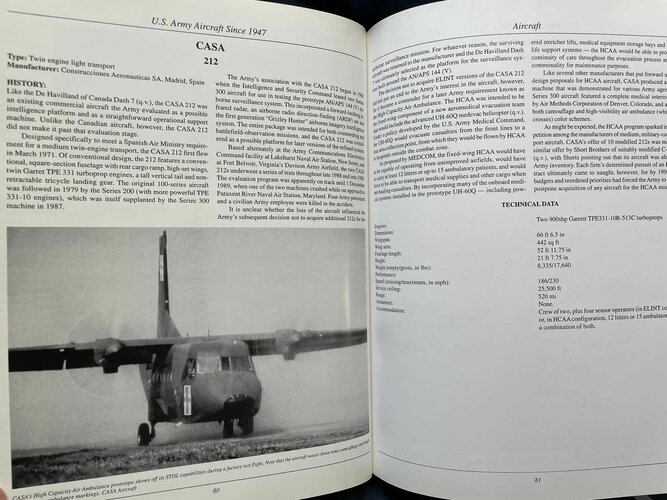
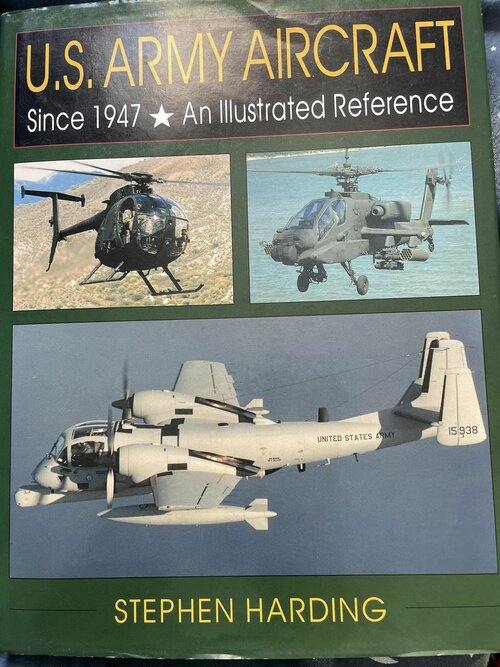
In my collection, the second edition of Stephen Harding's US Army Aviation

308835096_10160745839001490_4002316176184162636_n.jpg

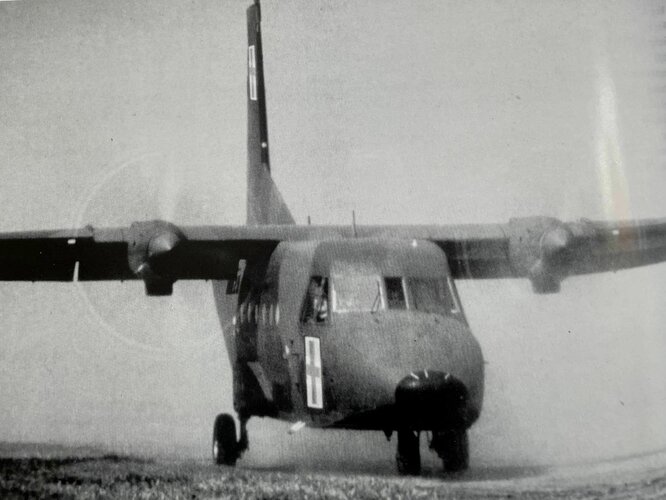
There is mention of the army experimented with an aermoedical C212 (the USAF AFSOC used one at Pope Field to support JFK Warfare Center). The medevac C212 proposed to complement the armey emdevac Dustoff UH-1D/V Hueys and Uh-60A Blackhawks and was known as High Capacity Air Ambulance.

309489963_10160745839031490_4971726038493510359_n.jpg 309442865_10160745839116490_2850392228115503038_n.jpg

cheers
 
CASA 3000 brochure post 2
nuestrasmaquetas/aeronautica-y-astronautica

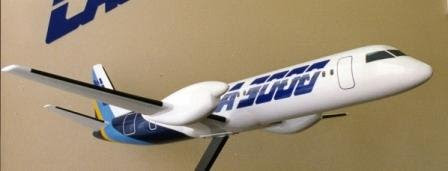
casa 3000 original model from "Armac Maquetas"

AM-JKLXZVqgZ_IL8x1-BQDjYFqFwliNIsxLa25GYgS6girtmrE0LS_76Pirwtj8FW_UcIyihYyubzf4-QA8lq4fnbMNdSH08yB5JE5mme8Sjs72jpj_MgcL2Q2H0VtzB_ZQKKEtDE_tDmnyOA8EOaJN-CtbS=w448-h171-no
 
Last edited:
A surprise,who heard about CASA-414 transport project ?.
 
A surprise,who heard about CASA-414 transport project ?.

From TU 238 magazine,

Alors que je travaillais à l’usine Avions Marcel Dassault-Breguet Aviation de Biarritz, dans le courant des
années 70, j'ai eu la chance de rencontrer Paul Déplanté qui supervisait le BE local et tout particulièrement la
définition du fuselage avant d’un projet d’avion de transport CASA 414. Jean Cuny et moi-même ayant formé
le projet d'un livre sur les avions créés à Bordeaux, Paul Déplanté, interrogé à ce sujet, me prêta obligeamment ses cahiers de notes manuscrites que je photocopiais. Sa mort brutale aux USA, en novembre 1974, mit
fin à notre projet et les photocopies, soigneusement conservées, restèrent pratiquement inexploitées jusqu’à
ce jour'.

While I was working at the Avions Marcel Dassault-Breguet Aviation factory in Biarritz, during the
70s, I had the chance to meet Paul Déplanté who supervised the local BE and particularly the
definition of the front fuselage of a CASA 414 transport aircraft project. Jean Cuny and myself having trained
the project of a book on the planes created in Bordeaux, Paul Déplanté, questioned on this subject, obligingly lent me his notebooks of handwritten notes which I photocopied. His sudden death in the USA, in November 1974,
end of our project and the photocopies, carefully preserved, remained practically unused until
this day'.
 
Back
Top Bottom