Post-war JMSDF Fire Support Ship Projects

ayatsuji

ACCESS: Restricted
Joined
26 March 2026
Messages
29
Reaction score
74
I looked into this topic, but there are still some things I don’t understand.
In1980 Japan Ship Design association (船舶設計協会)adviced JMSDF about battleship for amphibious combat.
I searched magazine world-warship(世界の艦船) at 1985-1990 but I cant found about this.

spec
30000 tons
30cm class guns

://wikiwiki.jp/yusuki/%EF%BC%98%EF%BC%90%E5%B9%B4%E4%BB%A3%E3%81%AB%E6%B5%B7%E8%87%AA%E3%81%AB%E3%83%9D%E3%82%B1%E3%83%83%E3%83%88%E6%88%A6%E8%89%A6%E3%81%8C%E7%94%9F%E3%81%BE%E3%82%8C%E3%81%9F%E5%8F%AF%E8%83%BD%E6%80%A7
 
Autotranslated:

Shigeru Makino and other members of the Yamato-class design team who built the Yamato went to the Naval Architects Association and proposed a 30,000-ton class
pocket warfare support ship for the JMSDF to support island warfare and counter-landings as a private proposal.

It was the 80s (blank stare)

A fire support battleship
equipped with 30cm-class main guns, built using destroyer construction technology from the 1960s and 70s, to intercept enemy invasions of islands and support counter-landings by the Japan Ground Self-Defense Force. Apparently, it was designed as a super-heavy cruiser converted into a missile destroyer , similar to the Iowa-class battleships that were just starting to be considered for reactivation at the time , and based on battleships from the Korean War and the Des Moines-class from the Vietnam War.

The paper plan at the time envisioned a command ship capable of carrying DLG, DLH, and what we would now call FIC
, and also a ship with increased survivability and the ability to continuously project firepower. It seems
they went to extreme lengths, proposing "artillery over missiles" and "reinforce armor to withstand direct defense," even
though they knew it was going against the times.

The timing appears to be around the early 1980s, during the serialization of a comparative analysis of Japanese and American battleships in the magazine "Sekai no Kansoku" (World Warships).

Also, that anti-aircraft cruiser design was apparently based on a modified Nodai (and C44 modified Agano-class) hull, and
they intended to mount it with US-supplied artillery and a Mk56-type fire control system.
 
Shigeru Makino and other members of the Yamato-class design team who built the Yamato went to the Naval Architects Association and proposed a 30,000-ton class
pocket warfare support ship for the JMSDF to support island warfare and counter-landings as a private proposal.
I asked several AIs about that matter, and they were pretty coherent in insisting that Shingery Makino make several articles in 1980s discussing how battleships may be relevant for modern warfare, and "what-if" scenario of Yamato-class ship modernized for modern (1980s) conditions. All refer to 284 issue of aforementioned magazine. So it seems that there is some data about Makino proposing some kind of big gun ships in 1980s.
 
Thank you very much.

I understand. I will check the magazines again at the National Diet Library. The magazines have a large number of pages (about 200 pages every month, and the table of contents was not reliable), so it is possible that I simply overlooked something.

I have also looked through all of the existing books written by Shigeru Makino from beginning to end, but there was no mention of it. So the magazines are probably the most likely source.

I missed that post bofore translation to English LOL
 
Last edited:
Autotranslated:

Shigeru Makino and other members of the Yamato-class design team who built the Yamato went to the Naval Architects Association and proposed a 30,000-ton class
pocket warfare support ship for the JMSDF to support island warfare and counter-landings as a private proposal.

It was the 80s (blank stare)

A fire support battleship
equipped with 30cm-class main guns, built using destroyer construction technology from the 1960s and 70s, to intercept enemy invasions of islands and support counter-landings by the Japan Ground Self-Defense Force. Apparently, it was designed as a super-heavy cruiser converted into a missile destroyer , similar to the Iowa-class battleships that were just starting to be considered for reactivation at the time , and based on battleships from the Korean War and the Des Moines-class from the Vietnam War.


The paper plan at the time envisioned a command ship capable of carrying DLG, DLH, and what we would now call FIC
, and also a ship with increased survivability and the ability to continuously project firepower. It seems
they went to extreme lengths, proposing "artillery over missiles" and "reinforce armor to withstand direct defense," even
though they knew it was going against the times.

The timing appears to be around the early 1980s, during the serialization of a comparative analysis of Japanese and American battleships in the magazine "Sekai no Kansoku" (World Warships).

Also, that anti-aircraft cruiser design was apparently based on a modified Nodai (and C44 modified Agano-class) hull, and
they intended to mount it with US-supplied artillery and a Mk56-type fire control system.
30cm guns supplied by the US? So, the Alaska-class guns?
 
30cm guns supplied by the US? So, the Alaska-class guns?
No, if translation is correct, it's a completely different project (not related to 1980s battleship) - a post-war anti-aircraft cruiser, based on Agano-class hull, that Shigeru Makino proposed. Judging by the Mk-56 FCS mentioned, it was probably a late 1950s - early 1960s project.

Also, that anti-aircraft cruiser design was apparently based on a modified Nodai (and C44 modified Agano-class) hull, and
they intended to mount it with US-supplied artillery and a Mk56-type fire control system.

Purely speculatively, this cruiser was likely supposed to be like a French Colbert - with multiple US-supplied 127-mm gun mounts on circa 7000-ton hull.
 
So to summarize - there are apparently two completely different Japanese post-war projects mentioned:

* A anti-aircraft cruiser, based on C-44 Agano-Kai hull, equipped with American-delivered guns (presumably, Mark-42) & Mk-56 fire control system. The mention of Mk-56 allowed us to tentatively put this project in late 1950s - early 1960s timeframe;

* A 30.000-ton fast fire support ship with 30-cm (12-inch) guns, based on destroyer construction tehcnology of 1970s, apparently supposed to serve both as landing support vessel and surface combatant. It was also stated to perform functions of DLG (i.e. carry the area defense missiles) and DLH (i.e. carry helicopters), as well as heavy armor. This project is firmly in 1980s timeframe;
 
I will supplement the discussion at the link I posted, because some of the topics there are mixed together. I should have translated it myself first.The discussion actually refers to two different concepts

1. A B-65–style “super cruiser” battleship (fire support ship)

This was a missile battleship intended to provide fire support for the Ground Self-Defense Force during counter-landing operations to retake islands.The proposal was made sometime between 1970 and around 1985.The required characteristics were

(1)30 cm-class main guns
(2)Flagship command capability for the FIC
(3)Armor sufficient to withstand missile hits

This concept was proposed to the Japan Maritime Self-Defense Force by Shigeru Makino of the Shipbuilding Research Association.
The sources for this idea are twofold.
(4)-a It is said to appear in Makino’s Japan–U.S. battleship comparison column in the magazine Ships of the World (1987–1988 issues).
However, I have not been able to find the relevant passage yet, so I plan to check again.
(4)-b A story told by an older acquaintance of the post’s author during a public open house event of the Japan Maritime Self-Defense Force.
(Incidentally, Makino—who worked on the design of Japanese battleship Yamato—remained involved with the JMSDF design bureau until the 1970s and participated in the design of early JMSDF destroyers.)


2. The anti-air cruiser concept based on the Y-Committee proposal

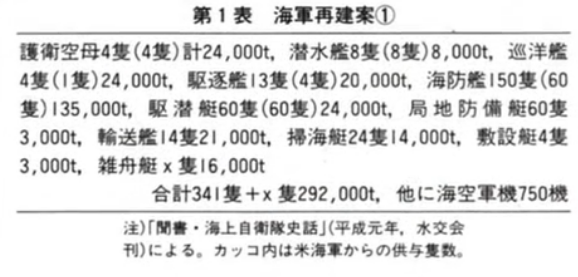
In 1951, the Japan Maritime Self-Defense Force (then the Maritime Guard Force, its predecessor) established the Y Committee to formulate a plan for rebuilding naval capabilities.

The committee proposed
borrowing four escort carriers from the United States Navy, andbuilding anti-aircraft cruisers to escort those carriers.The cruiser design was based on the Agano-class cruiser.
The escort carrier plan was soon abandoned, but the desire for an anti-air cruiser remained. One factor behind this was the proposal made to Japan during the Vietnam War by George Ball, suggesting that Japan build aircraft carriers (the so-called “Ball Proposal”).

The expected specifications were:

(1)U.S. naval guns
(2)Fire-control system: Mk 56

Since the original discussion does not provide a source, I will place a reference here instead:
://www.nids.mod.go.jp/publication/security/pdf/2025/202512_10.pdf
://kokkai.ndl.go.jp/simple/detail?minId=103804889X02919610424
://navgunschl2.sakura.ne.jp/Modern_Warfare/JMSDF_Nenshi/25years_nenshi_official/Honshi/25_02_mod_ed-1.pdf
://www.isc.meiji.ac.jp/~transfer/papers/jp/pdf/15/01_Shirato.pdf
 
The committee proposed
borrowing four escort carriers from the United States Navy, andbuilding anti-aircraft cruisers to escort those carriers.The cruiser design was based on the Agano-class cruiser.
The escort carrier plan was soon abandoned, but the desire for an anti-air cruiser remained. One factor behind this was the proposal made to Japan during the Vietnam War by George Ball, suggesting that Japan build aircraft carriers (the so-called “Ball Proposal”).

The expected specifications were:

(1)U.S. naval guns
(2)Fire-control system: Mk 56
IRRC, the C-44 Agano-kai was a four-turret version of Agano-class, with improved anti-aircraft armament? About 8.500 ton standard, 10.000 ton full?
 
In the 1970's the US partially developed a 12"/70 cannon for fire support ships in MCLWG Programme. This could be a candidate as well for the 30cm weapon
Possible, but I'm not sure it was very probable. As far as I know, the 12-inch/70 cannon was merely a proposal, and it's hard to imagine how Shigeru Makino could know about it. Not impossible, of course, just hard to explain.

(my personal opinion - the project of 30.000 ton fire support ship wasn't based on any existing gun system, and mostly rotated around theoretical calculation "what kind of gun we need to do coastal support")
 
IRRC, the C-44 Agano-kai was a four-turret version of Agano-class, with improved anti-aircraft armament? About 8.500 ton standard, 10.000 ton full?
The C-44 plan must also be considered as possibly a fake. At the very least, it is certain that it was a wartime plan rather than a postwar one.
The recommendation of the Y Committee envisioned four ships totaling 24,000 tons, which means 6,000-ton cruisers. This was likely not C-44, but rather a design derived from the Agano-class cruiser itself.

(my personal opinion - the project of 30.000 ton fire support ship wasn't based on any existing gun system, and mostly rotated around theoretical calculation "what kind of gun we need to do coastal support")
I share the same view.
Although this is somewhat off topic, postwar Japan possessed an unusually large number of LSTs, LSUs, LCUs, and LCMs. One wonders where exactly they intended to conduct amphibious landings.

That said, it is a fact that Japan possessed a large number of amphibious vessels, so it would not be strange if the navy were asked to provide naval gunfire support for ground operations based on that capability.
 

Attachments

  • Ghkhg1haMAAoy92.png
    Ghkhg1haMAAoy92.png
    176 KB · Views: 37
Although this is somewhat off topic, postwar Japan possessed an unusually large number of LSTs, LSUs, LCUs, and LCMs. One wonders where exactly they intended to conduct amphibious landings.
Japan has lots and lots of islands, any group of which could be invaded and would need to be retaken.

On top of the disaster response mission that the JMSDF also owns.

Nothing better to move things past a destroyed harbor than landing ships and landing craft.


That said, it is a fact that Japan possessed a large number of amphibious vessels, so it would not be strange if the navy were asked to provide naval gunfire support for ground operations based on that capability.
Agreed.
 
The C-44 plan must also be considered as possibly a fake. At the very least, it is certain that it was a wartime plan rather than a postwar one.
The recommendation of the Y Committee envisioned four ships totaling 24,000 tons, which means 6,000-ton cruisers. This was likely not C-44, but rather a design derived from the Agano-class cruiser itself.
Sounds logical. So we are talking about circa 6000 ton cruiser, likely armed with a large number of either 5-inch/54 Mark-16 guns or 5-inch/54 Mark 42 guns.

I share the same view.
Although this is somewhat off topic, postwar Japan possessed an unusually large number of LSTs, LSUs, LCUs, and LCMs. One wonders where exactly they intended to conduct amphibious landings.

That said, it is a fact that Japan possessed a large number of amphibious vessels, so it would not be strange if the navy were asked to provide naval gunfire support for ground operations based on that capability.
True, but JMSDF clearly wouldn't think of a heavy gun to perform that role - considering how hard it would be to produce such gun in first place. More likely, they would try to adapt the Type 75 5-inch MLRS to naval fire support role.

The 30.000-ton fire support ship is clearly a private initiative of Shigeru Makino & maybe other old school engineers, not a JMDSF inquire.
 
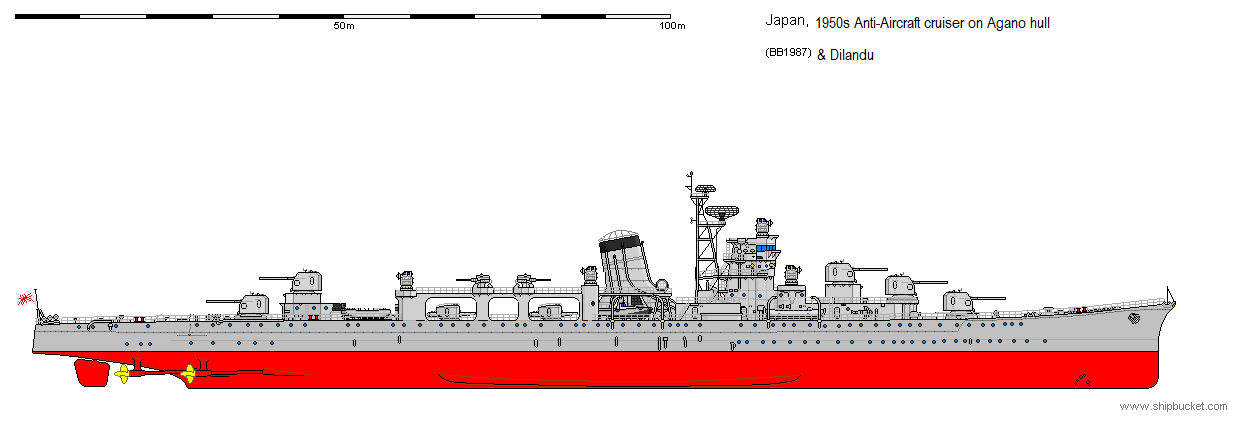
1774767444733.png

Calculated that Agano's 6-inch/50 twin mounts are about 72 tons, so three of them would weight about 220 tons. The American 5-inch/54 Mark 16 mounts (if the project is from 1951, then they are most likely to be used) weighted about 33 tons. So we could put six of them on the same hull.

On this sketch, I decided to install only five 5-inch mounts & some additional 3-inch/50 RF Mark 27. Japanese apparently liked 5-inch and 3-inch combo post-war.
 
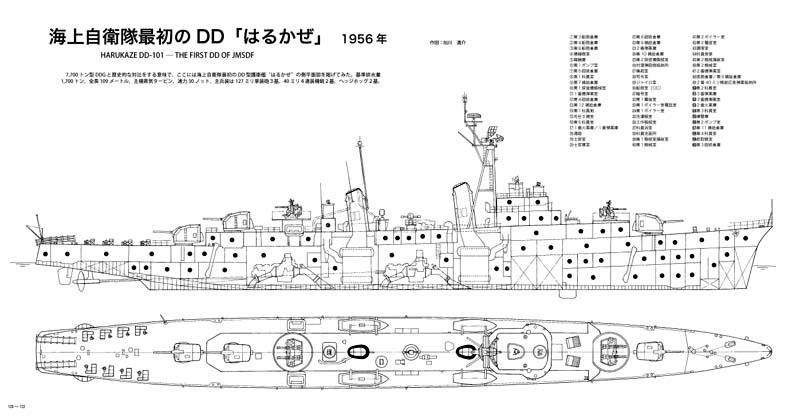
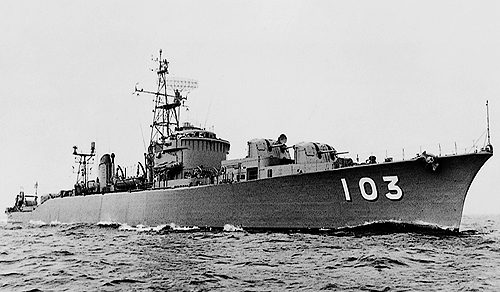
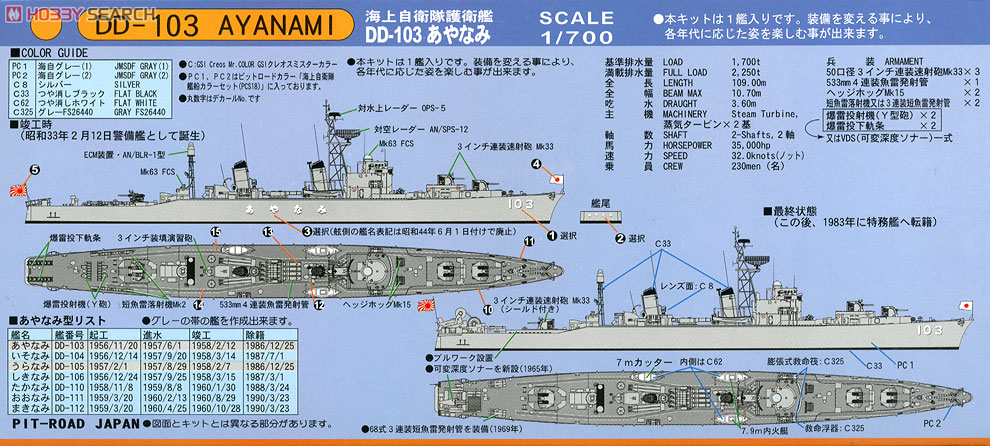
I think more elements from the Harukaze and Ayanami classes would inspire it:
1774773981156.png

10161999t2.jpg
 
A point. But isn't the AA cruiser project predate them?

The design itself may not have actually begun. The Y Committee was active until 1951–1952, but the air-defense cruiser remained as a proposal even after that. The proposal by George Ball for Japan to build two aircraft carriers appeared in The Washington Post in 1980, and it is said that the plan was still alive up to that point.

As I write this, I begin to wonder whether the cruiser in Ball’s proposed carrier task force in 1980 was the same Agano-class–based concept. I have begun to doubt the sources I referred to.

In any case, I plan to spend some time this week leisurely checking the materials at the National Diet Library regarding both the fire support ship and the air-defense cruiser.
 
As I write this, I begin to wonder whether the cruiser in Ball’s proposed carrier task force in 1980 was the same Agano-class–based concept. I have begun to doubt the sources I referred to.
Here I doubt that. By 1980s the Agano-based hull would be completely obsolete. Most likely the 1980s project involved enlarged destroyer hull, presumably from one of DDH's (they were the largest surface combatants of JMSDF for quite a long time)
 
Regarding the thread title, a reply was received from someone claiming to be the original poster.

The gist of the story seems to be "something heard from an acquaintance at a naval base open house," and the supporting evidence consists of a few lines from a book about warships around the world. They also provided further details.

948 名前:避難所の名無し三等兵[sage] 投稿日:2026/03/29(日) 20:15:19 ID:IuGAngzs0 [3/7]
>>878

I need your help.

Okay, I don't know if I can be of any help, but

I'm one of the people who wrote about the relevant JMSDF pocket battleship in the "Deshou" article.

I'm ID:BUatzuyP from the "Deshou" summary article. I'd be in trouble if you asked for proof, though.

Regarding the relevant 30,000-ton class fire support ship proposal, I still look into it occasionally when I have the chance, but
I haven't been able to find any documents that clearly support the claim that it was presented as a draft plan.
(I've checked with the National Diet Library and requested documents, but I haven't found anything with official backing.)
At the very least, even if it did exist, it probably wasn't proposed as a private plan on an official basis, and
I don't think the JMSDF officially considered it either.

The relevant article I could find is:

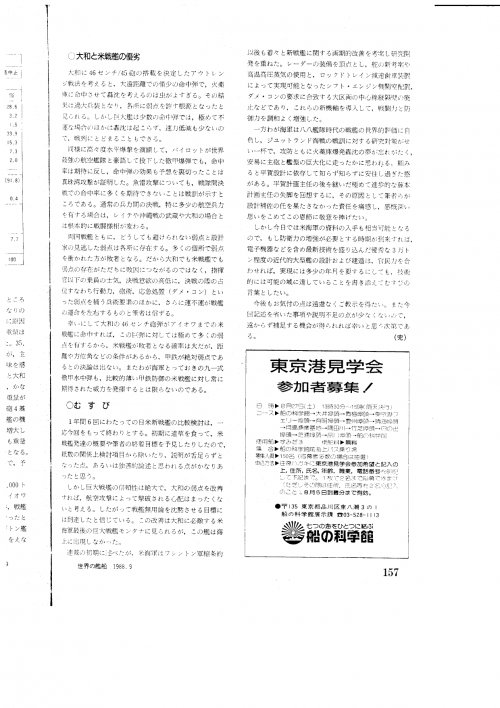
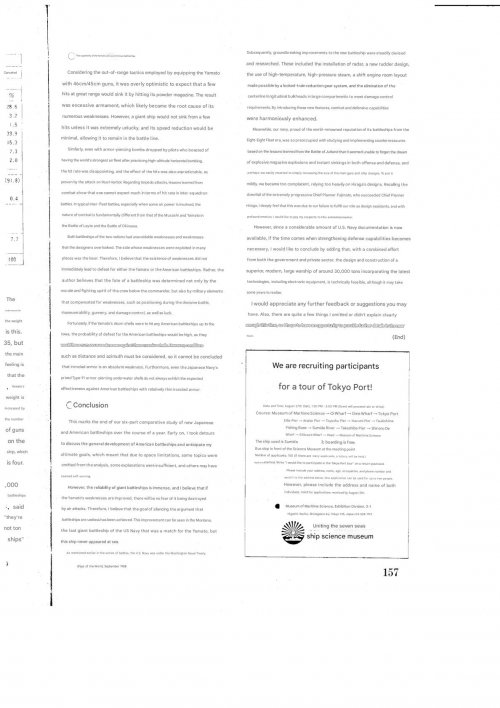
"Ships of the World" No. 397, September 1988 Page 157 of the issue, Shigeru Makino, "A Comparative Study of Japanese and American Battleships - Final Installment," concluding remarks:

"If the time comes when strengthening defense capabilities becomes necessary,
the design and construction of a superior, modern, large ship of around 30,000 tons incorporating the latest technologies, including electronic equipment,
is technically feasible, even if it takes some years to realize, given the combined efforts of the government and private sector."

That's about the extent of it, and I haven't found anything more than that even now.

Regarding the JMSDF's pocket battleship idea and the proposal for a 30,000-ton class fire support ship:
"Even if it existed, it would probably be less than a personal proposal, more like a joke."

"However, there is a possibility that there was some kind of personal anecdote or little story behind it,

or some kind of consideration (such as research or studies on artillery fire support during coastal operations)." "It cannot be determined."
"But the conclusion would be 'we don't know.'"
To add to that, as a personal hobby, I still look into large destroyer concepts from the 1960s to the 1990s whenever I have the chance.
However, the proposal for a 30,000-ton class fire support ship was merely a suggestion, presented as "something like this could also be considered," and it seems now like a joke or tall tale that has been embellished.
It was a story that I heard around the time I first became a ship enthusiast, and it left a lasting impression on me.
It's hard to find the right words, but it's been bothering me ever since, and I've been investigating it.
(The original story was just a casual conversation, and when I posted it, I only wrote it as a joke.
Even now, I occasionally look for supporting documents, but I myself am not a researcher.) I'm not an expert, so I'm not sure how to answer this, haha.

However, speaking of the time, these kinds of large destroyers were discussed in relation to topics from the 1960s-1980s:

- A 10,000-ton class large destroyer equipped with Tartar or Standard SAM (one of the draft and study plans for the cancelled 8,700-ton class DLH)

- An interceptor-carrying destroyer (another name for the plan that led to the DDV, a full-length flight deck destroyer considered by the National Institute for Defense Studies in 1986)

These two points are now almost certainly considered to have existed as official study plans by the JMSDF, so
I still can't really say anything definitive...

It's been over 10 years since this topic came up, so it's a bit of a mystery, haha.
If you find out anything about these kinds of large destroyers, please let me know.

971 名前:避難所の名無し三等兵[sage] 投稿日:2026/03/29(日) 21:00:53 ID:IuGAngzs0 [6/7]
>>964
Well, the 10,000-ton class large destroyer was simply a proposal for the 4th Defense Force Development Plan (1972-76).
It was an early draft that became the basis for two helicopter-carrying large destroyers (8,700-ton DLH).
It was considered to carry six helicopters and to have the capability to operate Harriers, and a full-length flight deck was also considered.

Frankly, at the stage of being included in the original plan, the ship size was reduced and the construction plan was abandoned,
and it was switched to the development of the 5,200-ton DDH (later the Shirane class).

The interceptor-carrying destroyer was a 15,000-20,000-ton class light aircraft carrier for escort, carrying Harriers and AEW helicopters.
This was a research proposal that leaked in the early 1980s, which would later lead to the DDV.
 
Last edited:
I received a reply from someone who identified themselves as the original poster regarding the thread title.

The main point seems to be "a story I heard from an acquaintance at a naval base open house," and the supporting evidence is a few lines of text from a book about warships around the world. They also provided further information.
So basically we could conclude, that the story of 30.000-ton fire support ship was not a serious study, and merely a private proposal, published in naval magazine as part of research article. Well, still pretty interesting, and I hope some data might appear eventually.

- A 10,000-ton class large destroyer equipped with Tartar or Standard SAM (one of the draft and study plans for the cancelled 8,700-ton class DLH)

- An interceptor-carrying destroyer (another name for the plan that led to the DDV, a full-length flight deck destroyer considered by the National Institute for Defense Studies in 1986)
Hm! Very interesting designs!
 
First, let me share the May 1988 issue of "Ships of the World."

In his column "A Comparative Study of Japanese and American Battleships," Shigeru Makino concludes with, "A 30,000-ton class warship is technically possible." That's quite thought-provoking.

Now, I will share some information I obtained this week, but unfortunately, it is based on what I heard from a officer, and I have not been able to find any documentary evidence to support it. Please keep that in mind.
In the 1970s, the 11th Chief of Staff of the Maritime Self-Defense Force, Mr. Nakamura, conceived the "Nakamura Line," a 1,000-nautical-mile sea lane defense plan. This plan was conceived during Japan's period of rapid economic growth, a time when the country was engaging in unethical trade practices, in order to protect its status as a trading nation.

However, the Japan Maritime Self-Defense Force's air defense capabilities consistently lagged behind those of the Soviet Union's anti-ship attack capabilities.

In the 1980s (probably 1985), the "Maritime Air Defense System Research Group"(洋上防空体制研究会) was established to study methods for dealing with the Soviet Union's anti-ship missile air fleet. This group was placed under the command of the Defense Reform Committee(防衛改革委員会), and the Japan Air Self-Defense Force and the Japan Ground Self-Defense Force also had similar organizations. The JASDF's project led to the FSX (F-2), and the JGSDF's led to the Ki-go (輝号)Project.

Within that context, the Maritime Air Defense System Research Group proposed the following regarding maritime air defense.


1. OTH radar + F15J * 20

2. Japanese Arleigh Burke class aegis destroyer(class Kongo DD)

3. 15,000t class DDV(air craft carrier) + Sea Harrier *12 (We would buy by U.K.)

4. make more class Amatsukaze DD and class Tachikaze DD

5. Over 20,000t class CCAA it use 8 inch gun for Antiair
Of these, proposal number 1 was from the Ministry of Finance, proposals 2 through 4 were from the Defense Agency, and the final proposal, number 5, was a large air defense ship proposed by Professor Shigeru Makino as a civilian design.

The DDV was scrapped immediately after consideration. This was because, after the US Navy demonstrated the air defense capabilities of the Ticonderoga-class cruiser during the 1975 Aegis system trials, the effectiveness of the Aegis system was recognized.

For the same reason, the plan to increase the number of conventional destroyers was also scrapped.

Now, let me talk about proposal number 5. My guess is that this was fabricated in order to get the budget approved.
Within the Japan Maritime Self-Defense Force, an OR (Operations Research) project began to investigate whether it was possible to build a ship capable of achieving results equivalent to Aegis using conventional (GUN) weapons. The result was a heavy cruiser equipped with numerous 8-inch guns. When Professor Makino was asked to create a construction plan for it, it became a ship exceeding 20,000 tons.

During the 1988 budget request, this was discussed as a backup plan in preliminary negotiations with the Ministry of Finance, but it was internally decided that "this cannot be realized," and the discussion ended there.

Subsequently, the Ministry of Finance and the Ministry of Defense proposed two plans: the OTHradar + F-15J plan and the Aegis destroyer plan. These were brought before the Diet and led to the Kongo-class destroyer.

I received suggestions from an informant about this matter regarding who I should interview. One of those suggestions included Mr. James David Watkins, Chief of Naval Operations.

However, Admiral Watkins, who made significant contributions to Japan's defense, has already passed away. I would appreciate it if someone could help me search for documents from Admiral Watkins' time.


What I can say with certainty about this matter is that their only purpose was to get the budget approved.
Thank you for reading. Just to clarify, this is not an April Fool's joke.
 

Attachments

  • IMG_0002_page-0008.jpg
    IMG_0002_page-0008.jpg
    929.3 KB · Views: 23
  • IMG_0002_page-0008.jpg
    IMG_0002_page-0008.jpg
    183.2 KB · Views: 25

Attachments

  • ADA294740.pdf
    7.5 MB · Views: 30
  • ADA619226.pdf
    10.2 MB · Views: 31
1. OTH radar + F15J * 20

2. Japanese Arleigh Burke class aegis destroyer(class Kongo DD)

3. 15,000t class DDV(air craft carrier) + Sea Harrier *12 (We would buy by U.K.)

4. make more class Amatsukaze DD and class Tachikaze DD

5. Over 20,000t class CCAA it use 8 inch gun for Antiair
Of these, proposal number 1 was from the Ministry of Finance, proposals 2 through 4 were from the Defense Agency, and the final proposal, number 5, was a large air defense ship proposed by Professor Shigeru Makino as a civilian design.

The DDV was scrapped immediately after consideration. This was because, after the US Navy demonstrated the air defense capabilities of the Ticonderoga-class cruiser during the 1975 Aegis system trials, the effectiveness of the Aegis system was recognized.

For the same reason, the plan to increase the number of conventional destroyers was also scrapped. с
Whoa! Extremely interesting! Especially 3 & 5: the anti-aircraft cruiser with 8-inch guns looks very extravagant for 1980s. Wonder if there are any additional data about it. Did they plan to use Mk-71 gun? Or it was supposed to be Japanese-own weapon?
 
スレッドのタイトルに関して、スレッドの投稿者本人だと名乗る人物から返信がありました。

要点は「海軍基地の一般公開で知人から聞いた話」のようで、それを裏付ける証拠は世界中の軍艦に関する本からの数行の文章である。彼らはさらに詳しい情報も提供した。
Oh...If I use browser's translation mode, My post is changed by it . even if My post was English yet damm. I will fix this post after today job.
Unfortunately browser's translation mode I cant stop it without only temporary stop.
 
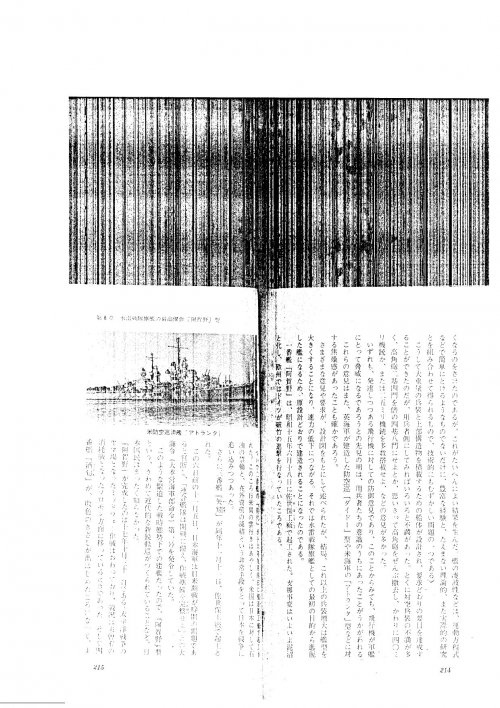
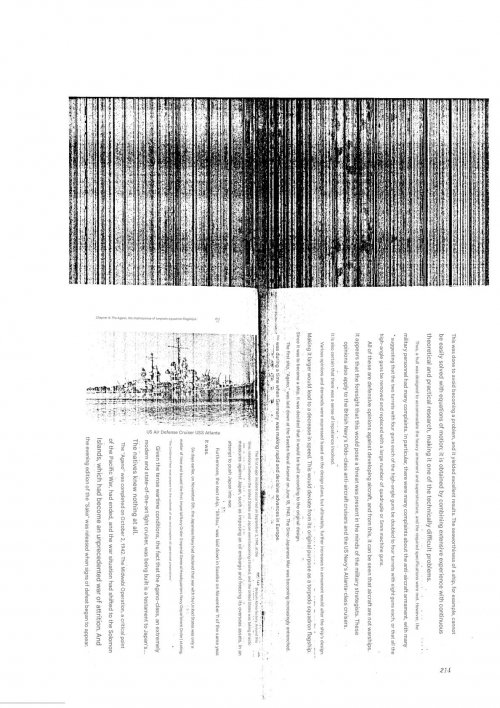
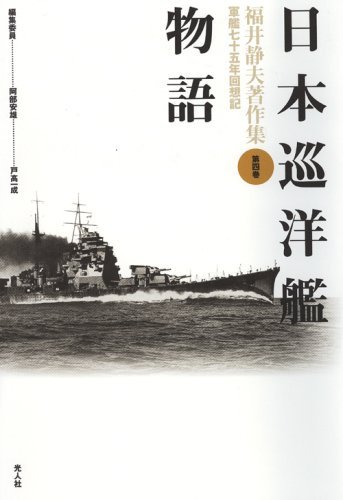
This post introduces the history of Japanese cruisers.Regarding the improvements to the Type-Agano cruiser mentioned in the above post, it states that the request was not for an increase in turrets, but rather for an increase in anti-aircraft guns and machine guns. IMG_0002_page-0001.jpg IMG_0002_page-0001.jpg 415ODWogTsL._SL500_.jpg
 
This post introduces the history of Japanese cruisers.Regarding the improvements to the Type-Agano cruiser mentioned in the above post, it states that the request was not for an increase in turrets, but rather for an increase in anti-aircraft guns and machine guns.
The translation is a bit unclear there. I'm not sure it correspond to Agano-kai type, and not to suggested alterations of basic Agano-class during their construction.
 
IJN Noshiro was proposed to get an AA refit in 1944.
The proposal included the removal of the 8cm twin guns replacing them with altogether 4 twin 10cm Type 98 guns and an increase in light AA armament to 12 triple and 16 single mounts.
Maybe this was described here?
 

Similar threads

Back
Top Bottom