The PATRIOT sensor is old and needs to be recapitalized with something more modern and actually capable of supporting defeating current and future threats. This needed to happen a decade ago. I would love to see an IG or DOD report citing the risk associated with having a sensor relying on decades old technologies against modern ballistic missiles, low observable missiles and aircraft and hypersonic threats and actually quantifying the impact on lives lost, and cost involved of doing maintaining that..But they are probably too busy to do such an analysis..
Ukraine is writing that report for us.
 
The PATRIOT sensor is old and needs to be recapitalized with something more modern and actually capable of supporting defeating current and future threats. This needed to happen a decade ago. I would love to see an IG or DOD report citing the risk associated with having a sensor relying on decades old technologies against modern ballistic missiles, low observable missiles and aircraft and hypersonic threats and actually quantifying the impact on lives lost, and cost involved of doing maintaining that..But they are probably too busy to do such an analysis..
The LATMDS contract was issued under the rapid prototyping pathway that Congress had authorized to speed up procurement with less controls to meet the very situation you mention, but Congress imposed a five year time limit. Raytheon failed to meet the terms of the contract to develop the radar in the five year time limit and it took them six years and 34% overspend. Certain members of the Senate were understandably upset as the Army knowing of the delay and the law never moved the contract to the standard major capability acquisition pathway which at $13 billion plus R&D $billions? it qualifies as. (Its an unknown if the other competitors for the contract Lockheed and Northrop Grumman would have succeeded, but as said Raytheon failed)
 
It took six years instead of five? On highly capable "rapid" requirements with timelines that were compressed enough where none of the other competitors could even offer up clean sheet sensors? What a bummer...we should have not have pursued a rapid path to develop and look to to field this capability then and waited ten plus years to get this into the hands of soldiers by following the other acq pathways..

Let's also reduce spending while we're at it so we add more delay and continue to push overdue sensor modernization to the right. :rolleyes:
 
Last edited:
The LATMDS contract was issued under the rapid prototyping pathway that Congress had authorized to speed up procurement with less controls to meet the very situation you mention, but Congress imposed a five year time limit. Raytheon failed to meet the terms of the contract to develop the radar in the five year time limit and it took them six years and 34% overspend. Certain members of the Senate were understandably upset as the Army knowing of the delay and the law never moved the contract to the standard major capability acquisition pathway which at $13 billion plus R&D $billions? it qualifies as. (Its an unknown if the other competitors for the contract Lockheed and Northrop Grumman would have succeeded, but as said Raytheon failed)
Needs to remember what happened to cause the added year.

A little bug called covid and Congress mandated 8 month shut down. The fact that was only a year delay is a surprise.
Happened once as a first time surprise. After winter 23/24 patriots are basically inconsequential.
Which is why Russia been avoiding targeting anything in the Patriot AO...
 
Which is why Russia been avoiding targeting anything in the Patriot AO...
Strikes happened many times in 2024 in all cities covered with Patriot batteries, from capital AD region (from shaheds to ballistics) to Odessa, Kharkiv and Dnipro.
But May example was a classic AD ambush - in that capacity, daily bimbing with glide bombs is long since completely uninterrupted. Which is serious, as RUSI expects that this year UMPK production alone will hit 70 thousand.

It isn't that big of a bite at patriot - it does that it can. It does things it's designed to very well. It isn't magic; there is geography, there is mathematical overwhelming, there are technical limitations of system design dating back to 1980s, there is number of interceptors.

It just isn't designed to be LRSAM, and without getting SM-6 on land there is no fast way to make western SAM system capable of it.
MRSAM are just about enough to provide protection against glide attacks at sea - that is, if the target is the system itself. When it came to protection of others, they ended up too vulnerable.
 
Last edited:
A little bug called covid and Congress mandated 8 month shut down. The fact that was only a year delay is a surprise.
Not to mention the technical requirements themselves..LTAMDS is a very substantial leap in capability over what's currently out there with the PATRIOT Bn's. There were folks in the Army that wanted to upgrade current PATRIOT sensor once more (perhaps the active electronically scanned array upgrade that Raytheon proposed) to allow industry to have multiple mature competitive clean sheet offers that could be selected for a future replacement but the advancement in threats and delay to move (mostly funding related) prevented that from happening leading to current sensor and award. Thus there was very little in terms of real competition here in terms of mature offerings that were designed to Army requirements. That said, folks in Congress would do well to sit down with the folks operating or testing out the sensor to understand what it brings to the table and why it is badly needed (need to accelerate funding not dial it back leaving units with outdated equipment).
 
Last edited:

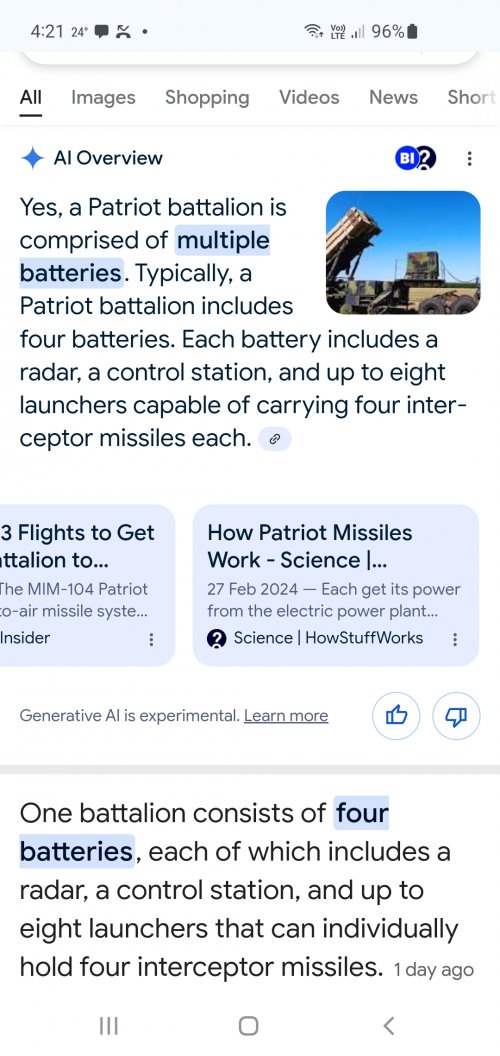
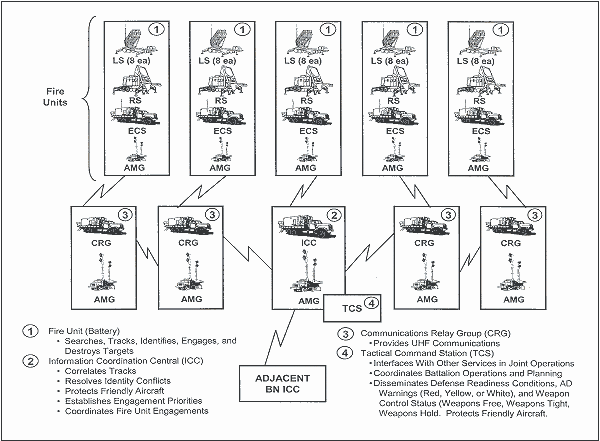
B-1. Patriot is a guided missile system designed to defeat the future air and missile threat, which includes theater missiles (TBMs, ASMs, CMs), fixed and rotary wing aircraft and UAVs. The system normally fights as a battalion, which usually consists of five batteries or fire units (FUs) operating under the control of a fire direction center (FDC). However, there are some battalions that currently have six batteries due to theater and type of mission.

1744445794791.png

And 8 launchers per battery.
 
Any word on whether or not the LTAMDS is compatible with legacy Patriot? Can existing customers upgrade to LTAMDS within their existing Patriot batteries? Or do they have to go all-in and also buy IBCS for it to work?
 
Any word on whether or not the LTAMDS is compatible with legacy Patriot? Can existing customers upgrade to LTAMDS within their existing Patriot batteries? Or do they have to go all-in and also buy IBCS for it to work?
It is not a US Army program of record as the Army required LTAMDS to be compatible with IBCS only. but Raytheon has developed it to a point where the company is now offering LTAMDS to Patriot users as an upgrade to the existing sensor independent of any IBCS upgrades.
 
Last edited:
The Army has validated LTAMDS has reached the beyond prototype stage and reached Milestone C production and deployment phase of the program after eight successful flight tests under the 2019 contract.

https://breakingdefense.com/2025/04/army-moves-ltamds-into-low-rate-initial-production/

Ref. above info requiring 73 C-17 flights transporting a Patriot battalion anyone know how many parts the LTAMDS will have to broken into to fly on the C-17 and will it make inter-theater transport any easier than the MPQ-65.
 
Defense Updates has just put out a video concerning how LTAMDS could improve the Patriot battery:


The U.S. Army has officially approved a new air and missile defense sensor for low-rate production, marking a significant step toward replacing its aging Patriot system.
Known as the Lower Tier Air and Missile Defense Sensor (LTAMDS), the next-generation radar is a vital upgrade to the US Army’s Patriot system, specifically designed to counter the growing complexity of modern aerial threats.

Maj. Gen. Frank Lozano, program executive officer for missiles and space, recently said LTAMDS, “is a huge, significant capability. We anecdotally say it doubles legacy Patriot radar capability and not only does it double it, it provides you 360-degree capability.

”This milestone comes on the heels of the U.S. Army’s successful completion of a comprehensive flight test campaign, followed by the radar’s approval under the Department of Defense’s Major Capability Acquisition Milestone C.


In this video, Defense Updates analyzes how LTAMDS would provide big boost to Patriot Air Defense System ?
#defenseupdates #patriotmissile #LTAMDS

Chapters:
0:00 TITLE
00:11 INTRODUCTION
01:17 SPONSORSHIP - NordVPN
01:51 BACKGROUND
03:50 LTAMDS
04:48 WORKING
07:02 ANALYSIS
 
Interceptor shortages

The stockpile of the Patriot missiles has fallen so low that it raised concern inside the Pentagon that it could jeopardize potential US military operations, and deputy defense secretary, Stephen Feinberg, authorized the transfer to be halted while they reviewed where weapons were being sent.

 
25% of what? The Army increased its acquisition objective from 3K to 13K. A four fold increase in inventory objective would warrant a four fold increase in annual buys or else there will be perpetual shortage and they'll take decades to get to their objective inventories.
 
How many Patriot missiles were fired defending the Al Udeid Air Base against Iranian SRBM attack June 23, 2025, Trump disclosed 14 Iranian SRBM were fired, one did get through and took out the radome containing the $15 million Modernized Enterprise Terminal for secure communications on the air base, Pentagon refused to disclose how many Patriots were fired, just believed it was the largest single Patriot engagement in U.S. military history, so presume that includes Ukraine.

Both US Army and Qatari Patriot batteries were used defending the air base which had been evacuated and have seen it said up to 3 or 4 Patriots missiles fired per SRBM, so perhaps anywhere up to a possible maximum of 56 Patriots were fired and perhaps prompted Pentagon to stop supplying Ukraine due to shortages of Patriots as down to only 25% stock required by military plans, later over ruled by Trump. Finally any thoughts/speculation as why did one SRBM got through, problems with radar, command & control or missiles?
 
How many Patriot missiles were fired defending the Al Udeid Air Base against Iranian SRBM attack June 23, 2025, Trump disclosed 14 Iranian SRBM were fired, one did get through and took out the radome containing the $15 million Modernized Enterprise Terminal for secure communications on the air base, Pentagon refused to disclose how many Patriots were fired, just believed it was the largest single Patriot engagement in U.S. military history, so presume that includes Ukraine.

Both US Army and Qatari Patriot batteries were used defending the air base which had been evacuated and have seen it said up to 3 or 4 Patriots missiles fired per SRBM, so perhaps anywhere up to a possible maximum of 56 Patriots were fired and perhaps prompted Pentagon to stop supplying Ukraine due to shortages of Patriots as down to only 25% stock required by military plans, later over ruled by Trump. Finally any thoughts/speculation as why did one SRBM got through, problems with radar, command & control or missiles?
If you don't know you can always speculate I guess. Could be 54..could be the entire magazine of two batteries or it could be far less. Somewhere between 1 and 100 would be a good guess :)

On a more serious note, the current PATRIOT battery does struggle to do proper shoot-look-shoot against longer ranged SRBM's and medium ranged missiles. This is due to sensor limitations as the PAC-3 MSE can actually be launched much earlier and intercept targets higher/farther than possible currently organically. When LTAMDS with its greatly expanded battlespace comes into service in a couple of years, the Army would have much better control over its shot doctrine allowing the MSE to engage threats earlier at greater distances / higher altitudes than presently possible allowing for a more controlled shoot-look-shoot execution. This is why the Army rushed to integrate PAC-3 MSE and launcher with THAAD deployed in S Korea. It is very easy to critisize moving from a $40 Million radar to a $100+ Million radar (broadly sticking with trends in BMD sensors) but the advantages a dramatically expanded battle space (on top of IFCN relay enabled launcher emplacement) delivers to how much footprint you can defend and the overall efficiency of a deployed AD footprint cannot be overstated.
 
Last edited:
If you don't know you can always speculate I guess. Could be 54..could be the entire magazine of two batteries or it could be far less. Somewhere between 1 and 100 would be a good guess :)

On a more serious note, the current PATRIOT battery does struggle to do proper shoot-look-shoot against longer ranged SRBM's and medium ranged missiles. This is due to sensor limitations as the PAC-3 MSE can actually be launched much earlier and intercept targets higher/farther than possible currently organically. When LTAMDS with its greatly expanded battlespace comes into service in a couple of years, the Army would have much better control over its shot doctrine allowing the MSE to engage threats earlier at greater distances / higher altitudes than presently possible allowing for a more controlled shoot-look-shoot execution. This is why the Army rushed to integrate PAC-3 MSE and launcher with THAAD deployed in S Korea. It is very easy to critisize moving from a $40 Million radar to a $100+ Million radar (broadly sticking with trends in BMD sensors) but the advantages a dramatically expanded battle space (on top of IFCN relay enabled launcher emplacement) delivers to how much footprint you can defend and the overall efficiency of a deployed AD footprint cannot be overstated.
DefenseOne reporting from the Royal International Tatoo with NG saying that IBCS will give a clearer picture so there will be no need as at Al Udeid Air Base, Qatar last month when more than two dozen Patriots were fired to defend base against Iranian SRBMs, NG making big claims saying "The physics-based modeling and simulation that we've done, and we've been asked to do, shows that with the IBCS system, we can vastly reduce the number of interceptors required to deal with the same amounts of threats". So not just improved sensors including LTAMDS, but with IBCS working in tandem.

 
Last edited:
So no more fat Izraeli finger on the trigger like in Gulf war 4-8 missile salvos on each target ? Or Kiev 130mio$ salvo?
 
TWZ August 14 write up on the poor performance of Patriot in Ukraine recently, June 28 attack included seven ballistic missiles, of which the UAF shot down one and on July 9 attack by 13 missiles of which the UAF shot down or suppressed only 7, Russian Iskander-M and KN-23 SRBMs, reason put down to recent Russian modifications made to missiles which are equipped with effective decoy systems and the use of quasi-ballistic manoeuvring flight paths making them more difficult to track, details understandably vague e.g. which Patriot missile fired, PAC-2 or PAC-3. In June the Iranian telegraphed attack on the US air base at Al Udeid, Qatar, one of 13 Iranian SRBMs hit, it would appear the new IBCS and the LTAMDS required for the Patriot System to improve its operational performance.
 
LM PR reporting understand for the first time the PAC-3 MSE used the secondary limited rear array panels of the LTAMDS radar enabling 360 degree coverage to target airbourne threat at White Sands. (As sensitivity for an AESA is proportional to panel area cubed and the rear arrays are like 1/10th the area of the main forward array it gives ~ 1/1000th sensitivity the of main forward array.)

 
The rear arrays are there primarily to defeat air breathing threats mostly cruise missiles and UAVs. There they are stated by program leaders as having capability similar to the outgoing legacy radar so this is actually quite a dramatic increase in capability for the PATRIOT Bns that will be fielding IBCS followed by LTAMDS in the coming years. Even more so since they will also have the Sentinel A4 that is plug and play with IBCS from the onset.
 
Last edited:
Army in push for a smaller and more agile version of the new IBCS architecture saying its currently too large and unwieldly, it “must evolve to leverage new technologies to enhance survivability, adaptability and supportability on the future battlefield".
Reduced signature and exposure
The ability to support mission capability in contested environments
Reduction of emplacement time
Modular open systems approach to enable rapid technology insertion
Ability to quickly integrate new capabilities such as sensors and effectors
Incremental scaling of capability
Incorporation of AI and Machine Learning to reduce operator workload

The Army plans to award at least one other transaction for prototype project, according to the notice. Responses to the notice are due Dec. 9.

Do wonder if there will be any reaction from Congress after the $billions they have poured into IBCS

https://insidedefense.com/insider/army-wants-smaller-more-agile-design-ibcs-architecture
 
Do wonder if there will be any reaction from Congress after the $billions they have poured into IBCS

Can you unpack this a bit? Why would follow on development and modernization to keep pace with changing needs, and technologies not sit well with Congress? While some might still be of the mindset that we should develop something that lasts fifty years and remain unchanged during that period, I would argue that most have accepted that systems, requirements and capabilities will evolve over decades and that is probably a good idea to constantly refresh each of these areas to be able to keep up.

The Army's IAMD footprint while optimal for CENTCOM deployments and other fixed/semi fixed applications is not really very optimized for the agility and expeditionary nature required for INDOPACOM. The Army has recognized that and is putting several other systems on a diet while developing common options for the FA and ADA teams to share (like CAML). Why would IBCS not evolve to include similar requirements as part of its modernization? Same for just about every other area the Army is interested in under this solicitation. All these are perfectly logical elements to pursue for modernization of IBCS. Almost every system of significance transitions from EMD to fielding, sustainment and follow on modernization. Especially those that spend a long time in EMD.
 
Last edited:
Boeing [NYSE: BA] has been awarded a combination of multiyear contracts valued at approximately $2.7 billion to produce additional Patriot Advanced Capability‑3 (PAC‑3) seekers. Under the agreements, Boeing will deliver more than 3,000 seekers at rates of up to 750 units per year through 2030.
 

Similar threads

Back
Top Bottom