
You are using an out of date browser. It may not display this or other websites correctly.
You should upgrade or use an alternative browser.
You should upgrade or use an alternative browser.
Parnall aircraft designations
- Thread starter hesham
- Start date
J
joncarrfarrelly
Guest
If you are referring to the photo listing from this page:
http://www.newzeal.com/aviation/PA/parnall.htm
'Fuffin' is a typo, it should read 'PARNALL PUFFIN BI-PLANE. 2 photos of seaplane incl. prototype N.137.'
N.137 was indeed one of the three Puffins built...N.136 - N.138. There was no series production.
Parnall and Sons Ltd. 1914-1918
Scout/Zepp/Chaser
Panther
George Parnall and Co. Aircraft 1920-1935:
Puffin
Plover
Possum
Pixie
Perch
Peto
Pike
Imp
Pipit
Parasol
Elf
Prawn
G.4/31
F.5/33
Parnall Aircraft Limited 1935-1939:
Heck
Type 382
Other types built by the various Parnall companies:
Avro 504
Short 827
Short Bomber
Hamble Baby
Autogiros(Cierva)
D.H Ninak
Hendy 302/302A
Miles M.1 Satyr
Percival Gull Four
No 'Sprito'.
Jon
http://www.newzeal.com/aviation/PA/parnall.htm
'Fuffin' is a typo, it should read 'PARNALL PUFFIN BI-PLANE. 2 photos of seaplane incl. prototype N.137.'
N.137 was indeed one of the three Puffins built...N.136 - N.138. There was no series production.
Parnall and Sons Ltd. 1914-1918
Scout/Zepp/Chaser
Panther
George Parnall and Co. Aircraft 1920-1935:
Puffin
Plover
Possum
Pixie
Perch
Peto
Pike
Imp
Pipit
Parasol
Elf
Prawn
G.4/31
F.5/33
Parnall Aircraft Limited 1935-1939:
Heck
Type 382
Other types built by the various Parnall companies:
Avro 504
Short 827
Short Bomber
Hamble Baby
Autogiros(Cierva)
D.H Ninak
Hendy 302/302A
Miles M.1 Satyr
Percival Gull Four
No 'Sprito'.
Jon

Maveric
Fight for yor Right!
- Joined
- 14 January 2007
- Messages
- 2,291
- Reaction score
- 1,024
Hi all,
I search for the system of Parnall aircraft designation. The only I know are:
Parnall 281 "Hobo" ( a Hendy aircraft build by Parnall )
Parnall 302 ( a Hendy aircraft build by Parnall )
Parnall 311 ( a Hendy project of 1931 with the plan to build by Parnall )
Parnall 381 ( a real Parnall project from 1938 )
Parnall 382 ( the Parnall entry for Spec. T.1/37 )
I believe the numbers means that 381 is the 381.aircraft build/projected by Parnall, like Fairey. But I´m not sure, because the numbers
Parnall 3303 ( a racer project from 1933/Hendy project ) and the Parnall 3308 "Heck" are totally wrong!
PLEASE HELP, I´m totally confused.
Servus Maveric
I search for the system of Parnall aircraft designation. The only I know are:
Parnall 281 "Hobo" ( a Hendy aircraft build by Parnall )
Parnall 302 ( a Hendy aircraft build by Parnall )
Parnall 311 ( a Hendy project of 1931 with the plan to build by Parnall )
Parnall 381 ( a real Parnall project from 1938 )
Parnall 382 ( the Parnall entry for Spec. T.1/37 )
I believe the numbers means that 381 is the 381.aircraft build/projected by Parnall, like Fairey. But I´m not sure, because the numbers
Parnall 3303 ( a racer project from 1933/Hendy project ) and the Parnall 3308 "Heck" are totally wrong!
PLEASE HELP, I´m totally confused.
Servus Maveric

- Joined
- 26 May 2006
- Messages
- 38,288
- Reaction score
- 20,425
Hi,hesham said:Hi,
I saw in Internet two aircraft by Parnall, the Fuffin and the Sprito,
any informations about them please.
we solved the Fuffin aircraft mystery,still the Sprito,I got both of them from a site on Internet,but of course it is not still there.
Last edited:
Maveric said:I search for the system of Parnall aircraft designation. The only I know are:
Parnall 281 "Hobo" ( a Hendy aircraft build by Parnall )
Parnall 302 ( a Hendy aircraft build by Parnall )
Parnall 311 ( a Hendy project of 1931 with the plan to build by Parnall )
Parnall 381 ( a real Parnall project from 1938 )
Parnall 382 ( the Parnall entry for Spec. T.1/37 )
I believe the numbers means that 381 is the 381.aircraft build/projected by Parnall, like Fairey. But I´m not sure, because the numbers
Parnall 3303 ( a racer project from 1933/Hendy project ) and the Parnall 3308 "Heck" are totally wrong!
PLEASE HELP, I´m totally confused.
Hi,
I believe that the first two digits are the project year, and the last single or two digits are the project number for that year, it seems to make sense.
Adrien

- Joined
- 25 June 2009
- Messages
- 15,515
- Reaction score
- 9,447
c460 said:I believe that the first two digits are the project year, and the last single or two digits are the project number for that year, it seems to make sense.
Makes perfect sense.
Maveric
Fight for yor Right!
- Joined
- 14 January 2007
- Messages
- 2,291
- Reaction score
- 1,024
Maveric said:Hi all,
I forget, for the Parnall/Hendy 311 and for the Parnall/Hendy 3303 I search for drawings and technical data. Can anybody of you help?
Thanks a lot
Maveric
Nothing???
- Joined
- 26 May 2006
- Messages
- 38,288
- Reaction score
- 20,425

Grey Havoc
ACCESS: USAP
- Joined
- 9 October 2009
- Messages
- 24,500
- Reaction score
- 18,175
http://www.dieselpunks.org/profiles/blogs/s-a-m-73-the-story-of-parnall-aircraft
My apologies if this is dragging up an old thread but ...
In researching details for an upcoming article of the prototype Percival Gull, G-ABUR, I was renewing my acquaintance with the Hendy 302 and 311.
It occurred to me that some of the missing numbers in the Hendy project numbers sequence could relate to partial design projects rather than complete aircraft.
Hendy designed the undercarriage for the Southern Martlet, and the wings of both the Hinkler Ibis and the Saro Percival Mailplane, presumably they were allocated project numbers - its just that we don't know what they were!
In researching details for an upcoming article of the prototype Percival Gull, G-ABUR, I was renewing my acquaintance with the Hendy 302 and 311.
It occurred to me that some of the missing numbers in the Hendy project numbers sequence could relate to partial design projects rather than complete aircraft.
Hendy designed the undercarriage for the Southern Martlet, and the wings of both the Hinkler Ibis and the Saro Percival Mailplane, presumably they were allocated project numbers - its just that we don't know what they were!
- Joined
- 26 May 2006
- Messages
- 38,288
- Reaction score
- 20,425
There are also Parnall Type 383,Type 384 & Type-401,
https://www.secretprojects.co.uk/threads/parnall-heavy-bomber-project-of-1938.29291/
https://www.secretprojects.co.uk/threads/parnall-heavy-bomber-project-of-1938.29291/

- Joined
- 25 July 2007
- Messages
- 4,916
- Reaction score
- 5,538
I've had a go at a Parnall build and project list arranged more chronologically. That arrangement makes sense to me, perhaps it will to others as well?
No new types are listed but I have fleshed out the licensed and commissioned builds. [1] Such builds were no small thing - after WW1, such commissions and licensed contracts made up the bulk of Parnall's activities by far. [2]
The draw for private commissioners and the Air Ministry went beyond available shop floor space. During WW1, the Admiralty had remarked upon the exceptional quality of contruction produced by Parnall's work force. (Not completely unexpected for workers experienced in creating 'bespoke' shop fronts and fittings in wood.) That established reputation for quality construction drew in others.
Something I avoided was applying the Parnall name to commissioned aircraft. In such cases, important though it is, a constructor's role is secondary to that of the designer. So, for example, there is no 'Parnall 302' [sic] since the Hendy 302 was built by Parnall prior to the 1935 merger formally connected the two firms. I have, however, included a few types that I have doubts about.
Pending Questions
There are some claims that Parnall built the one-off Hendy 281 Hobo (and, yes, I do reject the notion of any 'Parnall 281 Hobo'). In any case, there appears to be fairly strong evidence that the Hobo was actually built at Shoreham by Basil Henderson and B. J. W. Brady (albeit in a shed and prior to the formal creation of the Hendy Aircraft Company).
Another puzzle dates back to WW1. In his book Parnall Aircraft Since 1914, Kenneth E. Wixey mentions Royal Aircraft Factory R.E.7s powered by Brazil Straker's Bristol-built Rolls-Royce Falcon engines. Other aircraft types rebuilt at No.3 (Western) Aircraft Repair Depot at Yate are also mentioned. But I can find no evidence of R.E.7s being rebuilt at Yate, let alone being built by Parnall & Sons.
During WW1, No.3 (Western) Aircraft Repair Depot at Yate did rebuild 96 x R.E.8s [3] (amongst other types) but I find no mention of R.E.7s. And, here, it should be emphasised that Parnalls did not occupy its Yate properties until 1924-1925. (Probably, despite his title, Wixey was just trying to be thorough about overall activities at Yate.) Still, even if OT, info on R.E.7s with Brazil Staker-built engines would be welcome.
I'll begin the Parnall list in my next post. But, first, a little corporate chronology.
George Parnall - A Corporate History
1830 - Parnall & Sons Ltd. scale and weighing machine makers
-- Parnall & Sons Ltd., Narrow Wine Street in central Bristol
1916-1919 - Parnall & Sons Limited, Mivart Street, Eastville, Bristol
-- Parnall aircraft department works was at the Coliseum, Park Row
1918 - Parnall & Sons bought by Birmingham-based W & T Avery Ltd.
-- W & T Avery Ltd. was another manufacturer of weighing machines
-- New owner discontined aircraft department; G. G. Parnall resigned
1919 - George Parnall & Company * formed by George Geach Parnall
-- Firm intended to combine aircraft production & shop-fitting work
-- * Sometimes as George Parnall and Co. or George Parnall & Co. Ltd
1920 - George Parnall & Company leases old Coliseum works as HQ
1923 - George Parnall & Company takes over Feeder Road works*
-- * Parnall & Sons Ltd having moved to Lodge Causeway, Fishponds
1924-1925 - Parnall moves operations to abandoned Yate Aerodrome [4]
-- Formerly, the government's No.3 (Western) Aircraft Repair Depot
1925, 12 Dec - Acquisition of Yate Aerodrome formally announced
1932 - Anticipating retirement; G.G. Parnall sells shop-fitting business
1934 - Parnall Engine Repair Depot section ('Top works') at Yate sold off
-- Included Depot Guard House which had been Parnall's drawing office
1935 - G.G. Parnall sells Yate field and buildings to Nash & Thompson Ltd.
-- Nash & Thompson of Tolworth, Surrey, focusing on powered turrets
1935, 23 May - Parnall Aircraft Ltd. formed by Nash & Thompson Ltd.
-- Merging Nash & Thompson with Parnall & Hendy Aircraft Company
1938 - With last Parnell Heck 2C built, aircraft production ceased
-- Emphasis turned to FN [5] series of power-operated gun turrets
-- Parnall held the rights to all Nash & Thompson aircraft turrets*
-- * Powered Mountings subsidiary held rights to land-based turrets
1946, 31 May - Parnall Aircraft Ltd. re-titled Parnall (Yate) Ltd.
-- Parnall (Yate) built home appliance; no further aviation connections
There are far too many sources to list but, for corporate history, special mention must be made of the South Gloucestershire Compendium 1914 to 1918, Version 1, July 2018, by John Penny which provided a wealth of detail.
_______________________________________________________
[1] Exact numbers are tricky due to the Air Ministry having intentionally destroyed Yate repair depot documents in the 1920s. Then, the Luftwaffe did their bit during WW2. A particularly successful raid on Yate by II/KG 27 on 27 Feb 1941 resulted in the destruction of the bulk of the Parnall corporate archives (not to mention the deaths of 53 Parnall employees and injuries to another 150 workers).
[2] During WW1, Parnall & Sons completed an impressive 970 military aircraft.
[3] Postwar, the Air Ministry destroyed most files on this rebuild work at Yate so information on serials assigned (versus taken up) is a bit sketchy. Where engine types are mentioned for the R.E.8s, they are either 140 hp RAF 4 or 150 hp RAF 4a types. No mention of Brazil Staker's Bristol-built Rolls-Royce Falcons.
[4] The aircraft repair depot had been shut down back in 1920. Despite a grass field and intact hangars, the site remained unused until George Parnall & Company took ownership. This allowed the firm to consolidate an enterprise spread out across the Bristol area - including Park Row, Quakers Friars, and Feeder Road while final assembly and flying took place from Bristol Aeroplanes' Filton Aerodrome - and relocate most to the Yate property.
[5] The 'FN' prefix for Nash & Thompson turret designations came from co-founder Archibald Frazer-Nash, who later became a Director of Parnall Aircraft Ltd.
_______________________________________________________
No new types are listed but I have fleshed out the licensed and commissioned builds. [1] Such builds were no small thing - after WW1, such commissions and licensed contracts made up the bulk of Parnall's activities by far. [2]
The draw for private commissioners and the Air Ministry went beyond available shop floor space. During WW1, the Admiralty had remarked upon the exceptional quality of contruction produced by Parnall's work force. (Not completely unexpected for workers experienced in creating 'bespoke' shop fronts and fittings in wood.) That established reputation for quality construction drew in others.
Something I avoided was applying the Parnall name to commissioned aircraft. In such cases, important though it is, a constructor's role is secondary to that of the designer. So, for example, there is no 'Parnall 302' [sic] since the Hendy 302 was built by Parnall prior to the 1935 merger formally connected the two firms. I have, however, included a few types that I have doubts about.
Pending Questions
There are some claims that Parnall built the one-off Hendy 281 Hobo (and, yes, I do reject the notion of any 'Parnall 281 Hobo'). In any case, there appears to be fairly strong evidence that the Hobo was actually built at Shoreham by Basil Henderson and B. J. W. Brady (albeit in a shed and prior to the formal creation of the Hendy Aircraft Company).
Another puzzle dates back to WW1. In his book Parnall Aircraft Since 1914, Kenneth E. Wixey mentions Royal Aircraft Factory R.E.7s powered by Brazil Straker's Bristol-built Rolls-Royce Falcon engines. Other aircraft types rebuilt at No.3 (Western) Aircraft Repair Depot at Yate are also mentioned. But I can find no evidence of R.E.7s being rebuilt at Yate, let alone being built by Parnall & Sons.
During WW1, No.3 (Western) Aircraft Repair Depot at Yate did rebuild 96 x R.E.8s [3] (amongst other types) but I find no mention of R.E.7s. And, here, it should be emphasised that Parnalls did not occupy its Yate properties until 1924-1925. (Probably, despite his title, Wixey was just trying to be thorough about overall activities at Yate.) Still, even if OT, info on R.E.7s with Brazil Staker-built engines would be welcome.
I'll begin the Parnall list in my next post. But, first, a little corporate chronology.
George Parnall - A Corporate History
1830 - Parnall & Sons Ltd. scale and weighing machine makers
-- Parnall & Sons Ltd., Narrow Wine Street in central Bristol
1916-1919 - Parnall & Sons Limited, Mivart Street, Eastville, Bristol
-- Parnall aircraft department works was at the Coliseum, Park Row
1918 - Parnall & Sons bought by Birmingham-based W & T Avery Ltd.
-- W & T Avery Ltd. was another manufacturer of weighing machines
-- New owner discontined aircraft department; G. G. Parnall resigned
1919 - George Parnall & Company * formed by George Geach Parnall
-- Firm intended to combine aircraft production & shop-fitting work
-- * Sometimes as George Parnall and Co. or George Parnall & Co. Ltd
1920 - George Parnall & Company leases old Coliseum works as HQ
1923 - George Parnall & Company takes over Feeder Road works*
-- * Parnall & Sons Ltd having moved to Lodge Causeway, Fishponds
1924-1925 - Parnall moves operations to abandoned Yate Aerodrome [4]
-- Formerly, the government's No.3 (Western) Aircraft Repair Depot
1925, 12 Dec - Acquisition of Yate Aerodrome formally announced
1932 - Anticipating retirement; G.G. Parnall sells shop-fitting business
1934 - Parnall Engine Repair Depot section ('Top works') at Yate sold off
-- Included Depot Guard House which had been Parnall's drawing office
1935 - G.G. Parnall sells Yate field and buildings to Nash & Thompson Ltd.
-- Nash & Thompson of Tolworth, Surrey, focusing on powered turrets
1935, 23 May - Parnall Aircraft Ltd. formed by Nash & Thompson Ltd.
-- Merging Nash & Thompson with Parnall & Hendy Aircraft Company
1938 - With last Parnell Heck 2C built, aircraft production ceased
-- Emphasis turned to FN [5] series of power-operated gun turrets
-- Parnall held the rights to all Nash & Thompson aircraft turrets*
-- * Powered Mountings subsidiary held rights to land-based turrets
1946, 31 May - Parnall Aircraft Ltd. re-titled Parnall (Yate) Ltd.
-- Parnall (Yate) built home appliance; no further aviation connections
There are far too many sources to list but, for corporate history, special mention must be made of the South Gloucestershire Compendium 1914 to 1918, Version 1, July 2018, by John Penny which provided a wealth of detail.
_______________________________________________________
[1] Exact numbers are tricky due to the Air Ministry having intentionally destroyed Yate repair depot documents in the 1920s. Then, the Luftwaffe did their bit during WW2. A particularly successful raid on Yate by II/KG 27 on 27 Feb 1941 resulted in the destruction of the bulk of the Parnall corporate archives (not to mention the deaths of 53 Parnall employees and injuries to another 150 workers).
[2] During WW1, Parnall & Sons completed an impressive 970 military aircraft.
[3] Postwar, the Air Ministry destroyed most files on this rebuild work at Yate so information on serials assigned (versus taken up) is a bit sketchy. Where engine types are mentioned for the R.E.8s, they are either 140 hp RAF 4 or 150 hp RAF 4a types. No mention of Brazil Staker's Bristol-built Rolls-Royce Falcons.
[4] The aircraft repair depot had been shut down back in 1920. Despite a grass field and intact hangars, the site remained unused until George Parnall & Company took ownership. This allowed the firm to consolidate an enterprise spread out across the Bristol area - including Park Row, Quakers Friars, and Feeder Road while final assembly and flying took place from Bristol Aeroplanes' Filton Aerodrome - and relocate most to the Yate property.
[5] The 'FN' prefix for Nash & Thompson turret designations came from co-founder Archibald Frazer-Nash, who later became a Director of Parnall Aircraft Ltd.
_______________________________________________________
- Joined
- 25 July 2007
- Messages
- 4,916
- Reaction score
- 5,538
George Parnall Aircraft Production
Parnall and Sons Limited
Hamble Baby - Single-seat ASW Scout & bomber; x 130
- Hamble Baby: Fairey design deriv. from Sopwith Baby
-- Parnell-built retained Sopwith floats and tailplanes
-- 1st production batch; in N1190-N1219 serial range
- Hamble Baby: Seaplane; 1 x 110 hp Clerget 9Z; x 30
-- 2nd production batch; in N1960-N2059 serial range
- Hamble Baby: Seaplane; 1 x 130 hp Clerget 9B; x 26
- Hamble Baby Convert: Landplane; Clerget 9B; x 74
Avro 504 - As sub-contractor to A. V. Roe & Co; x 530+
- Avro 504 : Built by Parnall in 6 batches; 1916 - 1918
- Avro 504B: 1st batch; 1916; RNAS; x 30 (9861-9890)
-- Fitted with wing racks for 4 x 16 lb practice bombs
- Avro 504B: 2nd batch; RNAS;* x 20 (N6010-N6029)
-- * Admiralty order (but 15 x transferred to the RFC)
- Avro 504B: 3rd batch; 1917; RNAS; x 30 (N6650-N6679)
-- As armaments trainers with 80 hp Gnome engines
- Avro 504J: 4th batch; 1918; RNAS; x 200 (B8581-B8780)
- Avro 504K: 5th batch; 1918; RFC; x 100 (D9281-D9380)
- Avro 504K: 6th batch; 1918; RAF; x 150 (E3254-E3403)
-- Parnall poss. built some 504Ks in F8696-F8863 range
Short Type 184 - As repair contractor to Admiralty; x 1
- Type 184: Parnall rebuilt floatplane No. 843; Nov 1916
Short Type 827 - As sub-contractor to Short Bros.; x 20
- Type 827: 2-seat seaplane naval recce-bomber biplane
- Type 827: 1 x 150 hp Sunbeam Nubian; span 16.43 m
- Type 827: 2-bay biplane; steel-strutted folding wings
-- 1st production batch; in 8218-8229 serial range; x 12
-- included x 4 with dual-controls; 5 sent to East Africa
-- 2nd production batch; extension of 1st contract; x 8
Short Bomber - Adaptation of Type 184 as bomber; x 6
- Bomber: Single-engine 3-bay biplane; 8 x 112 lb bombs
- Bomber: 1 x 250 hp Rolls-Royce Eagle; span 25.60 m
- Bomber: Parnall contracted to build x 10* (9771-9780)
-- * Parnall only compl'd x 6 before contract cancelled
-- NB: Bomber consid. interim; no offical Type number
Parnall Scout - 1916 single-seat anti-airship fighter; x 1*
-- * 2 x Scouts ordered (N505-N506); only N505 built
- Scout : 2-seat anti-airship 'Zepp Chaser' interceptor
- Scout N505: 250 hp Sunbeam Maori II; span 13.41 m
- Scout N505: (Planned) 1 x 190 hp Rolls-Royce Falcon
-- For the Admiralty; base design by Adolf Camden-Pratt
- Scout : Overweight, poor flier; no further development
Parnall Panther - 1917 2-seat, carrier-based recce; x 155
-- Orig. Parnall N.2A;* Panther name applied to 6th a/c
- Panther : Single-bay biplane; foldable rear fuselage**
- Panther : 1 x 230 hp Bentley BR2 rotary; span 8.99 m
- Panther : 6 x prototypes; N.91-N.96 (Parnall c/n P.707)
-- * Harold Bolas design to meet Admiralty Spec N.2A
-- ** Of birch-ply monocoque constr.; patented folding
- Panther : 1 x prod'n; N7406; Parnall c/n P.1/10650***
-- *** Panther prod'n contracted to Bristols at Filton
George Parnall and Company
Parnall Puffin - 1920 2-seat fighter-recce biplane; x 3
- Puffin : Amphibious; 2-bay wings (lower underslung)
- Puffin : 1 x 450 hp Napier Lion II W12; span 12.19 m
- Puffin : Experimental land/sea/carrier undercarriage
-- Design by Harold Bolas; to May 1919 RAF Spec XXI
- Puffin : Prototypes used by MAEE at the Isle of Grain
Parnall Plover - 1922 biplane carrier/float fighter; x 13
- Plover : Single-seat single-bay biplane; wheels/floats
- Plover : 1 x 435 hp Bristol Jupiter III 9-cyl.; span 8.84 m
- Plover : Harold Bolas design; to Air Ministry Spec 6/22
Parnall Possum - 1923 triplane powertrain testbed; x 2
- Possum : Central engine; shaft-driven wing propellers
- Possum : 1 x 450 hp Napier Lion W12;* span 14.02 m
-- * With a radiator mounted to either side of fuselage
- Possum : Primarily fabric-covered wood construction
-- Possum demonstrated minimum advantage to layout
Parnall Pixie - 1923 ultralight low-power sportplane;* x 3
-- * At Lympne, Pixie was referred to as a 'motor-glider'
- Pixie : Single-seat ultralight; multiple config.; see below
- Pixie : (Pixie II) 1 x 750 cc Douglas HO2; span 5.44 m
- Pixie : Harold Bolas design; 1923 Lympne light a/c trials
-- Pixie I : Normal-span monoplane for cross-country use
-- Pixie II: Short-span monoplane for performance flying
-- Pixie III : Longer-span biplane (fixed; non-convertible)
-- Pixie IIIA: Convertible from monoplane to biplane config.
Parnall (??) - (Project) 1924 10-seat transport monoplane
- (??) : Trimotor; Nov 1924 Imperial Airways submission
- (??) : 3 x 240 hp Siddeley Puma* inline 6-cyl.; span (??)
- (??) : Harold Bolas design; 10-seat (2+8 pax ?) airliner
-- * Imperial sought Siddeley Puma, Jaguar or Napier Lion
Parnall Peto - 1925 submarine-carried recce biplane; x 2
- Peto : Catapult-launched submarine a/c; H. Bolas design
- Peto : 1 x 135 hp AS Mongoose IIIC 5-cyl.; span 8.66 m
- Peto : Foldable for compact-stowage in submarine hangar
- Peto : Mixed construction; Warren-truss wing bracings
- Peto : 2 x prototypes built; N181 (later modified) & N182
-- Peto N181 (as built): 1 x 128 hp Bristol Lucifer 3-cyl.
-- Peto N181 (as built): Consuta (4-veneer mahogany) floats
-- Peto N181 (as mod.): AS Mongoose and alum. floats
- Peto : Testing was very successful but category eliminated
-- Peto N182: Reg. as G-ACOJ by F.C.H. Allen, Selsey; ntu
Airco DH.9A - Under postwar Air Ministry contract; x 30
-- Parnall to refurbish & convert to dual-control trainers
- DH.9A : 1926 contract to repair/rebuild WW1 a/c; x 18
-- 1st batch DH.9As serialled in the J8096-J8225 range
- DH.9A : 1927 contract to construct/complete a/c; x 12
-- Not clear if built from scratch or stored components
-- 2nd batch DH.9As serialled in the J8483-J8494 range
-- Parnall-rebuilt airframes were all dual-control trainers
Parnall Perch - 1926 general-purpose military trainer; x 1
- Perch : Side-by-side seating; wheel or float u/c trainer
- Perch : 1 x 270 hp R-R Falcon III V12; span 12.19 m
- Perch : Harold Bolas design; to 1924 AM Spec 5/24
- Perch : 2-bay biplane for land/deck/water operations
Parnall Pike - 1927 shipboard recce biplane; 1 x prototype
- Pike : 2- or 3-seat a/c; from aircraft carrier or on floats
- Pike : 1 x 450 hp Napier Lion V W12; span 14.02 m
- Pike : Folding wings w/ Warren truss; backward stagger
- Pike : Mixed constr. with fabric-covered wooden wings
- Pike : Sluggish performer; not up to spec. requirements
Parnall Imp - 1927 2-seat light biplane w/o wing bracing
- Imp : Wings straight cantilever lower with swept upper
- Imp : 1 x 80 hp AS Genet II 5-cyl. radial; span 7.77 m
- Imp : Harold Bolas design; no wing bracing but I struts
- Imp : G-EBTE later tested 65 hp Pobjoy P 7-cyl. radial [1]
Parnall Pipit - 1928 single-seat shipboard fighter;* x 2
- Pipit : 2-/3-seat a/c; from aircraft carrier or on floats
- Pipit : 1 x 495 hp Rolls-Royce Kestrel;* span 10.67 m
- Pipit : Harold Bolas design to Air Ministry spec. 21/26
- Pipit : Mixed constr.; eg: stainless-steel tubing fuselage
-- Pipit N232 : 1st prototype; lost to tail flutter, Oct 1928
-- Pipit N233 : 2nd prototype; lost to tail flutter, Feb 1929
-- * Actually predecessors F.XI for N232 & F.XIIS for N233
Parnall Gyroplane - 1927 experimental 2-seat autogyro; x 2
- Gyroplane: Cierva Autogiro Co contract to build airframes
-- Both tractors with 4-blade rotors & outrigger stabilisers
- Gyroplane: aka Parnall C.10; stub wings in line w/ rotor
- Gyroplane: 1 x 70 hp AS Genet I; rotor diameter 10.70 m
- Gyroplane: Parnall/Cierva C.10 for RAF trials as J9038
- Gyroplane: C.10 crashed during trials w/ Avro-built C.9
- Gyroplane: aka Parnall C.11; H. Bolas-designed airframe
-- C.11: (As built) Clockwise-rotating rotor; wings as C.10
-- C.11: (As rebuilt) Counter-clockwise rotor; fwd. wings
- Gyroplane: 1 x 120 hp ADC Airdisco; rotor diam 10.70 m
-- C.11 flight test attempted Feb 1928; damaged taxi-ing
-- Juan de la Cierva tried t/o before the rotor was spun up
-- C.11 repaired by Oct 1928 but unlikely that it ever flew
Parnall Elf - 1929 tandem 2-seat light touring biplane; x 3
- Elf : Harold Bolas design; more conventional than Imp
- Elf : 1 x ADC or Cirrus Hermes 4-cylinder; span 9.53 m
- Elf : Fabric-covered wood construction; folding wings*
-- * Slightly-staggered; wireless with Warren-truss struts
- Elf I : Full-span ailerons; ground-adjustable tail incidence
- Elf I: 1 x 100 hp ADC Hermes I 4-cylinder; span 9.53 m
-- Elf I c/n 1, G-AAFH; to Lord Apsley; damaged March 1929
- Elf II: Half-span ailerons; flight-adjustable tail incidence
- Elf II: 1 x 120 hp Cirrus Hermes II 4-cyl.; span 9.53 m
-- Elf II c/n 2; Class B reg. J.6; G-AAIN; to Lord Apsley **
-- ** c/n2 later to K.E. Lloyd of Bristol; stored during WW2
-- ** Rebuilt at Kidlington, Oxon., Mar 1946; wfu Aug 1950
-- ** c/n2 restored in 1980 for the Shuttleworth collection
-- Elf II c/n 3; Class B reg. J.5; G-AAIO; to F. Rowland-Hall
-- Spun in, crashed & burned; Sapperton, Glos.; 13 Jan 1934
-- https://aviation-safety.net/wikibase/201025
-- Some sources attribute G-AAIO crash to fuel pump failure
Hendy 281 Hobo - 1929 single-seat cabin monoplane; x 1
- Type 281 : Basil B. Henderson design for Hendy Aircraft
- Type 281 : Some sources claim aircraft built by Parnall
-- Others claim built at Shoreham by Basil & B.J.W. Brady
Hendy 302 - 1929 2-seat coupé-top low-wing monoplane; x 1
- Type 302 : Parnall-built; cantilever wings; fixed main u/c
- Hendy 302 : 1 x 130 hp Cirrus Hermes IV 4-cyl.; span 10.67 m
- Hendy 302 : Basil B. Henderson design for Edgar Percival
- Hendy 302 : G-AAVT; wood constr.; Cirrus Major II testbed
- Hendy 302A: 1934 rebuild; 1 x 130 hp Cirrus Hermes IV
Parnall Parasol - 1930 experimental parasol winged a/c; x 2
- Parasol : To measure aerodynamic forces on wings in flight
- Parasol : 1 x 226 hp AS Lynx IV 7-cyl. radial; span 12.80 m
- Parasol : Last design by Harold Bolas for George Parnell
-- Parasol K1228 : 1st prototype; fully-slotted RAF 28 wings
-- Parasol K1229 : 2nd prototype; wings modified by Avro*
-- Parasol K1229 : Full-span split surfaces/out-rigged ailerons
-- * Parasol K1229 assigned the Avro designation Avro 661
Parnall Prawn - 1930 experimental parasol flying boat; x 1
- Prawn : Tilting engine mount to increase prop clearance
- Prawn : 1 x 65 hp Ricardo-Burt inline; [2] span ~8.5 m
- Prawn : Single-step all-metal hull; fabric covered wings
- Prawn : Designed by H. V. Clark (no background details)
- Prawn : To MAEE Felixstowe as S1576; refused to take off
Hendy 311 - (Project) 1931 3-seat low-winged lightplane
- Type 311 : Basil B. Henderson design for Hendy Aircraft
- Type 311 : Sim. to Percival Gull; to be built by Parnalls
Miles M.1 Satyr - 1932 aerobatic biplane prototype; x 1
- M.1 Satyr : single-seater designed by F.G. Miles; 1932
- M.1 Satyr : 1 x 75 hp Pobjoy R radial; span 6.40 m
- M.1 Satyr : G-ABVG crashed Sept 1936; devel. ended*
-- * Miles then having decided to focus on monoplanes
Percival Gull - 1933 low-winged cabin monoplane; x 24
- Gull : Initial production for Edgar Wickner Percival*
- Gull : 1 x 4- or 6-cylinder inline engine; span 11.02 m
- Gull : 3-seat tourer & racing a/c; 4 x Parnall models
-- D.1 Gull Four I : 1 x 130 hp Cirrus Hermes IV 4-cyl.
-- D.2 Gull Four II : 1 x 160 hp Napier Javelin III 6-cyl.
-- D.2 Gull Four IIA: 1 x 130 hp DH Gipsy Major I 4-cyl.
-- D.2 Gull Four III: 1 x 130 hp DH Gipsy Major I 4-cyl.
-- aka Mk.I x 5; Mk.II x 6; Mk.IIA x 11; Mk.III x 1 [3]
-- * Gull production then to Percival's Gravesend works
Parnall F.5/33 - (Project) Claims of Parnall submission
-- Specification F.5/33 for a pusher-prop turret fighter
-- No other details or confirmation
Hendy 3303 - (Project) 1933 racer; similar to Heck
- Type 3303 : Sometimes mis-listed as 'Parnall 3303'*
-- * Presumably in anticipation of a build by Parnall
-- * NB: Hendy & Parnall were not merged until 1935
Parnall 348 - (Project) no details*
-- * Could this actually be a Hendy Type 348 project?
Parnall Aircraft Limited
Hendy Heck - 1935 low-winged light cabin monoplanes
- Heck : Adaptation of Westland-built Hendy 3308 Heck
- Heck : 1 x 200 hp DH Gipsy Six inline; span 10.26 m
- Heck : G-ACTC; orig. featured slotted LE; retract. u/c
- Heck : 2-seater; main u/c legs fixed down, spats added
-- Heck developed by Parnall into Heck 2C 3-seater (qv)
Parnall Heck 2C - 1936 3-seat deriv.; aka Heck IIC; x 6
- Heck 2C: Unsuccessful tourer/light a/c entry; no sales
- Heck 2C: 1 x 200 hp DH Gipsy Six inline; span 10.26 m
- Heck 2C: J10 G-AEGH NF749 29.Apr.36 impressed 8.3.43
- Heck 2C: Class B J11; G-AEGI; dbr 1950; scrapped 1953 [4]
- Heck 2C: Class B J12; G-AEGJ 16 Sept 36; scrapped 1939
- Heck 2C: Class B J13; (G-AEGK) G-AEMR; scrapped 1938
- Heck 2C: Class B J14; (G-AEGL ntu); RAF serial K8853
-- Heck 2C K8853; gunsight trials; Martlesham Heath*
-- * At Armament & Instrument Experimental Unit (?)
-- * 2 x .303-in; prototype Barr & Stroud GJ3 refl. sight
- Heck 2C: 5th; no reg.(?); Wolseley Aries test flying
- Heck 2C: 6th; no reg.(?); Wolseley Aries test flying
Parnall G.4/31 - 1935 2-seat general-purpose* biplane; x 1
- G.4/31 : Designed to meet Air Ministry Spec. G.4/31
- G.4/31 : 1 x 690 hp Bristol Pegasus IM3; span 17.00 m
-- * Day/night bomber + recce, torpedo- and dive-bombing
- G.4/31 : 2-bay biplane; gulled upper wings; serial K2772
-- To A&AEE early 1936; armament trials until March 1937
-- Damaged in March 1927 crash & subsequently scrapped
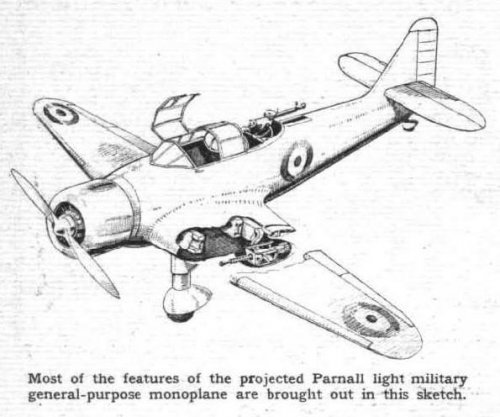
Parnall (??) - (Project) 1936 military general-purpose a/c
- (??) : Light, low-winged monoplane w/ spatted main u/c
- (??) : 1 x 260 hp Wolseley Scorpio II radial;* span (??) m
-- * Optional engines offered with power up to 400 hp; eg:
-- Czech: 1 x 260 hp Walter Bora or 340 hp Walter Castor II
-- British: 1 x 360hp Armstrong Siddeley Cheetah IX, etc.
- (??) : Advanced trainer or colonial/export light bomber
-- https://www.secretprojects.co.uk/threads/parnall-projects-prototypes.4492/
Parnall Type 381 - (Project) 1938 gunnery research aircraft
- Type 381: Twin-boom, twin-turret Nash & Thompson concept
- Type 381: 2 x 1,550 hp Bristol Hercules HE.6.SM; span 19.35 m
- Type 381: Mainly metal; crew Pilot, W/O, and Loader/Gunner
- Type 381: 6 x ordered; ACM Wilfrid Freeman cancelled 06.1940
-- https://www.secretprojects.co.uk/threads/parnall-type-381-project.20030/#post-194706
Parnall Type 382 - 1938 Heck Mk.III military trainer; x 1
- Type 382: Tandem 2-seat military elementary trainer
- Type 382: 1 x 200 hp DH Gipsy Six 6-cyl.; span 9.60 m
- Type 382: Heck 2C cabin monoplane deriv. to T.1/37*
-- * Meant to be heavier, more powerful Magister type
- Type 382: Class B J1; G-AFKF; impressed as R9138
-- Ground Instructional Airframe No. 3600M by 1943
Parnall Type 383 - (Project) Sept 1938 gunnery trainer
- Type 383: 2-seat (pilot and gunner) turret trainer
- Type 383: 1 x 425 hp DH Gipsy King V12; span 9.75 m
- Type 383: 1 x Nash and Thompson FN5 power turret
Parnall Type 384 - (Project) Sept 1938 heavy bomber
- Type 384: Heavy upper & lower turrets amidships
- Type 384: 4 x inline engines (type?); span 27.98 m
- Type 384: Twin-boomed; paired engines w/ shafts*
-- * Rear engines shaft-driving outboard airscrews
-- https://www.secretprojects.co.uk/threads/parnall-heavy-bomber-project-of-1938.29291/
Parnall Type 385-400 - (??) speculative designations
Parnall Type 401 - (Project) Sept 1938 research a/c
- Type 401: 2-seat (pilot and gunner) turret trainer
- Type 401: 1 x (??) hp Bristol Mercury; span 9.75 m
- Type 401: Nash and Thompson FN5 powered turret
- Type 401: (Project) revised Feb 1939; new turret
- Type 401: 1 x (??) hp Bristol Mercury; span 9.75 m
- Type 401: Nash and Thompson FN33 powered turret
__________________________________________________
[1] Initially, D.R. Pobjoy had been collaborating with Parnalls on engine development with the goal of forming an engine manufacturer division. When Pobjoy elected to go it alone, Parnalls abandoned its scheme to become an engine maker.
[2] Some sources list the Prawn's liquid-cooled engine as having been a spare from R.101 airship stocks. Ricardo-Burt engines were employed aboard the R.101 - as both starter motors and to drive generators for electrical power. However, the rating of those airship auxiliary engines is usually given as only 40 bhp.
[3] Production numbers/serials of Gulls built at Yate by George Parnall & Co are:
- D.1 Gull Four I (Mk.I) : c/ns D.22 (G-ABUV); D.24 (G-ACAT); D.26 (G-ACFY); D.29 (G-ACGR); and D.30 (G-ACHA) = x 5;
- D.2 Gull Four II (Mk.II) : c/ns D.21 (G-ACAL); D.28 (G-ACGP); D.33 (G-ACIP); D.34 (G-ACIR); D.40 (G-ACLJ); and D.44 (G-ACPA) = x 6;
- D.2 Gull Four IIA (Mk.IIA): c/ns D.23 (G-ACFJ); D.25 (G-ACGC); D.27 (G-ACLG); D.31 (G-ACHT); D.32 (G-ACHM); D.35 (G-ACIS); D.36 (G-ACJP); D.37 (G-ACJR); D.38 (G-ACJW); D.39 (G-ACJV); and D.42 (G-ACXY) = x 11; and
- D.2 Gull Four III (Mk.III): c/n D.45 (G-ACUL) = x 1
The D.2 Gull Four III was a one-off modification to suit Lt. Patrick Randolph. It featured a single-leg main undercarriage as well as revised cabin top and door.
Note: Presumably, since c/n D.45 was built at Yate, Parnalls also built Gulls c/ns D.41 and D.43. Unfortunately, the exact model type or types of these two airframes is not known. However, if they were Yate-built, the count of Parnall-built Gulls goes up from 24 to 25.
[4] Having just completed the 1950 King's Race, G-AEGI's tailplane was shredded by the propeller of Vickers-Armstrong's Spitfire G-AISU as the latter landed. Attempted repairs were abandoned in 1953, effectively making the Heck 2C an extinct type. The guilty Spitfire LF Mk Vb would go on to regain its RAF serial AB910 while flying with the BBMF.
__________________________________________________
Parnall and Sons Limited
Hamble Baby - Single-seat ASW Scout & bomber; x 130
- Hamble Baby: Fairey design deriv. from Sopwith Baby
-- Parnell-built retained Sopwith floats and tailplanes
-- 1st production batch; in N1190-N1219 serial range
- Hamble Baby: Seaplane; 1 x 110 hp Clerget 9Z; x 30
-- 2nd production batch; in N1960-N2059 serial range
- Hamble Baby: Seaplane; 1 x 130 hp Clerget 9B; x 26
- Hamble Baby Convert: Landplane; Clerget 9B; x 74
Avro 504 - As sub-contractor to A. V. Roe & Co; x 530+
- Avro 504 : Built by Parnall in 6 batches; 1916 - 1918
- Avro 504B: 1st batch; 1916; RNAS; x 30 (9861-9890)
-- Fitted with wing racks for 4 x 16 lb practice bombs
- Avro 504B: 2nd batch; RNAS;* x 20 (N6010-N6029)
-- * Admiralty order (but 15 x transferred to the RFC)
- Avro 504B: 3rd batch; 1917; RNAS; x 30 (N6650-N6679)
-- As armaments trainers with 80 hp Gnome engines
- Avro 504J: 4th batch; 1918; RNAS; x 200 (B8581-B8780)
- Avro 504K: 5th batch; 1918; RFC; x 100 (D9281-D9380)
- Avro 504K: 6th batch; 1918; RAF; x 150 (E3254-E3403)
-- Parnall poss. built some 504Ks in F8696-F8863 range
Short Type 184 - As repair contractor to Admiralty; x 1
- Type 184: Parnall rebuilt floatplane No. 843; Nov 1916
Short Type 827 - As sub-contractor to Short Bros.; x 20
- Type 827: 2-seat seaplane naval recce-bomber biplane
- Type 827: 1 x 150 hp Sunbeam Nubian; span 16.43 m
- Type 827: 2-bay biplane; steel-strutted folding wings
-- 1st production batch; in 8218-8229 serial range; x 12
-- included x 4 with dual-controls; 5 sent to East Africa
-- 2nd production batch; extension of 1st contract; x 8
Short Bomber - Adaptation of Type 184 as bomber; x 6
- Bomber: Single-engine 3-bay biplane; 8 x 112 lb bombs
- Bomber: 1 x 250 hp Rolls-Royce Eagle; span 25.60 m
- Bomber: Parnall contracted to build x 10* (9771-9780)
-- * Parnall only compl'd x 6 before contract cancelled
-- NB: Bomber consid. interim; no offical Type number
Parnall Scout - 1916 single-seat anti-airship fighter; x 1*
-- * 2 x Scouts ordered (N505-N506); only N505 built
- Scout : 2-seat anti-airship 'Zepp Chaser' interceptor
- Scout N505: 250 hp Sunbeam Maori II; span 13.41 m
- Scout N505: (Planned) 1 x 190 hp Rolls-Royce Falcon
-- For the Admiralty; base design by Adolf Camden-Pratt
- Scout : Overweight, poor flier; no further development
Parnall Panther - 1917 2-seat, carrier-based recce; x 155
-- Orig. Parnall N.2A;* Panther name applied to 6th a/c
- Panther : Single-bay biplane; foldable rear fuselage**
- Panther : 1 x 230 hp Bentley BR2 rotary; span 8.99 m
- Panther : 6 x prototypes; N.91-N.96 (Parnall c/n P.707)
-- * Harold Bolas design to meet Admiralty Spec N.2A
-- ** Of birch-ply monocoque constr.; patented folding
- Panther : 1 x prod'n; N7406; Parnall c/n P.1/10650***
-- *** Panther prod'n contracted to Bristols at Filton
George Parnall and Company
Parnall Puffin - 1920 2-seat fighter-recce biplane; x 3
- Puffin : Amphibious; 2-bay wings (lower underslung)
- Puffin : 1 x 450 hp Napier Lion II W12; span 12.19 m
- Puffin : Experimental land/sea/carrier undercarriage
-- Design by Harold Bolas; to May 1919 RAF Spec XXI
- Puffin : Prototypes used by MAEE at the Isle of Grain
Parnall Plover - 1922 biplane carrier/float fighter; x 13
- Plover : Single-seat single-bay biplane; wheels/floats
- Plover : 1 x 435 hp Bristol Jupiter III 9-cyl.; span 8.84 m
- Plover : Harold Bolas design; to Air Ministry Spec 6/22
Parnall Possum - 1923 triplane powertrain testbed; x 2
- Possum : Central engine; shaft-driven wing propellers
- Possum : 1 x 450 hp Napier Lion W12;* span 14.02 m
-- * With a radiator mounted to either side of fuselage
- Possum : Primarily fabric-covered wood construction
-- Possum demonstrated minimum advantage to layout
Parnall Pixie - 1923 ultralight low-power sportplane;* x 3
-- * At Lympne, Pixie was referred to as a 'motor-glider'
- Pixie : Single-seat ultralight; multiple config.; see below
- Pixie : (Pixie II) 1 x 750 cc Douglas HO2; span 5.44 m
- Pixie : Harold Bolas design; 1923 Lympne light a/c trials
-- Pixie I : Normal-span monoplane for cross-country use
-- Pixie II: Short-span monoplane for performance flying
-- Pixie III : Longer-span biplane (fixed; non-convertible)
-- Pixie IIIA: Convertible from monoplane to biplane config.
Parnall (??) - (Project) 1924 10-seat transport monoplane
- (??) : Trimotor; Nov 1924 Imperial Airways submission
- (??) : 3 x 240 hp Siddeley Puma* inline 6-cyl.; span (??)
- (??) : Harold Bolas design; 10-seat (2+8 pax ?) airliner
-- * Imperial sought Siddeley Puma, Jaguar or Napier Lion
Parnall Peto - 1925 submarine-carried recce biplane; x 2
- Peto : Catapult-launched submarine a/c; H. Bolas design
- Peto : 1 x 135 hp AS Mongoose IIIC 5-cyl.; span 8.66 m
- Peto : Foldable for compact-stowage in submarine hangar
- Peto : Mixed construction; Warren-truss wing bracings
- Peto : 2 x prototypes built; N181 (later modified) & N182
-- Peto N181 (as built): 1 x 128 hp Bristol Lucifer 3-cyl.
-- Peto N181 (as built): Consuta (4-veneer mahogany) floats
-- Peto N181 (as mod.): AS Mongoose and alum. floats
- Peto : Testing was very successful but category eliminated
-- Peto N182: Reg. as G-ACOJ by F.C.H. Allen, Selsey; ntu
Airco DH.9A - Under postwar Air Ministry contract; x 30
-- Parnall to refurbish & convert to dual-control trainers
- DH.9A : 1926 contract to repair/rebuild WW1 a/c; x 18
-- 1st batch DH.9As serialled in the J8096-J8225 range
- DH.9A : 1927 contract to construct/complete a/c; x 12
-- Not clear if built from scratch or stored components
-- 2nd batch DH.9As serialled in the J8483-J8494 range
-- Parnall-rebuilt airframes were all dual-control trainers
Parnall Perch - 1926 general-purpose military trainer; x 1
- Perch : Side-by-side seating; wheel or float u/c trainer
- Perch : 1 x 270 hp R-R Falcon III V12; span 12.19 m
- Perch : Harold Bolas design; to 1924 AM Spec 5/24
- Perch : 2-bay biplane for land/deck/water operations
Parnall Pike - 1927 shipboard recce biplane; 1 x prototype
- Pike : 2- or 3-seat a/c; from aircraft carrier or on floats
- Pike : 1 x 450 hp Napier Lion V W12; span 14.02 m
- Pike : Folding wings w/ Warren truss; backward stagger
- Pike : Mixed constr. with fabric-covered wooden wings
- Pike : Sluggish performer; not up to spec. requirements
Parnall Imp - 1927 2-seat light biplane w/o wing bracing
- Imp : Wings straight cantilever lower with swept upper
- Imp : 1 x 80 hp AS Genet II 5-cyl. radial; span 7.77 m
- Imp : Harold Bolas design; no wing bracing but I struts
- Imp : G-EBTE later tested 65 hp Pobjoy P 7-cyl. radial [1]
Parnall Pipit - 1928 single-seat shipboard fighter;* x 2
- Pipit : 2-/3-seat a/c; from aircraft carrier or on floats
- Pipit : 1 x 495 hp Rolls-Royce Kestrel;* span 10.67 m
- Pipit : Harold Bolas design to Air Ministry spec. 21/26
- Pipit : Mixed constr.; eg: stainless-steel tubing fuselage
-- Pipit N232 : 1st prototype; lost to tail flutter, Oct 1928
-- Pipit N233 : 2nd prototype; lost to tail flutter, Feb 1929
-- * Actually predecessors F.XI for N232 & F.XIIS for N233
Parnall Gyroplane - 1927 experimental 2-seat autogyro; x 2
- Gyroplane: Cierva Autogiro Co contract to build airframes
-- Both tractors with 4-blade rotors & outrigger stabilisers
- Gyroplane: aka Parnall C.10; stub wings in line w/ rotor
- Gyroplane: 1 x 70 hp AS Genet I; rotor diameter 10.70 m
- Gyroplane: Parnall/Cierva C.10 for RAF trials as J9038
- Gyroplane: C.10 crashed during trials w/ Avro-built C.9
- Gyroplane: aka Parnall C.11; H. Bolas-designed airframe
-- C.11: (As built) Clockwise-rotating rotor; wings as C.10
-- C.11: (As rebuilt) Counter-clockwise rotor; fwd. wings
- Gyroplane: 1 x 120 hp ADC Airdisco; rotor diam 10.70 m
-- C.11 flight test attempted Feb 1928; damaged taxi-ing
-- Juan de la Cierva tried t/o before the rotor was spun up
-- C.11 repaired by Oct 1928 but unlikely that it ever flew
Parnall Elf - 1929 tandem 2-seat light touring biplane; x 3
- Elf : Harold Bolas design; more conventional than Imp
- Elf : 1 x ADC or Cirrus Hermes 4-cylinder; span 9.53 m
- Elf : Fabric-covered wood construction; folding wings*
-- * Slightly-staggered; wireless with Warren-truss struts
- Elf I : Full-span ailerons; ground-adjustable tail incidence
- Elf I: 1 x 100 hp ADC Hermes I 4-cylinder; span 9.53 m
-- Elf I c/n 1, G-AAFH; to Lord Apsley; damaged March 1929
- Elf II: Half-span ailerons; flight-adjustable tail incidence
- Elf II: 1 x 120 hp Cirrus Hermes II 4-cyl.; span 9.53 m
-- Elf II c/n 2; Class B reg. J.6; G-AAIN; to Lord Apsley **
-- ** c/n2 later to K.E. Lloyd of Bristol; stored during WW2
-- ** Rebuilt at Kidlington, Oxon., Mar 1946; wfu Aug 1950
-- ** c/n2 restored in 1980 for the Shuttleworth collection
-- Elf II c/n 3; Class B reg. J.5; G-AAIO; to F. Rowland-Hall
-- Spun in, crashed & burned; Sapperton, Glos.; 13 Jan 1934
-- https://aviation-safety.net/wikibase/201025
-- Some sources attribute G-AAIO crash to fuel pump failure
Hendy 281 Hobo - 1929 single-seat cabin monoplane; x 1
- Type 281 : Basil B. Henderson design for Hendy Aircraft
- Type 281 : Some sources claim aircraft built by Parnall
-- Others claim built at Shoreham by Basil & B.J.W. Brady
Hendy 302 - 1929 2-seat coupé-top low-wing monoplane; x 1
- Type 302 : Parnall-built; cantilever wings; fixed main u/c
- Hendy 302 : 1 x 130 hp Cirrus Hermes IV 4-cyl.; span 10.67 m
- Hendy 302 : Basil B. Henderson design for Edgar Percival
- Hendy 302 : G-AAVT; wood constr.; Cirrus Major II testbed
- Hendy 302A: 1934 rebuild; 1 x 130 hp Cirrus Hermes IV
Parnall Parasol - 1930 experimental parasol winged a/c; x 2
- Parasol : To measure aerodynamic forces on wings in flight
- Parasol : 1 x 226 hp AS Lynx IV 7-cyl. radial; span 12.80 m
- Parasol : Last design by Harold Bolas for George Parnell
-- Parasol K1228 : 1st prototype; fully-slotted RAF 28 wings
-- Parasol K1229 : 2nd prototype; wings modified by Avro*
-- Parasol K1229 : Full-span split surfaces/out-rigged ailerons
-- * Parasol K1229 assigned the Avro designation Avro 661
Parnall Prawn - 1930 experimental parasol flying boat; x 1
- Prawn : Tilting engine mount to increase prop clearance
- Prawn : 1 x 65 hp Ricardo-Burt inline; [2] span ~8.5 m
- Prawn : Single-step all-metal hull; fabric covered wings
- Prawn : Designed by H. V. Clark (no background details)
- Prawn : To MAEE Felixstowe as S1576; refused to take off
Hendy 311 - (Project) 1931 3-seat low-winged lightplane
- Type 311 : Basil B. Henderson design for Hendy Aircraft
- Type 311 : Sim. to Percival Gull; to be built by Parnalls
Miles M.1 Satyr - 1932 aerobatic biplane prototype; x 1
- M.1 Satyr : single-seater designed by F.G. Miles; 1932
- M.1 Satyr : 1 x 75 hp Pobjoy R radial; span 6.40 m
- M.1 Satyr : G-ABVG crashed Sept 1936; devel. ended*
-- * Miles then having decided to focus on monoplanes
Percival Gull - 1933 low-winged cabin monoplane; x 24
- Gull : Initial production for Edgar Wickner Percival*
- Gull : 1 x 4- or 6-cylinder inline engine; span 11.02 m
- Gull : 3-seat tourer & racing a/c; 4 x Parnall models
-- D.1 Gull Four I : 1 x 130 hp Cirrus Hermes IV 4-cyl.
-- D.2 Gull Four II : 1 x 160 hp Napier Javelin III 6-cyl.
-- D.2 Gull Four IIA: 1 x 130 hp DH Gipsy Major I 4-cyl.
-- D.2 Gull Four III: 1 x 130 hp DH Gipsy Major I 4-cyl.
-- aka Mk.I x 5; Mk.II x 6; Mk.IIA x 11; Mk.III x 1 [3]
-- * Gull production then to Percival's Gravesend works
Parnall F.5/33 - (Project) Claims of Parnall submission
-- Specification F.5/33 for a pusher-prop turret fighter
-- No other details or confirmation
Hendy 3303 - (Project) 1933 racer; similar to Heck
- Type 3303 : Sometimes mis-listed as 'Parnall 3303'*
-- * Presumably in anticipation of a build by Parnall
-- * NB: Hendy & Parnall were not merged until 1935
Parnall 348 - (Project) no details*
-- * Could this actually be a Hendy Type 348 project?
Parnall Aircraft Limited
Hendy Heck - 1935 low-winged light cabin monoplanes
- Heck : Adaptation of Westland-built Hendy 3308 Heck
- Heck : 1 x 200 hp DH Gipsy Six inline; span 10.26 m
- Heck : G-ACTC; orig. featured slotted LE; retract. u/c
- Heck : 2-seater; main u/c legs fixed down, spats added
-- Heck developed by Parnall into Heck 2C 3-seater (qv)
Parnall Heck 2C - 1936 3-seat deriv.; aka Heck IIC; x 6
- Heck 2C: Unsuccessful tourer/light a/c entry; no sales
- Heck 2C: 1 x 200 hp DH Gipsy Six inline; span 10.26 m
- Heck 2C: J10 G-AEGH NF749 29.Apr.36 impressed 8.3.43
- Heck 2C: Class B J11; G-AEGI; dbr 1950; scrapped 1953 [4]
- Heck 2C: Class B J12; G-AEGJ 16 Sept 36; scrapped 1939
- Heck 2C: Class B J13; (G-AEGK) G-AEMR; scrapped 1938
- Heck 2C: Class B J14; (G-AEGL ntu); RAF serial K8853
-- Heck 2C K8853; gunsight trials; Martlesham Heath*
-- * At Armament & Instrument Experimental Unit (?)
-- * 2 x .303-in; prototype Barr & Stroud GJ3 refl. sight
- Heck 2C: 5th; no reg.(?); Wolseley Aries test flying
- Heck 2C: 6th; no reg.(?); Wolseley Aries test flying
Parnall G.4/31 - 1935 2-seat general-purpose* biplane; x 1
- G.4/31 : Designed to meet Air Ministry Spec. G.4/31
- G.4/31 : 1 x 690 hp Bristol Pegasus IM3; span 17.00 m
-- * Day/night bomber + recce, torpedo- and dive-bombing
- G.4/31 : 2-bay biplane; gulled upper wings; serial K2772
-- To A&AEE early 1936; armament trials until March 1937
-- Damaged in March 1927 crash & subsequently scrapped
Parnall (??) - (Project) 1936 military general-purpose a/c
- (??) : Light, low-winged monoplane w/ spatted main u/c
- (??) : 1 x 260 hp Wolseley Scorpio II radial;* span (??) m
-- * Optional engines offered with power up to 400 hp; eg:
-- Czech: 1 x 260 hp Walter Bora or 340 hp Walter Castor II
-- British: 1 x 360hp Armstrong Siddeley Cheetah IX, etc.
- (??) : Advanced trainer or colonial/export light bomber
-- https://www.secretprojects.co.uk/threads/parnall-projects-prototypes.4492/
Parnall Type 381 - (Project) 1938 gunnery research aircraft
- Type 381: Twin-boom, twin-turret Nash & Thompson concept
- Type 381: 2 x 1,550 hp Bristol Hercules HE.6.SM; span 19.35 m
- Type 381: Mainly metal; crew Pilot, W/O, and Loader/Gunner
- Type 381: 6 x ordered; ACM Wilfrid Freeman cancelled 06.1940
-- https://www.secretprojects.co.uk/threads/parnall-type-381-project.20030/#post-194706
Parnall Type 382 - 1938 Heck Mk.III military trainer; x 1
- Type 382: Tandem 2-seat military elementary trainer
- Type 382: 1 x 200 hp DH Gipsy Six 6-cyl.; span 9.60 m
- Type 382: Heck 2C cabin monoplane deriv. to T.1/37*
-- * Meant to be heavier, more powerful Magister type
- Type 382: Class B J1; G-AFKF; impressed as R9138
-- Ground Instructional Airframe No. 3600M by 1943
Parnall Type 383 - (Project) Sept 1938 gunnery trainer
- Type 383: 2-seat (pilot and gunner) turret trainer
- Type 383: 1 x 425 hp DH Gipsy King V12; span 9.75 m
- Type 383: 1 x Nash and Thompson FN5 power turret
Parnall Type 384 - (Project) Sept 1938 heavy bomber
- Type 384: Heavy upper & lower turrets amidships
- Type 384: 4 x inline engines (type?); span 27.98 m
- Type 384: Twin-boomed; paired engines w/ shafts*
-- * Rear engines shaft-driving outboard airscrews
-- https://www.secretprojects.co.uk/threads/parnall-heavy-bomber-project-of-1938.29291/
Parnall Type 385-400 - (??) speculative designations
Parnall Type 401 - (Project) Sept 1938 research a/c
- Type 401: 2-seat (pilot and gunner) turret trainer
- Type 401: 1 x (??) hp Bristol Mercury; span 9.75 m
- Type 401: Nash and Thompson FN5 powered turret
- Type 401: (Project) revised Feb 1939; new turret
- Type 401: 1 x (??) hp Bristol Mercury; span 9.75 m
- Type 401: Nash and Thompson FN33 powered turret
__________________________________________________
[1] Initially, D.R. Pobjoy had been collaborating with Parnalls on engine development with the goal of forming an engine manufacturer division. When Pobjoy elected to go it alone, Parnalls abandoned its scheme to become an engine maker.
[2] Some sources list the Prawn's liquid-cooled engine as having been a spare from R.101 airship stocks. Ricardo-Burt engines were employed aboard the R.101 - as both starter motors and to drive generators for electrical power. However, the rating of those airship auxiliary engines is usually given as only 40 bhp.
[3] Production numbers/serials of Gulls built at Yate by George Parnall & Co are:
- D.1 Gull Four I (Mk.I) : c/ns D.22 (G-ABUV); D.24 (G-ACAT); D.26 (G-ACFY); D.29 (G-ACGR); and D.30 (G-ACHA) = x 5;
- D.2 Gull Four II (Mk.II) : c/ns D.21 (G-ACAL); D.28 (G-ACGP); D.33 (G-ACIP); D.34 (G-ACIR); D.40 (G-ACLJ); and D.44 (G-ACPA) = x 6;
- D.2 Gull Four IIA (Mk.IIA): c/ns D.23 (G-ACFJ); D.25 (G-ACGC); D.27 (G-ACLG); D.31 (G-ACHT); D.32 (G-ACHM); D.35 (G-ACIS); D.36 (G-ACJP); D.37 (G-ACJR); D.38 (G-ACJW); D.39 (G-ACJV); and D.42 (G-ACXY) = x 11; and
- D.2 Gull Four III (Mk.III): c/n D.45 (G-ACUL) = x 1
The D.2 Gull Four III was a one-off modification to suit Lt. Patrick Randolph. It featured a single-leg main undercarriage as well as revised cabin top and door.
Note: Presumably, since c/n D.45 was built at Yate, Parnalls also built Gulls c/ns D.41 and D.43. Unfortunately, the exact model type or types of these two airframes is not known. However, if they were Yate-built, the count of Parnall-built Gulls goes up from 24 to 25.
[4] Having just completed the 1950 King's Race, G-AEGI's tailplane was shredded by the propeller of Vickers-Armstrong's Spitfire G-AISU as the latter landed. Attempted repairs were abandoned in 1953, effectively making the Heck 2C an extinct type. The guilty Spitfire LF Mk Vb would go on to regain its RAF serial AB910 while flying with the BBMF.
__________________________________________________
Last edited:
Fascinating, thank you for putting this together.George Parnall Aircraft Production
Parnall and Sons Limited
Hamble Baby - Single-seat ASW Scout & bomber; x 130
- Hamble Baby: Fairey design deriv. from Sopwith Baby
-- Parnell-built retained Sopwith floats and tailplanes
-- 1st production batch; in N1190-N1219 serial range
- Hamble Baby: Seaplane; 1 x 110 hp Clerget 9Z; x 30
-- 2nd production batch; in N1960-N2059 serial range
- Hamble Baby: Seaplane; 1 x 130 hp Clerget 9B; x 26
- Hamble Baby Convert: Landplane; Clerget 9B; x 74
Avro 504 - As sub-contractor to A. V. Roe & Co; x 530+
- Avro 504 : Built by Parnall in 6 batches; 1916 - 1918
- Avro 504B: 1st batch; 1916; RNAS; x 30 (9861-9890)
-- Fitted with wing racks for 4 x 16 lb practice bombs
- Avro 504B: 2nd batch; RNAS;* x 20 (N6010-N6029)
-- * Admiralty order (but 15 x transferred to the RFC)
- Avro 504B: 3rd batch; 1917; RNAS; x 30 (N6650-N6679)
-- As armaments trainers with 80 hp Gnome engines
- Avro 504J: 4th batch; 1918; RNAS; x 200 (B8581-B8780)
- Avro 504K: 5th batch; 1918; RFC; x 100 (D9281-D9380)
- Avro 504K: 6th batch; 1918; RAF; x 150 (E3254-E3403)
-- Parnall poss. built some 504Ks in F8696-F8863 range
Short Type 184 - As repair contractor to Admiralty; x 1
- Type 184: Parnall rebuilt floatplane No. 843; Nov 1916
Short Type 827 - As sub-contractor to Short Bros.; x 20
- Type 827: 2-seat seaplane naval recce-bomber biplane
- Type 827: 1 x 150 hp Sunbeam Nubian; span 16.43 m
- Type 827: 2-bay biplane; steel-strutted folding wings
-- 1st production batch; in 8218-8229 serial range; x 12
-- included x 4 with dual-controls; 5 sent to East Africa
-- 2nd production batch; extension of 1st contract; x 8
Short Bomber - Adaptation of Type 184 as bomber; x 6
- Bomber: Single-engine 3-bay biplane; 8 x 112 lb bombs
- Bomber: 1 x 250 hp Rolls-Royce Eagle; span 25.60 m
- Bomber: Parnall contracted to build x 10* (9771-9780)
-- * Parnall only compl'd x 6 before contract cancelled
-- NB: Bomber consid. interim; no offical Type number
Parnall Scout - 1916 single-seat anti-airship fighter; x 1*
-- * 2 x Scouts ordered (N505-N506); only N505 built
- Scout : 2-seat anti-airship 'Zepp Chaser' interceptor
- Scout N505: 250 hp Sunbeam Maori II; span 13.41 m
- Scout N505: (Planned) 1 x 190 hp Rolls-Royce Falcon
-- For the Admiralty; base design by Adolf Camden-Pratt
- Scout : Overweight, poor flier; no further development
Parnall Panther - 1917 2-seat, carrier-based recce; x 155
-- Orig. Parnall N.2A;* Panther name applied to 6th a/c
- Panther : Single-bay biplane; foldable rear fuselage**
- Panther : 1 x 230 hp Bentley BR2 rotary; span 8.99 m
- Panther : 6 x prototypes; N.91-N.96 (Parnall c/n P.707)
-- * Harold Bolas design to meet Admiralty Spec N.2A
-- ** Of birch-ply monocoque constr.; patented folding
- Panther : 1 x prod'n; N7406; Parnall c/n P.1/10650***
-- *** Panther prod'n contracted to Bristols at Filton
George Parnall and Company
Parnall Puffin - 1920 2-seat fighter-recce biplane; x 3
- Puffin : Amphibious; 2-bay wings (lower underslung)
- Puffin : 1 x 450 hp Napier Lion II W12; span 12.19 m
- Puffin : Experimental land/sea/carrier undercarriage
-- Design by Harold Bolas; to May 1919 RAF Spec XXI
- Puffin : Prototypes used by MAEE at the Isle of Grain
Parnall Plover - 1922 biplane carrier/float fighter; x 13
- Plover : Single-seat single-bay biplane; wheels/floats
- Plover : 1 x 435 hp Bristol Jupiter III 9-cyl.; span 8.84 m
- Plover : Harold Bolas design; to Air Ministry Spec 6/22
Parnall Possum - 1923 triplane powertrain testbed; x 2
- Possum : Central engine; shaft-driven wing propellers
- Possum : 1 x 450 hp Napier Lion W12;* span 14.02 m
-- * With a radiator mounted to either side of fuselage
- Possum : Primarily fabric-covered wood construction
-- Possum demonstrated minimum advantage to layout
Parnall Pixie - 1923 ultralight low-power sportplane;* x 3
-- * At Lympne, Pixie was referred to as a 'motor-glider'
- Pixie : Single-seat ultralight; multiple config.; see below
- Pixie : (Pixie II) 1 x 750 cc Douglas HO2; span 5.44 m
- Pixie : Harold Bolas design; 1923 Lympne light a/c trials
-- Pixie I : Normal-span monoplane for cross-country use
-- Pixie II: Short-span monoplane for performance flying
-- Pixie III : Longer-span biplane (fixed; non-convertible)
-- Pixie IIIA: Convertible from monoplane to biplane config.
Parnall (??) - (Project) 1924 10-seat transport monoplane
- (??) : Trimotor; Nov 1924 Imperial Airways submission
- (??) : 3 x 240 hp Siddeley Puma* inline 6-cyl.; span (??)
- (??) : Harold Bolas design; 10-seat (2+8 pax ?) airliner
-- * Imperial sought Siddeley Puma, Jaguar or Napier Lion
Parnall Peto - 1925 submarine-carried recce biplane; x 2
- Peto : Catapult-launched submarine a/c; H. Bolas design
- Peto : 1 x 135 hp AS Mongoose IIIC 5-cyl.; span 8.66 m
- Peto : Foldable for compact-stowage in submarine hangar
- Peto : Mixed construction; Warren-truss wing bracings
- Peto : 2 x prototypes built; N181 (later modified) & N182
-- Peto N181 (as built): 1 x 128 hp Bristol Lucifer 3-cyl.
-- Peto N181 (as built): Consuta (4-veneer mahogany) floats
-- Peto N181 (as mod.): AS Mongoose and alum. floats
- Peto : Testing was very successful but category eliminated
-- Peto N182: Reg. as G-ACOJ by F.C.H. Allen, Selsey; ntu
Airco DH.9A - Under postwar Air Ministry contract; x 30
-- Parnall to refurbish & convert to dual-control trainers
- DH.9A : 1926 contract to repair/rebuild WW1 a/c; x 18
-- 1st batch DH.9As serialled in the J8096-J8225 range
- DH.9A : 1927 contract to construct/complete a/c; x 12
-- Not clear if built from scratch or stored components
-- 2nd batch DH.9As serialled in the J8483-J8494 range
-- Parnall-rebuilt airframes were all dual-control trainers
Parnall Perch - 1926 general-purpose military trainer; x 1
- Perch : Side-by-side seating; wheel or float u/c trainer
- Perch : 1 x 270 hp R-R Falcon III V12; span 12.19 m
- Perch : Harold Bolas design; to 1924 AM Spec 5/24
- Perch : 2-bay biplane for land/deck/water operations
Parnall Pike - 1927 shipboard recce biplane; 1 x prototype
- Pike : 2- or 3-seat a/c; from aircraft carrier or on floats
- Pike : 1 x 450 hp Napier Lion V W12; span 14.02 m
- Pike : Folding wings w/ Warren truss; backward stagger
- Pike : Mixed constr. with fabric-covered wooden wings
- Pike : Sluggish performer; not up to spec. requirements
Parnall Imp - 1927 2-seat light biplane w/o wing bracing
- Imp : Wings straight cantilever lower with swept upper
- Imp : 1 x 80 hp AS Genet II 5-cyl. radial; span 7.77 m
- Imp : Harold Bolas design; no wing bracing but I struts
- Imp : G-EBTE later tested 65 hp Pobjoy P 7-cyl. radial [1]
Parnall Pipit - 1928 single-seat shipboard fighter;* x 2
- Pipit : 2-/3-seat a/c; from aircraft carrier or on floats
- Pipit : 1 x 495 hp Rolls-Royce Kestrel;* span 10.67 m
- Pipit : Harold Bolas design to Air Ministry spec. 21/26
- Pipit : Mixed constr.; eg: stainless-steel tubing fuselage
-- Pipit N232 : 1st prototype; lost to tail flutter, Oct 1928
-- Pipit N233 : 2nd prototype; lost to tail flutter, Feb 1929
-- * Actually predecessors F.XI for N232 & F.XIIS for N233
Parnall Gyroplane - 1927 experimental 2-seat autogyro; x 2
- Gyroplane: Cierva Autogiro Co contract to build airframes
-- Both tractors with 4-blade rotors & outrigger stabilisers
- Gyroplane: aka Parnall C.10; stub wings in line w/ rotor
- Gyroplane: 1 x 70 hp AS Genet I; rotor diameter 10.70 m
- Gyroplane: Parnall/Cierva C.10 for RAF trials as J9038
- Gyroplane: C.10 crashed during trials w/ Avro-built C.9
- Gyroplane: aka Parnall C.11; H. Bolas-designed airframe
-- C.11: (As built) Clockwise-rotating rotor; wings as C.10
-- C.11: (As rebuilt) Counter-clockwise rotor; fwd. wings
- Gyroplane: 1 x 120 hp ADC Airdisco; rotor diam 10.70 m
-- C.11 flight test attempted Feb 1928; damaged taxi-ing
-- Juan de la Cierva tried t/o before the rotor was spun up
-- C.11 repaired by Oct 1928 but unlikely that it ever flew
Parnall Elf - 1929 tandem 2-seat light touring biplane; x 3
- Elf : Harold Bolas design; more conventional than Imp
- Elf : 1 x ADC or Cirrus Hermes 4-cylinder; span 9.53 m
- Elf : Fabric-covered wood construction; folding wings*
-- * Slightly-staggered; wireless with Warren-truss struts
- Elf I : Full-span ailerons; ground-adjustable tail incidence
- Elf I: 1 x 100 hp ADC Hermes I 4-cylinder; span 9.53 m
-- Elf I c/n 1, G-AAFH; to Lord Apsley; damaged March 1929
- Elf II: Half-span ailerons; flight-adjustable tail incidence
- Elf II: 1 x 120 hp Cirrus Hermes II 4-cyl.; span 9.53 m
-- Elf II c/n 2; Class B reg. J.6; G-AAIN; to Lord Apsley **
-- ** c/n2 later to K.E. Lloyd of Bristol; stored during WW2
-- ** Rebuilt at Kidlington, Oxon., Mar 1946; wfu Aug 1950
-- ** c/n2 restored in 1980 for the Shuttleworth collection
-- Elf II c/n 3; Class B reg. J.5; G-AAIO; to F. Rowland-Hall
-- Spun in, crashed & burned; Sapperton, Glos.; 13 Jan 1934
-- https://aviation-safety.net/wikibase/201025
-- Some sources attribute G-AAIO crash to fuel pump failure
Hendy 281 Hobo - 1929 single-seat cabin monoplane; x 1
- Type 281 : Basil B. Henderson design for Hendy Aircraft
- Type 281 : Some sources claim aircraft built by Parnall
-- Others claim built at Shoreham by Basil & B.J.W. Brady
Hendy 302 - 1929 2-seat coupé-top low-wing monoplane; x 1
- Type 302 : Parnall-built; cantilever wings; fixed main u/c
- Hendy 302 : 1 x 130 hp Cirrus Hermes IV 4-cyl.; span 10.67 m
- Hendy 302 : Basil B. Henderson design for Edgar Percival
- Hendy 302 : G-AAVT; wood constr.; Cirrus Major II testbed
- Hendy 302A: 1934 rebuild; 1 x 130 hp Cirrus Hermes IV
Parnall Parasol - 1930 experimental parasol winged a/c; x 2
- Parasol : To measure aerodynamic forces on wings in flight
- Parasol : 1 x 226 hp AS Lynx IV 7-cyl. radial; span 12.80 m
- Parasol : Last design by Harold Bolas for George Parnell
-- Parasol K1228 : 1st prototype; fully-slotted RAF 28 wings
-- Parasol K1229 : 2nd prototype; wings modified by Avro*
-- Parasol K1229 : Full-span split surfaces/out-rigged ailerons
-- * Parasol K1229 assigned the Avro designation Avro 661
Parnall Prawn - 1930 experimental parasol flying boat; x 1
- Prawn : Tilting engine mount to increase prop clearance
- Prawn : 1 x 65 hp Ricardo-Burt inline; [2] span ~8.5 m
- Prawn : Single-step all-metal hull; fabric covered wings
- Prawn : Designed by H. V. Clark (no background details)
- Prawn : To MAEE Felixstowe as S1576; refused to take off
Hendy 311 - (Project) 1931 3-seat low-winged lightplane
- Type 311 : Basil B. Henderson design for Hendy Aircraft
- Type 311 : Sim. to Percival Gull; to be built by Parnalls
Miles M.1 Satyr - 1932 aerobatic biplane prototype; x 1
- M.1 Satyr : single-seater designed by F.G. Miles; 1932
- M.1 Satyr : 1 x 75 hp Pobjoy R radial; span 6.40 m
- M.1 Satyr : G-ABVG crashed Sept 1936; devel. ended*
-- * Miles then having decided to focus on monoplanes
Percival Gull - 1933 low-winged cabin monoplane; x 24
- Gull : Initial production for Edgar Wickner Percival*
- Gull : 1 x 4- or 6-cylinder inline engine; span 11.02 m
- Gull : 3-seat tourer & racing a/c; 4 x Parnall models
-- D.1 Gull Four I : 1 x 130 hp Cirrus Hermes IV 4-cyl.
-- D.2 Gull Four II : 1 x 160 hp Napier Javelin III 6-cyl.
-- D.2 Gull Four IIA: 1 x 130 hp DH Gipsy Major I 4-cyl.
-- D.2 Gull Four III: 1 x 130 hp DH Gipsy Major I 4-cyl.
-- aka Mk.I x 5; Mk.II x 6; Mk.IIA x 11; Mk.III x 1 [3]
-- * Gull production then to Percival's Gravesend works
Parnall F.5/33 - (Project) Claims of Parnall submission
-- Specification F.5/33 for a pusher-prop turret fighter
-- No other details or confirmation
Hendy 3303 - (Project) 1933 racer; similar to Heck
- Type 3303 : Sometimes mis-listed as 'Parnall 3303'*
-- * Presumably in anticipation of a build by Parnall
-- * NB: Hendy & Parnall were not merged until 1935
Parnall 348 - (Project) no details*
-- * Could this actually be a Hendy Type 348 project?
Parnall Aircraft Limited
Hendy Heck - 1935 low-winged light cabin monoplanes
- Heck : Adaptation of Westland-built Hendy 3308 Heck
- Heck : 1 x 200 hp DH Gipsy Six inline; span 10.26 m
- Heck : G-ACTC; orig. featured slotted LE; retract. u/c
- Heck : 2-seater; main u/c legs fixed down, spats added
-- Heck developed by Parnall into Heck 2C 3-seater (qv)
Parnall Heck 2C - 1936 3-seat deriv.; aka Heck IIC; x 6
- Heck 2C: Unsuccessful tourer/light a/c entry; no sales
- Heck 2C: 1 x 200 hp DH Gipsy Six inline; span 10.26 m
- Heck 2C: J10 G-AEGH NF749 29.Apr.36 impressed 8.3.43
- Heck 2C: Class B J11; G-AEGI; dbr 1950; scrapped 1953 [4]
- Heck 2C: Class B J12; G-AEGJ 16 Sept 36; scrapped 1939
- Heck 2C: Class B J13; (G-AEGK) G-AEMR; scrapped 1938
- Heck 2C: Class B J14; (G-AEGL ntu); RAF serial K8853
-- Heck 2C K8853; gunsight trials; Martlesham Heath*
-- * At Armament & Instrument Experimental Unit (?)
-- * 2 x .303-in; prototype Barr & Stroud GJ3 refl. sight
- Heck 2C: 5th; no reg.(?); Wolseley Aries test flying
- Heck 2C: 6th; no reg.(?); Wolseley Aries test flying
Parnall G.4/31 - 1935 2-seat general-purpose* biplane; x 1
- G.4/31 : Designed to meet Air Ministry Spec. G.4/31
- G.4/31 : 1 x 690 hp Bristol Pegasus IM3; span 17.00 m
-- * Day/night bomber + recce, torpedo- and dive-bombing
- G.4/31 : 2-bay biplane; gulled upper wings; serial K2772
-- To A&AEE early 1936; armament trials until March 1937
-- Damaged in March 1927 crash & subsequently scrapped
Parnall (??) - (Project) 1936 military general-purpose a/c
- (??) : Light, low-winged monoplane w/ spatted main u/c
- (??) : 1 x 260 hp Wolseley Scorpio II radial;* span (??) m
-- * Optional engines offered with power up to 400 hp; eg:
-- Czech: 1 x 260 hp Walter Bora or 340 hp Walter Castor II
-- British: 1 x 360hp Armstrong Siddeley Cheetah IX, etc.
- (??) : Advanced trainer or colonial/export light bomber
-- https://www.secretprojects.co.uk/threads/parnall-projects-prototypes.4492/
Parnall Type 381 - (Project) 1938 gunnery research aircraft
- Type 381: Twin-boom, twin-turret Nash & Thompson concept
- Type 381: 2 x 1,550 hp Bristol Hercules HE.6.SM; span 19.35 m
- Type 381: Mainly metal; crew Pilot, W/O, and Loader/Gunner
- Type 381: 6 x ordered; ACM Wilfrid Freeman cancelled 06.1940
-- https://www.secretprojects.co.uk/threads/parnall-type-381-project.20030/#post-194706
Parnall Type 382 - 1938 Heck Mk.III military trainer; x 1
- Type 382: Tandem 2-seat military elementary trainer
- Type 382: 1 x 200 hp DH Gipsy Six 6-cyl.; span 9.60 m
- Type 382: Heck 2C cabin monoplane deriv. to T.1/37*
-- * Meant to be heavier, more powerful Magister type
- Type 382: Class B J1; G-AFKF; impressed as R9138
-- Ground Instructional Airframe No. 3600M by 1943
Parnall Type 383 - (Project) Sept 1938 gunnery trainer
- Type 383: 2-seat (pilot and gunner) turret trainer
- Type 383: 1 x 425 hp DH Gipsy King V12; span 9.75 m
- Type 383: 1 x Nash and Thompson FN5 power turret
Parnall Type 384 - (Project) Sept 1938 heavy bomber
- Type 384: Heavy upper & lower turrets amidships
- Type 384: 4 x inline engines (type?); span 27.98 m
- Type 384: Twin-boomed; paired engines w/ shafts*
-- * Rear engines shaft-driving outboard airscrews
-- https://www.secretprojects.co.uk/threads/parnall-heavy-bomber-project-of-1938.29291/
Parnall Type 385-400 - (??) speculative designations
Parnall Type 401 - (Project) Sept 1938 research a/c
- Type 401: 2-seat (pilot and gunner) turret trainer
- Type 401: 1 x (??) hp Bristol Mercury; span 9.75 m
- Type 401: Nash and Thompson FN5 powered turret
- Type 401: (Project) revised Feb 1939; new turret
- Type 401: 1 x (??) hp Bristol Mercury; span 9.75 m
- Type 401: Nash and Thompson FN33 powered turret
__________________________________________________
[1] Initially, D.R. Pobjoy had been collaborating with Parnalls on engine development with the goal of forming an engine manufacturer division. When Pobjoy elected to go it alone, Parnalls abandoned its scheme to become an engine maker.
[2] Some sources list the Prawn's liquid-cooled engine as having been a spare from R.101 airship stocks. Ricardo-Burt engines were employed aboard the R.101 - as both starter motors and to drive generators for electrical power. However, the rating of those airship auxiliary engines is usually given as only 40 bhp.
[3] Production numbers/serials of Gulls built at Yate by George Parnall & Co are:
- D.1 Gull Four I (Mk.I) : c/ns D.22 (G-ABUV); D.24 (G-ACAT); D.26 (G-ACFY); D.29 (G-ACGR); and D.30 (G-ACHA) = x 5;
- D.2 Gull Four II (Mk.II) : c/ns D.21 (G-ACAL); D.28 (G-ACGP); D.33 (G-ACIP); D.34 (G-ACIR); D.40 (G-ACLJ); and D.44 (G-ACPA) = x 6;
- D.2 Gull Four IIA (Mk.IIA): c/ns D.23 (G-ACFJ); D.25 (G-ACGC); D.27 (G-ACLG); D.31 (G-ACHT); D.32 (G-ACHM); D.35 (G-ACIS); D.36 (G-ACJP); D.37 (G-ACJR); D.38 (G-ACJW); D.39 (G-ACJV); and D.42 (G-ACXY) = x 11; and
- D.2 Gull Four III (Mk.III): c/n D.45 (G-ACUL) = x 1
The D.2 Gull Four III was a one-off modification to suit Lt. Patrick Randolph. It featured a single-leg main undercarriage as well as revised cabin top and door.
Note: Presumably, since c/n D.45 was built at Yate, Parnalls also built Gulls c/ns D.41 and D.43. Unfortunately, the exact model type or types of these two airframes is not known. However, if they were Yate-built, the count of Parnall-built Gulls goes up from 24 to 25.
[4] Having just completed the 1950 King's Race, G-AEGI's tailplane was shredded by the propeller of Vickers-Armstrong's Spitfire G-AISU as the latter landed. Attempted repairs were abandoned in 1953, effectively making the Heck 2C an extinct type. The guilty Spitfire LF Mk Vb would go on to regain its RAF serial AB910 while flying with the BBMF.
__________________________________________________
I agree that the Hendy Hobo had no connection with Parnall and was built at Shoreham.
The Hendy/Parnall connection seems to have come about due to Edgar Percival doing freelance test pilot work for Parnall in 1929-30. He claimed to have test flown the Peto, Prawn and Elf - although his memory was somewhat confused as he claimed that the Prawn was built as a possible Schneider Trophy contender! He also claimed to have been friendly with George G. Parnall and it was his familiarity with the company and their workmanship which led him to place the contract for the Hendy 302 with Parnall. That led to the production order for Gulls.
Just noticed that the former Parnall Aircraft factory is to be redeveloped …
https://sites.southglos.gov.uk/news...-new-housing-and-employment-for-local-people/
https://sites.southglos.gov.uk/news...-new-housing-and-employment-for-local-people/


