P-51B Mustang: North American’s Bastard Stepchild that Saved the Eighth Air Force

Henning - I like this. Let me chew on it.

Two comments regarding information presented.

Important discriminants when comparing range are:
1. Increases (major) due to adding internal fuel. While the P-47D-25 was a major improvement for P-47 range, it was not delivered to the FGs in squadron level quantities until after D-Day. This is obviously important as the 56th FG, which received 6 in May, could not task any single squadron to perform long-range escort with a mix of older P-47Ds with only 305gal internal fuel. Conversely, both the P-51B and P-38J internal fuel tank kits were installed in Group level numbers during January/February 1944.

2. Each of the radii displayed show the increased capability by operational date - but for all the versions of P-47D it is not clear that the early increases were attributed to single tank capacity and type on the centerline rack, while the later two range extensions were due to finally having wing rack equipped P-47D-15 level/depot modified earlier models in squadron level quantity.

Conceivably your format is the best, busy but precise, by providing information along the radius. Possibly add more data/label to each radii.
Now:
P-47D 425 miles 3/1944
New
P-47D-15/-23 w/2x108gal Wing Tanks 3/44

All earlier P-47
P-47C/D-11 w/75gal Belly Tank 8/43
P-47C/D-11 w/108gal Belly Tank 10/43
P-47C/D-11 w/150gal Belly Tank 2/44

The question arises, "does deletion of internal fuel data leave the question regarding the range increases with same external tank combination with P-51 and P-38?"

Possibly change pre fuel tank kit installation identification by labeling the P-51B with only 184gal wing tanks, and P-38J with only 2x150gal wing tanks as follows:
On the radii:
As above, P-47C/D-11 and P-47D-15/-23
#P-51B
##P-51B

*P-38H/J-5
**P-38J-5/J-10
To explain the information on each radii:

Data block somewhere (like lower RH corner)
P-47C through P-47D-23 with only 305gal internal fuel

#P-51B-1/-5 with only 184gal internal fuel
##P-51B-1/-5/-10 with 269gal internal fuel

*P-38H/J-5 with only 300gal internal fuel
**P-38J-5/J-10/J-15 with 410gal internal fuel

You have done an amazing job of translating my previous work to another very good format less dependent on symbols and a large data block, or symbols matched with data blocks.

My only concern about leaving your existing product unmolested is that I know a huge population of readers about long-range escort are ignorant on the importance of fuel fractions/increases to internal fuel.
 
Hi Bill,


Here an example:

View attachment 798282


Seems like a logical option, too. Personally, if there is too much information in a map that's delegated to the legend, I find them a bit hard to read at times.

What about head-on silhouettes of the fighter configurations, showing tanks beneath the aircraft and annotations with fuel amounts? I think Focke-Wulf used that style in WW2, albeit not on a map.

Regards,

Henning (HoHun)
Hi Henning, apologies for overlooking this one. I like the idea about head on symbols. The differences would be cross section differences in the belly/wing tanks. Three sizes, 4 types - 75, 108, 150 and 150 flat.

Additionally, the FAREP table and same type symbols you suggest, using bar chart format were always an option, but radii covering different cities puts the escort requirements with more clarity than a simple range value with no context.

OTOH this map does everything I suggested and eliminates a separate block of explanations. Trade off of presenting all relevant data on one radii at sacrifice of brevity of identity and increased clutter, but beneficial in that one does not have to look elsewhere for explicit information.

The least cluttered map would require looking to a table to contain all the explicit information.
That map would be a plan view silhouette with an imbedded number, located on the map to scale, with only the date under the symbol, each associated number located in the data block which cites the internal fuel, external tank type/capacity.

I can't tell you how much I appreciate the work you have put into this project.
 
Hi Bill,

1. Increases (major) due to adding internal fuel. While the P-47D-25 was a major improvement for P-47 range, it was not delivered to the FGs in squadron level quantities until after D-Day.

Very good point.

I wonder if some arrows and annotations in the graph itself could help to illustrate both that and the development of the maximum fighter escort range, which doesn't increase "ring by ring". (I suspect that's why @Scott Kenny suggested to build separate 1943 and 1944 maps?)

Data block somewhere (like lower RH corner)
P-47C through P-47D-23 with only 305gal internal fuel

#P-51B-1/-5 with only 184gal internal fuel
##P-51B-1/-5/-10 with 269gal internal fuel

*P-38H/J-5 with only 300gal internal fuel
**P-38J-5/J-10/J-15 with 410gal internal fuel

I'll check how annotations work in GMT.

You have done an amazing job of translating my previous work to another very good format less dependent on symbols and a large data block, or symbols matched with data blocks.

Actually, I like the little aircraft symbols and think the new map would be better with some of them, too :)

It's only that GMT doesn't allow the defintion of custom vector heads, apparently, and I don't know how to calculate map positions that match the radii precisely, as GMT uses some kind of elliptoid earth model and my "manual" calculations based on spherical earth distances result in visibly displaced symbols. I guess there might be a point where it's more economical to overlay the base map from GMT with additional graphics from a vector-based drawing program, such as Inkscape. I'm not quite sure Inkscape provides an EPS preview though - that would be highly desirable so that one actually knows what one is drawing. On the other hand, with Inkscape's layer concept, it might be possible to draw on a raster image and then generate the final map from the vector image ... I have hardly ever used Inkscape before.

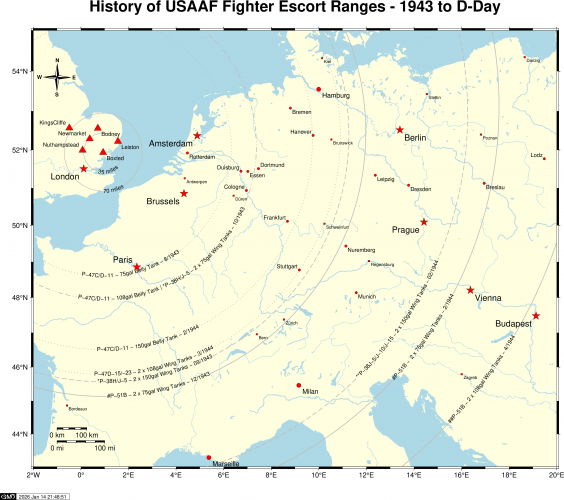
Latest version:

range_map.png

I've played around with adding more airfields to give perspective to the range circles, and tried to differentiate between the different aircraft types by using dotted/dashed lines. Maybe something like Duxford would be more representative than Nuthampstead, which I think was a good choice mainly because it's situationed in the middle of four fighter fields? Clearly, it makes no sense to try and to fit all fighter fields on the map, my thinking mainly is that the random selection makes it evident to the reader that not all fighters will have a chance to reach the "best case" range circle around Boxted.

Regards,

Henning (HoHun)
 
Hi Bill,


Very good point.

I wonder if some arrows and annotations in the graph itself could help to illustrate both that and the development of the maximum fighter escort range, which doesn't increase "ring by ring". (I suspect that's why @Scott Kenny suggested to build separate 1943 and 1944 maps?)


I'll check how annotations work in GMT.


Actually, I like the little aircraft symbols and think the new map would be better with some of them, too :)

It's only that GMT doesn't allow the defintion of custom vector heads, apparently, and I don't know how to calculate map positions that match the radii precisely, as GMT uses some kind of elliptoid earth model and my "manual" calculations based on spherical earth distances result in visibly displaced symbols. I guess there might be a point where it's more economical to overlay the base map from GMT with additional graphics from a vector-based drawing program, such as Inkscape. I'm not quite sure Inkscape provides an EPS preview though - that would be highly desirable so that one actually knows what one is drawing. On the other hand, with Inkscape's layer concept, it might be possible to draw on a raster image and then generate the final map from the vector image ... I have hardly ever used Inkscape before.

Latest version:

View attachment 798484

I've played around with adding more airfields to give perspective to the range circles, and tried to differentiate between the different aircraft types by using dotted/dashed lines. Maybe something like Duxford would be more representative than Nuthampstead, which I think was a good choice mainly because it's situationed in the middle of four fighter fields? Clearly, it makes no sense to try and to fit all fighter fields on the map, my thinking mainly is that the random selection makes it evident to the reader that not all fighters will have a chance to reach the "best case" range circle around Boxted.

Regards,

Henning (HoHun)
I agree your points. That said, the book will highlight the P-47, P-51 and P-38 'farthest' victory credits. To put the P-47 in best frame of reference for discussion, I used the 56th FG from Halesworth through March 1944, then Boxted. I used 354th, 357th and 355th for the P-51B so Boxted, Leiston and Steeple Morden. For the P-38 I used Kings Cliffe for 20th and Nuthampstead for 20th and 55th FG.

So, I would perhaps add Steeple Morden, Halesworth and remove Bodney and Newmarket?

Regards,

Bill
 
Last edited:
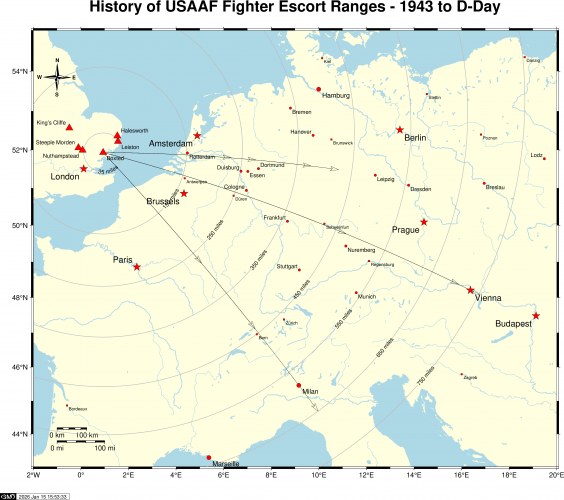
Henning, in a perfect world to show what I want, the final product would look like:
Strike a line (hidden) from 52 degrees to the east. Place four P-47 symbols with nose to mile scale. Within each P-47 is a triangle, within each triangle is a number 1 through 4. Under each symbol is the operational date for the mission drop tank configuration, e.g. "8/43" for P-47 with imbedded triangle 1.

The map itself is exactly as you have drawn both the continent and the cities.

The only radii shown and labeled are the 35mi circle around Boxted, then 150mi, 250mi, 350mi, 450mi, 550, 650 and 750mi

Strike a line from Boxted to Vienna. Place three Mustang symbols to mileage scale. Within each symbol is a circle, within each circle is a number 1 through 3. Align each symbol with the P-51 vector. Under each symbol is the operational date, e.g. "12/43" for P-51 with imbedded circle 1.

Strike a line from Boxted to Milan. Place three P-38 symbols to mileage scale. Within each symbol is a square, within each square is a number 1 through 3. Align each P-38 symbol with the P-38 vector. Under each symbol is the operational date e.g. "10/43" for P-38 with imbedded square 1.

In the lower right corner is the place for a data block. Within the data block are three columns with title "P-47", "P-51", "P-38". Above each column is the aircraft symbol with imbedded geometric artifact.

For each row is the row number, followed by the specific data corresponding to the numbered symbol on the map. E.G.
1. P-47C/D-6, 305gal Internal 1. P-38H/J-5, 300gal Internal 1. P-51B-1/-5, 184gal Internal
. 1x75gal Belly tank 2x75gal Wing Tanks 2x75gal Wing Tanks
2. P-47C/D-6, 305gal Internal 2. P-38H/J-5, 300gal Internal 2. P-51B-1/-10, 269gal Internal
1x10⁸gal Belly Tank 2x150gal Wing Tanks 2x75gal Wing Tanks
3. P-47C/D-11, 305gal Internal 3. P-38J-5/-10, 410gal Internal 3. P-51B-1/-10, 269gal Internal
1x150 Flat Belly Tank 2x1150gal Wing Tanks 2x10⁸gal Wing Tanks
4. P-47D-15/-23, 305gal Internal
2x10⁸gal Wing Tanks

At the end of the day I may substitute the 2x10⁸gal with 2x150gal for the P-47D-15 but FAREP didn't include data for 2x150 until the D-25 arrived with 370gal internal fuel. There is much anecdotal data that the 2x10⁸gal drop tank config was more desirable from flight characteristic standpoint.
 
Hi Bill & HoHun, just a few remarks:

- Note that not everybody is aware that there are two kinds of Gallons: the Imperial Gallon (IG) and the US Gallon (USG). Therefore one should always indicate which is meant so that some people don't assume the wrong one.
I assume that you are referring to USG but some Britons that are not even aware of the existence of USG, may assume that IG is meant.
(I have seen many mistakes with units of measurement in my professional life (process design for chemical engineering) including mistakes with gallons.)

- HoHun makes beautiful drawings, but how are you gonna fit those on one book page?
Your 'Bastard Stepchild' book has pages of 27 x 20 cm, which is already too small for the above map, but if you decide to choose Pen & Sword as the publisher it will be even worse.
You really would need a fold-out. Please don't print the map over two pages as the gutter obscures part of the map.
 
Hi Bill,

The map itself is exactly as you have drawn both the continent and the cities.

The only radii shown and labeled are the 35mi circle around Boxted, then 150mi, 250mi, 350mi, 450mi, 550, 650 and 750mi

Strike a line from Boxted to Vienna. Place three Mustang symbols to mileage scale. [...]

Strike a line from Boxted to Milan. Place three P-38 symbols to mileage scale.

Here is the base map, the rest would have to be done in a second program on top of the GMT output.

range_map.png

The vector stems seem unavoidable, but I can (hopefully) use one map layer for placing the symbols and a different one without the vectors for generating the final output.

Note that the choice of Vienna for the P-51 line results in a P-51 symbol overlaying Vienna ... probably better to move the line halfway between Prague and Vienna?

Why the "odd" radii? Personally, I like regular hundreds better ...

Regards,

Henning (HoHun)
 
Hi Dagger,

- HoHun makes beautiful drawings, but how are you gonna fit those on one book page?
Your 'Bastard Stepchild' book has pages of 27 x 20 cm, which is already too small for the above map, but if you decide to choose Pen & Sword as the publisher it will be even worse.

All I can say is that 27 x 20 cm^2 is close to A4, and I've printed one version on an A4 sheet and found it well-readable. However, the practically available space in a Pen & Sword book might well be smaller, I wouldn't know ... certainly an important consideration.

I'm hopeless at drawing, by the way - the maps are all algorithmically generated with GMT: https://www.generic-mapping-tools.org/

(It's meant for Geophysicists etc., so while it has a fantastic number of specialized capabilities, regrettably some options that would be really nice to have in a more general context are absent.)

Regards,

Henning (HoHun)
 
Hi Bill & HoHun, just a few remarks:

- Note that not everybody is aware that there are two kinds of Gallons: the Imperial Gallon (IG) and the US Gallon (USG). Therefore one should always indicate which is meant so that some people don't assume the wrong one.
I assume that you are referring to USG but some Britons that are not even aware of the existence of USG, may assume that IG is meant.
(I have seen many mistakes with units of measurement in my professional life (process design for chemical engineering) including mistakes with gallons.)

- HoHun makes beautiful drawings, but how are you gonna fit those on one book page?
Your 'Bastard Stepchild' book has pages of 27 x 20 cm, which is already too small for the above map, but if you decide to choose Pen & Sword as the publisher it will be even worse.
You really would need a fold-out. Please don't print the map over two pages as the gutter obscures part of the map.
Good coaching tips. Thank You.
Hi Dagger,


All I can say is that 27 x 20 cm^2 is close to A4, and I've printed one version on an A4 sheet and found it well-readable. However, the practically available space in a Pen & Sword book might well be smaller, I wouldn't know ... certainly an important consideration.

I'm hopeless at drawing, by the way - the maps are all algorithmically generated with GMT: https://www.generic-mapping-tools.org/

(It's meant for Geophysicists etc., so while it has a fantastic number of specialized capabilities, regrettably some options that would be really nice to have in a more general context are absent.)

Regards,

Henning (HoHun)
Henning - what you have done is make my communication with Pen & Sword much easier. May I have your permission to submit your files to them as a basis of discussion? You are already in my Acknowledgement section, but still 'Henning".
 
Hi Bill,

Henning - what you have done is make my communication with Pen & Sword much easier. May I have your permission to submit your files to them as a basis of discussion? You are already in my Acknowledgement section, but still 'Henning".

Of course, they're all yours! Glad you find them useful! :)

Are you referring to the map files or to the source files with the various tables and the GMT script, which I haven't posted yet? With the source files, it's much easier to change something about the map (or even to make a similar map for a completely different region, for example for the Pacific Theatre). I was actually intending to share these too, once they're sufficiently "stable".

Regards,

Henning (HoHun)
 
Hi Bill,

Here is the base map, the rest would have to be done in a second program on top of the GMT output.

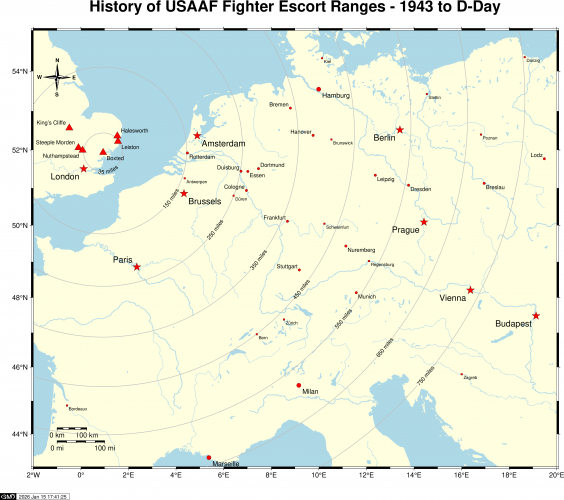
Here's an "actual" base map that would be input for the final map, as opposed to the above base map that would only be used for arranging the aircraft symbols.

range_map.png

EPS output would also be feasible.

Regards,

Henning (HoHun)
 
Hi Bill,


Here is the base map, the rest would have to be done in a second program on top of the GMT output.

View attachment 798578

The vector stems seem unavoidable, but I can (hopefully) use one map layer for placing the symbols and a different one without the vectors for generating the final output.

Note that the choice of Vienna for the P-51 line results in a P-51 symbol overlaying Vienna ... probably better to move the line halfway between Prague and Vienna?

Why the "odd" radii? Personally, I like regular hundreds better ...

Regards,

Henning (HoHun)
All good points. That said, the actual ranges often are very close to the odd radii. Methinks I need to ponder.
 
Hi Bill,

All good points. That said, the actual ranges often are very close to the odd radii. Methinks I need to ponder.

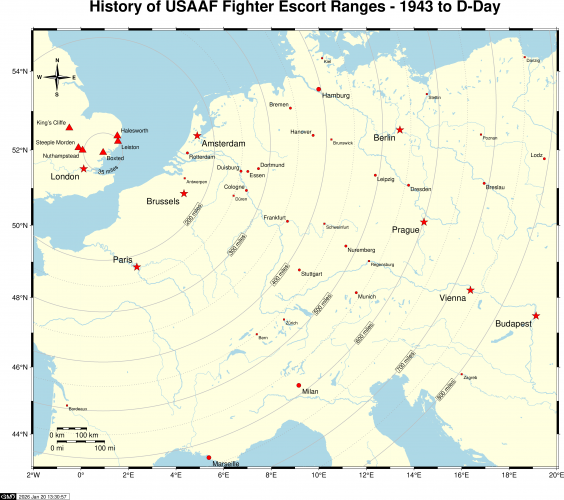
Here a variant that shows the "regular" radii with the '50s radii indicated in a lighter style. That might actually be a bit tidier as the aircraft labels won't be competing for space with the radius circle annotations:

range_map.png

Regards,

Henning (HoHun)
 
I think you're going to be better off with 2 maps. 1943 and 1944.


I was under the impression that the later P38s were running pressure carbs, which only have an Auto Lean option.
All P-38s had pressure Bendix-Stromberg carburettors with 4-position mixture controls. By pulling back aft of the Auto Lean position It was possible to manually lean the mixture. In later P-51B/Ds (I don't know the exact transition date) had the mixture control changed to 3 positions (idle cut-off, run and full rich) which as far as I know eliminated the possibility of manual leaning. At least I have never seen manual leaning being mentioned with Merlin installations. But it is mentioned by P-38 pilots, F6F manual and F8F USN test report.
 
I wonder how wartime Mustang pilots reacted to the occasionally very harsh criticism expressed in the "modern" SETP test report? I know that Eric Brown was very dismissive of the report.
 
@drgondog

On page 64 you quote Schmeud saying "We looked around to find an engineer or somebody in our organization that weighed 140lb and was 5ft 10in. Right in our Engineering Department, we found a man that fitted that specification – Art Chester. "

The source is attributed to either a talk in 1970 or a paper from 1985, do you recall which one this mention of Chester was from? Is there any other mention of Chester by Schmeud? As an aside, that weight of 140lbs is a bit lower than other mentions of Chesters weight.

The second thing I'd like to ask is about the Menasco powered P-509; are there any drawings of this variant known to exist?
 
@drgondog

On page 64 you quote Schmeud saying "We looked around to find an engineer or somebody in our organization that weighed 140lb and was 5ft 10in. Right in our Engineering Department, we found a man that fitted that specification – Art Chester. "

The source is attributed to either a talk in 1970 or a paper from 1985, do you recall which one this mention of Chester was from? Is there any other mention of Chester by Schmeud? As an aside, that weight of 140lbs is a bit lower than other mentions of Chesters weight.

The second thing I'd like to ask is about the Menasco powered P-509; are there any drawings of this variant known to exist?
Schmued's 1985 manuscript via Rolf Schmued.

The P-500 was Menasco powered and first submitted to BPC. The P-509 was Allison V-1710 from inception and presented as High Speed Allison Powered Pursuit. I have several versions of P-509 in image format, but the drawings were donated to Boeing. The P-509 matured from various dimensional proposals to X73 between April 20 and May 5, 1940.

P-500 did make mock up stage but was scrapped
 
"Modern" test pilots compared 4 warbirs from the handling point of view: P-51D, F6F-5, FG-1D and P-47D-40. My information comes from the June 1990 issue of Sport Aviation.
Two points regarding the P-51 eval. First the power applied in the testing never exceeded MTO power at 61" and the ailerons were rigged at 10 degrees instead of 15 degrees +/-. The difference in roll rates are substantial at all speeds. Corky Meyer was an excellent test pilot but several points should be made.

IIRC all the R-2800s were tested at 59" without water injection, but substantially at Military Power at 2400 HP.

From memory as I don't have a copy of the article or the book.

This is his Flight Journal article however,


I was not impressed particularly by the article. Somehow 'low speed handling' such as P-factor and mismanagement of airspeed and turn at low altitude were critical factors for him when the roll rates, acceleration and speed in all envelopes P-51 and acceleration and high speed roll/climb in comparison to the P-47 and F6F were seemingly not important. Nor was the huge difference in tactical footprint in both Fighter and Fighter Bomber role important.

He mentioned that he was one of the test pilots at the Patuxent River NAS flyoff in October 1944 but failed to mention that the P-51D was rated Best Fighter below 25,000 feet and just barely lost to P-47D for best above 25,000 feet. The number of Naval pilots making the evaluations far exceeded the combined AAF/Mfr test pilots to add emphasis to the voting.

Nor did he mention that the P-51D was rated far above both the F6F-5 and F4U-1/-4 in both those categories.

In fairness the XF8 was rated 29 votes to 28 (out of 94) for the P-51D, but that is tantamount to extending the competition three more months to include the production P-51H-1.

He also mentioned that in his opinion the vulnerability to enemy fire from the rear was more of a hazard to the P-51 than the P-47 which helped him place the P-47 above the P-51. Most of the MANY fighter pilots I have known favored the fighter that provided the best opportunity to get behind the other guy - or extend with maneuverability or speed.

I suspect that Carrier Ops flight test focus had a significant influence as well as favoring R-2800 fleets over Merlin.

In the book that comes to mind:
Internal loading was not specified. Nor were the comparisons in gross weight relative to Fighter Mission.
P-51D engine not specified, nor rated HP used for comparisons.
Comparisons were made at or below 15000 feet.
What I do recall is that METO was discussed as maximum power used by P-51D. That is roughly Mil. Power. For sure, 145 octane fuel was not used, which is a substantial detriment to P-51D in a combat power vs combat power comparisons in both ROC and accelerations and top speed.
I suspect that neither guns nor ammo were installed - a significant weight reduction advantage for the P-47D vs P-51D as well as the F6F and F2G.

Another factor is that 15,000 feet and below is in the optimal strike zone for the FG-2 with single speed/single stage supercharger. Also notable is that the low drag advantage to available Hp at 15K while still slightly in favor for the P-51D - is a major advantage for the P-51D above 20K through 30K even against the P-47D with 50-60% more available HP.

I also noted with some sense of irony that he left out the total victory credit comparisons of the P-51 vs the F6F, F4U and P-47 on a global basis.
 
Hi Bill,

I was not impressed particularly by the article. Somehow 'low speed handling' such as P-factor and mismanagement of airspeed and turn at low altitude were critical factors for him when the roll rates, acceleration and speed in all envelopes P-51 and acceleration and high speed roll/climb in comparison to the P-47 and F6F were seemingly not important. Nor was the huge difference in tactical footprint in both Fighter and Fighter Bomber role important.

I'd say it's clear that Corky Meyer was a loyal Grummanite, and he elegantly managed to split his list of best fighters in Europe and Pacific parts so that the Grumman F6F could effortlessly be assigned a credible number one position! ;-)

He also mentioned that in his opinion the vulnerability to enemy fire from the rear was more of a hazard to the P-51 than the P-47 which helped him place the P-47 above the P-51. Most of the MANY fighter pilots I have known favored the fighter that provided the best opportunity to get behind the other guy - or extend with maneuverability or speed.

Good point, and it's also worth mentioning that a bigger fighter inevitably offers a bigger target area as well, and thus is likely to receive more hits than a smaller one. I believe terminal ballistics discern between target susceptibility (as the likelihood of being hit) and target vulnerability (as the likelihood of being damaged/destroyed upon being hit). That would be a factor in favour of inline-engined fighters such as the lean Mustang and the deminuitive Yak fighters, counteracting the radial-engined fighters' lower vulnerability to a degree.

I'm sort of surprised that Corky didn't mention the very substantial cost advantage the Hellcat had over the Vought Corsair, despite pointing out the Corsair's complex compound curves. I believe Grumman did very well with regard to the suitability of their design for mass production, for example by introducing spot welding techniques into the production process that appear to have been cutting edge at the time. Maybe he didn't want to create the impression that the F6F was preferred over the F4U because it was cheap, but in my opinion, if a fighter was suitable for highly efficient production, that was an important advantage of the design that deserves appreciation in such a ranking.

Regards,

Henning (HoHun)
 
Hi Henning - good points as usual. I hesitated to name Meyer a fanboi because I once met him and respect his obvious skills. His opinion regarding flying characteristics shall always trump mine.

His comments reminded me however, that pilots of relatively similar skill and experience can have differing opinions about the same aircraft type. Kit Carson was very disparaging about the FW 190D that he flew when 357FG rotated to Germany post VE Day. My father, OTOH liked the one he flew for 26 hours at Gablingen very much and opined he could easily be persuaded that it was comparable to the P-51D. Perhaps the Black Gang hired by 355th FG were better skilled at rigging. The 355th had the two seat FW 190A/ Bf 109G, a standard FW 190A-8 and the FW 190D but I don't recall the version if I ever saw it.

Of the above, he was particularly disparaging about the 109G-12 as a 'deathtrap' due to extremely poor visiblity in the back seat.

One other thing about the F6F. All the warbird pilots I have talked to love the F6F handling qualities far more than F4U. That said the same pilots that made those comments mostly stated that they preferred the F4U in a shooting war against other aircraft.

In the Patuxent River surveys both the F4U and the P-51D suffered in low speed handling compared to the F6F, but both the F4U and P-51D were ranked far higher as 'Best Fighter' below and above 25000 feet.
 
Some notes:
1. There was no "145 octane fuel", since the maximum octane number is 100. And actually how much 115/145 fuel was used in WW2 since apparently in Europe 100/150 was used by the British as higher end fuel (and apparently by US, aircraft in Europe as well).

2. In Corky Meyer's book "Flight Journal" (the above link did not work) he notes that he places major emphasis on how each fighter could be effectively flown by pilots with shortish "200 hrs. of training". Just for note: Several younger pilots, who became aces, of the Finnish AF had fewer than 150 hours before their first combat in 1941.

3. The "modern" evaluation punished the P-47 severely by not having a working turbo. Yes, others were limited too. None had ADI.

4. The P-51H had very lousy armament for the period. The USN BuOrd rated one 20 mm equal to 3 x 12.7 mm MGs. I once asked Roland Beamont about his opinion of the firepower of the Tempest vs. the P-47. He replied that the former had far better firepower. Also: the BuOrd rep in that fighter conference noted that the .50" MG was very susceptible to burning the barrels with longer bursts (for this reason the wing guns in Finnish Buffaloes were adjusted to crappy 550 rpm) while the 20 mm gun was not.

5. It seems that the cmodern" test was not conducted optimally. For example, all take-off trians were conducted with flaps up, giving very skewed results as for example the P-47 benefits, according to wartime tests, significantly by the use of flaps on take-off. The article does not report any data to clear 50 ft. obstacle. Neither it has no data at all on the landing distances, in which, according to British "data sheets", the P-51D was the poorest.

6. The USN report on the P-51B vs. F4U vs. F6F isn't liked by P-51 fans.

7. A very rarely mentioned aspect, yet highly important for aircraft availability rates, would have been the high susceptibility of the P-51 radiators to damage from the debris thrown up by the propeller slipstream on non-paved airfields.
 
Some notes:
1. There was no "145 octane fuel", since the maximum octane number is 100. And actually how much 115/145 fuel was used in WW2 since apparently in Europe 100/150 was used by the British as higher end fuel (and apparently by US, aircraft in Europe as well).

That's not correct, the way of determining the
Some notes:
1. There was no "145 octane fuel", since the maximum octane number is 100. And actually how much 115/145 fuel was used in WW2 since apparently in Europe 100/150 was used by the British as higher end fuel (and apparently by US, aircraft in Europe as well).

Just like the definition for meter, kg and second has changed in the last 200 years, also the definition of the Oktan number has changed, so that Oktan numbers above 100 have a viable definition. It's still called Oktanzahl (but defined in a different way) with the number below 100 still in line with the old oktan based definition.
 
Hi Bill,

I hesitated to name Meyer a fanboi because I once met him and respect his obvious skills. His opinion regarding flying characteristics shall always trump mine.

That must have been a fascinating meeting! :) I didn't mean to imply he was a fanboi in the modern sense when I wrote "loyal Grummanite" - usually company-loyal people are open about it, like "If you ask me, the best fighter is a Grumman of course, but I'll explain to you why I think so, and you can make up your own mind" ... and then they come up with a really good explanation.

type. Kit Carson was very disparaging about the FW 190D that he flew when 357FG rotated to Germany post VE Day. My father, OTOH liked the one he flew for 26 hours at Gablingen very much and opined he could easily be persuaded that it was comparable to the P-51D. Perhaps the Black Gang hired by 355th FG were better skilled at rigging.

After reading through "Ending the Arguement" again, I was in fact wondering if the P-51D they used for testing had some airframe rigging problems, too. I am not sure that "extraordinarly high maneuvering stick forces, totally inadequate stall warning and vicious departure characteristics" are in line with historic pilot comments, especially regarding the stick forces. My impression was that the Mustang's elevator (which seems to be the "offending" control here) was in fact a bit on the light side, leading to the installation of a bobweight in the elevator circuit to increase control forces. However, I haven't checked if there are any applicable NACA reports shedding some light on this.

I vaguely remember one report (might have been USAAF, if it wasn't NACA) which discussed control force requirements, and it concluded something like "Most of our operational aircraft have control forces either too light or too heavy compared if judged retro-actively by our newly suggested requirements" (from memory - I'd really like to find that report again!).

One other thing about the F6F. All the warbird pilots I have talked to love the F6F handling qualities far more than F4U. That said the same pilots that made those comments mostly stated that they preferred the F4U in a shooting war against other aircraft.

Considering the amount of positive appreciation the F6F's handling usually receives, I was a bit suprised that "Ending the Argument" finds a lot to criticize about it, including the lack of rudder trim authority and heavy rudder forces that are often quoted when criticizing the Me 109! :)

Good point about the F4U vs. F6F speed, the same pilot preference was also noted by Ed Heinemann when he toured the Pacific Theatre in WW2 to conduct interviews on operational experiences, as recorded in his "Combat Aircraft Designer".

By the way, Corky Meyer argued that the F6F's speed was equal to the F4U's if the F6F's airspeed indicator was properly calibrated. That might in fact be a bit of a fanboi-ism, though considering that he was in fact engaged in flight-testing a redesigned airspeed indicator system on the F6F, which was considerably more accurate than the original one, it's evident how he might have arrived at this conclusion. Taking airframe and engine variations into account, maybe it was actually literally true for the F4U/F6F pairing he based his observation on.

Another interesting pattern in "Ending the Argument" is that the P-47's handling is rated fairly highly in most respects. Usually, one reads a lot about P-47 performance, but off the top of my head, I don't really remember any quotes on its handling! :)

Regards,

Henning (HoHun)
 
Hi Bill,


That must have been a fascinating meeting! :) I didn't mean to imply he was a fanboi in the modern sense when I wrote "loyal Grummanite" - usually company-loyal people are open about it, like "If you ask me, the best fighter is a Grumman of course, but I'll explain to you why I think so, and you can make up your own mind" ... and then they come up with a really good explanation.


After reading through "Ending the Arguement" again, I was in fact wondering if the P-51D they used for testing had some airframe rigging problems, too. I am not sure that "extraordinarly high maneuvering stick forces, totally inadequate stall warning and vicious departure characteristics" are in line with historic pilot comments, especially regarding the stick forces. My impression was that the Mustang's elevator (which seems to be the "offending" control here) was in fact a bit on the light side, leading to the installation of a bobweight in the elevator circuit to increase control forces. However, I haven't checked if there are any applicable NACA reports shedding some light on this.

I vaguely remember one report (might have been USAAF, if it wasn't NACA) which discussed control force requirements, and it concluded something like "Most of our operational aircraft have control forces either too light or too heavy compared if judged retro-actively by our newly suggested requirements" (from memory - I'd really like to find that report again!).


Considering the amount of positive appreciation the F6F's handling usually receives, I was a bit suprised that "Ending the Argument" finds a lot to criticize about it, including the lack of rudder trim authority and heavy rudder forces that are often quoted when criticizing the Me 109! :)

Good point about the F4U vs. F6F speed, the same pilot preference was also noted by Ed Heinemann when he toured the Pacific Theatre in WW2 to conduct interviews on operational experiences, as recorded in his "Combat Aircraft Designer".

By the way, Corky Meyer argued that the F6F's speed was equal to the F4U's if the F6F's airspeed indicator was properly calibrated. That might in fact be a bit of a fanboi-ism, though considering that he was in fact engaged in flight-testing a redesigned airspeed indicator system on the F6F, which was considerably more accurate than the original one, it's evident how he might have arrived at this conclusion. Taking airframe and engine variations into account, maybe it was actually literally true for the F4U/F6F pairing he based his observation on.

Another interesting pattern in "Ending the Argument" is that the P-47's handling is rated fairly highly in most respects. Usually, one reads a lot about P-47 performance, but off the top of my head, I don't really remember any quotes on its handling! :)

Regards,

Henning (HoHun)
Henning - all good comments.

The Merlin Mustangs all had 'light elevator' forces in low speeds, although improved when the elevator incidence was reduced from 2 degrees to 1 degree with installation of metal elevators in late D-20's.

In the Patuxent River evaluation comments, the navy pilots rated the P-51D as having best ailerons - unknown what Meyer's comments were as individuals were not cited.

What I know to be true, based on many anecdotal confirmations, is that the P-51B/D (very early D) absent the reverse rudder boost tab installation was a better 'handling' airframe in maneuver, We all recognize that the P-51D and B and A and A-36 and Mustang I had the same empennage with no surface/dimensional changes. But Horsepower and torque increased dramatically without associated changes to empennage until the Lightweights were being designed from a blank sheet of paper. The dorsal fin did not degrade control response but the Reverse rudder boost tab certainly mandated higher rudder forces in both roll and dive.

My father had no opinion on the P-47 as he never flew one, but Gabreski and Zemke both agreed that the P-51D handled 'better' across a wide range of maneuvers than the P-47D. Interestingly (to me) was that Gabreski's Mustang time was largely P-51H while in CA Nat'l Guard post WWII. The Gabreski's were next door neighbors when he and my father were at Air War College together in 1955. I was privy to a lot of interesting conversations during meat burning brown water/beer consuming back patio gatherings as various P-47/P-51 and F-86 pilots visited.

On the airspeed indicator question, I have heard the same as you. Anecdotally Chris Fahey who flys the P-38, P-47, P-51A/B/D, F4U, F6F, Mig 15 and F-86 at Planes of Fame (he is a Delta captain and former USAF F-16 driver), states the following:
F6F is as fast as the F4U in similar load out and MP settings but the F6F is slightly more fun to fly.
Each (F6F and P51D and F4U) have slight advantages against each other in low to medium altitude but P-51D gains speed advantage with altitude. P-51D has advantage in roll.
P-51A is faster than B/D at same load out and MP up to 10,000 feet+ but only METO power ever attained.

What I know to be true is that the new P-51D airspeed indicator was more accurate than the P-51B at airspeeds above 300mph where the B indicated ~ 6mph more than actual and the P-51D was ~ 2+/- mph actual airspeed in level flight. I would believe Meyer but wonder why they (Grumman) would not upgrade unless they preferred to have better accuracy at low airspeeds (i.e. carrier landings)?

If you don't have the Joint Fighter Conference, Patuxent River book I highly recommend it.

Regards,

Bill
 
Hope Mustang Volume 2 is coming along well. But even these last few posts have yielded some pretty interesting info.
 
Hi Bill,

The Merlin Mustangs all had 'light elevator' forces in low speeds, although improved when the elevator incidence was reduced from 2 degrees to 1 degree with installation of metal elevators in late D-20's.

That agrees with what seems generally to be reported on the type, and appears contradictory to the observation stated in "Ending the Argument":

"Finally, the Mustang. The very high longitudinal stick forces required both hands on the stick and made delicate lateral corrections difficult."

While I believe we probably can be confident that this was correct for the aircraft available for testing at the time, based on my reading I would tend to think that it possibly gives a wrong impression of what a Mustang flying in USAAF service in WW2 handled like.

My father had no opinion on the P-47 as he never flew one, but Gabreski and Zemke both agreed that the P-51D handled 'better' across a wide range of maneuvers than the P-47D. Interestingly (to me) was that Gabreski's Mustang time was largely P-51H while in CA Nat'l Guard post WWII.

The P-51H's handling probably was improved particularly with regard to elevator control characteristics? Must have been fascinating to hear what the experts thought about these aircraft, straight from the source! :)

I would believe Meyer but wonder why they (Grumman) would not upgrade unless they preferred to have better accuracy at low airspeeds (i.e. carrier landings)?

I believe they did actually go through with the update: There are two different position error tables in the F6F manuals with markedly different correction values, I believe. In his book, Meyer relates that the first variant of the pitot/static system re-design was not accepted by the Navy though, as they were not happy that under certain side slip conditions, the airspeed indication fell to zero! :)

If you don't have the Joint Fighter Conference, Patuxent River book I highly recommend it.

Great recommendation for everyone! :) I do have the book, and it's in fact highly interesting. So much good stuff there that's hardly mentioned anywhere else, like the difficulties in producing satisfactory bubble canopies. Overall, a real good snapshot of the aeronautical state of the art at the time, including the various differences of opinions between services and manufacturers, between USAAF and Navy, and among the experts in general, when all were figuring out how to make their combat aircraft more effective.

Regards,

Henning (HoHun)
 
Hi again,

"Ending the Argument":

Since the comparison also addresses visibility from the cockpit, this diagram I just stumbled upon might be of interest:


Unfortunately, only USAAF fighters are included, the F6F and F4U are missing ... still, a very interesting comparison.

The only other aircraft ever for which I've seen such a diagram is an early version of the Fw 190, maybe one that pre-dated even the first prototype and wasn't actually built in this form, where the visibility was mapped in the same style for the entire field of view, including backwards. That I'd really love to see for more types, and with accurate 3D modelling being very common these days, I'm sort of disappointed no-one has tried to come up with something like it.

Regards,

Henning (HoHun)
 
Back
Top Bottom