P-51B Mustang: North American’s Bastard Stepchild that Saved the Eighth Air Force

Hi Bill,

Suggestion - note that the 'point of origin is ~ 52degrees for East Anglia. The CR would originate 2degrees above Schweinfurt.

Hm, I've got to admit that I have no idea what you mean, perhaps because I don't recognize the abbreviation "CR".

Second note - plots before D-Day when P-47 operating on 305gal internal fuel, or before mid March when 2x10⁸gal capability arrived could be revealing.

Third note - D-Day screws context up when 9th AF P-47s arrive on the continent and continuously east.

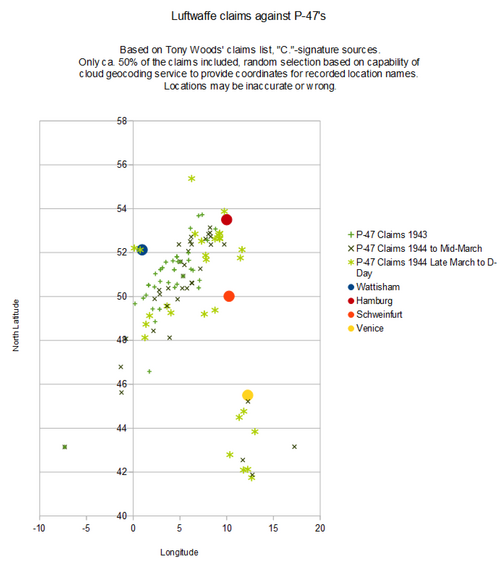
Excellent input, I've eliminated the post-D-Day claims and split up the 1944 data at the mid-March point:

Luftwaffe claims against P-47s V3.png

Regards,

Henning (HohUn)
 
Hi again,

Excellent input, I've eliminated the post-D-Day claims and split up the 1944 data at the mid-March point:
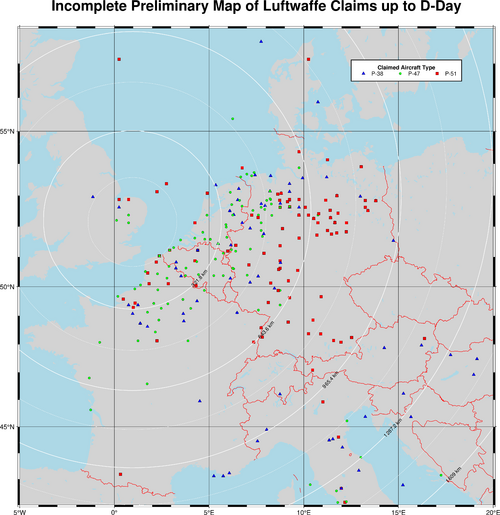
Now I've used GMT to create an actual map for the three main US fighter types (P-38 - blue, P-47 - green, P-51 - red) as claimed by the Luftwaffe up to and including on D-Day. The usual caveats apply, but I've so far been unable to figure out how to give the map a nice legend <edit:>Now I have, so I'm replacing the legend-less map here</edit>:

europe_map.png.png

Oh, and the odd kilometer rings are even 100 mile rings! :) Centered on Wattisham, as before.
Regards,

Henning (HoHun)
 
Last edited:
Hi Bill,

Third note - D-Day screws context up when 9th AF P-47s arrive on the continent and continuously east.

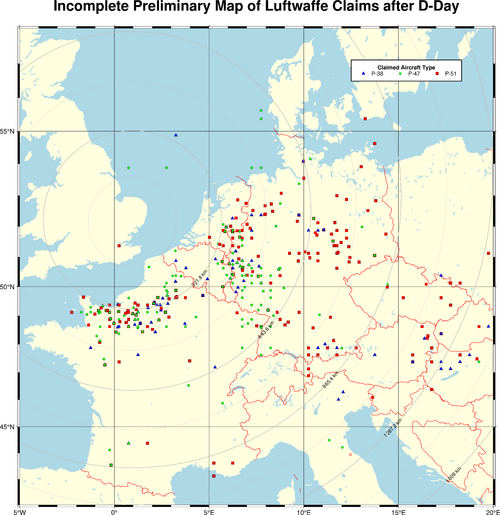
Here's a map showing (half of) the post-D-Day claims ... I'd say you hit the nail on the head there:

europe_map_2.png

One shortcoming of the map is that where the position data is grid-based, multiple claims can fall onto the same grid square, looking exactly like only a single claim. If different types are involved, that's sort of visible because you might be able to see two overlaid symbols, but it's another reason to consider these maps preliminary.

Regards,

Henning (HoHun)
 
Hi again,


Well, it struck me that instead of a breakdown by year, we're actually more interested in the pre-D-Day situation, so I made a new version of the diagram.

I also restricted the selection of claims to those with a "C." signature in Tony Woods' list, which I think are the official records and not secondary sources like Prien, in the hopes of getting more accurate location information. The ratio of location-codable claims is still around 50%, though. Additionally, I removed the Wintergerst claim from June 30, 1943, as it's clear that the main grid square information is missing, and he was almost certainly fighting over the Netherlands with the rest of JG 1 that day.

So here it is:

View attachment 733527

Regards,

Henning (HoHun)
Much better story here. 1943 losses show max Combat Radius (CR) for the 108gal. Pre Day show the extensions of single 150 and dual 108s to extend range.

The Venice vicinity I would speculate are spring 44 325FG before they converted to Mustangs and probably D-15 equivalent w 2x10⁸gal pylon mounted.

Great presentation
 
Last edited:
2deg of longitude is just 120NM/200km. A fairly credible genuine navigation error for VFR flight at the time that could explain any discrepancy b/w claims and reported losses.
120nmi is still ~30min flying time for these birds at best range cruise. That's pretty freaking lost in your navigation errors! +-15 min is a much more reasonable error and is only 60nmi or 1deg longitude.
 
I do agree but see it more as an angular deviation from home base. The guys here will tell us better.

If 120mmi = r*Alpha with Alpha being the deviation, it´s an alpha for a range of
r =120 / 0,3 = 400nmi range (0,3 rad = 17 deg)
r=120/0,15= 800nmi (0,15 rad = 8deg)
r=120/0,075= 1600nmi (0,075 = 4 deg)

As you can see, the cumulative error in direction change can be fairly low (considering that all changes are made in the same angular direction (hence clockwise or anticlockwise but not both) to have that resulting error.

Let´s say that Tony, a fresh pilots with a dozen of mission is flying his 51 on a 400nmi mission with 3 consecutive planned direction change and make a 6 deg error at each. Then the cumulative angular error would have seen him offset of 120nmi at his final planned destination ;)

If then Tony, a not as fresh pilot, with 30 missions logged, is flying that day an 800nmi range mission with 6 consecutive planned direction changes, with an error of only 1,5 deg at each turn, he will still be offset of 120nmi at the end leg of his journey

I do agree that 120nmi is way too much for our present navigational usage, but please, keep in mind that pilot´s charts were not the kind you´ve got for cheap today, VFR was not always VFR granted all the way... And, today, generally, nobody is trying to shoot you down,

By the way, I just ordered the book.
 
Last edited:
Hi again,


Now I've used GMT to create an actual map for the three main US fighter types (P-38 - blue, P-47 - green, P-51 - red) as claimed by the Luftwaffe up to and including on D-Day. The usual caveats apply, but I've so far been unable to figure out how to give the map a nice legend <edit:>Now I have, so I'm replacing the legend-less map here</edit>:

View attachment 733617

Oh, and the odd kilometer rings are even 100 mile rings! :) Centered on Wattisham, as before.
Regards,

Henning (HoHun)
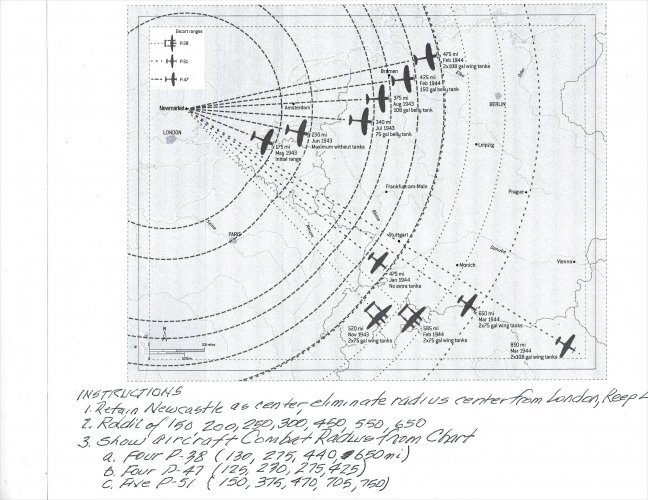
Henning - this map is exactly the base format in 100 'mile' rings of Combat Radius (CR) from origin.
The format I used in the Osprey book is one I would like as an end product.
 

Attachments

  • book  range map changes to radius.jpg
    book range map changes to radius.jpg
    1.9 MB · Views: 51
Will there be a volume 2 that would cover the rest of the variants up to the P-51H? Especially interesting would be detailed info on the structural strength. Many sources claim the lightweight ones were designed to "lower British standards" quoting e.g. lower acceleration requirement for the undercarriage (but failing to mention anything about vertical velocity requirement). Yet, it is claimed that the P-51H was designed to "standard higher U. S. strength requirements", yet the SAC sheet for it states the max. allowed g for it was 7.33 g which means an ultimate factor of tad below 11 g (safety factor 1.5) which is below that of the Typhoon (about 11.5 g) and well below the 14 g of the Tempest.
 
Last edited:
Will there be a volume 2 that would cover the rest of the variants up to the P-51H? Especially interesting would be detailed info on the structural strength. Many sources claim the lightweight ones were designed to "lower British standards" quoting e.g. lower acceleration requirement for the undercarriage (but failing to mention anything about vertical velocity requirement). Yet, it is claimed that the P-51H was designed to "standard higher U. S. strength requirements", yet the SAC sheet for it states the max. allowed g for it was 7.33 g which means an ultimate factor of tad below 11 g (safety factor 1.5) which is below that of the Typhoon (about 11.5 g) and well below the 14 g of the Tempest.
Yes. One third of the book is a condensed history of the Long Range Escort history from 1938 through D-Day with particular detail regarding the Droppable Tank Program and the Fighter Aircraft Range Extension Program focus on increased internal fuel. The XP-51F was being designed in parallel as the AAF finally settled on 85 gal internal fuel tank as a mandate for ALL mustangs delivered after Dec 31, 1943. I contend that despite more internal fuel in the wings compared to B/D that it was not enough, and that ultimately to add enough internal fuel with the 50-gal fuselage tank, that the P-51H morphed in total length to re-position the wing/AC and corresponding empennage/wing static margin for maneuverability to accommodate removing the aft CG issues of the earlier fuselage tank designs.

The 'British Standard' is presented by many without context. The XP-51F through P-51H were designed to 7.33 G Limit Load with a 1.5 safety factor for Ultimate - standard for 2024/7075 aluminum.

The XP-51 through P-51M on the evolved P-51, P-51B/C/D/K/M line was designed to 8G Limit load on 8,000 pound Gross Weight. So, by the time that the P-51D 10,100 pound gross weight internal at takeoff was standard for full fuel and internal ammo load, the actual Limit Load factor was closer to 6.3 G.

By contrast to the P-51D the P-51H was designed to 7.3 G Limit load at full internal load of 9,600 pounds.

Ditto for load factors of XP-51F/G/J at full internal load at takeoff at ~7,600 pounds.

The fuselage aft of the firewall for F/G/J was very close to the B/D dimensionally, but the skin was dominantly a 7075 hybrid produced by NAA based on the Alcoa specs for their reverse engineered skin on the captured A6M.

The H skin reverted to 24S/2024 and the airframe aft of the firewall was completely different, the wing load carrying beams were ~ 6" further aft, the fuselage extension aft of wing to rudder interface was another 7", the rudder chord was about 1" less for a total increase of about 12".

The reason I am reaching out for guidance on AI assisted map development is that Pen and Sword wish me to pay for them to their contractor. I am not disposed to that condition. I believe that the discussion of CR (Combat Radius) is essential to explain why the P-47D was replaced quickly for long range escort as they were very slow to react to both adding standard drop tank capability as well as introducing increased internal fuel for the P-47D-25, and later the P-47N.

IMO, The P-47N could have been done conceptually in 1942 with just a wing 'plug' of 13" each for the 180 extra gallons.
 
Last edited:
Hi Bill,

Henning - this map is exactly the base format in 100 'mile' rings of Combat Radius (CR) from origin.
The format I used in the Osprey book is one I would like as an end product.

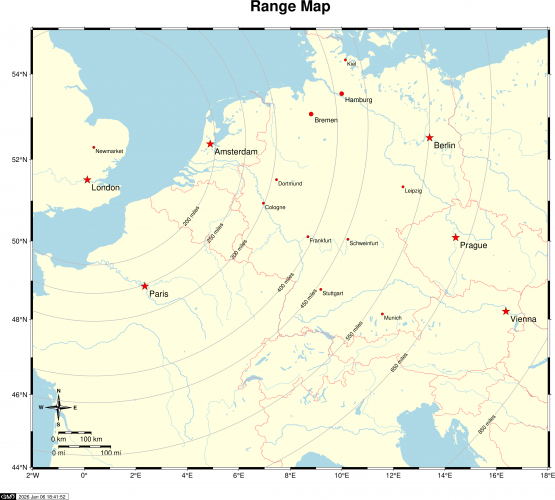
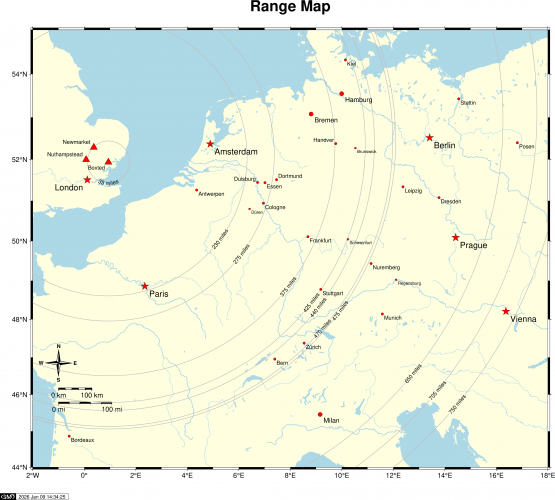
Not being a cartographer, I try to figure it all out as I'm adding features to the graph ... here's my result so far.

range_map.png

Modern borders ... I found a file defining 1938 borders here ...


... but haven't figured out yet how to convert the file format to GMT's, which is the tool I'm using.

Regards,

Henning (HoHun)
 
The fuselage aft of the firewall for F/G/J was very close to the B/D dimensionally, but the skin was dominantly a 7075 hybrid produced by NAA based on the Alcoa specs for their reverse engineered skin on the captured A6M.
I was not expecting to see 7075 aluminum in WW2.
 
Hi Bill,


Not being a cartographer, I try to figure it all out as I'm adding features to the graph ... here's my result so far.

View attachment 797714

Modern borders ... I found a file defining 1938 borders here ...


... but haven't figured out yet how to convert the file format to GMT's, which is the tool I'm using.

Regards,

Henning (HoHun)
Henning - THAT is an excellent base map and exactly what I am looking for.
Adding Bordeaux, Hanover, Brunswick and placing the center around Boxted to make a point of airbase locations that achieve highest CR's as it is close to Halesworth and a good comparison for P-51 vs P-47. I would also position Nuthampstead on the map to show the range disadvantage that all the P-38s had based on relative location.
 
I was not expecting to see 7075 aluminum in WW2.
I wasn't either. The root of the application was apparently the A6M recovered in the Aleutians. Schmued devotes some observations about the adoption of it to the lightweight Mustangs as well as the tooling changes NAA had to make to dimple it without punching holes through the lighter gauges.

Alcoa designated the 'Zero skin type' as XA758, NAA stretch formed and heat treated 24ST to make 75ST because Alcoa was not yet producing XA758.
 
Hi Bill,

Adding Bordeaux, Hanover, Brunswick and placing the center around Boxted to make a point of airbase locations that achieve highest CR's as it is close to Halesworth and a good comparison for P-51 vs P-47. I would also position Nuthampstead on the map to show the range disadvantage that all the P-38s had based on relative location.

Is this the location of WW2 Boxted airfield? Now a solar farm, former RAF Boxted, but as it's some way off the namesake village of Boxted, I'd like to make sure.


Nuthampstead still has an airfield, so I suppose I can use that:


Regards,

Henning (HoHun)
 
Yes. One third of the book is a condensed history of the Long Range Escort history from 1938 through D-Day with particular detail regarding the Droppable Tank Program and the Fighter Aircraft Range Extension Program focus on increased internal fuel. The XP-51F was being designed in parallel as the AAF finally settled on 85 gal internal fuel tank as a mandate for ALL mustangs delivered after Dec 31, 1943. I contend that despite more internal fuel in the wings compared to B/D that it was not enough, and that ultimately to add enough internal fuel with the 50-gal fuselage tank, that the P-51H morphed in total length to re-position the wing/AC and corresponding empennage/wing static margin for maneuverability to accommodate removing the aft CG issues of the earlier fuselage tank designs.

The 'British Standard' is presented by many without context. The XP-51F through P-51H were designed to 7.33 G Limit Load with a 1.5 safety factor for Ultimate - standard for 2024/7075 aluminum.

The XP-51 through P-51M on the evolved P-51, P-51B/C/D/K/M line was designed to 8G Limit load on 8,000 pound Gross Weight. So, by the time that the P-51D 10,100 pound gross weight internal at takeoff was standard for full fuel and internal ammo load, the actual Limit Load factor was closer to 6.3 G.

By contrast to the P-51D the P-51H was designed to 7.3 G Limit load at full internal load of 9,600 pounds.

Ditto for load factors of XP-51F/G/J at full internal load at takeoff at ~7,600 pounds.

The fuselage aft of the firewall for F/G/J was very close to the B/D dimensionally, but the skin was dominantly a 7075 hybrid produced by NAA based on the Alcoa specs for their reverse engineered skin on the captured A6M.

The H skin reverted to 24S/2024 and the airframe aft of the firewall was completely different, the wing load carrying beams were ~ 6" further aft, the fuselage extension aft of wing to rudder interface was another 7", the rudder chord was about 1" less for a total increase of about 12".

The reason I am reaching out for guidance on AI assisted map development is that Pen and Sword wish me to pay for them to their contractor. I am not disposed to that condition. I believe that the discussion of CR (Combat Radius) is essential to explain why the P-47D was replaced quickly for long range escort as they were very slow to react to both adding standard drop tank capability as well as introducing increased internal fuel for the P-47D-25, and later the P-47N.

IMO, The P-47N could have been done conceptually in 1942 with just a wing 'plug' of 13" each for the 180 extra gallons.
Thanks! So a new publisher?
 
Hi Bill,


Is this the location of WW2 Boxted airfield? Now a solar farm, former RAF Boxted, but as it's some way off the namesake village of Boxted, I'd like to make sure.


Nuthampstead still has an airfield, so I suppose I can use that:


Regards,

Henning (HoHun)
Yes, the F-150 airfield (RAF Boxted) was 3mi N. Colchester. South by southwest of Halesworth.
 
Last edited:
Thanks! So a new publisher?
Yes, at least at this moment but we are having some contract issues. I really liked Osprey but pretty disappointed that their security sucked. The Bastard Stepchild book in pdf format was hacked by a Russian website and downloaded for free for two years before Osprey (theoretically) stopped them.

I'm negotiating with Pen and Sword at the moment and their edit team is working on the final product.
 
Hi Bill,

Henning - THAT is an excellent base map and exactly what I am looking for.
Adding Bordeaux, Hanover, Brunswick and placing the center around Boxted to make a point of airbase locations that achieve highest CR's as it is close to Halesworth and a good comparison for P-51 vs P-47. I would also position Nuthampstead on the map to show the range disadvantage that all the P-38s had based on relative location.

Glad you like it! :)

Next progression, this was more difficult to figure out than I had thought.

range_map.png

I added all German cities with a >500,000 population - hope it get's not too cluttered. Modern day Austrian/Polish cities not considered, I couldn't find any data on these.

I added a tiny 37 mile radius circle to show the distance between Boxted and Nuthampstead ... just an idea, I think it looks good :)

Regards,

Henning (HoHun)
 
I'm def. looking forward to the book on the lightweights and later developments on the P-51 once it's complete.

And is it me, or does the radiator scoop on the XP-51 lightweights and the P-51H remind one of the illustrations for the SLAM rocket/Project Pluto?

 
Last edited:
Hi again,

Next progression, this was more difficult to figure out than I had thought.

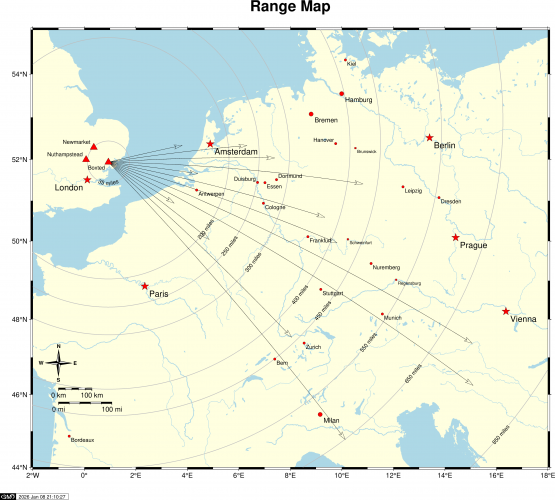
Here's an update. I added little arrowheads to the lines, and while it's possible to plot custom symbols in GMT, including EPS files in which might encapsulate an appropriate aircraft silhouette, it seems this doesn't apply to arrowheads at the end of vectors. This means I need to calculate the end points of the vectors to place the aircraft silhouette, and that's not easy. It might be easier to take a map with arrowhead-less vectors and then manually paste the aircraft silhouettes into it with a suitable tool like Inkscape, I'm afraid.

range_map.png

@drgondog , which sequence of the range arrows would you suggest? Currently it's (starting north-east, clockwise) P-47 short to long ranges, P-51 short to long ranges, P-38 short to long ranges.

It would probably be more desirable to arrange them chronologically, but the range list on your reference chart doesn't provide dates (or configurations). Also, a pure chronological order would of course fail to reflect where the fighters were actually operating at the time.

I've removed the modern borders as they don't really match, and I haven't even looked at the file conversion for the 1938 borders I found. I have a hunch they might be too coarse in resolution, unless that's an artifact of the preview.

Instead, I added some more cities. I also put Newmarket back in, which by (I assume) coincedence is about 35 miles from Boxted again, so I adjusted the small range circle slightly. Gives an idea of the area where the USAAF fighter bases were, I guess - maybe another representative one comes to your mind that would fit in the right upper quadrant?

Regards,

Henning (HoHun)
 
Hi again,


Here's an update. I added little arrowheads to the lines, and while it's possible to plot custom symbols in GMT, including EPS files in which might encapsulate an appropriate aircraft silhouette, it seems this doesn't apply to arrowheads at the end of vectors. This means I need to calculate the end points of the vectors to place the aircraft silhouette, and that's not easy. It might be easier to take a map with arrowhead-less vectors and then manually paste the aircraft silhouettes into it with a suitable tool like Inkscape, I'm afraid.

View attachment 797895

@drgondog , which sequence of the range arrows would you suggest? Currently it's (starting north-east, clockwise) P-47 short to long ranges, P-51 short to long ranges, P-38 short to long ranges.

It would probably be more desirable to arrange them chronologically, but the range list on your reference chart doesn't provide dates (or configurations). Also, a pure chronological order would of course fail to reflect where the fighters were actually operating at the time.

I've removed the modern borders as they don't really match, and I haven't even looked at the file conversion for the 1938 borders I found. I have a hunch they might be too coarse in resolution, unless that's an artifact of the preview.

Instead, I added some more cities. I also put Newmarket back in, which by (I assume) coincedence is about 35 miles from Boxted again, so I adjusted the small range circle slightly. Gives an idea of the area where the USAAF fighter bases were, I guess - maybe another representative one comes to your mind that would fit in the right upper quadrant?

Regards,

Henning (HoHun)
Henning - ideally the vectors are not even shown, merely to help the cartographer position the aircraft symbols at approximate FAREP escort mission combat radius range. There would only be 3 tracks as you chose correctly. There are dates in the data block to represent when the first instance of each tank type was operational.

For example, the 11x8 inch map done by Osprey was large enough to place a symbol of say a P-47D near the upper vector near Hanover with the legend :
375 miles
Feb 1944
1x150gal Belly Tank
305gal Internal Fuel

The symbol for P-47 at the extreme location along the upper vector would have the legend:
475 miles
April/May 1944
2x150gal Wing Tanks
305gal Internal Fuel

Placing the legend data block combined with the symbol required some adjustment in placing the symbol 'near' the vector, up or down, when trying to display the symbol 'spinner/prop' at the desired range position.

I am trying to reduce 'clutter' but it seems to me that five P-47 data elements need a symbol and data block. The other three:
230 miles
August 1943
1x200gal Ferry Tank or
1x75gal Belly Tank
305gal Internal Fuel

275 miles
September 1943
1x10⁸gal Belly Tank
305gal Internal Fuel

425 miles
March 1944
2x10⁸gal Wing Tanks
305gal Internal Fuel

The P-38 symbols and data blocks positioned from Boxted would reflect optimistic CR for Kings Cliffe and Nuthampstead but the range data blocks would be correct to reflect FAREP tables as IF P-38H/J Missions were flown from Boxted or Halesworth. A little explanation here. To show FAREP data values for Escort Mission I chose to use the 56th FG which had the best placement on East Anglia Coast at Halesworth - which is close enough to Boxted (for 354FG Mustangs doing all the P-51B escort prior to Big Week). The 56th FG had a tactical advantage in position compared to the 4th and 355th and 352nd FG with respect to victory credit distances from home base and I wished to show maximum P-47 combat radius in best case scenario in order to present objective comparisons of 'actual vs FAREP' for the ETO. Ditto for P-38 and P-51.

The P-38H/J data
275 miles
October 1943
2x75gal Wing Tanks
300gal Internal Fuel

440 miles
November 1943
2x150gal Wing Tanks
300gal Internal Fuel

650 miles
2x150gal Wing Tanks
410gal Internal Fuel

The P-51B data
December 1943
470 miles
2x75gal Wing Tanks
184gal Internal Fuel

February 1944
705 miles
2x75gal Wing Tanks
269gal Internal Fuel

April 1944
850 miles
2x10⁸gal Wing Tanks
269gal Internal Fuel

The map doesn't need too many city placements.

Duren, Bremen, Hanover, Brunswick Hamburg, Berlin and Posnan for upper track. Berlin is the target for the vector/track

Antwerp, Frankfurt, Schweinfurt, Regensburg, Prague, Vienna for middle track. Prague is the target for the vector/track.

Stuttgart, Munich and Vienna with Munich as the target for the vector/track.

Include Paris and Bordeaux.

The Objective is to produce one more Map - exactly the same except the symbol placement will display Actual P-47 combat distance from Halesworth and P-51 combat distance from Boxted in which a victory credit was claimed per 8th AF Final Victory Credits - June 1945. Ditto for P-38.

The data blocks will be the same except for actual maximum range (vs FAREP escort calculations) and the date.

BTW the result of the Actual placements compare Very well to LW claims over each of the US Fighter types.

You do nice works.
 
Hi Bill,

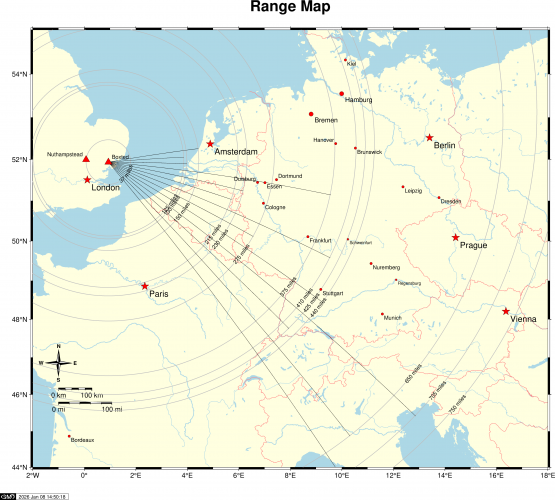
Henning - ideally the vectors are not even shown, merely to help the cartographer position the aircraft symbols at approximate FAREP escort mission combat radius range.

How about a map then where the range circles directly give the FAREP radius? This way, the spinner/nose would always touch a range circle, and it would be very easy to see where the fighter could reach.

range_map.png

There would only be 3 tracks as you chose correctly.

I haven't quite understood the track idea, so that's probably a coincedence only! :)

This P-38 data block seems to be missing the date:

650 miles
2x150gal Wing Tanks
410gal Internal Fuel

The Objective is to produce one more Map - exactly the same except the symbol placement will display Actual P-47 combat distance from Halesworth and P-51 combat distance from Boxted in which a victory credit was claimed per 8th AF Final Victory Credits - June 1945. Ditto for P-38.

That would probably have "regular" range circles?

BTW the result of the Actual placements compare Very well to LW claims over each of the US Fighter types.

Great, that's pretty encouraging considering that the evaluation is all preliminary, and stuff like "50 km North of Munich" might still be read as "Munich" by my database query, introducing some hard-to-quantify amount of error in the positions.

You do nice works.

Thanks a lot, I'm really intrigued by the range question and am very impressed by the thorough and methodic way you tackle it, too! :)

Regards,

Henning (HoHun)
 
Hi Bill,

Placing the legend data block combined with the symbol required some adjustment in placing the symbol 'near' the vector, up or down, when trying to display the symbol 'spinner/prop' at the desired range position.

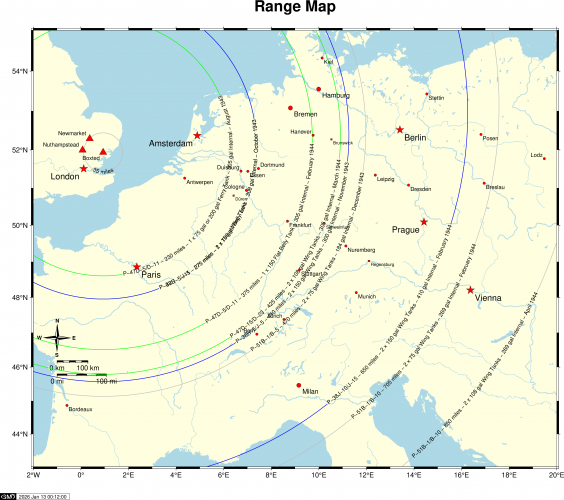
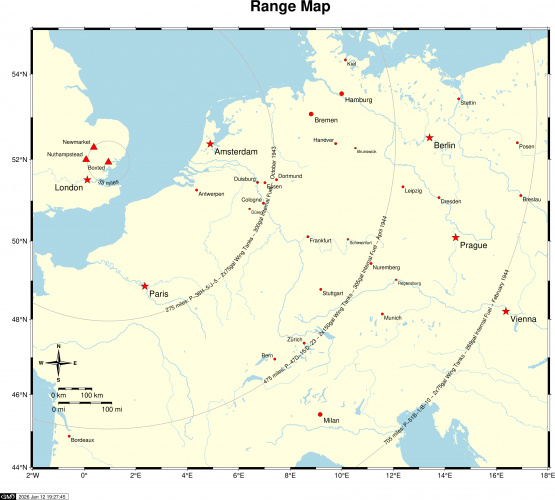
Sudden inspiration: When I do specific radii for each data block instead of regular intervals, I can put some or all of the data block information on the range circles, where it no says "425 miles" etc.

That should result in a very clean graph, I hope.

Regards,

Henning (HoHun)
 
Hi Bill,


Sudden inspiration: When I do specific radii for each data block instead of regular intervals, I can put some or all of the data block information on the range circles, where it no says "425 miles" etc.

That should result in a very clean graph, I hope.

Regards,

Henning (HoHun)
I need to get my head around the visual, but it sounds like a great idea.

Foremost facts to be presented on the map are the ranges attained by specific model/tank arrangement beginning with first operational dates. Maybe each fighter type silhouette is accompanied by a 'triangle', 'circle' or 'square' with imbedded triangle 1, 2, 3, 4, 5 for P-47; imbedded circle 1, 2, 3 for P-38; imbedded square 1, 2, 3 for P-51.

Another idea is to use each specific range radii as a preliminary step to place the nose of each symbol exactly on the map, then 'remove' the radii and leave only even numbered radii with fighter silhouettes, no data blocks, cities and geography as you have displayed. That approach would seem to reduce clutter on the map and invite the reader to look into a broad data block below the map.

Below the Map is a block allocated for Data which formerly was attached to each symbol:

1. P-47D-5/D-11, 230 miles 1. P-38H-5/J-5, 275 miles 1. P-51B-1/B-5, 470 miles
1x75gal or 200gal Ferry Tank 2x75gal Wing Tanks 2x75gal Wing Tanks
305gal Internal Fuel 300gal Internal Fuel 184gal Internal Fuel
August 1943 October 1943 December 1943

2. P-47D-5/-11, 275 miles 2. P-38H-5/J-5, 440 miles 2. P-51B-1/B-10, 705 miles
1x10⁸gal Belly Tank 2x150gal Wing Tanks 2x75gal Wing Tanks
305gal Internal Fuel 300gal Internal Fuel 269gal Internal Fuel
October 1943 November 1943 February 1944

3. P-47D-5/D-11, 375 miles 3. P-38J-10/J-15, 650 miles 3. P-51B-1/B-10, 850 miles 1x150 Flat Belly Tank 2x150gal Wing Tanks 2x10⁸gal Wing Tanks
305gal Internal Fuel 410gal Internal Fuel 269gal Internal Fuel
February 1944 February 1944 April 1944

4. P-47D-15/D-23, 425 miles
2x10⁸gal Wing Tanks
305gal Internal Fuel
March 1944

5. P-47D-15/D-23, 475 miles
2x150gal Wing Tanks
305gal Internal Fuel
April 1944

With this scheme of symbol with numbered triangle (etc), the symbol for P-47 silhouette next to 'triangle 3' is placed to scale where you have the '375 mi radius' on the map. Whether the map finally has only six radii (250, 350, 450, 550, 650, 750) shown, the nose of the symbol is exactly to scale and identified in the numbered block below. In that way only 5 P-47, 3 P-38 and 3 P-51 need to be on map.

What do you think?
 
The P-38H/J data

650 miles
2x150gal Wing Tanks
410gal Internal Fuel

The P-51B data


April 1944
850 miles
2x10⁸gal Wing Tanks
269gal Internal Fuel

Are these data at the most economical cruising conditions for each? I.e. cruising at the best air miles per gallon speed.
 
Are these data at the most economical cruising conditions for each? I.e. cruising at the best air miles per gallon speed.
No - cruising slow near bomber speeds was hazardous to health and tactically unsound. Typical cruising speeds were near 210mph IAS at 25000 feet - while B-17s were cruising at 150 mph IAS. So effectively the US fighters had to 'Ess' at 300+mph to accompany bombers cruising inbound at 210mph TAS.

That said, given long stretches over water or mountains with low to zero defensive density in flak or fighters, provided SWPA options to operate Lindbergh method at 10,000 feet or less - then climb as required near target and increase speed for defensive purpose.
 
Did the VLR Mustangs in the Pacific do anything differently in the Pacific to allow them to reach Japan from Iwo Jima?
 
No - cruising slow near bomber speeds was hazardous to health and tactically unsound. Typical cruising speeds were near 210mph IAS at 25000 feet - while B-17s were cruising at 150 mph IAS. So effectively the US fighters had to 'Ess' at 300+mph to accompany bombers cruising inbound at 210mph TAS.

That said, given long stretches over water or mountains with low to zero defensive density in flak or fighters, provided SWPA options to operate Lindbergh method at 10,000 feet or less - then climb as required near target and increase speed for defensive purpose.
Which severely skews the numbers to favour the Stinky (Mustang). Besides, the escorts had often the tactical advantage due to German interceptors having short endurance giving adequate time to react.
 
Yes it does, because 210 mph IAS is much closer to the best range airspeed of the P-51.
Should not there be some comparison, like 'P-47 does so many miles at that speed at that altitude', as well as the same stuff for the P-38, before the comment is taken as a fact rather than an opinion?
Yes, the Mustang has never been my favourite. Hence that nick.
Haters gonna hate.
 
Did the VLR Mustangs in the Pacific do anything differently in the Pacific to allow them to reach Japan from Iwo Jima?
The VLR Mustangs mostly accompanied B-29s inbound to take advantage of superior navigators over long stretches of water - so same cruise speeds as B-29, which coincidently was nearly the same as 210-220 mph IAS at 25,000 feet.
Which severely skews the numbers to favour the Stinky (Mustang). Besides, the escorts had often the tactical advantage due to German interceptors having short endurance giving adequate time to react.
I'm not sure what you base the comments on. The optimal straight line cruise speed with 108/110gal wing tanks was about 260mph TAS, with 75gal tanks about 280mph and clean about 305mph at 25K. The P47 optimal cruise speed in two pylon, two tank configuration was lower, ditto P-38.

The only condition which favored escorts is when the LW controllers failed to alert a specific JG in time to takeoff, form up and climb in time to avoid a US fighter group sweeping out in front of the bomber stream.
 
Hi Bill,

I need to get my head around the visual, but it sounds like a great idea.

Here an example:

range_map.png

Whether the map finally has only six radii (250, 350, 450, 550, 650, 750) shown, the nose of the symbol is exactly to scale and identified in the numbered block below. In that way only 5 P-47, 3 P-38 and 3 P-51 need to be on map.

Seems like a logical option, too. Personally, if there is too much information in a map that's delegated to the legend, I find them a bit hard to read at times.

What about head-on silhouettes of the fighter configurations, showing tanks beneath the aircraft and annotations with fuel amounts? I think Focke-Wulf used that style in WW2, albeit not on a map.

Regards,

Henning (HoHun)
 
Hi again,

Here an example:

I tried it with all the rings, and it doesn't look as clean as I had hoped:

range_map.png

(I also tried to colour-code the rings, using preliminary and somewhat ugly colours.)

Regards,

Henning (HoHun)
 
The VLR Mustangs mostly accompanied B-29s inbound to take advantage of superior navigators over long stretches of water - so same cruise speeds as B-29, which coincidently was nearly the same as 210-220 mph IAS at 25,000 feet.

I'm not sure what you base the comments on. The optimal straight line cruise speed with 108/110gal wing tanks was about 260mph TAS, with 75gal tanks about 280mph and clean about 305mph at 25K. The P47 optimal cruise speed in two pylon, two tank configuration was lower, ditto P-38.

The only condition which favored escorts is when the LW controllers failed to alert a specific JG in time to takeoff, form up and climb in time to avoid a US fighter group sweeping out in front of the bomber stream.
Based on the "max air range" column in the P-51D and P-38 manuals' range tables. For the P-51D with 2 x 75 gals drop tanks at 25 000 ft. 190 mph IA/285 mph TAS, for the P-38 (though the manual I have now at hand is for the F) with similar drop tanks 180 mph IAS/270 mph TAS. One issue not available in the manual is the effect of manual leaning. As far as I know, by that time manual leaning was not possible in the P-51D while in the P-38 it was possible up to and including the L.
 
Hi again,


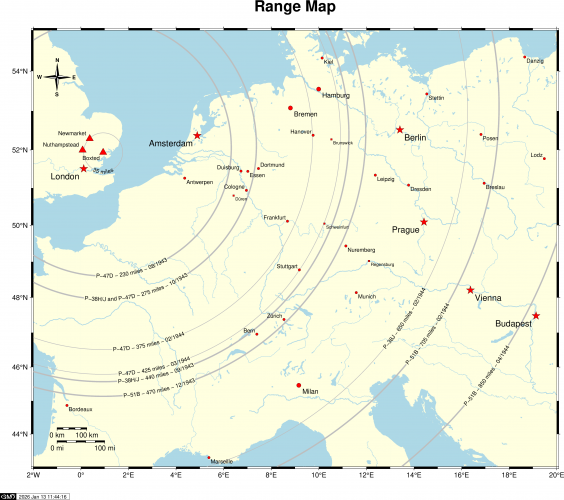
After some cleaning up ... some kind of legend will be needed:

View attachment 798348

Regards,

Henning (HoHun)
I think you're going to be better off with 2 maps. 1943 and 1944.


Based on the "max air range" column in the P-51D and P-38 manuals' range tables. For the P-51D with 2 x 75 gals drop tanks at 25 000 ft. 190 mph IA/285 mph TAS, for the P-38 (though the manual I have now at hand is for the F) with similar drop tanks 180 mph IAS/270 mph TAS. One issue not available in the manual is the effect of manual leaning. As far as I know, by that time manual leaning was not possible in the P-51D while in the P-38 it was possible up to and including the L.
I was under the impression that the later P38s were running pressure carbs, which only have an Auto Lean option.
 
Back
Top Bottom