Oreshnik MRBM

Status
Not open for further replies.
Yes, cobbled together using two-stages from a three-stage ICBM the SS-29 which is not a new design but Russian propaganda would us believe that it is this brand new weapon (Which it is not), this to me at least is a sign of desperation.
So when USAF cobbled together a bunker-buster bomb in 1991 from the old howitzer barrel and spare Paveway kit - it was an act of desperation also?
 
I find it hilarious that someone may use the phrase "cobbled together" when talking about an intermediate range ballistic missile fielded by a country which has a long history of ballistic missile development and successful combat usage
Its basically a pre-set thinking pattern, formed by mass media; the idea is, that Western tech is always superior to anyone else's, and therefore if "bad guys" have something that West currently lacked (but clearly wanted to have) it must therefore be "cobbled together as act of desperation". Essentially its a way to dismiss as "not a real thing, and therefore didn't count".
 
So when USAF cobbled together a bunker-buster bomb in 1991 from the old howitzer barrel and spare Paveway kit - it was an act of desperation also?

No, that is a false comparison and you know it. the USAF merely took the existing Paveway kit and some spent M110 8" barrels modifying them into warheads on an urgent basis.
 
No, that is a false comparison and you know it. the USAF merely took the existing Paveway kit and some spent M110 8" barrels modifying them into warheads on an urgent basis.
Then please elaborate what is "urgent basis" and what "sign of desperation", if in both cases existing hardware is modyfied to serve a new purpose.

P.S. I apologise if my wording was too harsh. But I don't recall that I ever called any "cobbled together" Western tech "an act of desperation". Even if it actually was this - like "Chaparral" SAM, which appeared exactly as act of desperation after "Mauler" failure - I always viewed high adaptability of American hardware as major advantage. And I fail to see why adaptability of Russian hardware should be viewed differently.
 
It's one failed test out of many?
Are there anyone else trialling super heavy ground based ICBMs right now?

It's actually five test failures out of seven known launch attempts since 2022 and three successive failures with no successes since it was declared "on combat duty" in September 2023. One of those failures, on September 2024, demolished the Plesetsk test silo, leaving a 60m (200ft) crater.
 
So when USAF cobbled together a bunker-buster bomb in 1991 from the old howitzer barrel and spare Paveway kit - it was an act of desperation also?

I'd say yes, in the sense that the US needed to hit certain targets and had no available capacity to do so, leading to the crash development of a non-optimized solution deployed without full testing. Note that post-war GBU-28s are different from the first batch to fix significant shortcomings in the initial batch.
 
It's actually five test failures out of seven known launch attempts since 2022 and three successive failures with no successes since it was declared "on combat duty" in September 2023. One of those failures, on September 2024, demolished the Plesetsk test silo, leaving a 60m (200ft) crater.
I was aware of one singular attempt that went viral (the one that blew up the silo). Regardless the people who started bringing Sarmat into this should be aware that by comparing their operational success alone the Oresnik is on another league.

Though it does seem Sarmat is being terribly handled. Maybe a nepo baby latching onto a big ticket national pride item. In any case Sarmat should be unrelated to this as it's from a different design bureau.
 
There is.

Same as above, the US DoD needs to make up its' mind.

Yes there is.
Media reports do not NATO designators make. The US DoD has made up its mind and has official designators. That the media keeps using wrong or made up ones is not on the DoD.
 
What the fuck is a "Satan II" supposed to be? As for Oreshnik, it hit the industrial complex it was meant to hit, induced damage (which given the lack of any warhead was considerable) and it is, if rumors are to be believed, developed from existing components adapted to it's mission and requirements. So there's no significant technical hurdle to overcome there, unlike in the early phases of Bulava or the ongoing development of Sarmat, which are departures from previous missiles fielded.

Furthermore, I don't know if calling the service entry and deployment of an intermediate range ballistic missile that's generally speaking intended to be nuclear armed a bluff. Especially as it can hit any target in Europe quite comfortably, which means that the ICBMs and SLBMs can be allocated for targets that genuinely require the range advantage they offer. It neatly bridges the gap from Iskander to Topol and Yars. A segment Russia looked into already when it was still part of the Soviet Union. So this is just a natural development, accelerated by perceived outside threats. But a system like Oreshnik was always going to happen and consequently previous studies, fielded weapons and available components were at their disposal to build upon something that's inherently less ambitious than something like Sarmat or the Bulava.
Oreshnik has done more damage as a propaganda weapon to the minds of "global southerners", who now believe it's some sort of wunderwaffe, than as a missile to whatever the russians desperately tried to hit in Ukraine as payback for the humiliation they had recently suffered.
 
So when USAF cobbled together a bunker-buster bomb in 1991 from the old howitzer barrel and spare Paveway kit - it was an act of desperation also?
Very based.
Do we really even know what Oreshkin even looks like, what it do and how it be?
 
It must be a boring day if we are criticizing new missiles still in the testing phase but ignoring our personal problems of having aging ICBMs and even operational SLBMs like the Trident that still fail launches. Honestly where did this negativity come from today? Did the owner of Blackrock pay Zelensky a personal visit or something?
 
In principle, how hard would it be to have part of the re-entry vehicle slow enough that it could identify its position (e.g. using imaging) and then transmit guidance corrections to the submunitions?

Surely one could get a reasonable accuracy for each submunition against static targets at least? Something more like 10 square metres rather than 600?
 
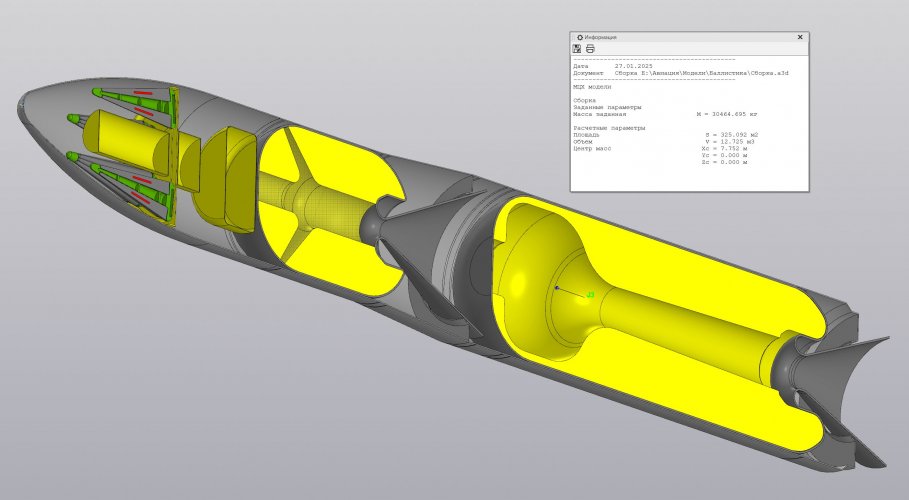
The launch tube looks roughly Bulava-sized, but there's no knowing whether the missile occupies the full length.
 
Oreshnik has done more damage as a propaganda weapon to the minds of "global southerners", who now believe it's some sort of wunderwaffe, than as a missile to whatever the russians desperately tried to hit in Ukraine as payback for the humiliation they had recently suffered.
The main point of such systems is deterrence, they're meant to instill fear of their potential combat use. Every SSBN, every ICBM, every strategic bomber is a "propaganda weapon" in that sense. And the message the test deployment of the Oreshnik was meant to send wasn't directed at the "global south", which have a very different perception of Russia anyway, it was directed towards the west and Europe in particular. As at the time several European states felt cocky with regards to what weapons they considered supplying, the meaningless talks about troops on the ground and the prospect of allowing the Ukrainians to use certain weapons to attack Russia proper. And while the rhetoric from Brussels was very belligerent before that, after the Russians deployed the missile, the outcry and panic was huge. Which was most likely what the Russians desired all things considered. It was a test and a reminder in one. Oreshnik isn't a weapon that's supposed to deter the Americans, that's for the large ICBMs and the SLBMs. It's very nature shows it's meant for Eurasia.

In short, it's a deterrent first and foremost and it's field test was meant to scare the folks in Brussels shitless, which it definitely achieved. Like any weapons system of it's kind, it's combat potential outside of WW3 scenarios is limited, but that's an inherent trait of all weapons of deterrence.
 
The main point of such systems is deterrence, they're meant to instill fear of their potential combat use. Every SSBN, every ICBM, every strategic bomber is a "propaganda weapon" in that sense. And the message the test deployment of the Oreshnik was meant to send wasn't directed at the "global south", which have a very different perception of Russia anyway, it was directed towards the west and Europe in particular. As at the time several European states felt cocky with regards to what weapons they considered supplying, the meaningless talks about troops on the ground and the prospect of allowing the Ukrainians to use certain weapons to attack Russia proper. And while the rhetoric from Brussels was very belligerent before that, after the Russians deployed the missile, the outcry and panic was huge. Which was most likely what the Russians desired all things considered. It was a test and a reminder in one. Oreshnik isn't a weapon that's supposed to deter the Americans, that's for the large ICBMs and the SLBMs. It's very nature shows it's meant for Eurasia.

In short, it's a deterrent first and foremost and it's field test was meant to scare the folks in Brussels shitless, which it definitely achieved. Like any weapons system of it's kind, it's combat potential outside of WW3 scenarios is limited, but that's an inherent trait of all weapons of deterrence.
In the end the cocky Europeans supplied the weapons they wanted to supply, let the Ukrainians use them on russian soil, and talk of troops on the ground to this day. I don't really see how Brussels was scared shitless, I don't recall huge outcry and panic. The one-off attack on Dnipro was quickly forgotten, and what exactly did it show anyway? That their nth road-mobile fiberglass-bodied ballistic missile works as intended?
Either way discussing the political side of things is not that useful, there are two entrenched sides that won't budge on their beliefs and I'd rather not see the thread get locked again.
 
It must be a boring day if we are criticizing new missiles still in the testing phase but ignoring our personal problems of having aging ICBMs and even operational SLBMs like the Trident that still fail launches. Honestly where did this negativity come from today? Did the owner of Blackrock pay Zelensky a personal visit or something?
Trident

These test flights were part of a planned test event and resulted in the achievement of 197 total successful missile flight test launches of the Trident II D5 strategic weapon system. The test flights were launched from a submerged SSBN and landed in a broad ocean area of the Atlantic Ocean.

And I think MMIII is 9 out of the last 10.
 
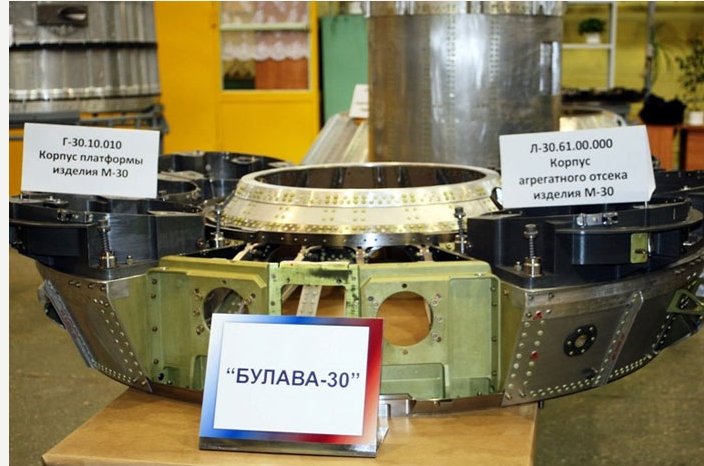
The place called the "bus" from Bulava
Maybe the "Hazel Tree" is deprived not of the second stage, but of the third, then the diameter will be close to the desired one.
 

Attachments

  • c89aaca31bb03bbbc5860b487093f2d1.jpeg
    c89aaca31bb03bbbc5860b487093f2d1.jpeg
    223.1 KB · Views: 67
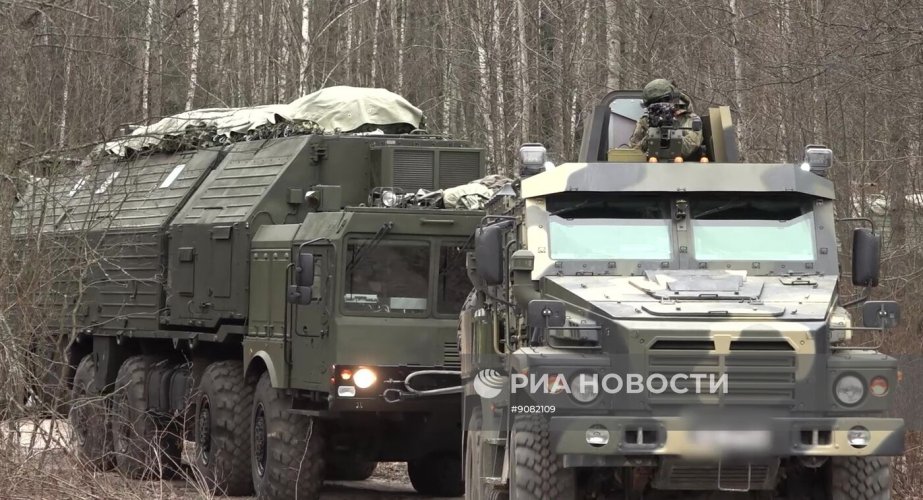
'Oreshnik' entered combat duty in Belarus

ria-9082109-preview.jpeg


The Oreshnik missile system has entered combat service in the Republic of Belarus. The ceremony marking this occasion was held in accordance with military traditions, including the ceremonial raising of the flag of the Strategic Missile Forces (SMF).

"A ceremonial commissioning ceremony for a unit equipped with the Oreshnik mobile ground-based missile system took place in the Republic of Belarus," the statement said.

According to the Russian Ministry of Defense, the unit's entire personnel—from combat crews and communications specialists to driver-mechanics—have undergone in-depth retraining on modern simulators to confidently operate the new system.

As a reminder, Belarusian President Alexander Lukashenko previously announced that the Oreshnik missile system had entered combat duty in the republic. He suggested that Minsk could have as many as ten Oreshnik missile systems at its disposal . Belarus has already determined the combat patrol areas for the Oreshnik missile system .

The Russian Armed Forces launched the latest Oreshnik missile at a target in Ukraine for the first time on November 21, 2024. Serial production of the medium-range missiles was announced by Vladimir Pu tin in June.
 
Assuming that's the actual TEL in that photo, that's different to the model that was speculated to be the TEL earlier (on less wheel among other things).
Most people I've seen say that these are command and logistics vehicles. And that the actual launcher wasn't shown in the video. I guess we'll have to wait for more info to surface over time.
 
Most people I've seen say that these are command and logistics vehicles. And that the actual launcher wasn't shown in the video. I guess we'll have to wait for more info to surface over time.
Wonder what the cover on top is over?
 
Tom Cooper says CEP is 200 meters, which is not sufficient to destroy a peculiar target, unless it is larger than a football field. Albeit they could use it as a terror weapon against large cities, just to kill people.
Just means a bigger warhead to get said destruction.

Say, 800kt to 1.4MT instead of 300kt.


The launch tube looks roughly Bulava-sized, but there's no knowing whether the missile occupies the full length.
Cold Launch requires a small space below the missile for the gas generator exhaust to cool and expand to limit pressure in the tube.


There is an opinion that "Oreshnik" is a "Yars" without a second stage.
Yars has a 3rd stage like Trident D5, then? 3rd stage engine part of the bus?
 
Yars has a 3rd stage like Trident D5, then? 3rd stage engine part of the bus?
3rd stage is separate to bus I think, 4 if you include bus. Typical for most modern ICBMs. 1 less is the norm for SLBMs.

I think that video shows the cab of the TEL at one point.
 
Last edited:
Tom Cooper says CEP is 200 meters, which is not sufficient to destroy a peculiar target, unless it is larger than a football field. Albeit they could use it as a terror weapon against large cities, just to kill people.

With a 200 m CEP and 100 kt warheads, this would be considered a class 3 hard target warhead system, which is capable of a 70% SSKP against a 500 psi target. That's more than sufficient to take out all types of soft targets and many types of medium-hard targets. There is no pressing need for more yield or accuracy in this system than that. If they need to take out something harder, then they have other weapon systems for that, and such targets are exceptionally rare anyways.

Additionally, they could likely adapt this system to carry a single 500 kt warhead instead of multiple lower yield warheads. If they did that, then this would become a class 2 hard target warhead system, which is capable of a 70% SSKP against a 2000 psi target. That's more than enough to take out almost all types of target classes that Russia would encounter in Europe.

Only ultra hardened targets would be capable of surviving a hit from a class 2 warhead. I'm not even sure how many targets there even are in all of Europe outside of Russia that are hardened to such an extreme degree. Most leadership/C&C bunkers aren't even hardened to anywhere near this level.

Just means a bigger warhead to get said destruction.

Say, 800kt to 1.4MT instead of 300kt.
There's no need for that much yield unless you have an ultrahardened target to crack open, and there's vanishingly few of those in Europe outside of Russia.

500 kt would be enough for 70% SSKP against 2000 psi targets.

100 kt would be enough for 70% SSKP against 500 psi targets.

Equipping it with a single 500 kt warhead or multiple 100 kt warheads would be plenty of bang for its intended role.
 
With a 200 m CEP and 100 kt warheads, this would be considered a class 3 hard target warhead system, which is capable of a 70% SSKP against a 500 psi target. That's more than sufficient to take out all types of soft targets and many types of medium-hard targets. There is no pressing need for more yield or accuracy in this system than that. If they need to take out something harder, then they have other weapon systems for that, and such targets are exceptionally rare anyways.

Additionally, they could likely adapt this system to carry a single 500 kt warhead instead of multiple lower yield warheads. If they did that, then this would become a class 2 hard target warhead system, which is capable of a 70% SSKP against a 2000 psi target. That's more than enough to take out almost all types of target classes that Russia would encounter in Europe.

Only ultra hardened targets would be capable of surviving a hit from a class 2 warhead. I'm not even sure how many targets there even are in all of Europe outside of Russia that are hardened to such an extreme degree. Most leadership/C&C bunkers aren't even hardened to anywhere near this level.

My comment was about non-nuclear warheads as happened in November 2024.
 
Last edited:
My comment was about non-nuclear warheads as happened in November 2024.
Non-nuclear warheads are not the intended payload. The usage of inert warheads without any payload was a simple message, thank God.

There's little need to quip such a system with anything but a nuclear warhead. Even chemical or biological weapons could be deployed more effectively in other ways. And the damage potential of conventional explosives or thermobaric warheads doesn't justify the high cost of the launch system. For conventional precision strike, there's Iskander-M. Oreshnik is a sledgehammer for adversaries on the continent.
 
The destruction of a buried and protected bunker with undesirable persons fully justifies the existence of such a system. Moreover, this will not lead to a nuclear escalation

Orezhnik / Rubezh rocket launcher (-1 stage)

Total length 12550 mm
Maximum diameter 1800 mm
Total weight 24140 kg

1st stage
Length 6050 mm
Diameter 1800 mm
Solid fuel weight 15,500 kg (1950 kg/m3)
The weight of the structure is 1550 kg
Thrust 274,680 N
Acceleration 11.38 m/s2
Working time 155 s
Flight time 400 s
Flight range 787 km

2nd stage
Length 2800 mm
Diameter 1800 – 1600 mm
Solid fuel weight 5400 kg (1950 kg/m3)
The weight of the structure is 540 kg
Thrust 137,340 N
Acceleration 19.37 m/s2
Working time 108 s
Flight time 385 s
Flight range 726 km

Payload weight 1150 kg

Cone weight 13 kg
The mass of the tungsten core is 1.6 kg \ the mass of the submunition is 14.6 kg
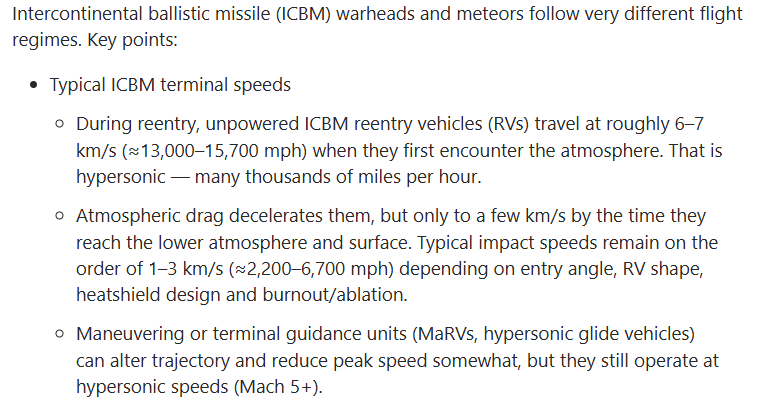
Arrival speed 2.95 km/s
Energy 65.26875 MJ
Total energy 65.26875 MJ × 36 submunitions = 2349.675 MJ
The energy of artillery nuclear munitions can range from 334.72 MJ to 9204.8 MJ, depending on their power.
 
The destruction of a buried and protected bunker with undesirable persons fully justifies the existence of such a system. Moreover, this will not lead to a nuclear escalation
2350 MJ is only 0.6 tons of yield. The smallest nuclear weapon ever fielded is probably the Davy Crockett, which had a yield of 10–20 tons (42–84 GJ = 42,000–84,000 MJ). This is hilariously low yield, well below the nuclear threshold.

Even if you had perfect accuracy (which is impossible), the best you could do is mildly damage the outer entrance to the bunker. It won't touch the occupants. You need a lot of yield and/or accuracy to do anything to a buried bunker with leadership or C&C in it.

The only conventional munition with any utility for bunker busting is the GBU-57 MOP, and even that is pretty awful at bunker busting compared to any vaguely modern US nuclear weapon (e.g. W76, W78, W87, B61, W88, B83), let alone an actual earth-penetrating nuclear weapon (B61-11, B61-13).

Also, your calculations regarding thrust, structural weight, flight time, range, payload weight, arrival speed, energy, etc seem somewhat sketchy to me. Where did you derive these figures from?

Edit: I plugged your figures into my ballistic missile simulator program.

I could not match your results exactly in terms of flight time (flight time is 1074 sec at MET, not 785 sec), range (flight range is 3200 km at MET, not 1513 km), or staging (I was able to match your working times for each stage by deriving the Isp to be 280 on both stages, but this program cannot model delayed stage ignition without rewriting a bunch of code, and I can't figure out why you would even want to have delayed stage ignition in the first place).

The dry mass fraction you used seems kinda overly optimistic, although I guess with modern composites it may be more plausible than I initially thought. However, your figures for total weight are incompatible with the stage, fuel, and payload weights that you've listed. I can't comment on the dimensions, solid fuel density, or thrust figures, but I'm a bit skeptical about their accuracy, especially given the other issues I've found. Would like to see sources/reasoning to justify why those values were chosen.

I was able to confirm was that 2.95 km/s is a reasonably sane speed at impact for a missile of the specs you describe under MET, although as the reentry drag simulation in this program isn't really optimized for accurate simulation of reentry deceleration, I don't have high confidence in the accuracy of that result. It's close enough to work with though.

 
Last edited:
higher terminal velocity = bigger boom,
1767556772336.png


Supposedly the production of the missiles.
1767556588644.png
 
higher terminal velocity = bigger boom,
View attachment 797389


Supposedly the production of the missiles.
View attachment 797388
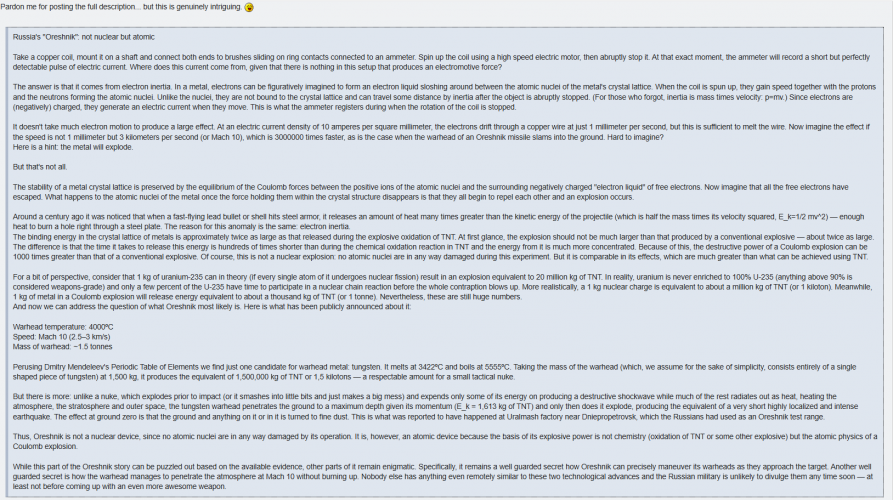
Their math is flawed. 1500 kg at 2.95 km/s is:

KE = 1/2mv^2 = 0.5*1500*((2.95*1000)^2) = 6.53 GJ

6.53 GJ = 1.6 tons

That assumes the 2.95 km/s figure from @paralay is correct. Given that this is roughly Mach 8.5, I think it's a pretty good rough number to use for testing reasonable rods from gods scenarios, as it's pretty close to the speed range that nuclear RVs are thought to be at immediately prior to impact. Given that this is a MRBM, I expect it to be closer to a SLBM in terms of reentry speed, which would make 2.95 km/s a very fair estimate. Also, it is in alignment with the range in that post, so there should be no issues with using it.

Anyways, 1.6 tons is not 1.5 kilotons – it's roughly 1/1000th of that. So the original poster got their math terribly wrong.

Another outrageous quote from the original post:

[...] Another well guarded secret is how the warhead manages to penetrate the atmosphere at Mach 10 without burning up. Nobody else has anything even remotely similar to these two technological advances and the Russian military is unlikely to divulge them any time soon [...]

This is comedically stupid and plainly false. Russia and the US have both mastered the art of building reentry vehicles. Both countries are more than capable of building RVs capable of surviving Mach 10 without burning up. Heck, both countries are capable of building RVs capable of surviving much higher reentry velocities. This is decades old technology. Claiming that this is some big secret is pure bullshit, and claiming that nobody else has anything even remotely similar to this is hilariously false. This poster is clearly some Russian nationalist with little to no technical (or historical) knowledge but plenty of patriotic zeal. I guess they're just carrying on the proud Russian tradition of historical revisionism...
 
Well both sources are in conflict at this point, so best ignored until sources start agreeing.
 
oth countries are more than capable of building RVs capable of surviving Mach 10 without burning up
They are probably talking about re-entry speeds to the atmosphere.
1767754840129.png
I guess the significance is that maybe the warheads get released earlier during flight and manage to maintain high re-entry speeds towards the atmosphere as MRBM/IRBMs
 
Status
Not open for further replies.

Similar threads

Back
Top Bottom