- Joined
- 25 July 2007
- Messages
- 4,916
- Reaction score
- 5,537
Oeffag - Oesterreichische Flugzeugfabrik AG
In 1912, the Austro-Hungarian Oesterreichische Daimler Motoren AG (Austro-Daimler) became independent from its German parent, DMG. Prior to that, technical director Ferdinand Porsche had begun designing aero-engines. In late 1913, with investment via Skodawerke AG, the decision was made to begin aircraft production. Construction of a factory began in early 1915 after receiving approval from the Wiener-Neustadt council. However, before aircraft construction could begin, with the backing of the k.u.k. government, the major investors [1] took control of the aircraft plant. The new name was to be Oesterreichische Flugzeugfabrik AG (Oeffag, now often seen as the umlauted Öffag).
The Managing Director of the new Oeffag was ingenieur Leo Portsch, brought in from Skodawerke AG. Aircraft design would be under Technical Director ing Karl Ockermüller from LFG Roland. Design work at Oeffag during WW1 was by: director Karl Ockermüller; Oblt Eduard Zaparka; Dipl-Ing Joseph Mickl (Josip Mikl); Ingenieurleutnant Karl Saliger; and others. Oeffag received outside contributions from Prof. Richard Knoller. The firm was also detailed to potentially build designs by outsiders, including Hauptman Rudolf Holeka and Major Stephan Petróczy von Petrócz.
Oeffag Aircraft Designations
Much of Oeffag's production was of licensed German designs. In Austro-Hungarian service, these licensed types were often referred to by their German designations with '(Oef)' appended - eg: Albatros D.III(Oef). However, both the k.u.k. Luftfahrtruppen (LFT) and the k.u.k. Seefliegerkorps assigned type numbers to both licensed aircraft and original Oeffag designs.
Here, a note should be made on nomenclature. Even modern Austrian sources use the English 'Type' or 'Series' (rather than the German typ or serie) when listing these numbers. However, properly, the term should be Bauart (design or construction type) so that is what I have used for these Oeffag lists. That Bauart was sometimes truncated into forms like 'Ba.53' (which I have chosen to avoid). [2]
Oeffag's k.u.k. Luftfahrtruppen Bauart Numbers
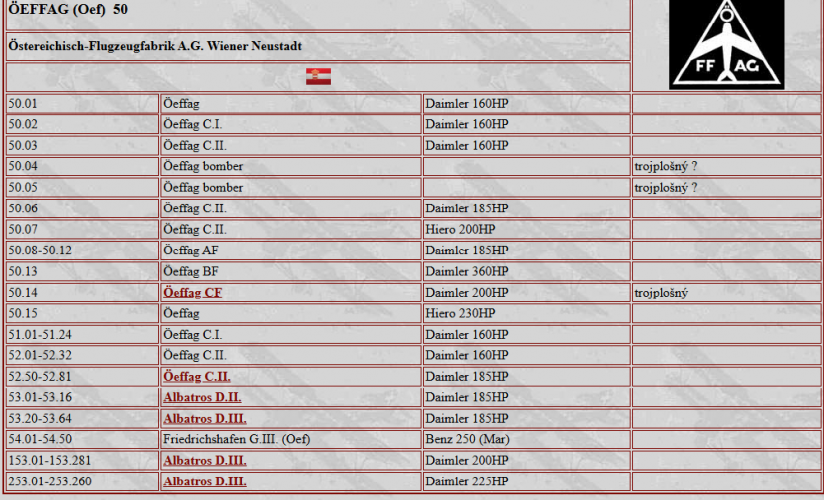
The k.u.k. Luftfahrtruppen (LFT) - the Austro-Hungarian army aviation troop - allocated each aircraft manufacture with its own number. The Oesterreichische Flugzeugfabrik AG code number was '5'. From that came a block of Bauart numbers beginning with 5. Standard LFT designation practice was for prototypes to be given type number '0'. So, Oeffag prototypes and experimental variants were allocated Bauart numbers in the 50 series - thus, individual aircraft serial (or Flugzeugnummer) 50.02 was Oeffag's second experimental design. After some refinement, the 50.02 acted as a prototype for a service type - the Oeffag C.I. The latter was a generic LFT role designation. The specific type designation was Oeffag Bauart 51.
That string of Bauart numbers ran from 50 to 54 ... but that is where things get a bit complicated. For example, when the Bauart 52 line was improved, it was dubbed Bauart 52.5 for some reason. [3] It got more complicated with the much more numerous Bauart 53 family of licensed-built Albatros D.II(Oef) fighters. The Bauart 53s were Albatros D.II biplanes. When sequiplane Albatros D.III(Oef)s were introduced, those became 53.2s. Then the Bauart pattern changes again.
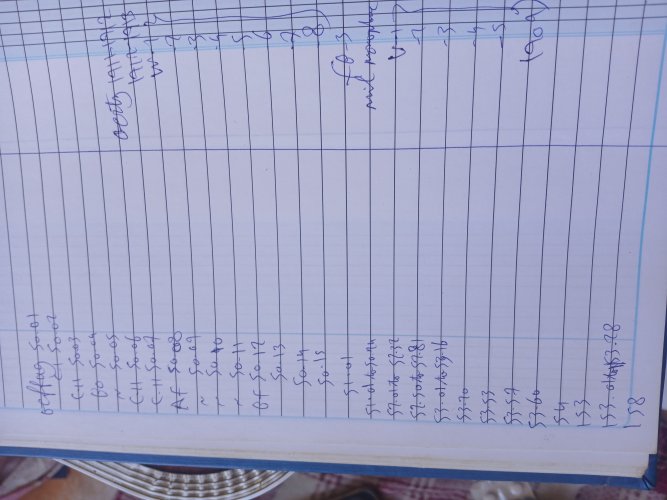
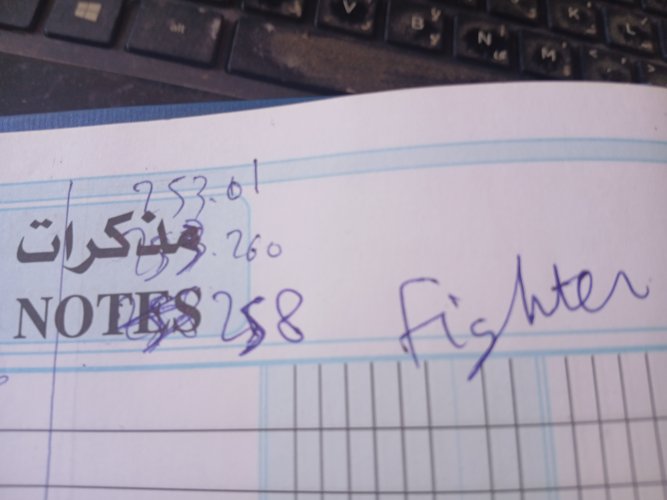
Bauart 53 serials had run from 53.01 to 53.16, then Bauart 53.2 serials jumped to 53.20 and ran to 53.64. But the, more powerful variant became Bauart 153 (153.01 to 153.281). Improvements in armament arrangement then led to Bauart 253 (253.01 to 253.330). Clear as mud, right?
Oeffag's k.u.k. Seefliegerkorps Naval Role Letters
In place of Bauart numbers, the k.u.k. Seefliegerkorps assigned type letters to its aircraft. Akin to k.u.k. Luftfahrtruppen role designators, those type letters were often short for a role. Aircraft destined for the K.u.K. Seefliegerkorps were assigned type letters. Those letters would then form part of the individual aircraft identifier (usually painted into the hull or fuselage).
I don't actually know exactly what those role designators stood for. But some *plausible speculation* can be based on those roles. For Oeffag, the most common designator is 'K' around which is seen the term Kampfflugboot (combat flying boat). The 'G' almost certainly stood for Groß (or Großflugzeug (for large aircraft). The 'R' was probably for Rekognoszierung (reconnaissance, although the more common term in German is Aufklärung). The Oeffag R types were later recategorised as 'F'. Here, I will go well and truly out on a speculative limb and suggest Fernspäher (pathfinder).
Please approach all of the above 'explanations' with extreme scepticism! I will be most relieved to receive confirmation or corrections on these naval role designators.
Oeffag designation lists will follow but, in the next post, I will cover the designs of Josef Mickl. This seems warranted since there is so much overlap in designs (as well as, hopefully, dispelling some confusion over Mickl types built by Oeffag).
________________________________________
[1] These main investors were Dr Karl Freiherr von Skoda, Ferdinand Porsche, and a bank - the Oesterreichisch-Ungarische Escompte und Creditbank. These main investors took control on o3 March 1915. The company was known as the Oesterreichische Flugzeugfabrik AG (Oeffag).
[2] Also seen are 'Va.' forms. I do not know whether that is simply a corruption of 'Ba.' or if it stood for something else (like 'Variante', perhaps). Either way, I have chosen to ignore those 'Va.' prefixes.
[3] This may have been to clarify individual aircraft numbering. The original Bauart 52 production run (including production prototypes) ran from 52.01 to 52.32. When Bauart 52.5 production began, the 32 x aircraft built were serialed 52.50 to 52.81 - so, still in the '52' range but not in sequence from 52.32.
[4] At least this numerical jumping bean approach wasn't distinct to Oeffag - it seems to have occurred with all major Austro-Hungarian aircraft makers.
In 1912, the Austro-Hungarian Oesterreichische Daimler Motoren AG (Austro-Daimler) became independent from its German parent, DMG. Prior to that, technical director Ferdinand Porsche had begun designing aero-engines. In late 1913, with investment via Skodawerke AG, the decision was made to begin aircraft production. Construction of a factory began in early 1915 after receiving approval from the Wiener-Neustadt council. However, before aircraft construction could begin, with the backing of the k.u.k. government, the major investors [1] took control of the aircraft plant. The new name was to be Oesterreichische Flugzeugfabrik AG (Oeffag, now often seen as the umlauted Öffag).
The Managing Director of the new Oeffag was ingenieur Leo Portsch, brought in from Skodawerke AG. Aircraft design would be under Technical Director ing Karl Ockermüller from LFG Roland. Design work at Oeffag during WW1 was by: director Karl Ockermüller; Oblt Eduard Zaparka; Dipl-Ing Joseph Mickl (Josip Mikl); Ingenieurleutnant Karl Saliger; and others. Oeffag received outside contributions from Prof. Richard Knoller. The firm was also detailed to potentially build designs by outsiders, including Hauptman Rudolf Holeka and Major Stephan Petróczy von Petrócz.
Oeffag Aircraft Designations
Much of Oeffag's production was of licensed German designs. In Austro-Hungarian service, these licensed types were often referred to by their German designations with '(Oef)' appended - eg: Albatros D.III(Oef). However, both the k.u.k. Luftfahrtruppen (LFT) and the k.u.k. Seefliegerkorps assigned type numbers to both licensed aircraft and original Oeffag designs.
Here, a note should be made on nomenclature. Even modern Austrian sources use the English 'Type' or 'Series' (rather than the German typ or serie) when listing these numbers. However, properly, the term should be Bauart (design or construction type) so that is what I have used for these Oeffag lists. That Bauart was sometimes truncated into forms like 'Ba.53' (which I have chosen to avoid). [2]
Oeffag's k.u.k. Luftfahrtruppen Bauart Numbers
The k.u.k. Luftfahrtruppen (LFT) - the Austro-Hungarian army aviation troop - allocated each aircraft manufacture with its own number. The Oesterreichische Flugzeugfabrik AG code number was '5'. From that came a block of Bauart numbers beginning with 5. Standard LFT designation practice was for prototypes to be given type number '0'. So, Oeffag prototypes and experimental variants were allocated Bauart numbers in the 50 series - thus, individual aircraft serial (or Flugzeugnummer) 50.02 was Oeffag's second experimental design. After some refinement, the 50.02 acted as a prototype for a service type - the Oeffag C.I. The latter was a generic LFT role designation. The specific type designation was Oeffag Bauart 51.
That string of Bauart numbers ran from 50 to 54 ... but that is where things get a bit complicated. For example, when the Bauart 52 line was improved, it was dubbed Bauart 52.5 for some reason. [3] It got more complicated with the much more numerous Bauart 53 family of licensed-built Albatros D.II(Oef) fighters. The Bauart 53s were Albatros D.II biplanes. When sequiplane Albatros D.III(Oef)s were introduced, those became 53.2s. Then the Bauart pattern changes again.
Bauart 53 serials had run from 53.01 to 53.16, then Bauart 53.2 serials jumped to 53.20 and ran to 53.64. But the, more powerful variant became Bauart 153 (153.01 to 153.281). Improvements in armament arrangement then led to Bauart 253 (253.01 to 253.330). Clear as mud, right?
Oeffag's k.u.k. Seefliegerkorps Naval Role Letters
In place of Bauart numbers, the k.u.k. Seefliegerkorps assigned type letters to its aircraft. Akin to k.u.k. Luftfahrtruppen role designators, those type letters were often short for a role. Aircraft destined for the K.u.K. Seefliegerkorps were assigned type letters. Those letters would then form part of the individual aircraft identifier (usually painted into the hull or fuselage).
I don't actually know exactly what those role designators stood for. But some *plausible speculation* can be based on those roles. For Oeffag, the most common designator is 'K' around which is seen the term Kampfflugboot (combat flying boat). The 'G' almost certainly stood for Groß (or Großflugzeug (for large aircraft). The 'R' was probably for Rekognoszierung (reconnaissance, although the more common term in German is Aufklärung). The Oeffag R types were later recategorised as 'F'. Here, I will go well and truly out on a speculative limb and suggest Fernspäher (pathfinder).
Please approach all of the above 'explanations' with extreme scepticism! I will be most relieved to receive confirmation or corrections on these naval role designators.
Oeffag designation lists will follow but, in the next post, I will cover the designs of Josef Mickl. This seems warranted since there is so much overlap in designs (as well as, hopefully, dispelling some confusion over Mickl types built by Oeffag).
________________________________________
[1] These main investors were Dr Karl Freiherr von Skoda, Ferdinand Porsche, and a bank - the Oesterreichisch-Ungarische Escompte und Creditbank. These main investors took control on o3 March 1915. The company was known as the Oesterreichische Flugzeugfabrik AG (Oeffag).
[2] Also seen are 'Va.' forms. I do not know whether that is simply a corruption of 'Ba.' or if it stood for something else (like 'Variante', perhaps). Either way, I have chosen to ignore those 'Va.' prefixes.
[3] This may have been to clarify individual aircraft numbering. The original Bauart 52 production run (including production prototypes) ran from 52.01 to 52.32. When Bauart 52.5 production began, the 32 x aircraft built were serialed 52.50 to 52.81 - so, still in the '52' range but not in sequence from 52.32.
[4] At least this numerical jumping bean approach wasn't distinct to Oeffag - it seems to have occurred with all major Austro-Hungarian aircraft makers.
Last edited: