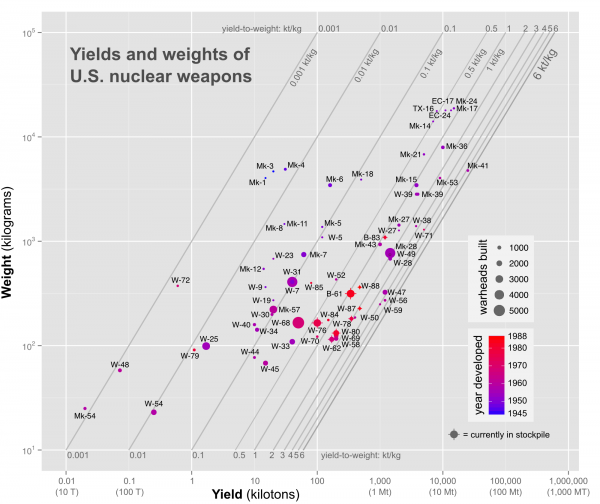
Why do the (relatively) new and shiny W88s underperform the old and creaky W47 Polaris warheads by such a wide margin? W47Y2 (in RV) had a yield in the 1.2 megaton range and weighed 350 kg; W88 has a 500kt yield and weighs somewhat more (with RV).
Chuck Hansen claims that LLNL once tested a 100kt warhead (PEBBLE) in a 30-kg test package (this would make a killer A2A missile warhead or atomic demolition device).
W88 is apparently a much more compact warhead, is denser, and is conical in shape. It is also much more reliable (theoretically), houses a radar altimeter, and is hardened against nuclear effects. Is it just me, or did the ballistic, explosive sensitivity, and hardening improvements really take that much performance off the warhead?
W47Y2/Mk1 weighs 850 lbs (386 kg). Yield is 1200 kt. Yield to weight is 3.1 kt/kg.
W56/Mk11 weighs 830 lbs (377 kg). Yield is 1200 kt. Yield to weight is 3.2 kt/kg.
W58/Mk2 weighs 300 lbs (136 kg). Yield is 200 kt. Yield to weight is 1.5 kt/kg.
W88/Mk5 weighs 386 lbs (175 kg). Yield is 455–475 kt. Yield to weight is 2.6–2.7 kt/kg.
If you look at the W47Y2/Mk1, it was not even all that impressive of a yield to weight compared to later designs like the W56/Mk11, which outperformed the W47Y2/Mk1 despite being a longer-range ICBM warhead (which always weigh significantly more than shorter-range SLBM warheads due to multiple factors such as onboard spin rockets and higher heating loads) with multiple generations of weight-bloating hardening measures incorporated into it (my figures are for the Mk11C, so the impact of these are already accounted for).
Anyways, high-yield (megaton class) warheads have always had a
significant pure yield to weight performance advantage over lower-yield (sub-megaton class) warheads, and it is
incredibly misleading to compare the two disparate classes directly like this. They are two
very different weapons with
very different properties, capabilities, and roles.
If you compare two warheads of more comparable types/roles (the W58/Mk2 vs the W88/Mk5), you'll see that the gain in yield to weight for this class of warheads was actually
enormous (1.5 kt/kg to 2.6–2.7 kt/kg).
The gap between the W47Y2/Mk1 and the W88/Mk5 is actually surprisingly small given the
enormous differences in warhead weight, dimensions, volume, beta, accuracy, hardening, etc. The W88/Mk5 weighs literally less than half what the W47Y2/Mk1 does, and has less than half the yield, yet it has 84–87% of its yield to weight.
Yield to weight also isn't everything – yield to volume, beta, accuracy, hardening, reliability, maintainability, and other factors are far more important.
High yield warheads are very inefficient at transferring explosive energy to targets. Multiple lower yield MIRV warheads can actually deal out greater actual damage to area targets than single high yield warheads.
Low yield high accuracy warheads can actually directly outperform high yield low accuracy warheads in terms of SSPK, even against hardened targets.
The combination of these factors, well...
Let's just compare the two weapons systems, shall we?
The W47Y2/Mk1 on the Polaris A2 missile can achieve a 3700 meter CEP at 1500 nmi range. It delivers one 1200 kt warhead.
The W88/Mk5 on the Trident II D5 missile can achieve a 130 meter CEP at 4000 nmi range. It delivers eight 455–475 kt warheads.
For area targets, that's 3640–3800 kt of total yield (actually significantly more than that in equivalent yield after accounting for the greater efficiency of multiple small warheads vs single large warheads, but I don't feel like calculating that right now).
Yes, the individual warheads pack less than half the punch, but the 28.5x greater accuracy completely compensates for the decrease in yield (accuracy is
everything) all on its own. Indeed, it is all but certain that the W88 actually has a substantially higher SSPK than the W47Y2.
Then on top of that, you can hit 8 times the number of discrete targeting points at 2.67 times longer distance with a single missile.
Who even cares about yield to weight when the "inferior" warhead unlocks these kinds of capabilities?
One last word of caution. The weight figures on the internet for most nuclear warheads are misleading at best. Many of them are flat-out wrong.
It is far too common to conflate warhead and RV weights.
Warhead weights are all but useless – RV weights are all that matter. A bare warhead has zero utility. It cannot even operate without the AF&F and boost gas system. Even with those extra systems, it remains largely useless as a practical weapon. It needs the aeroshell (and ballast) to survive reentry, and the spin rockets (for land RVs – naval RBs use a different system attached to the PBV) to ensure it doesn't drift off course during reentry. The RV weight includes every single component necessary to ensure the warhead operates as designed once it is released from the missile's PBV.
A common issue is confusion over the exact definition of warhead and RV weights. The warhead weight is the weight of the bare physics package alone. The RV weight is the weight of the entire RV (inclusive of warhead physics package, boost gas system, AF&F system, RV aeroshell, ballast, spin rockets, etc). Do not add the warhead and RV weights together – the RV weight already includes the weight of the warhead.
The conflation of warhead and RV weights has led to it becoming common to have a warhead weight incorrectly quoted as the RV weight (or less commonly, the RV weight quoted as the warhead weight). Oftentimes it is ambiguous which type of weight is being referred to. When in doubt, assume that ambiguous weight is the warhead weight unless explicitly specified otherwise.
An extremely huge issue is that certain sources have naively calculated RV weights by dividing missile throw weight by the number of RVs. This is not correct. Missile throw weight is the payload capacity of the missile's primary thrust stages. This payload capacity must include the weight of all components propelled by the primary thrust stages. For example, this includes the missile nosecone, the entire missile post boost vehicle (including the guidance computer and ISP/INS assemblies), the propellant for the post boost vehicle, the chaff used for countermeasures (when carried), etc. The warheads themselves are only a small proportion of this total payload, typically roughly 50%.
This issue with naively calculated RV weights is one of the biggest problems in this area, as certain otherwise highly reputable sources (such as the Nuclear Weapons Archive) list these inaccurately calculated figures for RV/warhead weights, which has led to many other sources uncritically republishing said figures, and countless others citing or relying on these inaccurate figures.
A similar issue of inaccurate figures spreading has occurred with other types of errors, especially so with the extremely common conflation of warhead and RV weights. Oftentimes the original publication is ambiguous as to which term is meant, especially to readers that are unfamiliar with the subject area. This has led to many absurd errors becoming far too common, including massive overestimations and underestimations of warhead/RV weights.
Even highly respected figures like Alex Wellerstein have fallen prey to these issues, with his
kilotons per kilogram blog post (which was previously mentioned in this thread) and
Yield to Weight explorer (the direct successor to that blog post) being prime examples of this.
Wikipedia is also highly problematic, as many articles uncritically quote blatantly inaccurate figures, or quote inaccurate figures alongside accurate ones, or mix and match figures wrongly, all of which creates even more confusion for readers not familiar with all the nuances and pitfalls in this subject area. Oftentimes it isn't even differentiated if the quoted figures refer to warhead or RV weight. Even when accurate figures are quoted by wikipedia articles, it is rare for them to be clearly labeled, and they are most commonly mentioned uncritically alongside blatantly inaccurate figures. It's also not uncommon to encounter cases where the original source was misinterpreted, most commonly resulting in warhead weights being listed as RV weights.
All of these issues that I have mentioned do not only affect warhead and RV weights. They also affect yield to weight figures.
In an ideal world, we would have accurate information on warhead weight and warhead yield to weight figures for all nuclear weapons. Sadly, for many weapons (especially bombs and modern RVs), only the weight of the entire bomb or RV is available. This poses obvious issues when it comes to comparing weapons systems using warhead yield to weight figures.
It's extremely common to see yield to weight figures derived from bare warhead weight presented alongside yield to weight figures derived from RV or bomb weights, with no distinction made between the two.
Even worse, most sources end up using inaccurate RV/warhead weight figures to calculate yield to weight, or use accurate figures but do not interpret/apply them correctly (e.g. using the accurate warhead weight as the RV weight or vice versa).
These errors are rarely uniformly applied, which only makes the problem more severe.
All of this leads to severe misconceptions and confusion about the actual capabilities of weapons systems.
Sources: