NPOMash 3M22 Zircon / Tsirkon (SS-N-33)

Basically the brochure issued for the Zircon was ironically a better fit for ROK's Hycore missile - at least the warhead weight and range are correct as well as the general shape, even if the speed is still off.
There were no any "brochure issued for Zircon". There were only fantasies of state channels build editors feeded with fast checking of internet theories.
 
Still I'm forced to admit that their arguments about solid-fuel rocket engine looks presuasive (despite obviously fake "warhead" and "seeker").
Zircon nose fairing on impact test rig matching patent was shown when, like four years ago? Still "I want to believe" mode is on for some...
 
Zircon nose fairing on impact test rig matching patent was shown when, like four years ago? Still "I want to believe" mode is on for some...
They showed seeker identical to the one they demonstrated as "Neptun"'s in 2019. Not merely similar - indentical in every small element. So at least seeker is pretty obviously fake.
 
What the connection to nose fairing images from Military Acceptance?
 
What the connection to nose fairing images from Military Acceptance?
I said nothing about fairing. My point was that seeker image is obviously fake, and I rather seriously suspect that warhead is too. 120-kg is far too small for the useful anti-ship missile, especially relatively heavy one. It's shape is also rather puzzling for intended purpose. I could concede on warhead part, if more definitive proofs would be presented, but not on seeker.
 
The commonly claimed performance figure is Mach 9 speed and ~1,000 km range, which should have immediately raised the BS alarm around it being airbreathing as that's outside the speed range of any feasible hydrocarbon fueled ram/scramjet engine, even using exotic endothermic fuels. Mach 9 however just so happens to be around the burnout speed you would expect from an otherwise entirely conventional 1,000 km range two-stage ballistic missile (sqrt(1000)*0.09 ≈ 2.85 km/s or about Mach 9 to 9.5 depending on the burnout altitude).
 
Mach 9 however just so happens to be around the burnout speed you would expect from an otherwise entirely conventional 1,000 km range two-stage ballistic missile (sqrt(1000)*0.09 ≈ 2.85 km/s or about Mach 9 to 9.5 depending on the burnout altitude).
Entirely conventional ballistic missile would flew entirely conventional ballistic trajectory, while nobody question the fact, that Zirkon did NOT follow conventional ballistic trajectory.
 
About the seeker issue, the only way i could think this might make sense if there was collaboration on such seekers before 2014, with the ukrainians putting a version on Neptun and the russians a version on Zircon. Was there such collaboration?
 
Zirkon did NOT follow conventional ballistic trajectory.
Neither do Iskander or Kinzhal. These however are unpowered for the majority of their flight envelope. I think @Scott Kenny was right in bringing up the Kh-22/32, which serve a similar role, are not air breathing and still considered anti-ship cruise missiles, like Zircon. A multi-stage design, SRM or flying a lofted trajectory doesn't make a missile inherently a ballistic missile.
 
Neither do Iskander or Kinzhal. These however are unpowered for the majority of their flight envelope. I think @Scott Kenny was right in bringing up the Kh-22/32, which serve a similar role, are not air breathing and still considered anti-ship cruise missiles, like Zircon. A multi-stage design, SRM or flying a lofted trajectory doesn't make a missile inherently a ballistic missile.
My current assumption is that Zirkon is indeed a rocket-powered cruise missile with multiple pulse second-stage motor, allowing for prolonged boost-glide phases and active maneuvering.
 
Neither do Iskander or Kinzhal. These however are unpowered for the majority of their flight envelope. I think @Scott Kenny was right in bringing up the Kh-22/32, which serve a similar role, are not air breathing and still considered anti-ship cruise missiles, like Zircon. A multi-stage design, SRM or flying a lofted trajectory doesn't make a missile inherently a ballistic missile.
Kh-22/32 and Zircon are sort of skating around the boundary between aeroballistic BMs and cruise missiles. They aren't definitively in either category IMO, but the Kh-22/32 is probably closer to the cruise missile side in that it remains powered throughout the majority of its flight, whereas Zircon uses pulses of acceleration, which isn't the definition of cruising.
 
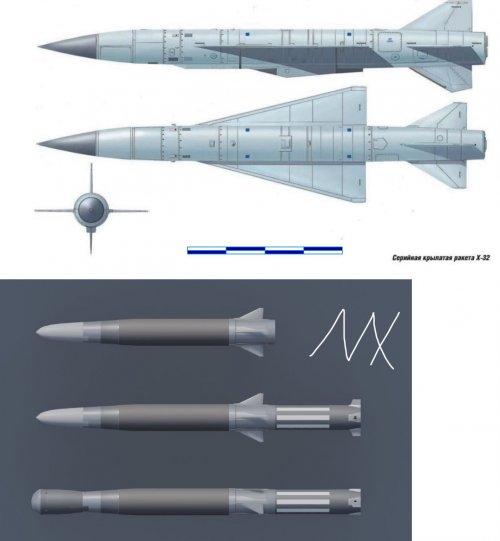
X‑32 and 3M22 at the same scale
launch mass: 5,780 kg / 3,000 kg;
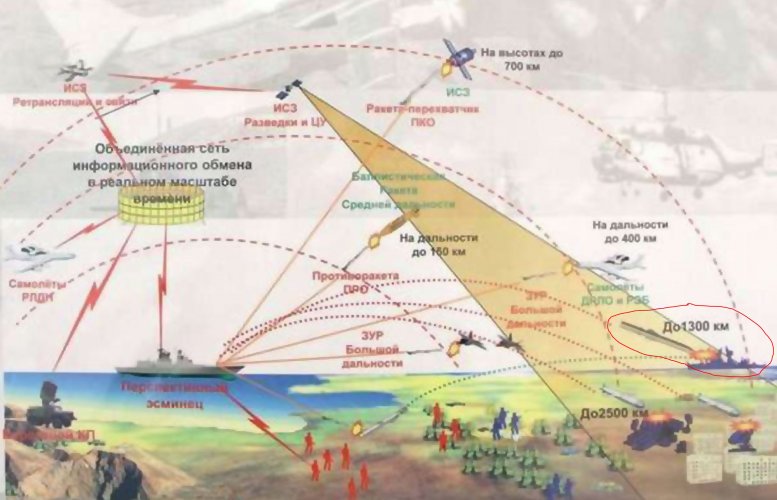
flight range: 600 km - 1,000 km / up to 1,300 km;
warhead mass: 500 kg - 1,000 kg / 120 - 145 kg;
flight speed: 5,400 km/h / 11,600 km/h.
 

Attachments

  • 32_3М22.JPG
    32_3М22.JPG
    111 KB · Views: 62
We considered the rocket-powered Kh-22/Kh-32 cruise missiles.
The Kh-22 uses a liquid-fueled engine. Liquid fuel has a higher specific impulse than the solid-fueled 9M723 derivative. The feasibility of storing high-specific-impulse (and, of course, highly toxic) fuel on ships needs careful consideration; even if ampoule-based, this would lead to a deterioration in cost and safety. Furthermore, the 3M22's cruising speed is significantly faster than that of any Kh-22-like missile【3M22 about Ma5.5-Ma6.8,Kh-22 about Ma4.8】, making the use of ramjet engines seem necessary.

Of course, it cannot be ruled out that Ukraine often refers to any slightly faster-moving object (e.g., the Kh-22) as any advanced missile they recognize, which could give the Kh-22, as a non-maneuverable missile, a much higher penetration probability than the Kh-47M2.

"Ihnat said that a total of 412 Kh-22 or Kh-32 missiles have been used against Ukraine, of which only three had been destroyed so far. With the latest attack, air defense has added another nine, bringing the total number destroyed to 12.
In any case,Should understand but also take seriously any possible biases in the Ukrainian reports.
 
Liquid fuel seems unlikely given that Zircon is also deployed on the Yasen-M SSNs. I imagine liquid fuel would be difficult to handle on a submarine, let alone an SSN. Also the Gorshkov frigates are also medium sized surface combatants, so unlikely they handle liquid fueled missiles either.
 
Liquid fuel seems unlikely given that Zircon is also deployed on the Yasen-M SSNs. I imagine liquid fuel would be difficult to handle on a submarine, let alone an SSN. Also the Gorshkov frigates are also medium sized surface combatants, so unlikely they handle liquid fueled missiles either.
Most important argument against liquid fuel is that Zircon is clearly launched from the standard UKSK (3S-14) cells; the missile with highly dangerous liquid rocket fuel would clearly require specially-adapted cells.
 
X‑32 and 3M22 at the same scale
launch mass: 5,780 kg / 3,000 kg;
flight range: 600 km - 1,000 km / up to 1,300 km;
warhead mass: 500 kg - 1,000 kg / 120 - 145 kg;
flight speed: 5,400 km/h / 11,600 km/h.
1,300km for Zircon? Early Ukrainian assessments put it at about 700km.
https://english.nv.ua/russian-war/r...-on-sumy-what-the-weapon-can-do-50561551.html

Liquid fuel seems unlikely given that Zircon is also deployed on the Yasen-M SSNs. I imagine liquid fuel would be difficult to handle on a submarine, let alone an SSN. Also the Gorshkov frigates are also medium sized surface combatants, so unlikely they handle liquid fueled missiles either.
Russia does use liquid-fuelled SLBMs though - RSM-54 Sineva.
 
Liquid fuel seems unlikely given that Zircon is also deployed on the Yasen-M SSNs. I imagine liquid fuel would be difficult to handle on a submarine, let alone an SSN.
It's been done, mostly by Soviet/Russian Navy. Their current missiles have a liquid-fueled top stage for deploying the warheads.

USN originally planned to with Jupiter missiles on subs, but Teller said that megaton-class nukes could be made small enough for Polaris-sized solid rockets. And the USN said "thank God"
 
Russia does use liquid-fuelled SLBMs though - RSM-54 Sineva.
SLBMs and SSBNs offer far more real estate to work with though. While the Zircon is more compact, as are it's launch platforms and the cells that launch it.
 
It's been done, mostly by Soviet/Russian Navy. Their current missiles have a liquid-fueled top stage for deploying the warheads.
Liquid-fuel bus for SLBM and liquid-fuel anti-ship missiles are quite different things. In first case, the ammount of fuel is very small and it is encapsulated inside bus structure. In second case, there are tons of fuel filling missile tanks.
 
Kh-22/32 and Zircon are sort of skating around the boundary between aeroballistic BMs and cruise missiles. They aren't definitively in either category IMO, but the Kh-22/32 is probably closer to the cruise missile side in that it remains powered throughout the majority of its flight, whereas Zircon uses pulses of acceleration, which isn't the definition of cruising.

Kj-22/32 is a pretty straight forward cruise missile, just one that does not use air. It does not use rocket pulses; its engine operates continuously until its dive onto the target and its trajectory is AFAIK perfectly flat after climbing to altitude. That’s the very definition of a cruise missile, IMO.

Iskander still has a largely ballistic trajectory and I would label it “aeroballistic”.

Zircon seems to be more of hybrid of some kind, but I would not put a label on it without knowing more about its flight path when actually used.
 
1,300km for Zircon? Early Ukrainian assessments put it at about 700km.
https://english.nv.ua/russian-war/r...-on-sumy-what-the-weapon-can-do-50561551.html
Ukraine merely measured the distance from launch to impact point and then claimed that the range was only that short. They made the exact same estimate for the Iskander missile, claiming it had a range of only 380 km. Furthermore, they believed the Kh-47M2 and Iskander had the same range.

Furthermore, they claimed to be able to intercept the 3M22 and Kh-47M2 with an intercept probability of 0.2-0.5, but were almost unable to intercept the Kh-22, which is often launched simultaneously and used as a decoy.

90% of the world's open-source intelligence analysts do not truly understand the physics they learned in high school or university, nor do they have a deep understanding of military matters. While Ukrainian official reports contain some factual elements, they always seem to contain seemingly contradictory deviations at key points.

This is part of the propaganda war.
Russia does use liquid-fuelled SLBMs though - RSM-54 Sineva.
Ampoule storage of liquid fuels is costly and is generally used in IRBMs and ICBMs to reduce setup complexity.

Using ampoule-based liquid fuels in 3M22s is feasible, but cost must still be considered.
 
Ukraine merely measured the distance from launch to impact point and then claimed that the range was only that short. They made the exact same estimate for the Iskander missile, claiming it had a range of only 380 km. Furthermore, they believed the Kh-47M2 and Iskander had the same range.
They didn't because the Iskander-M has been used at ranges exceeding 500km several times from very early on.
Furthermore, they claimed to be able to intercept the 3M22 and Kh-47M2 with an intercept probability of 0.2-0.5, but were almost unable to intercept the Kh-22, which is often launched simultaneously and used as a decoy.
First two were used primarily on Kyiv where there was definitely air defences, Kh-22 was mostly used elsewhere.
90% of the world's open-source intelligence analysts do not truly understand the physics they learned in high school or university, nor do they have a deep understanding of military matters. While Ukrainian official reports contain some factual elements, they always seem to contain seemingly contradictory deviations at key points.

This is part of the propaganda war.
Doubt the Ukrainian engineers analysing debris and flights are 'open-source intelligence analysts'.
 
True, they have worse reliability due to their allegiance
What, so it's to their advantage to list a random solid rocket manufacturer as a supplier rather than the actual liquid-fuelled scramjet manufacturer, so that NATO can sanction a company unrelated to the missile instead of the the supplier that is related to it. Sure, that makes sense.
 

Similar threads

Back
Top Bottom