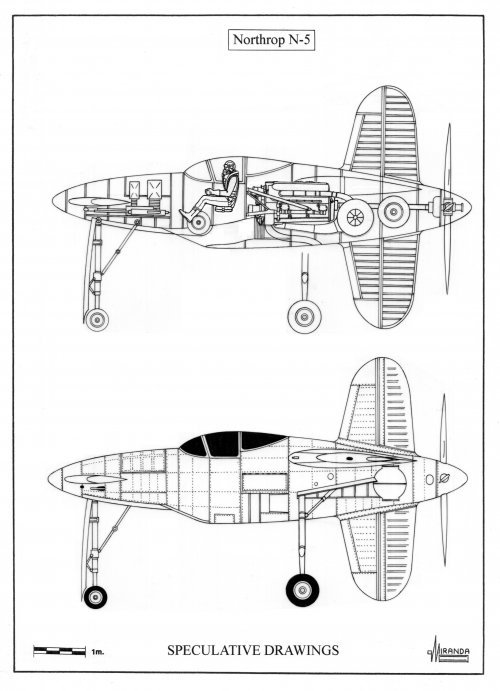
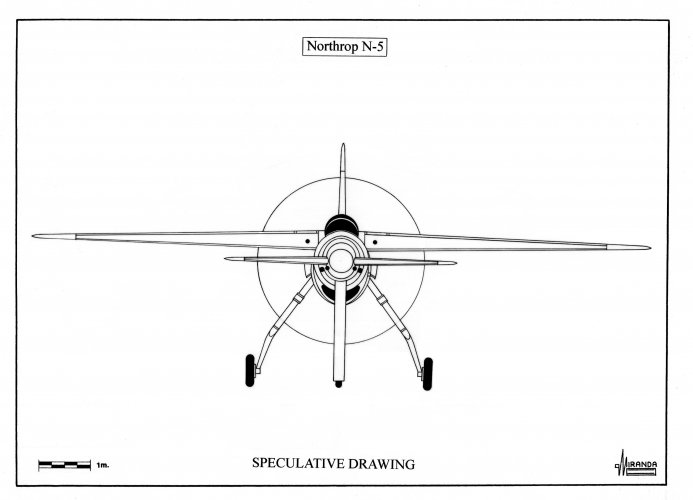
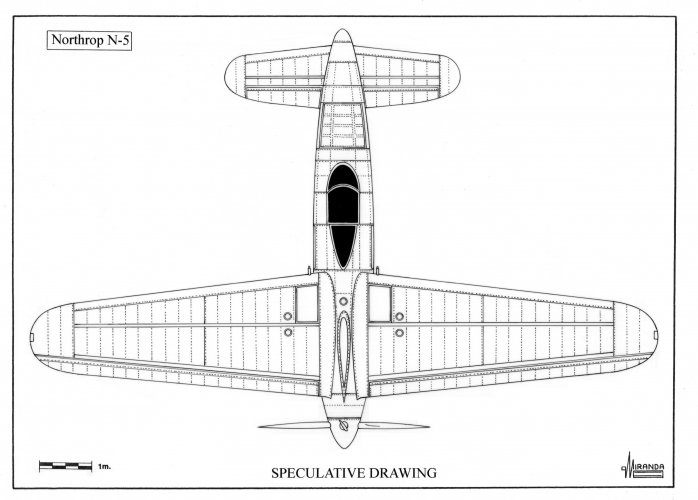
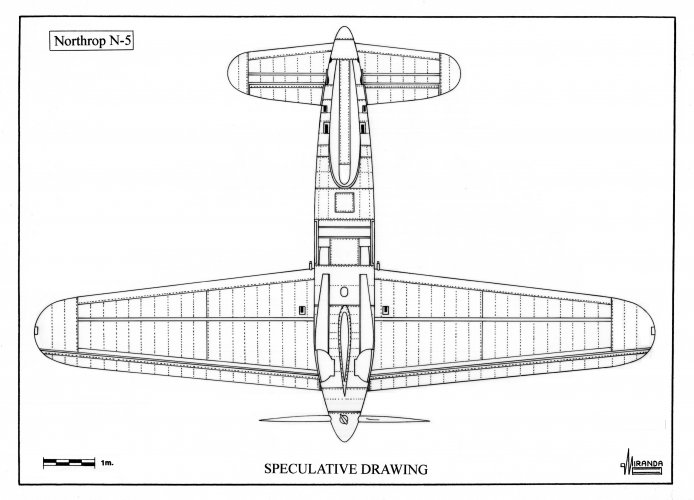
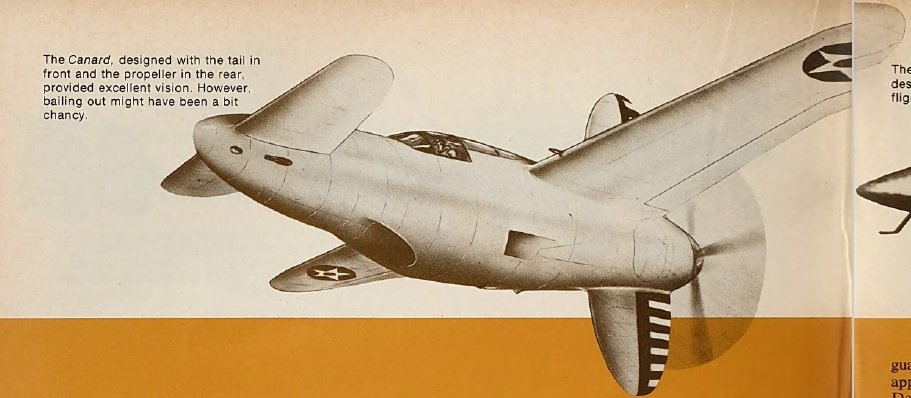
Northrop N-5
This is one of the most obscure projects defined in the Hawthorne Designation List of which there is hardly any evidence:
-On November 28, 1941, a drawing of the patent made by Lt. Col. Carl E. Reichert from USAAC Air Materiel Command Aircraft Laboratory.
-In September 1972 Wings & Airpower magazine published an illustration made by the USAAC in 1942.
After the failure of the USAAC specifications X-609, CP 39-770, CP 39-13, XC-616, XC-619 y del NACA Drag Reduction Program, the U.S. aviation industry failed to produce any single-engine fighter that would equal the German and British projects.
At the start of Second World War, Allison and P&W turbocharged engines were not yet sufficiently perfected to compete with European models equipped with two-stage mechanical superchargers.
The USAAC staff understood that it would be very difficult to match the technological level achieved by Luftwaffe fighters before the United States was forced into the war.
The R-40C fighter competition was a failed attempt to obtain air superiority fighters using advanced construction techniques, 24-cylinder monster engines, and unusual aerodynamic configurations to reduce the drag parasite of the airframes: laminar flow wings, pusher propellers, flush riveting surfaces, magnesium structures and Meredith Effect cooling systems.
Following the publication of the XC-622 specification, thirteen aircraft manufacturers responded with 26 design proposals that used eight basic structural concepts.
In May 1940, the USAAC Engineering Evaluation Committee (EEC) evaluated all incoming material by classifying it into three Classes:
- Class I, projects with 425 mph top speed powered by one Allison V-1710-39 F3R/F6R fitted with mechanical supercharger, to be mass-produced in 1941 (Curtiss XP-46 and Republic XP-47).
- Class II, projects with 525 mph powered by one turbo-supercharged Hyper Engine Allison V-1710-E8/E9, Continental XIV-1430-3 or Pratt and Whitney X-1800 -A3G/A4G, to be mass-produced in 1942 (Bell XP-52, Curtiss XP-53, Vultee XP-54 Model 70, Curtiss XP-55 Model P-249-C, Northrop XP-56 Model N-2B, Bell model 11, Bell Model 13/13A/13B, Douglas Model 312 A, McDonnell Model 1, Curtiss CP-40-1/2, Curtiss P-248A, Curtiss P-249A/T, Northrop N-2A/C/D and Republic AP-12).
- Class 3, depended on the successful completion of new power plants that were available within the next 18 months: Allison W3420, Wright 2160, P&W XH-3130, P&W R-2800-A5G, Lycoming XH-2470 and Wright R-2160-3.
The EEC carried out three phases of selection for the Class II: first it eliminated the conventional airframes (Curtiss XP-53, Bell Model 11) because it considered them to have excessive drag, then it eliminated the models that used engines not available in 1942 (Republic AP-12, McDonnell Model 1) and finally it eliminated the designs that used drive shaft extensions due to the loss of power and maintenance problems that had already been experienced with the Airacobra.
At the end of 1940, only three tailless designs equipped with pusher propellers and short fuselage remained (Vultee XP-54 Model 70, Curtiss XP-55 Model P-249-C, Northrop XP-56 Model N-2B) and was ordered the construction of prototypes.
When Douglas Model 312 A was phased out, Northrop modified the design of the N-6 naval fighter by placing the propeller behind the wing to eliminate the long shaft.
Possibly the N-5 project appeared at this time, because it seemed to be specially designed to circumvent the EEC's objections. Apparently, the N-5 was designed as a canard version of the Douglas Model 312 A, with the same landing retraction system and the same engine V-1710-E9 with a four bladed propeller. Placing the tailplane on the nose in canard configuration, the long shaft saving drag and weight could be eliminated.
Possibly the N-5 was ignored by the USAAC because it was expected to obtain all the engineering data on canards with the XP-55 and it was preferable that Northrop devote all its resources to the investigation of flying wing configurations.
Following the cancellation of the P&W X-1800 in October 1940, USAAC lost interest in 24-H engines and gave priority to the development of the P&W R-2800 air cooled radial engine.
The XC-622 specification was also cancelled in early September 1940, but experimental development of the XP-54, XP-55 and XP-56 prototypes was allowed to study the behavior of the pusher configuration in future jet fighters.
The USAAC's favorite project was the XP-54 tail boom pusher, the XP-55 was designed as a canard pusher fighter without the use of an extension shaft, and the XP-56 was a compromise solution to study the behavior of flying wings without experiencing the stability problems suffered by Northrop N-1M due to the lack of vertical surfaces.
The N-5 got a second chance in early 1941 when USAAC was not entirely satisfied with the results obtained during the wind tunnel tests performed with XP-55 models between November 5, 1940, and January 28, 1941.
Combination of canard straight foreplanes and laminar flow swept wings had not been completely satisfactory and promised bad stall/spin characteristics and poor directional stability.
To avoid cancellation of the project, Curtiss Wright built during the fall of 1941 the private venture technologic demonstrator Model 24-B, but that was not enough to achieve serial production of the XP-55.