North American P-500 (SC-46) lightweight fighter proposal

JC Carbonel

ACCESS: Secret
Joined
7 September 2006
Messages
231
Reaction score
197
NA_XX.JPG


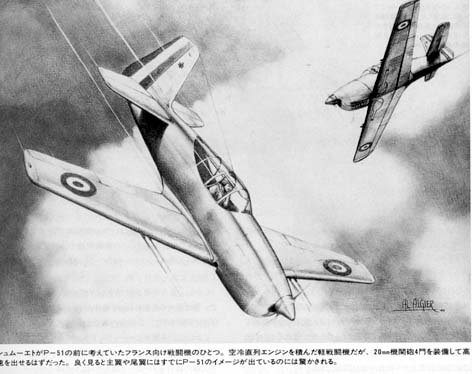
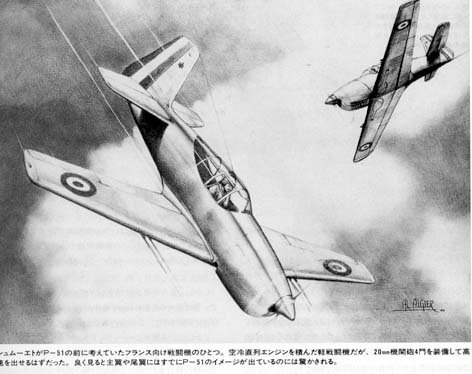
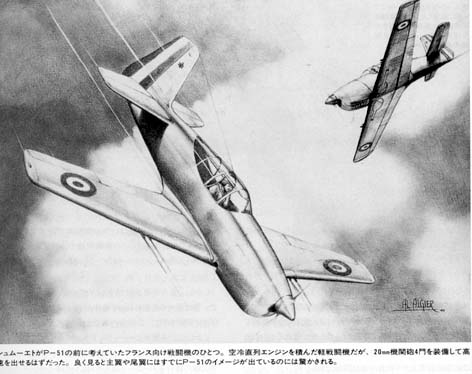
comes from a Japanese article about the P-51 ! Could it be an early pre-P51 proposal for the French purchasing comission ?

JCC
 
This is a light weight fighter concept designed by Edgar Schmued
of North American in the late 1930's.
Sometimes it is mentioned in relation to the Mustang.
I never have found a N.A. design number for it.
 
thank you . the wings and tail are very Mustang-ish but the whole machine does not seem much bigger than a Caudron 714 . Any 3-views , dimensions etc... around ?

JCC
 
Well, just as a preliminary estimate, consider a cross between the XAT-6E and either the Boomerang or the NA-50/P-64. Say the P-64's dimensions with the squared-off wingtips and engine installation of the XAT-6E?
 
Maybe the fuselage, but the tail doesn't look like the P-64/AT-6 & the wings definitely don't have the center section arrangement of those either.

elmayerle said:
Well, just as a preliminary estimate, consider a cross between the XAT-6E and either the Boomerang or the NA-50/P-64. Say the P-64's dimensions with the squared-off wingtips and engine installation of the XAT-6E?
 
elmayerle said:
Well, just as a preliminary estimate, consider a cross between the XAT-6E and either the Boomerang or the NA-50/P-64. Say the P-64's dimensions with the squared-off wingtips and engine installation of the XAT-6E?

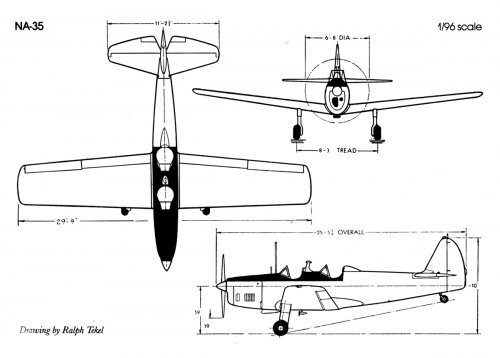
With a dash of NA-35.
 

Attachments

  • NA35_01.jpg
    NA35_01.jpg
    168.3 KB · Views: 1,063
frank said:
Maybe the fuselage, but the tail doesn't look like the P-64/AT-6 & the wings definitely don't have the center section arrangement of those either.

elmayerle said:
Well, just as a preliminary estimate, consider a cross between the XAT-6E and either the Boomerang or the NA-50/P-64. Say the P-64's dimensions with the squared-off wingtips and engine installation of the XAT-6E?

Actually, the tail looks similar to the Mustang's tail. I suspect Edgar Schmued may have been working with some of the concepts well before the start of the Mustang's genesis. Besides, the tail as shown, like the Mustang's tail, is quite adapted for mass production, more so than the rounded vertical tail of other NAA designs.
 
My memory is no longer sharp as in past time... re-reading this post, I remember that I read something about a "pre-Mustang" proposal about some modifications to P-40 in case of license production by NAA but I was unable to trace it on the pages of this blog. Perhaps I read that matter on another forum or was a false memory?
Nico
 
To the extent it is more than a notional design, it seems more in the jockey fighter class. North American did play around with an inline aircooled engine in the 700 hp range. This could be a fighter designed around it.

It could even have been based on the T-6 to some degree. In the 30s, Vultee, Seversky, and NA all played around with the idea of modular aircraft, and by mixing and matching various components at the factory one could make a primary trainer, advanced trainer, attack aircraft, or fighter.
 
In the book "Mustang designer" by Ray Wagner (Orion Books 1990), page 52, the same picture has the caption: "Edgar Schmued's first light fighter design (souce NAA)". And the text page 51 says: "Among the ideas he had considered offering France was a light low-wing monoplane with a Ranger SGV-770, a 525hp air-cooled, inverted in-line engine. Four wing guns were the suggested armament for this proposal, which would be quickly replaced by a more powerful design."
The small engine Ranger V-770 was used on other light fighters: XP-77, XP-48 and other planes (1 engine Seamew, Vibor, OSE-1, YO-50, XSO2U, 2 engines Gunner, T.214D, SIAI 102, FK 49)
 
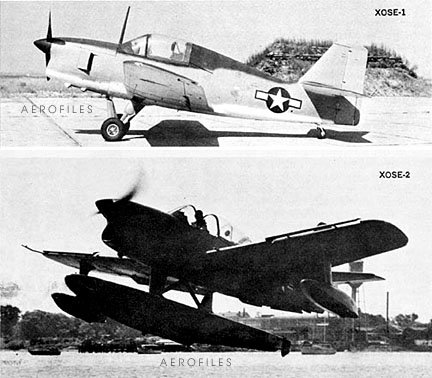
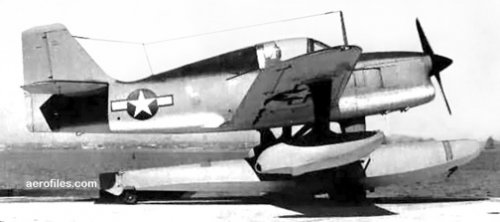
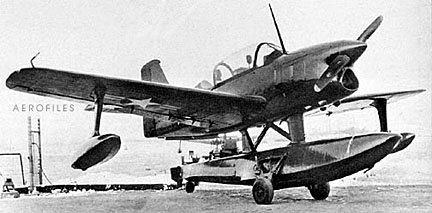
Makes you wonder if NAA didn't simply sell that early design to Edo...
 

Attachments

  • edo-ose.jpg
    edo-ose.jpg
    44.7 KB · Views: 807
  • edo-xose1.jpg
    edo-xose1.jpg
    63.1 KB · Views: 721
  • edo-xte1.jpg
    edo-xte1.jpg
    28.9 KB · Views: 705
If you put an inverted linear piston engine (as opposed to a vee) on the nose, most things start looking like Caudrons very quickly... :)
EDIT:Oh, I realize now it had a vee engine.
 
Hi,


in early 1940s,North American and its designer Edgar Schmued created a lightweight
fighter project,powered by one Allison V-1710 engine,who know more about it ?.
 
Hi, hesham

Edgar Schmued -Mustang designer, maby this book help: https://books.google.com.ua/books?id=56hqBgAAQBAJ&pg=PT190&lpg=PT190&dq=Edgar+Schmued+created+a+lightweight+fighter&source=bl&ots=qNt8DalIZR&sig=ffUdsqNazI5TRodMfx7x63A316k&hl=ru&sa=X&ved=0CD8Q6AEwBGoVChMIrY_w7_DiyAIVJXVyCh1ctADC#v=onepage&q=Edgar%20Schmued%20created%20a%20lightweight%20fighter&f=false
 
It's the NA-105, XP-51J you're looking for - two were built with V-1710-119 engines. -SP
 
Steve Pace said:
It's the NA-105, XP-51J you're looking for - two were built with V-1710-119 engines. -SP


My dear Steve,


it was looks like Bell XP-77,and not related to P-51.
 
hesham said:
Steve Pace said:
It's the NA-105, XP-51J you're looking for - two were built with V-1710-119 engines. -SP


My dear Steve,


it was looks like Bell XP-77,and not related to P-51.
The XP-51J was designed and built as a lightweight fighter as were the NA-105 XP-51F and XP-51G airplanes and finally the P-51H production airplane. -SP
 
We've discussed this project before, in another topic. I'm surprised you have forgotten, hesham and Steve!

Here it is again.
 

Attachments

  • light weight fighter concept designed by Edgar Schmued.JPG
    light weight fighter concept designed by Edgar Schmued.JPG
    28.6 KB · Views: 608
maby this: XP-77 futher development
 

Attachments

  • 6942039181_f326cb2c37_o.jpg
    6942039181_f326cb2c37_o.jpg
    75.9 KB · Views: 635
Skyblazer said:
We've discussed this project before, in another topic. I'm surprised you have forgotten, hesham and Steve!

Here it is again.
I guess I'm getting senile. -SP
 
Vladimir said:
maby this: XP-77 futher development

No Vladimir, we're discussing a North American design, not Bell! I've already answered and provided a picture (three posts above).
 
A quick search resulted in this, the old topic mentioned before.
http://www.secretprojects.co.uk/forum/index.php/topic,1308.msg96675.html#msg96675
May I suggest merging topics?
<edit> Thanks!
 
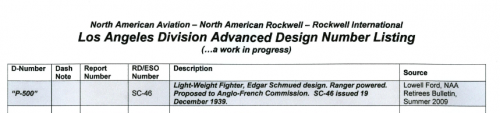
"In the wake of the NA-53 project retirement, a decision was made to respond to comments indicating that France and Britain were leaning towards a lightweight fighter. This information evolved into Edgar Schmued’s design P-500 which became known as Shop Charge SC-46. Funding for the SC-46 program had been approved by the GM Board of Directors in response to a request from Kindelberger with the support of board members Breech and DuPont.

A first thought of reviving the NA-53, since its production was cancelled earlier in the year, was short lived in favor of proceeding with the Ranger powered SC-46 as a stopgap fighter with potential sales as a fighter-trainer for export. This seemed more plausible as the Allison powered pursuit, P-509, moved forward in a cloak of secrecy. The General Order for the SC-46 was issued on December 18, 1939. In order to support production of the SC-46 with limited delays, the Ranger Engine Company had been approached by NAA to open a plant two miles to the north of the NAA location at Mines Field. With one strike against them with the failure of the French or British to consider the NA-53 design beneficial, Edgar Schmued’s rough proposal drawings for the SC-46 design were handed over to Al Algier, who was responsible for putting them into the correct NAA format. Herein lay the secret as to why so few of Edgar Schmued’s drawings survived carrying his name. Al Algier would erase Ed Schmued’s information in the lower right corner of the drawing and add the proper format title block and border,
bring the line weights up to standard and then sign off the drawing as the preparer in the “Drawn By” block.

By January 23, 1940, the P-500 Light Weight Fighter Design was ready for presentation to the British and the French. Kindelberger and Atwood traveled to New York and met with representatives of the British Air Ministry, with the purpose of selling them on the P-500 design. The presentation was a dismal failure and ended with the British insisting that NAA build the P-40 under license from Curtiss. Atwood, quite familiar with the P-509 design that was fermenting back at the plant, requested another meeting on February 6 th in which he sketched out the general arrangement of the P-509 Allison engine pursuit. However, without a proper proposal, the effort was futile and the British pressed forward with their demand that NAA build the P-40. At this point, Kindelberger returned to the factory in California, leaving Atwood to continue working with the British on a favorable solution to the problem."

from; https://static1.squarespace.com/static/56c78acd0442626b2590f5ea/t/590591d02994ca1b11d96680/1493537249560/2009-2_Summer.pdf
 

Attachments

  • NAA p500.png
    NAA p500.png
    1.1 MB · Views: 455
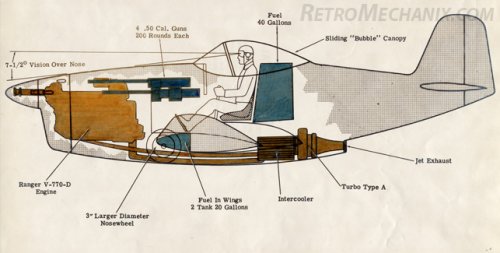
Like many people, I have alway found the lightweight fighter concept fascinating even if it was rarely if ever very successful in practice. Does anyone know what Ranger engine was intended to be used in the P-500 and what sort of performance was expected?

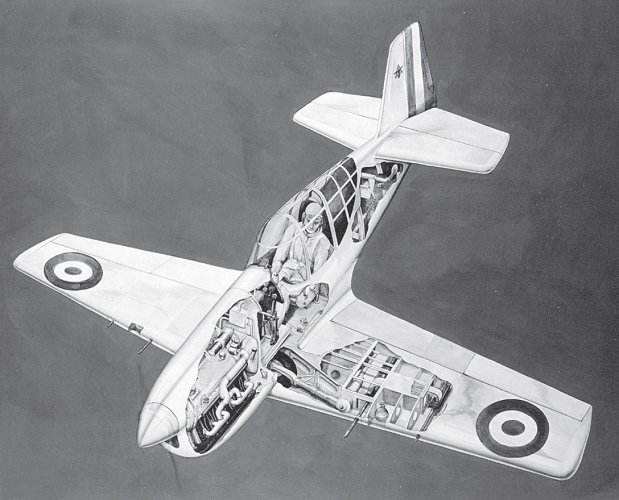
From the cutaway it looks like the proposed armament was 2 x .30 cal and 2 x .50 cal machine guns. If one of our "what if" artists is looking for a project, how about a production P-500 in British or French colors with the .50 cal machine guns replaced with early WWII 20 mm cannons (with faired bulges for the magazines) and the .30 cal guns replaced with appropriate .303 British or 7.5 mm French machine guns? ;-)
 
Not sure you would fit a 20mm cannon in that wing?

I think that even with hindsight the British were right to stick to their guns and rejected the light fighter concept.
The French had some experience with light fighters like the Caudron C.710 series so might have been more willing to investigate this concept but its hard to see any advantages this had over the Caudron.
 
cluttonfred said:
Like many people, I have alway found the lightweight fighter concept fascinating even if it was rarely if ever very successful in practice. Does anyone know what Ranger engine was intended to be used in the P-500 and what sort of performance was expected?

From the cutaway it looks like the proposed armament was 2 x .30 cal and 2 x .50 cal machine guns. If one of our "what if" artists is looking for a project, how about a production P-500 in British or French colors with the .50 cal machine guns replaced with early WWII 20 mm cannons (with faired bulges for the magazines) and the .30 cal guns replaced with appropriate .303 British or 7.5 mm French machine guns? ;-)

Its almost certainly the V-770.
 
The early fixed-gear Caudron racer-fighters actually had a pair of 20mm cannon as their armament, and it was mocked up with bulged fairings for the drum magazines for the later retractable-gear versions. In the end the C.714s used briefly in combat were equipped with just 4 x 7.5mm machine guns. I think they would have been better off with the 20mm cannon in the bomber interceptor role, which is the role that made the most sense.

Hood said:
Not sure you would fit a 20mm cannon in that wing?
 

Attachments

  • c710-7.jpg
    c710-7.jpg
    55.1 KB · Views: 496
  • 47-1.jpg
    47-1.jpg
    143.1 KB · Views: 500
cluttonfred said:
... the C.714s used briefly in combat were equipped with just 4 x 7.5mm machine guns...

Those guns were mounted in trays beneath the wings ... another option for a cannon-armed P-500.

As for the P-500's powerplant, my bet would be for the Ranger XV-770-9 (as in Bell's Tri-4) with its two-speed Szydlowski-Planiol supercharger.
 
Apophenia said:
As for the P-500's powerplant, my bet would be for the Ranger XV-770-9 (as in Bell's Tri-4) with its two-speed Szydlowski-Planiol supercharger.

Yes it was for the Specification.
 
"In the wake of the NA-53 project retirement, a decision was made to respond to comments indicating that France and Britain were leaning towards a lightweight fighter. This information evolved into Edgar Schmued’s design P-500 which became known as Shop Charge SC-46. Funding for the SC-46 program had been approved by the GM Board of Directors in response to a request from Kindelberger with the support of board members Breech and DuPont.

A first thought of reviving the NA-53, since its production was cancelled earlier in the year, was short lived in favor of proceeding with the Ranger powered SC-46 as a stopgap fighter with potential sales as a fighter-trainer for export. This seemed more plausible as the Allison powered pursuit, P-509, moved forward in a cloak of secrecy. The General Order for the SC-46 was issued on December 18, 1939. In order to support production of the SC-46 with limited delays, the Ranger Engine Company had been approached by NAA to open a plant two miles to the north of the NAA location at Mines Field. With one strike against them with the failure of the French or British to consider the NA-53 design beneficial, Edgar Schmued’s rough proposal drawings for the SC-46 design were handed over to Al Algier, who was responsible for putting them into the correct NAA format. Herein lay the secret as to why so few of Edgar Schmued’s drawings survived carrying his name. Al Algier would erase Ed Schmued’s information in the lower right corner of the drawing and add the proper format title block and border,
bring the line weights up to standard and then sign off the drawing as the preparer in the “Drawn By” block.

By January 23, 1940, the P-500 Light Weight Fighter Design was ready for presentation to the British and the French. Kindelberger and Atwood traveled to New York and met with representatives of the British Air Ministry, with the purpose of selling them on the P-500 design. The presentation was a dismal failure and ended with the British insisting that NAA build the P-40 under license from Curtiss. Atwood, quite familiar with the P-509 design that was fermenting back at the plant, requested another meeting on February 6 th in which he sketched out the general arrangement of the P-509 Allison engine pursuit. However, without a proper proposal, the effort was futile and the British pressed forward with their demand that NAA build the P-40. At this point, Kindelberger returned to the factory in California, leaving Atwood to continue working with the British on a favorable solution to the problem."

from; https://static1.squarespace.com/sta...4ca1b11d96680/1493537249560/2009-2_Summer.pdf
Sorry, very very late to this game (SC-46/P-500 design).....in fact, I never ever heard of it until I came across this thread!
Thanks sienar for the information!!

Regards
Pioneer
 
Last edited:
North American P-500

During the period between both World Wars, the size and weight of the fighters was progressively augmented in parallel with the increasing power of the available engines. Against that general trend, there was a minority of aeronautical designers defending the small sized fighters, known as Jockey Fighters, at that time. This type of airplanes, if well designed, could generally compete in performance with the conventional fighters, using a less powerful engine, with an important save in fuel, manpower and strategic materials. They were also easier to maintain and store and their reduced size and weight helped to increase agility in combat, making more difficult to be seen by the rear gunners in the bombers, or by the pilots in the escort fighters, and their destruction required a higher consumption of ammunition.
At the beginning of World War II, the conventional fighters used to have 10 to 12 m of wingspan, operational weight of 2,500 to 3,500 kg and a maximum speed of 450 to 500 km/h. The light fighters of the time could be divided in two categories:
Jockey Fighters, with less than 10 m. wingspan, maximum weight of 1,800 to 2,500 kg and the same speed than the conventional fighters.
Midget Fighters, with less than 10 m wingspan, maximum weight of 600 to 1,800 kg and maximum speed of 350 to 400 km/h.
Since the mid-1930s, France was preparing for a long World War I-style attrition war against Germany.
Anticipating that the depletion of resources would affect the production of conventional fighters, l’Armée de l’Air issued several specifications calling for light fighters built in wood/plywood and engines with less than 800 hp. not to compete with the conventional fighters in the use of strategic materials.
On July 12, 1934, the Service Technique de l’Aéronautique laid down the Programme Technique de Chasseur Léger C.1, a specification for a lightweight interceptor with a maximum speed of 400 km/h and armed with four machine guns. The original specification was amended in August 22 dividing it in two categories: one for aircraft powered by 800-1,000 hp engines, armed with a cannon and two machine guns, to replace the outdated fighters Dewoitine D.500 and Loire 46, and another for 450-500 hp engines and two cannons. On December 17, 1934, the maximum speed rose to 450 km/h and on 16 November 1935 to 500 km/h. The winner of the first category was the Morane-Saulnier M.S.405, winning the production of the 860 hp Hispano-Suiza H.S.12 Y engines.
In the second category were competing small manufacturers and designers of racer airplanes experienced in obtaining the maximum speed with minimum power, often using self-made engines.
ANF Les Mureaux built the prototype 190, all-metal monoplane powered by an air-cooled inverted V-12 engine Salmson 12 Vars.
The project was abandoned due to design deficiencies in the power plant.

This engine may run at 4,000 rpm, with compression ratio 6, and a reduction box designed for firing an H.S. 404 cannon.
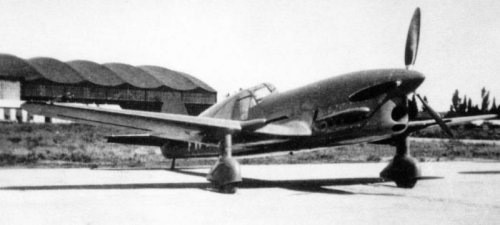
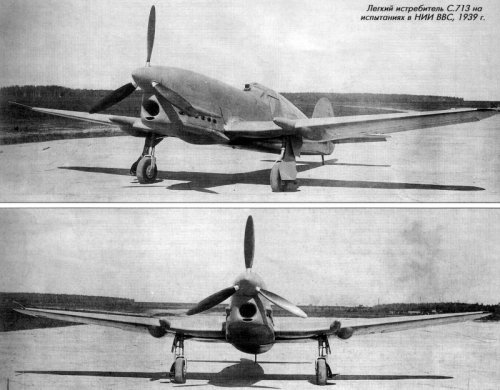
The success achieved by the Caudron racers, encourage designer Marcel Riffard to build the C.710 and C.713 prototypes, two wooden, cannon-armed, light fighters capable of flying to 455-470 km/h powered by a 450 hp air-cooled inverted V-12 engine Renault 12 R.01. On December 1937 l’Armée de l’Air dismissed its serial construction in favour of the Arsenal VG 30, much faster, with retractable undercarriage and better climb rate.
The wooden Arsenal VG. 30 was designed as a light fighter to fulfil the Chasseur Monoplace C.1 (June 3, 1937) specification that called for a small fighter propelled by one 690 hp Hispano-Suiza H.S.12 X crs engine and armed with one 20-mm H.S.9 cannon and two 7.5 mm MAC 34A drum-feed machine guns, from the obsolete Dewoitine D.510 fighters.
Fifteen days after the declaration of war on Germany the S.N.C.A. du Nord received a commission for the manufacture of 220 units of the VG 33, later expanded to 500. Deliveries to l’Armée de l’Air should start at the beginning of 1940. But there were problems with the import of spruce from Canada and Romania and only seven planes entered combat between 18 and 25 June 1940.
The Potez firm proposed the model 23, a high-performance small all-metal airplane fitted with retractable undercarriage that could use some technical elements left aside by first line fighters.
Thus, the surplus of Hispano-Suiza H.S.12 Xcrs engines, H.S.9 cannons and MAC 34A machine guns coming from the obsolete Dewoitine D.510 fighters could go back to combat without overloading the French war production of H.S.12 Y-45, H.S.404 and MAC 34 M39, intended for the Dewoitine D.520. Would the new equipment be available in enough quantity, it would also have been used by the Potez 230 as it was compatible to both.
A prototype was built in the Potez C.A.M.S. factory of Sartrouville in 1939. During a series of tests performed in the Villacoublay test centre in March 1940, it reached the speed of 560 km/h being equipped with an H.S.12 Xcrs of just 680 hp (the Dewoitine D.520 reached 525 km/h and the Bf 109 E-1, 575 km/h with much more powerful engines).
On January 12, 1937, l’Armée de l’Air issued the specification Programme technique A.23 calling for a light fighter able to fly at 520 km/h powered by one air-cooled radial engine Gnôme-Rhône 14 M rated at 690 hp.
The Roussel R.30 was conceived as a private venture all metal Jockey Fighter. Construction of the prototype began at Courbevoie, flying for the first time in April 1939.
In August 1939 it was transferred to the Centre d’Essais du Matériel Aérien (C.E.M.A.) for official trials, because of which it was recommended to install a more powerful engine to better use its excellent flying performances. During the Battle of France, the airplane was armed with two 20-mm Oerlikon FFS cannons mounted in the wings and some tests were performed for the installation of a bomb rack under the fuselage.
The Bloch M.B.700 was also designed as an answer to the Programme technique A.23. This small interceptor differentiated from the Roussel in that it was built from wood. Outwardly, it looked like an 83% scaled down version of the conventional fighter Bloch M.B.152. The main advantage of the M.B.700 reduced size was that while equipped with an engine with 75% the power of an M.B.152, it flew 80 km/h faster, still carrying the same armament, and was a more difficult target in dogfight.
In 1939 a prototype was built in the Blériot-Aéronautique of Suresnes, flying for the first time by mid-April 1940.
After the Third Reich annexation of Sudetenland, the Polish Department of Aeronautics issued the Sokół specification, calling for a light-weight single seat fighter powered by one 660-730 hp Gnôme-Rhône 14M-05 Mars double-row radial engine.

The P.Z.L. firm proposed two Sokół versions, with all-metal construction, semi-monocoque fuselage structure and P.Z.L. two-blade, adjustable pitch airscrew: the P.45/I with fixed undercarriage and the P.45/II with retractable undercarriage. The estimated maximum speed of the P.45/II was 520 km/h.

The Design nº 25 proposed by the firm R.W.D. was very similar to the Fokker D.XXI and used the same construction system.
This version of the Sokół, would have an estimated maximum speed of 450 km/h.

The Design nº 42, proposed by the firm P.W.S. would be totally built of wood/plywood, with inwards retractable landing gear.
Its estimated maximum speed would be 520 km/h.

In anticipation of political circumstances prevented the import of the Italian fighters, the Danish Naval Shipyard Orlogs Vaerftet began working on the design of the OV-J-1 Marinejager. It was a single-seat light fighter powered by an inverted-Vee, air-cooled engine, of the type of Walter Sagitta or Isotta Fraschini Delta. It would have been completely manufactured in metal, with retractable landing gear.
In 1939, the Latvian local industry Valsts Elektro-Fabrika (VEF) produced
the VEF I-16 wooden light fighter powered by one 520 hp. air cooled, inverted V-12 engine Walter Sagitta ISR with a maximum speed of 460 km/h.

By the time of the Munich Crisis, it was unclear to the British authorities if the production of the new monoplane Hawker Hurricane and Supermarine Spitfire fighters could be accelerated sufficiently to equip the 123 Squadrons that the Fighter Command required for the defence of the British Islands.
In October 1938, F.G. Miles, designer of the Miles Master advanced trainer, proposed the construction of a single-seat fighter that could supplement the Hurricanes and Spitfires already in production, without competing with them for the Merlin engines or in the use of strategic materials. The project, called Miles M.20/1 Munich Fighter, could be built entirely of wood/plywood using the retractable landing gear and several parts of the Miles Master trainer.
It would be propelled by one 885 hp liquid-cooled V-12 Rolls-Royce Peregrine engine, driving a two-bladed airscrew and would be armed with two 20-mm Hispano-Suiza H.S. 404 cannons. A wooden mock-up was built at the end of 1938, but no orders were placed because production of the Peregrine was reserved for the Westland Whirlwind twin engine fighter.
Miles persisted with the M.20/2 project, adapted to the Specification F.19/40, calling for a fighter armed with eight 0.303-in Browning Mk. II machine guns and propelled by one 1,300 hp Rolls-Royce Merlin XX 'power egg' interchangeable with the Bristol Beaufighter and the Avro Lancaster airplanes. The M.20/2 had a fixed landing gear, thus removing the need of hydraulic circuits and enabling the construction in fourth the time than a Hurricane and tenth time than a Spitfire. During the flying tests carried out on September 14, 1940, the prototype AX 834 showed a top speed exceeding that of the Hawker Hurricane Mk. I and manoeuvrability equivalent to that of the Supermarine Spitfire Mk. I. The stabilization of the German offensive and the increase in production of the conventional fighters rendered it mass production worthless and the project was left aside in April 1941.
The projected fighter Percival P.33 AB, based on the aerodynamic configuration of the Mew Gull racer that competed for the Merlin XX engine, was also cancelled. It would have been a 556 km/h fighter.
During the critical days of 1940 the Panic Effect boosted numerous interim solutions to increase the number of fighters available: A.A. Bage, the Percival chief designer, proposed to build a version of the Mew Gull armed with two 0.303 in Vickers Mk. II machine guns. The projected light fighter, called Percival P.32 AA, was rejected in favour of the Miles M.24, the single-seat version of the Miles Master, capable of flying at 370 km/h and with handling characteristics like those of the Hawker Hurricane.
The Panic Effect caused by the Munich Agreement forced the French Government to carry out large, massive purchases of foreign aircraft, but it turned out that the production capacity of Curtiss and Boeing was saturated by the enormous orders of planes made by British.
The panic increased. Left to their own devices, the weak countries had three options only: to improve the fighters at their disposal, to develop new fighters from advanced trainer planes or to build them from scratch creating their own panic fighters. Swedish and Finnish tried the latest solution with average results, due their lack of experience. The old Swiss and Finnish Morane 406 were equipped with more powerful engines in a try to expand their operational life. Australians, Peruvians and Thais bought fighters based on the North American Texan trainer. British, Lithuanian and Latvian modified their Miles Master, Irbitis and Aviotehase trainers to use them as emergency fighters.

The U.S. military showed no interest in lightweight fighter until the early months of World War Two but North American Aviation Inc. (NAA) was a new company in the aviation industry interested in capturing new business.
In 1938, the General Manager James H. Kindelberger and a representative from Export Sales traveled to England to formalize the export contract for 200 AT-6C/D Harvard trainers.
When it became clear that the development of the Napier Sabre engine would not be completed in time to power the new Hawker Thyphoon and Martin-Baker M.B. 3 fighters that were to replace the Hurricane and Spitfire, British suggested to Kindelberger that NAA build a new fighter of its own.
But the project was frozen for two years because of laws regulating the export of U.S. technology.
After the cancellation of the NA-53 fighter on February 3, 1939, because its engine was too powerful, NAA decided to enter the European market for light fighters powered by air-cooled, inverted V-12 engines.
A new design program called SC-46 (Shop Charge) was issued on December 18, 1939.
A team consisting of designer Edgard Schmued and drawer Al Algier began working on the concept P-500, a light fighter that was ready for presentation to British Air Ministry and Armée de l’Air representatives on January 23, 1940.
The new fighter was powered by one Ranger SGV-770C-1C rated at 520 hp., but the British Purchasing Commission were only interested in acquiring many conventional fighters and suggested to NAA the manufacture of Curtiss Hawk 87 A-1 (P-40D) fighters and rejected the P-500 concept.
On February 6, NAA offered the French a cannon-armed variant powered by one Fairchild-Ranger XV-770-9 engine fitted with two-speed Szydlowski-Planiol mechanical supercharger and superimposed gear box but the Service Technique de l’Aéronautique had already decided to use two hundred units of the Caudron C.R. 714 that had just entered service in January with Armée de l’Air as an advanced trainer.
On April 25, 1940, the U.S. Government restrictions of exportation were lifted, and NAA was able to concentrate on the design of the NA-73 (the future Mustang) in competition with the Curtiss XP-46.
 

Attachments

  • 284.jpg
    284.jpg
    814.6 KB · Views: 100
  • 286.jpg
    286.jpg
    822 KB · Views: 88
  • 287.jpg
    287.jpg
    772.2 KB · Views: 88
Last edited:
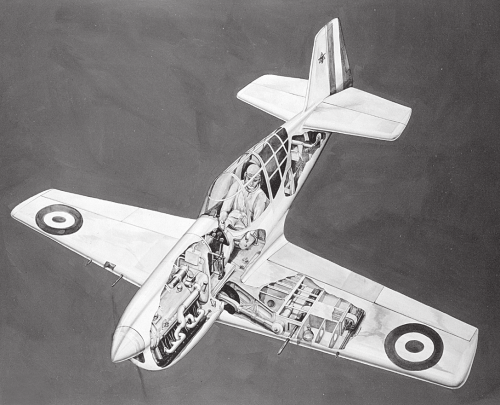
Nice work, although the drawings give the impression of a somewhat stubbier aircraft that the original artwork suggests:

lightweight P-500 fighter (SC-46) designed by Edgar Schmued.JPG
P-500 (SC-46).jpg
 

Similar threads

Back
Top Bottom