NIIP Bars and Irbis series of radar for Su-30/Su-35

Is it possible for N011M to detect a fighter sized target(3sqm) at 300 km?

Hm, there is info that N001V 'Myech' in Su-27SM/SM3 ( Su-30M2) can detect incoming MiG-21 ( RCS 3 sqm) at 150km in the PPS-DO mode ( forward hemisphere-further detection).

N011M has more powerful TWT and with more sensitive receive unit.There is also question if Bars-M/R has that PPS-DO combat mode.
 
Why don’t you guys just calculate range with the Radar equation? We have all the parameters for N011m.

Which parameters?

Btw, this is something interesting ( if it is right):

''It's worth noting that N011M is not simply a PESA, but instead, it's a transition between PESA and AESA in that it adopts technologies from both: each transceiver on the antenna array of N011M has its own receiver amplifier, which is the same as AESA, and with noise level of 3 dB, which is also in the same class of AESA arrays. However, for transmitting, N011M uses PESA technology in that a single Chelnok traveling-wave tube is used for EGSP-6A transmitter. There are three receiving channels for N011M.''

Info for the N035 Irbis :

''The noise level is increased to 3.5 dB from the 3 dB of N011M, and against typical aerial target with 3 square meters, the effective range is in excess of 400 km (head-on).''

So we have 3 dB in N011M vs 3.5 dB in N035 which is capable of detecting e.g. MiG-21 from 400km away in the PPS-DO mode.

Again, old N001(V) with TWT which can 'produce' 8 kW- pulses in the HPRF mode ( PRF in the HPRF mode is 180kHz) ,can detect MiG-21 at 100/150km away ( PPS/PPS-DO). N011M has almost twice as much output pulse power and what about PRF in the High PRF mode?
 
Which parameters?

Btw, this is something interesting ( if it is right):

''It's worth noting that N011M is not simply a PESA, but instead, it's a transition between PESA and AESA in that it adopts technologies from both: each transceiver on the antenna array of N011M has its own receiver amplifier, which is the same as AESA, and with noise level of 3 dB, which is also in the same class of AESA arrays. However, for transmitting, N011M uses PESA technology in that a single Chelnok traveling-wave tube is used for EGSP-6A transmitter. There are three receiving channels for N011M.''

Info for the N035 Irbis :

''The noise level is increased to 3.5 dB from the 3 dB of N011M, and against typical aerial target with 3 square meters, the effective range is in excess of 400 km (head-on).''

So we have 3 dB in N011M vs 3.5 dB in N035 which is capable of detecting e.g. MiG-21 from 400km away in the PPS-DO mode.

Again, old N001(V) with TWT which can 'produce' 8 kW- pulses in the HPRF mode ( PRF in the HPRF mode is 180kHz) ,can detect MiG-21 at 100/150km away ( PPS/PPS-DO). N011M has almost twice as much output pulse power and what about PRF in the High PRF mode?

Overscan put them together from public sources on his original site

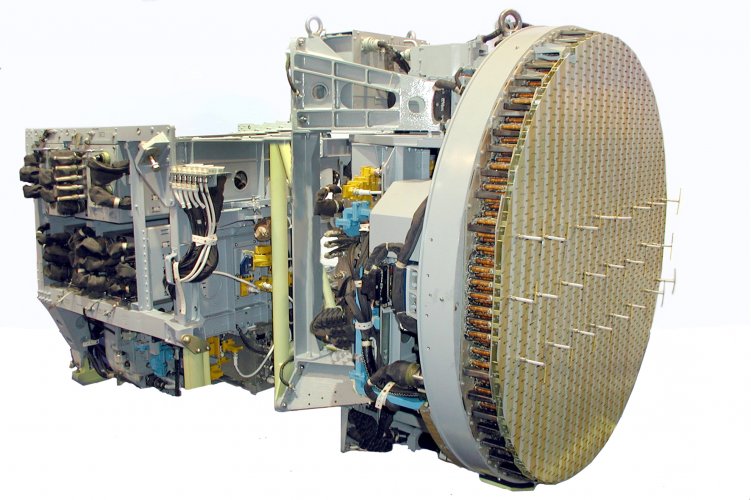
.N011M Bars is an upgraded phased array antenna version of the N011. Under development since the early 1990s, two prototype N011M radars were produced, of which one was flight tested in Su-27M prototype "712". It is now in production, and is currently fitted to the Su-30MKI. Antenna diameter is 1m, antenna gain 36dB, the main sidelobe level is -25dB, average sidelobe level is -48dB, beamwidth is 2.4° with 12 distinct beam shapes. The antenna weighs 110kg. It is both mechanically and electronically scanned to give increased field of view over a fixed phased array antenna and also to allow the radar to be tilted away when not in use, decreasing RCS. Two variants were initially proposed, the first was both electronically and mechanically scanned in azimuth (±30° mechanically plus ±60° electronically, for a total coverage of ±90°) and electronically scanned in elevation (±60°). The second was mechanically and electronically scanned in both azimuth and elevation (±90° in both axes). The N011M fitted to the Su-30MKI was the first type, but in testing the passive phased array proved unable to be electronically steered greater than 40° without unacceptable degredation of performance. Therefore scanning limits are reduced to ±70° (±30° mechanically, ±40° electronically) in azimuth and ±40° in elevation. Peak Power output is 4-5kW, average power output is 1.2kW. Ts200 PSP (Programmable Signal Processor) Data entry speed: 28 MHzPeak performance on fourier transforms of "butterfly" type: 75 Million operations per second. Radar control processor Number of processors: 3 Processor RAM (or possibly Flash memory): 16 Mb Processor ROM: 16 MbWeight of complete radar system is 650kg.

In this topic there are several other public sources listing variations of this information, you have the noise figure.
 
public sources


Hm, do we have any real Military Technical Manual about N011M at all?

Take a look friend :

''Peak Power output'' ( or precisely , max output pulse power /in the High PRF mode of course/ ) is 4-5kW where ''average power output'' or precisely ,TWT's average power in the High PRF mode is 1.2kW.

How can it be when much older N001 has max output pulse power of 8 kW ( practically twice as much )???

Another detail ,what about on-board (aircraft) electric net which can be used by the radar and give that power ( average and max output) ? What about AC/DC ? Is it 27V DC or 115V/200V (f=400Hz) AC which gives mentioned results ? I didn't find any of data from the public sources.

So when pilot of the Su-27S/P turns on his radar and choose PPS mode, he will get max detection range of 150km and when pilot/ RIO in the Su-30SM(MKA,MKI,MKM) turn radar and choose PPS mode, they will get even 400km of max detection range. I don't think it is possible with 4-5kW of max output pulse power ( in the HPRF mode).

Even today ,we have no data about the real ''energetic capabilities'' of the N011M. I asked earlier, what about PRF in the HPRF or MPRF mode? There is no data about it. In fact, there is so much confusion in most of the 'civilian sources' of info...


I will repeat again, old N001 Myech with the max output pulse power in the High PRF mode of 8kW where PRF in that mode is 180kHz and with the average power in the High PRF mode of 1kW , can detect 3sqm= MiG-21 in the PPS mode from 100km away. N001V ( with the same parameters ) in the PPS-DO mode can do that from 150km away.
 
he will get max detection range of 150k
This is probably in highly favourable/unrealistic scenarios, the su-27sk manual usually give around 50km range for targets in real world scenarios.
 
This is probably in highly favourable/unrealistic scenarios, the su-27sk manual usually give around 50km range for targets in real world scenarios.

There is no such thing in the Su-27SK F.M.

From the same ( I think,hope ,it is easy to translate and understand ) :

Дальность действия РЛПК в свободном пространстве и на фоне земли практически одинакова и зависит от высоты полета самолета, полусферы атаки и составляет по истребителям (σ = 3 м2):

а) при полете самолета на больших высотах:

в ЗПС:

при атаке сверху вниз: Добн = 30 – 40 км;

Дзахв = 30 – 35 км;

при атаке снизу вверх: Добн = 50 – 55 км;

Дзахв = 45 – 50 км;

в ППС: Добн = 80 – 100 км, Дзахв = 65 – 80 км;

б) при полете самолета на средних высотах (более 1000 м):

в ППС: Добн = 80 – 100 км, Дзахв = 65 – 80 км;

в ЗПС: Добн = 25 – 35 км, Дзахв = 25 – 30 км;

в) при полете самолета на малых в

ысотах (200 м):в ЗПС: Добн = 20 – 25 км, Дзахв = 18 – 20 км;

в ППС: Добн = 35 – 40 км, Дзахв = 28 – 32 км;
​
The range of the radar in free space and against the background of the earth is practically the same and depends on the altitude of the aircraft, the hemisphere of attack and is for fighters (σ = 3 m2):

Bolded ( for the high flying target) : in the forward hemisphere : 80-100km , lock -on range : 65-80 km.

For the N001V data is 150 km in the PPS-DO mode. I'll try to find the source and If I remember well ,one of the sources was ''library.voenmeh.ru'' .

When it comes to the 'open sources', they tell us that N011M is capable of positioning beams in 400 microsec.That has nothing to do with the reality. In fact ,400µs is time that N011M needs to change one combat mode to another.That info is from one interview with the Tamerlan Bekirbayev ,its chief constructor.There is so much useful info and data in the interviews with that man.

https://ru.wikipedia.org/wiki/Файл:Тамерлан_Бекирбаев.jpg


​
 
Last edited:
I will repeat again, old N001 Myech with the max output pulse power in the High PRF mode of 8kW where PRF in that mode is 180kHz and with the average power in the High PRF mode of 1kW , can detect 3sqm= MiG-21 in the PPS mode from 100km away. N001V ( with the same parameters ) in the PPS-DO mode can do that from 150km away.
N001VEP can detect Mig-21 from 100 km away according to Su-30 flight manual
 
N001VEP can detect Mig-21 from 100 km away according to Su-30 flight manual

I know for that data and I know for that ''Su-30MK2 F.M.'' which is btw very suspicious. Main characteristics of the N001V : integrated PPS-DO mode, possibility of engaging two differ targets etc ...Of course question is ,are those characteristics of the exported VE( VEP).


About the capabilites of detecting incoming MiG-21 ( 3 sqm) or ''fighter type target'' ,from earlier, reportage about the N011M Bars-M : detection range 150-200km

View: https://www.youtube.com/watch?v=xcdYVZrwHik&t=188s


Possible lock-on range of fighter type target : 120-140km ( data from MAKS 2003 )

https://www.airbase.ru/alpha/rus/b/bars/
 
Last edited:
This is probably in highly favourable/unrealistic scenarios, the su-27sk manual usually give around 50km range for targets in real world scenarios.
When squirrel says stuff like “150 km detection in PPS-DO or PESA with 400 km in PPS-DO” he means VELOCITY SCAN. As in,

You don’t even know height of target becuase it only shows the closure rate

You don’t know range to target

You only know azimuth

When you lock, it transitions to normal STT with its 100-200 km limits depending on the radar.

It’s a mode almost no pilot would actually use in combat and is basically useless except for companies to try and oversell them.
 
Well. I always wondered this VS mode.. if you have ESA radar with electronic scan, it is always possible to freeze your scan for just longer time, as long as you need, in position of newly detected contact. So you can measure distance the same manner as you do this in normal high prf modes (so with modulating frequency for example). Just speculation :
I think this PPS-DO is mode in which you sacrifice speed of beam movement to have beam longer over target. If you are able to integrate more returns (coherently - better, or not) you can achieve more range. It was somehow explained in Stimson book, that if are able to compensate change of relative speed over time, you can increase coherently integration time. So maybe this is approach to increase range without increasing power of transmission and antenna size (decreasing noise parameters)?
Its is some kind of “targeted search” , at cost of decreasing size of scan zone.
 
It will be the max detection range. ;)

N011M ''Bars-R'' working in the High PRF mode ( combat mode PPS). Current distance to target scale on the left side : 0,80,160,240,320 and 400km.
@Squirrel Having a display with a scale that ends at 400km pretty much guarantees that maximum range is lower than 400km.
AN/APG-68 had a maximum range scale of 160nm (about 300km) but you would be very hard pressed to detect anything that far away.
 
When squirrel says stuff like “150 km detection in PPS-DO or PESA with 400 km in PPS-DO” he means VELOCITY SCAN. As in,

You don’t even know height of target becuase it only shows the closure rate

You don’t know range to target

You only know azimuth

When you lock, it transitions to normal STT with its 100-200 km limits depending on the radar.

It’s a mode almost no pilot would actually use in combat and is basically useless except for companies to try and oversell them.
Velocity scan can be useful to get the azimuth heading to steer towards a distant target and close to the point you can actually detect and lock on with a better mode.
 
Info for the N035 Irbis :

''The noise level is increased to 3.5 dB from the 3 dB of N011M, and against typical aerial target with 3 square meters, the effective range is in excess of 400 km (head-on).''

So we have 3 dB in N011M vs 3.5 dB in N035 which is capable of detecting e.g. MiG-21 from 400km away in the PPS-DO mode.
Irbis gets longer range by fitting very high power output TWT, which outweighs the worse noise level figure. You do know higher noise levels are bad, right? Not sure what we are supposed to conclude about Bars range from this.

I'm not sure in general what this technique you have of argument-by-vague-analogy is supposed to prove.
 
Regarding the original slot array N011, it never achieved its intended performance, so I would largely ignore any figures for it.

N011M was a 'Hail Mary' mashup of the workable N011 parts with a new antenna based on Zaslon technologies.
 
Regarding the original slot array N011, it never achieved its intended performance, so I would largely ignore any figures for it.

N011M was a 'Hail Mary' mashup of the workable N011 parts with a new antenna based on Zaslon technologies.
That’s really interesting, is there any futher reading on N011 mech scan? I’ve always been curious about that radar, I didn’t realize it was unsuccessful, though not being produced might have been a tip off.


Not surprising that n011m is based of Zaslon but it’s good to hear that it was the case.
 
That’s really interesting, is there any futher reading on N011 mech scan? I’ve always been curious about that radar, I didn’t realize it was unsuccessful, though not being produced might have been a tip off.


Not surprising that n011m is based of Zaslon but it’s good to hear that it was the case.

It was the radar for the Su-27M (old Su-35), the actual Flanker E aka Super Flanker.

It featured a slotted planar array. From its descriptions it sounded pretty much like the N-010 Zhuk for the MiG-29M/K, just more powerful. Already for the originalN-011 a range of 400 km was claimed, as was the 400 km VLRAAM KS-172. Spec called for 15 tracks and engagement of 6, achieved were 13/4. Actual detection range against fighter sized target was 130 km vs 100 km on the N-001. AG modes listed matched those listed for the N-010, with capabilities equivalent to AN/APG-65 at that time.
 
Some historic N011M info from NIIP Website in 2005
https://web.archive.org/web/20050206182802/http://niip.ru/basic_variant/raz_sky_bars.html

BARS Airborne Radar Control System

The BARS airborne radar control system, in conjunction with the aircraft's onboard equipment, provides:

Tactical situational awareness in the forward hemisphere of the aircraft while tracking both ground and surface targets;
Simultaneous missile engagement of multiple targets (depending on the missile type) in long-range combat mode;
Mission engagement of a single target in close-range combat mode;
Use of air-to-ground weapons in conjunction with other aircraft in the system;
Aircraft flight control during combat operations against air, sea, and ground targets;
Integrated processing of information received from various aircraft systems and other aircraft to enhance the aircraft's combat effectiveness;
Information support for the aircraft's onboard systems;
Recognition of airborne target types in conjunction with each other;
Assessment of the condition of equipment and weapons at all stages of ground preparation and in flight.

Main technical characteristics of the devices:
Antenna type: phased array
hydraulic driven
Maximum deflection angles for
single target tracking, deg.:
- azimuth +70
- elevation +40
Scanning range for simultaneous target tracking, deg. 5,500
Scanning range for target search and acquisition
in close combat maneuvers, deg.:
- azimuth +3; +10
- elevation -15...+40; +7.5
Receiver

Number of channels 3
Noise figure, dB 3
Transmitter
Power in kW, not less than
- Pulse 4-5

- Average 1.2
- Illumination (radio correction) 1

Programmable signal processor
Data input speed, MHz 28
Peak throughput when performing
"butterfly" operations, 75 MIPS
Radar control processor
Number of processors 3
Processor flash memory size, MB 16
Processor static memory size, MB 16
Air-to-air mode
Fighter acquisition range, not less than, km:
- On a collision course 120-140
- On a pursuit course 60
Air-to-surface mode
Detection range, not less than, km:
- Railway bridge 80-120
- Tank group 40-50
- Destroyer 120-150
Maximum resolution, m: approximately 10

MAIN RADAR OPERATIONAL MODES:

AIR-TO-AIR
Speed search;
Range search;
Close-range search and acquisition;
Tracking of up to 15 targets en route to assess the tactical situation and conduct group aircraft operations without interrupting the search;
Precise tracking of up to 4 targets to support weapons deployment without interrupting the search;
Target illumination and transmission of radio correction commands for missile guidance;
Target type recognition by its spectral characteristics;
Determination of group target characteristics while maintaining visibility.

AIR-TO-SURFACE
Real beam mapping;
Mapping with Doppler beam detection;
Synthetic aperture mapping;
Selecting moving ground targets;
Measuring coordinates to a ground target;
Tracking of up to two ground targets.

AIR-SEA
Maritime search;
Long-range maritime search;
Selecting moving maritime targets;
Measuring coordinates of moving or stationary maritime targets.
Google translate has improved markedly in the last 20 years :)
 
Last edited:
There was an Bars-R version developed for the Russian Su-30SM with minor improvements - airborne detection range increased from 140km to 160 km.
 
When squirrel says stuff like “150 km detection in PPS-DO or PESA with 400 km in PPS-DO” he means VELOCITY SCAN. As in,

You don’t even know height of target becuase it only shows the closure rate

You don’t know range to target

You only know azimuth

When you lock, it transitions to normal STT with its 100-200 km limits depending on the radar.

It’s a mode almost no pilot would actually use in combat and is basically useless except for companies to try and oversell them.

Whaaat ?

Radar N035 Irbis , combat mode PPS-DO ,real flight test ( Su-30MK2 No 503 blue from 2006):

Distance to detected/tracked target data :

View: https://www.youtube.com/watch?v=cieLN4_tn0A


Sorry but how ( in which way ) ,N035 Irbis locked on some UkrAF fighters in the real combat situations at ranges more than 200km?


@Squirrel Having a display with a scale that ends at 400km pretty much guarantees that maximum range is lower than 400km.
AN/APG-68 had a maximum range scale of 160nm (about 300km) but you would be very hard pressed to detect anything that far away.

I think that ''400 km'' ( in the case of Bars-M and Irbis) is the max detection range of those radars.In fact, it is instrumental (calibrated) current distance to target scale.Something can be detected at that distance,e.g. MiG-21 flying at medium/high alt ( in the case of N035).

Data for the AN/APG-68 is the same for the AN/APG-63/70 and if I remember well, that is for the LRS/VS modes. In that mode ( HPRF/MPRF combo) is possible to detect /track only one target( something very similar to combat mode AVT/Automatic ) .That combat mode could be used for long range detection/track of incoming e.g. strategic missile carrier etc ...

PS

About data for the N011M from 2005 :

Pulse power ( output ) : 4-5kW but for which working mode? MPRF or HPRF. For which used electrical net ? AC ( 115V/200V ) or DC ( 27V) ? There is no info for that.

Again, TWT of the N001 'Myech' when using DC-27V net, has max output pulse power 8kW on the HPRF working mode.
 
Velet (Takeoff) April 2006

Better translation

New details about the Irbis radar system for the Su-35 fighter jet

Recently, the V.V. Tikhomirov Research Institute of Instrument Making (NIIP) released fairly detailed information about its new Irbis phased array radar control system (PARS), which is being developed for use on new modifications of the Su-27 family of fighters – primarily the Su-35 and the modernized Su-27SM2 fighter. Last year, the company issued a data sheet for the Irbis-E radar system, which now allows it to discuss some of the design features and capabilities of the new radar. The Irbis radar system, which has been under development at the Research Institute of Instrument Engineering since 2004 under the leadership of Chief Designer Vladimir Zagorodny, is based on the experience of creating the Bars and Osa passive phased array radars. It is designed to perform a wide range of tasks within the integrated avionics suite of a carrier aircraft, including detecting and tracking air, ground, and surface targets, determining their nationality, recognizing the class and type of air targets, determining the number of air targets in a group, generating a radar image of the underlying surface (terrain map) in low, medium, and high resolution modes, providing information support for low-altitude flights during obstacle avoidance and avoidance, and correcting navigation systems. Range measurement, guidance of missiles with radar homing heads (RSH), etc. Structurally, the Irbis-E radar control system is a multifunctional X-band radar system with a passive phased array (PA) mounted on a two-stage hydraulic drive (azimuth and roll), using the advanced EKVS-E computing system with the Solo-35 onboard computer. The antenna device, based on a passive PA with a diameter of 900 mm, vertically polarized waves, and a beam switching time of 0.4 ms with electronic beam control, scans with electronic beam control in azimuth and elevation in sectors of at least 60°. In addition, a two-stage electrohydraulic drive mechanically rotates the antenna in azimuth by up to 60° and in roll by 120°. This increases the maximum azimuth beam deflection angle to 120° with electronic control and mechanical antenna rotation. Furthermore, the vertical polarization of the wave can be changed to horizontal to improve the observation of surface targets. The transmitter, based on an "Oliva" solid-state master oscillator and a chain of two "Chelnok" traveling-wave tube power amplifiers, provides a maximum peak power of at least 20 kW at surveillance frequencies with an average power of 5 kW, as well as an average discrete continuous transmit power of at least 2 kW at illumination frequencies. A four-channel receiver based on a low-noise input amplifier receives and initially converts high-frequency signals with a noise figure of 3.5 dB. Primary digital processing of received signals occurs in a programmable signal processor based on the Solo-35.01 onboard digital computer, while data processing and radar control are performed in the Solo-35.02 onboard digital computer, which together form the EKVS-E onboard digital computer.

The development of the Irbis-E radar system utilizes a number of already well-developed devices from the Bars radar system used on the Su-30MKI aircraft. These include a synchronizer, low-frequency and microwave receivers, and a master oscillator. The two-stage EGSP-27 actuator of the Irbis-E radar is a further development of the single-stage actuator of the Bars, the EGSP-6A. The new passive phased array (PA) was developed based on technical and technological solutions tested during the development of the PAs of the Osa and Bars radars. The transmitter amplifier is based on the Chelnok traveling-wave tube-based output power amplifier, developed as part of the N011M radar program (the Bars prototype) and tested as part of the avionics of the Su-27M No. 712 prototype aircraft during flight testing, significantly increasing the system's operating range. The Irbis-E radar can detect and simultaneously track up to 30 air targets while maintaining a continuous surveillance (pass-through tracking mode), and simultaneously engage two targets with two missiles with semi-active radars and up to eight targets with eight missiles with active radars, including up to four targets at ranges exceeding 300 km. In air-to-surface mode, the system provides land and sea surface mapping and ground target detection in real beam (low resolution), Doppler beam narrowing (medium resolution), and adaptive focused aperture synthesis (high and ultra-high resolution) modes. The Irbis-E radar's detection range for airborne targets with an image intensifier of 3 m2 on a collision course is at least 350–400 km, and on a pursuit course, at least 150 km (at a target altitude of 10 km or more). The station can detect "ultra-low-observable" targets with an image intensifier of 0.01 m2.
 
^

So what we have :

''The antenna device, based on a passive PA with a diameter of 900 mm, vertically polarized waves, and a beam switching time of 0.4 ms with electronic beam control, scans with electronic beam control in azimuth and elevation in sectors of at least 60°.''

N035 Irbis - 0.4ms vs N007 Zaslon- 1.2ms .


''The transmitter, based on an "Oliva" solid-state master oscillator and a chain of two "Chelnok" traveling-wave tube power amplifiers, provides a maximum peak power of at least 20 kW at surveillance frequencies with an average power of 5 kW, as well as an average discrete continuous transmit power of at least 2 kW at illumination frequencies.''

''Oliva'' as the so called 'generator of probing pulse signals' and two Chelnok TWT's . For the search ( detect/track) max output pulse power is 20kW ( HPRF mode) with average power 5kW ( same mode).For the ill mode, I think also for the lock on, secondary TWT has average power of 2kW.
For comparison, old N001 has average power of 1kW and max output pulse power 8kW ( HPRF mode).

This is interesting :

''The Irbis-E radar can detect and simultaneously track up to 30 air targets while maintaining a continuous surveillance (pass-through tracking mode), and simultaneously engage two targets with two missiles with semi-active radars and up to eight targets with eight missiles with active radars, including up to four targets at ranges exceeding 300 km.''

So two differ targets can be engaged with two R-27R/ER , eight targets with eight R-77-1/R-77M and four targets with R-37M at ranges more than 300km.
Suppose that two targets can be engaged with maybe four R-27R/ER and other targets with salvo of two missiles for one target ?
 
You really don't understand any of this stuff do you?

The Irbis uses Oliva signal generator and two 10kW Chelnok TWT acting as amplifiers in series, giving a maximum 20KW peak output. 10kW + 10kW, see?

There's no "primary TWT" and "secondary TWT".

N001 doesn't have 8kW peak power, its 3.5-5kW depending on mode and 700W - 1kW average power. Where did you get 8kW from?
 
You really don't understand any of this stuff do you?

The Irbis uses Oliva signal generator and two 10kW Chelnok TWT acting as amplifiers in series, giving a maximum 20KW peak output. 10kW + 10kW, see?

There's no "primary TWT" and "secondary TWT".

I will find the interview with Yuri Beliy where he clearly said that during first tests of N035 they used 1kW TWT after that ,they developed and tested completely new 5kW TWT. He said that 1kW /5kW were as the parameter ''the average power''.

So we have two '10 kW TWT' ( 10kW as the max output pulse power ?) , giving the total of 20kW ,with the average 5kW ,during Ill mode for the SARH missiles we have 2kW average.

I suppose that I'll mode uses some kind of time sequences. Also the question is ,how it perform scanning both the air space and the land/sea surface at the same time than? Maybe they used the same technique as N011M which is capable to change working modes within 400μs as Tamerlan Bekirbayev told once ?

N001 doesn't have 8kW peak power, its 3.5-5kW depending on mode and 700W - 1kW average power. Where did you get 8kW from?

Source was one Ukr. site about the program of the modernisation of N001 .Even N019 has max output pulse power 6.5kW in the HPRF/MPRF mode.
 
I will find the interview with Yuri Beliy where he clearly said that during first tests of N035 they used 1kW TWT after that ,they developed and tested completely new 5kW TWT. He said that 1kW /5kW were as the parameter ''the average power''.

So we have two '10 kW TWT' ( 10kW as the max output pulse power ?) , giving the total of 20kW ,with the average 5kW ,during Ill mode for the SARH missiles we have 2kW average.

I suppose that I'll mode uses some kind of time sequences. Also the question is ,how it perform scanning both the air space and the land/sea surface at the same time than? Maybe they used the same technique as N011M which is capable to change working modes within 400μs as Tamerlan Bekirbayev told once ?
Can you not read?

. The transmitter, based on an "Oliva" solid-state master oscillator and a chain of two "Chelnok" traveling-wave tube power amplifiers, provides a maximum peak power of at least 20 kW
One transmitter, comprising one master oscillator and chain of two TWT amplifiers. This is unambigious.Makes one 20kW+ transmitter.

A typical modern pulse-doppler radar mode might have a duty cycle of 25%, which means that the transmitter transmits for 25% of the time. A 20kW maximum peak pulse with a 25% duty cycle results in 5kW average power.

Yuri Beliy talked about initially using a transmitter like the one on the Bars with 1kW average power and then switching to the chained TWT transmitter which does 5kW average power.

Also the question is ,how it perform scanning both the air space and the land/sea surface at the same time than?
An active phased array could physically split into multiple arrays each performing a different function. A passive phased array with decent computing power would typically interleave different modes over time, so spending a certain amount of milliseconds on air-to-air search then a certain amount of milliseconds doing air to surface search and storing both sets of results in memory. Rafale's RBE2 does it.
 
One transmitter, comprising one master oscillator and chain of two TWT amplifiers. This is unambigious.Makes one 20kW+ transmitter.

A typical modern pulse-doppler radar mode might have a duty cycle of 25%, which means that the transmitter transmits for 25% of the time. A 20kW maximum peak pulse with a 25% duty cycle results in 5kW average power.

Yuri Beliy talked about initially using a transmitter like the one on the Bars with 1kW average power and then switching to the chained TWT transmitter which does 5kW average power.

Absolutely understand,thanks. Yes ,that's what he said about. During the first tests ,N035 was able to detect Su-27 from over 300 km away and lock-on at 250km.

An active phased array could physically split into multiple arrays each performing a different function. A passive phased array with decent computing power would typically interleave different modes over time, so spending a certain amount of milliseconds on air-to-air search then a certain amount of milliseconds doing air to surface search and storing both sets of results in memory. Rafale's RBE2 does it.

Just like N011M Bars-M/R.
 
This is continuation of the translated article by the 'overscan'.

''Разрешающая способность при распознавании плотной групповой цели (на расстоянии 50 км) составляет:по дальности – 50–100 м, по скорости – 5 м/с и по угловым координатам – 2,5°. Являясь логическим развитием«Барса», РЛСУ «Ирбис», таким образом, имеет значительно более высокие характеристики: расширенную (более чем вдвое) полосу рабочих частот, увеличенную с 70° до 120° зону обнаружения и сопровождения воздушных целей по азимуту, значительно возросшую дальность действия, улучшенную помехозащищенность и т.д. ''

''The resolution for recognizing a dense group target (at a distance of 50 km) is: by range – 50–100 m, by speed – 5 m/s, and by angular coordinates – 2.5°. Being a logical development of the "Bars", the "Irbis" radar control system, therefore, has significantly higher characteristics: an expanded (more than double) operating frequency band, an increased detection and tracking zone of air targets in azimuth from 70° to 120°, a significantly increased range, improved immunity to interference, etc.''

In the bottom right corner is the pic of the N011M 's antenna.

Original article on the page No 41 :

Source: http://www.take-off.ru/pdf/04_2006_small.pdf

Question about bolded : does it mean that radar beam has width of 2.5° ?
 
This is continuation of the translated article by the 'overscan'.

''Разрешающая способность при распознавании плотной групповой цели (на расстоянии 50 км) составляет:по дальности – 50–100 м, по скорости – 5 м/с и по угловым координатам – 2,5°. Являясь логическим развитием«Барса», РЛСУ «Ирбис», таким образом, имеет значительно более высокие характеристики: расширенную (более чем вдвое) полосу рабочих частот, увеличенную с 70° до 120° зону обнаружения и сопровождения воздушных целей по азимуту, значительно возросшую дальность действия, улучшенную помехозащищенность и т.д. ''

''The resolution for recognizing a dense group target (at a distance of 50 km) is: by range – 50–100 m, by speed – 5 m/s, and by angular coordinates – 2.5°. Being a logical development of the "Bars", the "Irbis" radar control system, therefore, has significantly higher characteristics: an expanded (more than double) operating frequency band, an increased detection and tracking zone of air targets in azimuth from 70° to 120°, a significantly increased range, improved immunity to interference, etc.''

In the bottom right corner is the pic of the N011M 's antenna.

Original article on the page No 41 :

Source: http://www.take-off.ru/pdf/04_2006_small.pdf

Question about bolded : does it mean that radar beam has width of 2.5° ?
No, it means it can resolve two targets separated by an angle of 2.5°.

However, a 1m antenna at 10GHz would give 2.1° at best case, through with a phased array the radar beam width increases as angle increased to close to 5° at 60° deflection.
 
^

Thanks. This is comment from 'stealthflanker' about possible working frequencies ,wavelenght and radar beam width.

https://www.secretprojects.co.uk/th...-radar-for-su-30-su-35.622/page-2#post-611229

In basic there is : 0.9m antenna with 1846 RE's ....

PS

For me it is interesting and in the same time suspicious that Irbis enables engaging only two targets with only 'SARH' missiles while old Zaslon as we know ,enables targeting four differ targets with R-33.Especially when we know that newer R-37M and R-77-1 have in fact dual homing mode in terminal phase: active/semi-active.
 
A question on a more obscure subject, is there any info as to the weight of the antenna hydraulic drives for Bars and Irbis? Most western fighter PESA and AESA radars i can think of have fixed antennas except aiui the swashplate designs for the Typhoon and Gripen AESAs. I imagine the hydraulic drives for Bars/Irbis must have added a significant amount of weight to the radar, on top of the russian radars being usually heavier than western counterparts in the first place.
 
is there any info as to the weight of the antenna hydraulic drives for Bars and Irbis?

Didn't find any info about it yet. Maybe someone did?

''The two-stage EGSP-27 actuator of the Irbis-E radar is a further development of the single-stage actuator of the Bars, the EGSP-6A. ''

This is another article about N035 in the ''Vzlyot'' magazine.

Взлёт 2007 .03 ,Журнал «Взлёт»

« Ирбис» – в воздухе!​


''Во второй половине января НИИ приборостроения им. В.В. Тихомирова приступил к летным испытаниям своей новой бортовой радиолокационной станции с фазированной антенной решеткой – «Ирбис-Э» (подробнее о ней – см. «Взлёт» №4/2006, с. 41). Эта РЛС, оснащаемая пассивной ФАР диаметром 900 мм с двухстепенным гидроприводом, предназначена для установки на новый истребитель «ОКБ Сухого» Су-35. Являясь логическим развитием РЛС «Барс», применяемой на истребителе Су-30МКИ и его модификациях, «Ирбис» по сути является принципиально новой разработкой, имеющей существенно более широкие возможности. Достаточно сказать, что диапазон углов обзора по азимуту возрос с ±70 до ±120°, по углу места – с ±45 до ±60°, а максимальная дальность обнаружения увеличилась в 2-2,5 раза, достигнув рекордных показателей в 350-400 км (для цели типа «истребитель» с ЭОП 3 м² в передней полусфере при работе в зоне 100 град. 2 ). Вдвое возросло количество одновременно сопровождаемых на проходе и обстреливаемых воздушных целей (до 30 и 8 соответственно).
Значительно расширилась номенклатура и характеристики режимов «воздух-поверхность», повысилась помехозащищенность.

Первый опытный комплект РЛС «Ирбис-Э», прошедший цикл стендовых испытаний в НИИП, осенью прошлого года был готов к установке на летающую лабораторию – в ее качестве «ОКБ Сухого» выделило предсерийный самолет Су-30МКК №503. По независящим от НИИП причинам монтаж опытного комплекта «Ирбиса» (пока еще без гидропривода) на самолет удалось выполнить только к январю. Первый же полет летающей лаборатории с включением «Ирбиса» в ЛИИ им. М.М. Громова продемонстрировал высокие характеристики новой РЛС в режиме «воздух-поверхность». На очереди – летные испытания

«Ирбиса» в режиме «воздух-воздух». Их начало запланировано на март, после чего летающая лаборатория будет перебазирована в Ахтубинск для проведения всесторонней летной отработки новой РЛС.

А тем временем НИИП совместно с серийным Государственным Рязанским приборным заводом готовит первые штатные комплекты «Ирбиса» для установки на опытные самолеты Су-35. Две РЛС уже практически готовы для размещения на борту второго и четвертого экземпляров нового истребителя. Как известно, летные испытания Су-35 должны начаться еще до середины этого года. А.Ф.''

https://military.wikireading.ru/hdB6Nvr5ay

"Irbis" is in the air!

''In the second half of January, the V.V. Tikhomirov Institute of Instrument Engineering began flight testing its new airborne phased-array radar, the Irbis-E (for more information, see Vzlyot, No. 4/2006, p. 41). This radar, equipped with a 900mm-diameter passive phased-array antenna with a two-stage hydraulic drive, is designed for installation on the new Sukhoi Design Bureau Su-35 fighter.
A logical development of the Bars radar used on the Su-30MKI fighter and its modifications, the Irbis is essentially a fundamentally new development with significantly expanded capabilities. Suffice it to say that the azimuth viewing angle range has increased from ±70 to ±120°, and the elevation angle from ±45 to ±60°, while the maximum detection range has increased by 2-2.5 times, reaching a record-breaking 350-400 km (for a fighter-type target with an image intensifier of 3 m² in the forward hemisphere when operating within a 100-degree zone). The number of simultaneously tracked and engaged aerial targets has doubled (to 30 and 8, respectively).
The range and characteristics of air-to-surface modes have been significantly expanded, and interference immunity has been improved.

The first Irbis-E radar prototype, having completed a series of bench tests at the Research Institute of Instrument Design (NIIP), was ready for installation on a flying laboratory last fall. Sukhoi Design Bureau allocated pre-production Su-30MKK No. 503 aircraft for this purpose. For reasons beyond NIIP's control, the Irbis prototype (still without a hydraulic drive) was only installed on the aircraft by January. The first flight of the flying laboratory with the Irbis installed at the Gromov Flight Research Institute demonstrated the new radar's high performance in air-to-surface mode. Flight testing is next.
Irbis air-to-air tests are scheduled to begin in March, after which the flying laboratory will be relocated to Akhtubinsk for comprehensive flight testing of the new radar.

Meanwhile, NIIP, together with the State Ryazan Instrument-making Plant, is preparing the first standard Irbis systems for installation on Su-35 prototypes. Two radars are almost ready for installation on the second and fourth prototypes of the new fighter. Flight tests of the Su-35 are expected to begin before the middle of this year. A.F.''


Additional Comment :

''During high-speed ground tests in April 2009, the prototype(904) of the Su-35 program crashed at Komsomolsk-on-Armur. The crash damaged the new NIIP Irbis-E radar set installed on Su-35.''


Source: https://su27flankerfamily.wordpress.com/2018/11/24/su-35bm/

 
https://tekhnosfera.com/metody-povy...-s-kombinirovannym-upravleniem-luchom-antenny

Thesis highlights development of Bars and Irbis tracking algorithms. Looking for full copies.
Welp got the full thesis, towards the end their is a bit of flight testing of an n011m on a Su-30mki in 2003.

Bars and Irbis use Extended Kalman Filter using a continuous loop of physics and imperfection measurements, and probabilistic data association, much more sophisticated then n019 or n001 simple predictive Kalman Filtering.

  • 30ms Gyro Delay Limit: Positional data delays over 30 milliseconds from the gyroscope cause tracking errors exceeding \(0.8^{\circ }\).
  • 0.3° Alignment Boundary: Structural misalignment greater than \(0.3^{\circ }\) creates severe ghost maneuvers during high-G turns.
  • 250ms Refresh Threshold: Target update intervals longer than 250ms cause dynamic errors to exceed the narrow radar beamwidth.
  • Track Discontinuity: Sharp tracking updates longer than 300ms break the linear discriminator limits and drop the target.
Bars algorithms (described as quasi optimal due to processor limitations) are ridged and it may struggle to maintain lock while maneuvering aggressively

Gate overlap also seems to cause issues with target discrimination (mentioned in red flag 2008).

Actual flight test data is quite good though and the system is a clear improvement over what’s in the MiG-29b avionics book.

Looking for better OCR software for a more detailed look.
 

Attachments

  • M10250.pdf
    11.2 MB · Views: 44
I've just skimmed chapter dealing with flying tests and it's obvious that this is good reading material, especially since the author took part in development of the tracking algorithms himself.
What puzzles me (hoping that I'm not wrong in my assumption) is that these radars are missing any organic IMU (and rely on the one from the aircraft, which is usually RLG), which at least might eliminate installation offset errors and improve tracking of antenna dynamics.
I remember reading many years ago that Akopyan was mentioning that they were analyzing possibility of installing some western FOG type IMU into missile homing heads, but haven't seen any mention after.
 
Yeah but not sure if you can compare it with Bars, as it's a much newer more advanced design.

That 150 km range is probably obtained through very long dwell time, which may not be realistic for combat scenario.
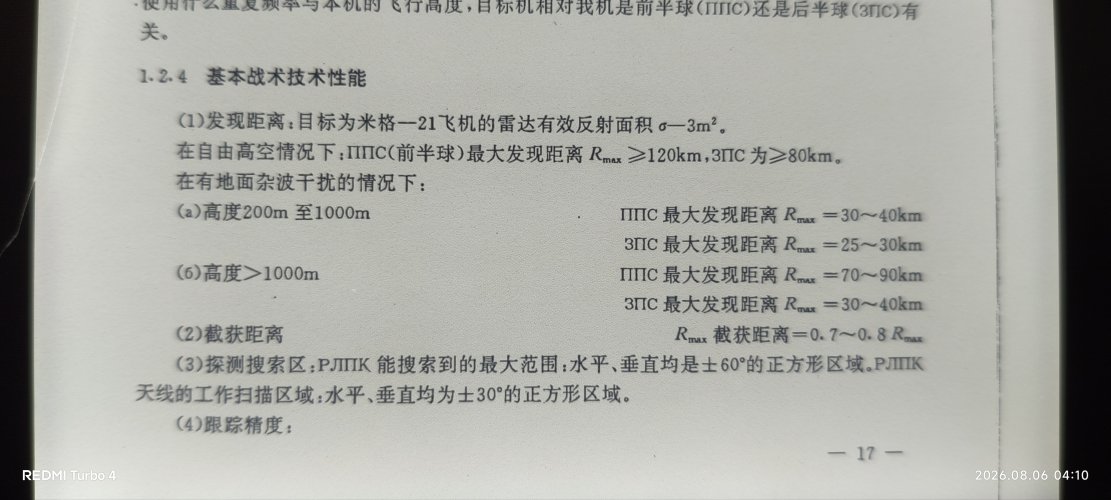
This is the data marked in a Chinese booklet, Su-27 Aircraft Fire Control Radar, with the following meanings:

For a MiG-21 target [RCS = 3 m²],
in clear high-altitude conditions:

· Maximum detection range in the forward hemisphere: 120 km
· Maximum detection range in the rear hemisphere: 80 km

Under ground clutter interference:
At altitudes from 200 m to 1,000 m:

· Head‑on maximum detection range: 30–40 km
· Tail‑chase maximum detection range: 25–30 km

At altitudes above 1,000 m:

· Head‑on maximum detection range: 70–90 km
· Tail‑chase maximum detection range: 30–40 km

Lock‑on range is 0.7–0.8 times the maximum detection range.
 

Attachments

  • IMG_20260806_041048.jpg
    IMG_20260806_041048.jpg
    4 MB · Views: 27
The inconsistency is probably caused by use of range of different PD and PFA's. Bars has always been credited with 250-300 km range. It could be however for PD-50%, while the 110 km range figure is for PD-90%.

No, the range difference would not be that extreme. However, Bars probably have a 300km range - against B-52s.
 
This is the data marked in a Chinese booklet, Su-27 Aircraft Fire Control Radar, with the following meanings:

Su-27SK 'Flight Manual' ( edition by KnAAPO ,2004) :

Дальность действия РЛПК в свободном пространстве и на фоне земли практически одинакова и зависит от высоты полета самолета, полусферы атаки и составляет по истребителям (σ = 3 м2):

а) при полете самолета на больших высотах:

в ЗПС:

при атаке сверху вниз: Добн = 30 – 40 км;

Дзахв = 30 – 35 км;

при атаке снизу вверх: Добн = 50 – 55 км;

Дзахв = 45 – 50 км;

в ППС: Добн = 80 – 100 км, Дзахв = 65 – 80 км;

б) при полете самолета на средних высотах (более 1000 м):

в ППС: Добн = 80 – 100 км, Дзахв = 65 – 80 км;

в ЗПС: Добн = 25 – 35 км, Дзахв = 25 – 30 км;

в) при полете самолета на малых высотах (200 м):в ЗПС: Добн = 20 – 25 км, Дзахв = 18 – 20 км;​

в ППС: Добн = 35 – 40 км, Дзахв = 28 – 32 км

Transl :

The operating range of the radar-sighting system in free space and against a ground background is virtually identical and depends on the aircraft's flight altitude and the angle of attack; for fighter-type targets (σ = 3 m²), it is:

a) during high-altitude flight:

rear hemipshere : for a top-down attack: detection range = 30–40 km; lock-on range 30-35km
for an attack from below,detection range = 50–55 km;,lock on range 45-50km

forward hemisphere : detection range 80-100km,lock on range 65-80km.

b) during flight at medium altitudes (above 1,000 m):

forward hemisphere: detection range 80-100km,lock on range 65-80km.
rear hemisphere: detection range 25-35km, lock on range 25-30km.

c) for an aircraft flying at low altitudes (200 m): in the rear hemisphere: detection range = 20–25 km, lock-on range = 18–20 km;

forward hemisphere: detextion range 35-40km, lock on range 28-32km.

However, Bars probably have a 300km range - against B-52s.

Maybe even 400km ( of course in the High PRF/ PPS mode)?
 

Similar threads

Back
Top Bottom