athpilot
Fly me to the moon...
- Joined
- 18 November 2012
- Messages
- 436
- Reaction score
- 553
Удалов К. Г. / Г. О. Тавейра:
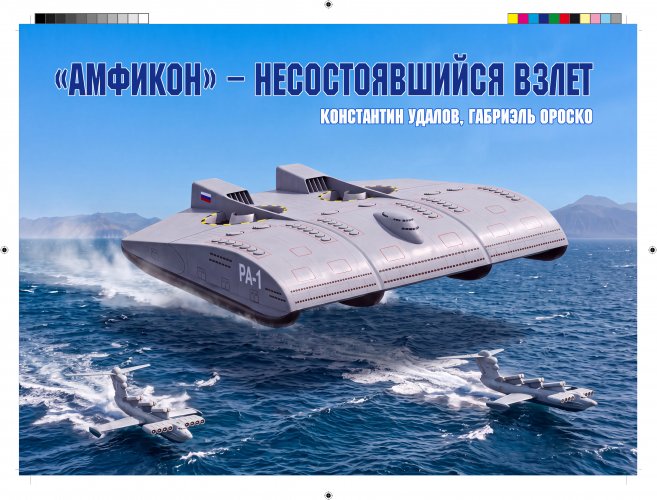
Амфикон - несостоявшийся взлет.
Москва. 2026 г., 376 с.; УДК. 82-94: 629. 7. Амфикон – несостоявшийся взлет. 01/08
ББК 39.5г
Konstantin G. Udalov / Gabriel Orosco: Amfikon – aborted take-off
Moscow 2026, 376 pages
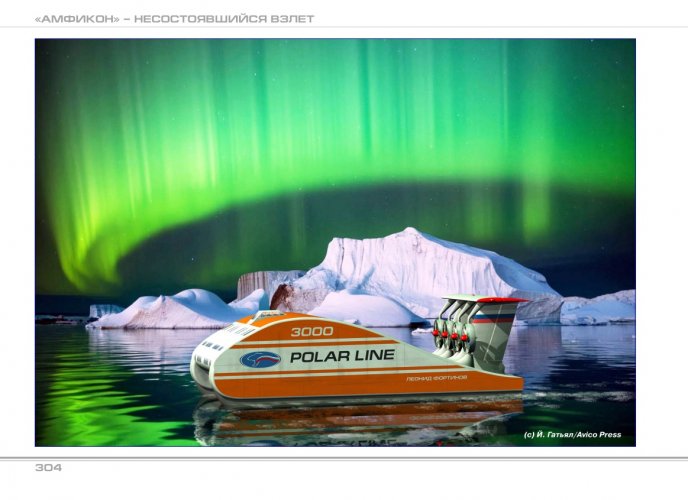
Hi everyone! I had the great the opportunity to read the new book by Konstantin Udalov and Gabriel Orosco about the truly fascinating „Amphicon“ project, which I never heard of before. The book recounts the history of the research and development firm “Ekolen”/“Amfikon” and its remarkable projects involving ekranoplanes and land-air amphibians. The publication is illustrated with a large number of diagrams and photographs that have not been published before. Most of the fotos are from the firms archives. I´m glad that this book is so richly illustrated – its good to see Iozef Gatial back in action here – because these paper projects are sometimes so futuristic, that it would be otherwise hard to imagine, how they would perform in real life.
A major innovation—and a great convenience—is that the book is bilingual: Russian and English! First is russian text followed by detailed english summaries.
The book starts with an overview oft he soviet WIG vessels and projects until the 1990s, the so-called first WIG generation. In the early 1990s, the company Amphicon (Amphibious Designs) was created with an innovative proposal. The goal was to create a national transportation system based entirely on second-generation amphibious ekranoplanes, using a flying wing structure. In addition to flying, these vehicles could move over various surfaces using the same movement system as a hovercraft, consisting of large «air cushions» inflated below the fuselage.The goal was to develop a line of vehicles over 15 years, starting with the design of small, three-ton Ekranoplanes, until 5,000 tons giants. By 1993, the group had already developed ten major base projects. These ekranoplanes had different modules that could be combined according to need, increasing their size and capacity, providing great versatility.
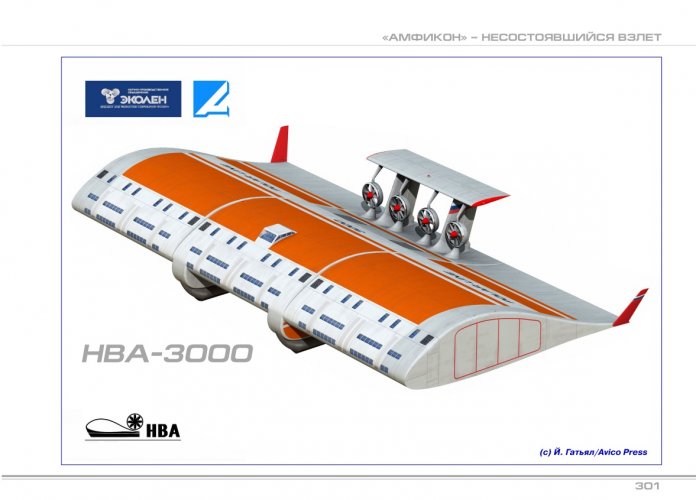
Most part of thebook is about the NVA - the effective international transport sytem, based on WIGs (from page 41 onward). Ground and airamfibian vehicle (HBA) Multipurpose effektive transportation facility coul be used in a variety of tasks, e.g. international heavy lift and cargo, even as transport train for specified cargoes based on employingof the hinged modules. All the NVA components are envisaged to be exchangeable and unified thus faciliting the maintenance and repair. Different types and sizes of the NVA facilities may be offered with a range of the main engine power from1600kw to 32000 kw in one unit.
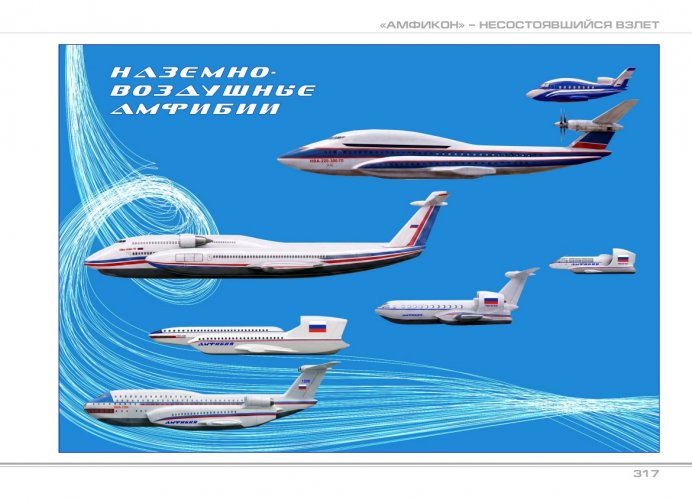
The book provides a detailed overview of the various vehicle series. It starts with the big NVA which covered a wide range from civilian (from personnel leisure time use till giant transportation) and military NVA vessels. The following projects are describe in detail (pp. 134-305): NVA-03, NVA-60, NVA-120, NVA-600, NVA-900, NVA-1200, NVA-01, NVA-03, NVA-09, NVA-20, SM-1, NVA-30, NVA-30g,, NVA-30gp, NVA-30p, NVA-60p, NVA-120 till NVA-5000.
The next part of the book is devoted to the Ekolen and Amphicon program. The Ekolen program dates back into 1970s and had its roots in the Alekseyev and Krylov organizations. The name abbreviated Ekologiya Leningrada, «Ecology of Leningrad City». These NVAs followed a modified and adjusted design philosophy. The range of these projects were from light regional amphibians, through regional transport aircraft to oceanic heavy transport aircraft. They looked more "traditional", like a mesh up of an aircraft and a WIG. Truly fascinating (pp. 3317-370).
The authors naturally wonder why this concept could not be implemented. The answers lie in the circumstances of the early 1990s, when, following the collapse of the Soviet Union, resources and funds were scarce and the government was pursuing other goals. However, the authors cite the following as the main reason: „Despite bringing together extremely experienced engineers in the ekranoplanes segment, the administrative side of the company was seriously compromised by the interplay of individual interests, leading to internal conflicts that resulted in the gradual end of the project,not due to external factors, but rather a collapse from within, like all great empires.“ (p. 372).
A truly fascinating book, which I highly recommend for aviation enthusiasts.If you are interestted in purchasing the book, please PM Gabriel Orosco here on the forum.
Амфикон - несостоявшийся взлет.
Москва. 2026 г., 376 с.; УДК. 82-94: 629. 7. Амфикон – несостоявшийся взлет. 01/08
ББК 39.5г
Konstantin G. Udalov / Gabriel Orosco: Amfikon – aborted take-off
Moscow 2026, 376 pages
Hi everyone! I had the great the opportunity to read the new book by Konstantin Udalov and Gabriel Orosco about the truly fascinating „Amphicon“ project, which I never heard of before. The book recounts the history of the research and development firm “Ekolen”/“Amfikon” and its remarkable projects involving ekranoplanes and land-air amphibians. The publication is illustrated with a large number of diagrams and photographs that have not been published before. Most of the fotos are from the firms archives. I´m glad that this book is so richly illustrated – its good to see Iozef Gatial back in action here – because these paper projects are sometimes so futuristic, that it would be otherwise hard to imagine, how they would perform in real life.
A major innovation—and a great convenience—is that the book is bilingual: Russian and English! First is russian text followed by detailed english summaries.
The book starts with an overview oft he soviet WIG vessels and projects until the 1990s, the so-called first WIG generation. In the early 1990s, the company Amphicon (Amphibious Designs) was created with an innovative proposal. The goal was to create a national transportation system based entirely on second-generation amphibious ekranoplanes, using a flying wing structure. In addition to flying, these vehicles could move over various surfaces using the same movement system as a hovercraft, consisting of large «air cushions» inflated below the fuselage.The goal was to develop a line of vehicles over 15 years, starting with the design of small, three-ton Ekranoplanes, until 5,000 tons giants. By 1993, the group had already developed ten major base projects. These ekranoplanes had different modules that could be combined according to need, increasing their size and capacity, providing great versatility.
Most part of thebook is about the NVA - the effective international transport sytem, based on WIGs (from page 41 onward). Ground and airamfibian vehicle (HBA) Multipurpose effektive transportation facility coul be used in a variety of tasks, e.g. international heavy lift and cargo, even as transport train for specified cargoes based on employingof the hinged modules. All the NVA components are envisaged to be exchangeable and unified thus faciliting the maintenance and repair. Different types and sizes of the NVA facilities may be offered with a range of the main engine power from1600kw to 32000 kw in one unit.
The book provides a detailed overview of the various vehicle series. It starts with the big NVA which covered a wide range from civilian (from personnel leisure time use till giant transportation) and military NVA vessels. The following projects are describe in detail (pp. 134-305): NVA-03, NVA-60, NVA-120, NVA-600, NVA-900, NVA-1200, NVA-01, NVA-03, NVA-09, NVA-20, SM-1, NVA-30, NVA-30g,, NVA-30gp, NVA-30p, NVA-60p, NVA-120 till NVA-5000.
The next part of the book is devoted to the Ekolen and Amphicon program. The Ekolen program dates back into 1970s and had its roots in the Alekseyev and Krylov organizations. The name abbreviated Ekologiya Leningrada, «Ecology of Leningrad City». These NVAs followed a modified and adjusted design philosophy. The range of these projects were from light regional amphibians, through regional transport aircraft to oceanic heavy transport aircraft. They looked more "traditional", like a mesh up of an aircraft and a WIG. Truly fascinating (pp. 3317-370).
The authors naturally wonder why this concept could not be implemented. The answers lie in the circumstances of the early 1990s, when, following the collapse of the Soviet Union, resources and funds were scarce and the government was pursuing other goals. However, the authors cite the following as the main reason: „Despite bringing together extremely experienced engineers in the ekranoplanes segment, the administrative side of the company was seriously compromised by the interplay of individual interests, leading to internal conflicts that resulted in the gradual end of the project,not due to external factors, but rather a collapse from within, like all great empires.“ (p. 372).
A truly fascinating book, which I highly recommend for aviation enthusiasts.If you are interestted in purchasing the book, please PM Gabriel Orosco here on the forum.