Removal of one turret (blasphemy, I know) would make room for a goodly number or missiles, I would think.

Get rid of that aft turret…you could have drone rails to either side maybe?

Removing a turret, especially the single aft one would have pretty significant impacts on stability, trim and hull stresses. Also would then be constrained by size and shape of the barbette for whatever went in, and the mazarines and powder handling rooms are likewise difficult to repurpose. Also, the barbette armor probably isn't usable structurally (likely can't effectively weld to it or drill it), so there's some weird structural support challenges. Likely far more work than it's worth.

All very interesting for discussion but, how would she have managed with the original engines and machinery? Is this the sort of thing that makes more sense with new propulsion? Nuclear even? This would (Shirley, I know) allow more of a free hand with deck and upperwork mods.

This would of course cost half a body or more let alone a few legs.

Essentially impossible to backfit a warship to nuclear power for the same reasons it's essentially impossible to remove the reactor - the reactor is very deeply integrated into the ship structure to the degree it's literally designed and built around the reactor vessel. Conceptually you'd have to build an entirely new engineering plant, including hull structure and somehow mate it to rest of the ship. While not technically impossible, the practical difficulties are rather mind boggling, and it would also certainly be far more difficult than building a new ship from scratch.
 
Essentially impossible to backfit a warship to nuclear power for the same reasons it's essentially impossible to remove the reactor - the reactor is very deeply integrated into the ship structure to the degree it's literally designed and built around the reactor vessel. Conceptually you'd have to build an entirely new engineering plant, including hull structure and somehow mate it to rest of the ship. While not technically impossible, the practical difficulties are rather mind boggling, and it would also certainly be far more difficult than building a new ship from scratch.
Well, if reactor is relatively compact, and made as single integrated module, it's possible. USSR backfitted one of diesel-electric submarine with a very small nuclear reactor in streamlined external module under rear hull. The idea was, that it would not directly power the drive (it was too low-power for that) but constantly recharge batteries without the need to surface or snorkel.
 
Well, could a Ford type reactor fit in an IOWA turret well? About the same mass--maybe scale it down some more.

It wouldn't even need be part of the drive train--just hook it up to DEWs/ECW.
 
Well, could a Ford type reactor fit in an IOWA turret well? About the same mass--maybe scale it down some more.
Highly doubtful. The D2G plant, which was considerably smaller and less powerful, required a reactor compartment 31 feet in diameter, not much narrower than an Iowa's turret.

Even if the primary plant itself would physically fit, you still would need the entire secondary system, which takes up more volume than the primary plant. If you could somehow figure out a way to get the steam lines to the existing main engines and turbine generators, you would have to reblade all of the turbines to work with the different steam conditions (the reactor could not produce superheated steam). You'd probably have to gut a lot of the existing secondary system; levels of chloride in feedwater that might be tolerable for a conventional steam plant would be unacceptable for a naval reactor plant.

So there's no practical way to provide any meaningful power to an Iowa via nuclear propulsion. You would have to gut the ship, and it would almost certainly be faster and cheaper just to build a new ship.
 
Well, if reactor is relatively compact, and made as single integrated module, it's possible. USSR backfitted one of diesel-electric submarine with a very small nuclear reactor in streamlined external module under rear hull. The idea was, that it would not directly power the drive (it was too low-power for that) but constantly recharge batteries without the need to surface or snorkel.

Possible perhaps. Practical, unlikely. Small reactor is something of an oxymoron because things like shielding don't scale linearly. As an example, something like 2/3 of NR-1 (12x96' pressure hull) was taken up by the reactor plant, and for all of that volume it makes enough power to run life support and move at <5 kts. I would be inclined to imagine the 'small streamlined module' looked something like a rather large tumor, probably cause more power loss in resistance than it produced, and likely resulted in some interesting handling issues underwater. Not to mention given the Soviet idea of radiation health essentially boils down to if you drink enough vodka you don't notice the radiation sickness, I'd recommend avoiding service in that boat.


Highly doubtful. The D2G plant, which was considerably smaller and less powerful, required a reactor compartment 31 feet in diameter, not much narrower than an Iowa's turret.

Even if the primary plant itself would physically fit, you still would need the entire secondary system, which takes up more volume than the primary plant. If you could somehow figure out a way to get the steam lines to the existing main engines and turbine generators, you would have to reblade all of the turbines to work with the different steam conditions (the reactor could not produce superheated steam). You'd probably have to gut a lot of the existing secondary system; levels of chloride in feedwater that might be tolerable for a conventional steam plant would be unacceptable for a naval reactor plant.

So there's no practical way to provide any meaningful power to an Iowa via nuclear propulsion. You would have to gut the ship, and it would almost certainly be faster and cheaper just to build a new ship.

This. An A4W reactor vessel would probably fit in the barbette. The rest of the primary loops wouldn't, and the shielding, secondary plant, etc. etc. most certainly would not. The propulsion plant on a carrier takes up a similar amount of space to the existing plant on a BB. There's a heck of a lot of bits you need, some of them quite large. Also lots of integration. Things that drain tanks for potentially radioactive liquid - you don't just stick that in a random inner bottom tank.

Good point about turbines - didn't think of that but you're right.
 
Not to mention given the Soviet idea of radiation health essentially boils down to if you drink enough vodka you don't notice the radiation sickness, I'd recommend avoiding service in that boat.
Sigh. And now could you re-read my post, please? The reactor was in external shielded capsule.
 
The issue with something like that used for the Project 651E is that the power is so low, just 600 kW. For comparison, an Iowa had eight 1,250 kW turbine generators. External (seawater) shielding is only really practical for submarines.
 
Sigh. And now could you re-read my post, please? The reactor was in external shielded capsule.

Yes, I read that bit. Unless it was in a free-floating capsule or something equally absurd it's going to be attached to the main hull. And yes, it was shielded.... to the Soviet standard of shielding. Hence my point. Very likely a similar setup meeting western standards for shielding would be somewhat larger and heavier than what they used.
 
Yes, I read that bit. Unless it was in a free-floating capsule or something equally absurd it's going to be attached to the main hull. And yes, it was shielded.... to the Soviet standard of shielding. Hence my point. Very likely a similar setup meeting western standards for shielding would be somewhat larger and heavier than what they used.
It'd only have major shielding in the directions where crew normally were.

Otherwise they'd just leave the shielding out entirely. If we had divers over the side when the reactor was running, we had to mark the edges of the reactor compartment so the divers would not linger there.
 
The issue with something like that used for the Project 651E is that the power is so low, just 600 kW. For comparison, an Iowa had eight 1,250 kW turbine generators. External (seawater) shielding is only really practical for submarines.

Note as well that reactors are commonly rated by thermal power, which is typically about 4 times the electrical power you can generate (and that usually doesn't include hotel load to run the plant itself, typically around 10% of gross power). Wouldn't be surprised if it's 600 kW thermal, i.e. about 100-150 kW usable electrical output.
 
to the Soviet standard of shielding.
Well, considering that American standards of radiation protection were "hey, let's send troops without so much as gas masks through the ground zero of nuclear blast"... American submarine reactors were better basically because of Hyman Rickover's adamant position of "safety above all", not because USN in general particularly cared.
 
Note as well that reactors are commonly rated by thermal power, which is typically about 4 times the electrical power you can generate (and that usually doesn't include hotel load to run the plant itself, typically around 10% of gross power). Wouldn't be surprised if it's 600 kW thermal, i.e. about 100-150 kW usable electrical output.
No, I was quoting the power of the turbine generator. The thermal power was 5 MW.
 
to the Soviet standard of shielding.
What you are suggesting is a common misconception. The Soviets certainly had several nuclear accidents, but they were not due to the shielding, which was perfectly adequate. The myth that the Soviets skimped on shielding is primarily due to the western underestimation of the November SSN's top speed: 30 knots compared with the Nautilus' 23 knots. Some suggested that the Soviets had achieved such high power density by reducing shielding. What they did not realize is that the November had two reactors, each with more power than the Nautilus' single reactor plant. Again, this is not to say that the Soviets did not have issues with their reactors; they absolutely did. But it was not the fault of the shielding.
 
Well, considering that American standards of radiation protection were "hey, let's send troops without so much as gas masks through the ground zero of nuclear blast"... American submarine reactors were better basically because of Hyman Rickover's adamant position of "safety above all", not because USN in general particularly cared.

The objective facts say something rather different. The Manhattan project as far back as 1942 had a fairly rigorous radiation health program, and this continued through various power and weapons programs. Yes, some of the early atomic tests lacked the protective measured we would consider common sense today, but that doesn't equate to a lack of protection/concern. Further, when you look at actual doses / dose estimates instead of the overly dramatic talking point, the exposure of those folks wasn't in the grand scheme of things all that significant. (note - I'm NOT saying it was appropriate, rather that in pretty much all cases the exposure was less than the yearly allowable radiation worker dose rate).

In contrast, the Soviet nuclear weapons program had multiple years in which the average worker dose for a specific facility was ~100 rem, including one in which 1.8% of the workforce received over 400 rem in a year. Granted, this was in the early 50's, and by the 70's doses are much lower, but still significantly higher than in the west, and at no point was there anywhere near that level of intentional exposure anywhere in the west.

Point isn't to shame Russia, but rather to point out that at least in some areas there was a significantly different perspective on safe exposure.

Source for above figures is this book: https://www.amazon.com/Making-Russian-Bomb-Stalin-Yeltsin/dp/0813323282


What you are suggesting is a common misconception. The Soviets certainly had several nuclear accidents, but they were not due to the shielding, which was perfectly adequate. The myth that the Soviets skimped on shielding is primarily due to the western underestimation of the November SSN's top speed: 30 knots compared with the Nautilus' 23 knots. Some suggested that the Soviets had achieved such high power density by reducing shielding. What they did not realize is that the November had two reactors, each with more power than the Nautilus' single reactor plant. Again, this is not to say that the Soviets did not have issues with their reactors; they absolutely did. But it was not the fault of the shielding.

My understanding was that Soviet submarines pretty much all had higher allowable Sailor dose rates and less rigorous shielding requirements. I will acknowledge that it's not something I have researched in detail. Do you have any recommendations for English language sources on soviet naval radiation health/exposure?
 
My understanding was that Soviet submarines pretty much all had higher allowable Sailor dose rates and less rigorous shielding requirements. I will acknowledge that it's not something I have researched in detail. Do you have any recommendations for English language sources on soviet naval radiation health/exposure?
I don't know of any good sources in English on Russian submarines except Cold War Submarines by Polmar and Moore. I would have to do some looking into the Russian-language books I have; I am not aware of any that cover that specific topic, but I have never looked.

Even the Alfa, which had engineering spaces that were not continuously-manned, had an extensive shield with thick layers of lead, polyethylene, water, concrete, and steel. If the Soviets had more lax requirements, it was not because of the shield.
 
I wasn't thinking of a reactor to power the ship---a pebble bed in place of a turret plugged to a DEW was my thinking. Front turrets keep the guns--smokestack back all high tech.

Ship gets made a museum piece again--put the old turret(s) in and have the reactor-laser turrets like Aegis Ashore.

The goal would be to keep each socket piece has self-maintained as possible...lasering drones to protect a carrier group
 
Last edited:
Soviet shielding was lower but the compartments were designed to be more automated with crew only accessing them for repair, the engineering stations were on the bridge.
 
Soviet shielding was lower but the compartments were designed to be more automated with crew only accessing them for repair, the engineering stations were on the bridge.
As we have been discussing, that misconception is not supported by Russian literature on the subject. Concentrating the entire watch section in the control room was only the case for the Project 705 (Alfa) SSN. And in the Russian literature on the Alfa, I can find no reference to any relaxation of shield requirements. The designers went to great efforts in designing the reactor shield for that submarine.
 
Funnily enough the Alfa using the Lead-Bismuth reactor is noted for requiring less shielding than water cooled designs, as if the reactor was allowed to cool into a solid mass the lead in the core provided adequate shielding for the crew such that extra shielding wasn't required in the event of an emergency. They needed a steady steam supply above 257 fahrenheit for the core to remain molten, if they boiled dry the core would cool, so they were inherently fail-safe (though resulted in Bricking as they couldn't be restarted). They did produce a large amount of Po210 isotopes though and were noted as suffering from severe corrosion problems. The core also had to be supplied with steam during the fuelling process.
 
Last edited:
I wasn't thinking of a reactor to power the ship---a pebble bed in place of a turret plugged to a DEW was my thinking. Front turrets keep the guns--smokestack back all high tech.

Ship gets made a museum piece again--put the old turret(s) in and have the reactor-laser turrets like Aegis Ashore.

The goal would be to keep each socket piece has self-maintained as possible...lasering drones to protect a carrier group
That... May be doable.

I'm not sure about the size of a pebble bed reactor that can crank out a couple megawatts for lasers plural.
 
That... May be doable.

I'm not sure about the size of a pebble bed reactor that can crank out a couple megawatts for lasers plural.
A generator...hell, a 777 engine.. something...Capsules, S.S. UNITED STATES, MiGs--lots of old tech is on its way out...I'd like to see *something* from the past live again.
 
Does anyone know what kind of reactor the Chinese are using in their nuclear Stirling driven sub?
Do we even know if they are building such a submarine? I was under the impression that it they merely may or may not be building a small nuclear submarine.
 
To my modest knowledge, there are two types of naval nuclear propulsion.

Combined Nuclear and Steam (CONAS) is a propulsion system for ships in which steam turbines can be powered by both nuclear reactors and fuel oil boilers.

Direct Nuclear Steam generation (I don’t know the acronym).

Is plausible to have in the future new type nuclear propulsion?

I was thinking about a kind of ‘CONAG’ Combined Nuclear and Gas (turbo electric?) in which a gas turbine can be used if the nuclear reactor is off and can’t produce steam. A kind of ‘Combined IEP’?

Are there any potential combination and option that are being developed or theorized?
 
I don't see why not.
It might be easier with electric propulsion, because it removes complex gearbox, which is heavy and expensive (for example, one of the main problems with Russian 22350 frigates was a gearbox for CODAG - they spent quite a lot of time and money to localize it's production and build a special testbed for it).
CONAS is easier in this regard, as you can have common turbine with two separate steam feeds.

But I don't see a use for it apart being an auxiliary/reserve power source.
 
CONAG has been studied, with gas turbines for boost power. The problem is that once you've committed to having a reactor, it doesn't cost an awful lot more to have a slightly bigger reactor. Adding a combustion plant of any kind means you have to pay for it, and add whole lot of complexity, to get a ship that's less capable than if you had slightly bigger reactors.

I'm not entirely sure why the Soviet Navy felt it needed a backup steam plant on Project 1144, but there's a reason it's not been done by anyone else.
 
CONAG has been studied, with gas turbines for boost power. The problem is that once you've committed to having a reactor, it doesn't cost an awful lot more to have a slightly bigger reactor. Adding a combustion plant of any kind means you have to pay for it, and add whole lot of complexity, to get a ship that's less capable than if you had slightly bigger reactors.

I'm not entirely sure why the Soviet Navy felt it needed a backup steam plant on Project 1144, but there's a reason it's not been done by anyone else.
Backup in case they have to scram both reactors. They are powerful enough to move ship up to 20kts and provide full electric power, thus not leaving the ship vulnerable. Or for operations in port when reactors are cold.
BTW, I'm not sure why 1144's propulsion is considered CONAS. It's more like CONOS, because I didn't found any info that it's possible to use both simultaneously. Only that you can engage steam boiler to already working turbine.
 
Last edited:
Backup in case they have to scram both reactors. They are powerful enough to move ship up to 20kts and provide full electric power, thus not leaving the ship vulnerable. Or for operations in port when reactors are cold.
That is what the diesels engines are for and it doesn't mess up the steam propulsion system
 
That is what the diesels engines are for and it doesn't mess up the steam propulsion system
But you have to use complex gearbox for it, which takes place and weight. Sufficiently powerful diesels are also not small or light. Here you can have common turbine, reduction drives.
 
No need for any other types if nuclear steam is done right.
Blatantly false, as all nuclear ships need some sort of fossil fuel generator in case the reactor SCRAMs.

Are there any potential combination and option that are being developed or theorized?
I’ve been playing around with the IEP CONAG idea.

The MAMJDF AoA examined 2 nuclear powerplants for CG(X), an A1B from the Ford, or 2 S6Gs from the Seawolf. Let’s look at how those compare to our speculative power requirements.

Let’s use a Burke Flight III as our base. That means we need to be able to sustain 30+ knots, generate 9MW of ship service power (probably more), and let’s do a 7.5% growth margin.

To fit 14-foot SPY-6s, FXR, SEWIP Block III, 96 Mk41 cells, and flag facilities, we’re going to need a big hull. Zumwalt can fit all that comfortably, but nuclear reactors are big and heavy, so we need something even larger. Let’s call it a ~19000 ton hull, at 700 feet long. That’s nearly identical to the Strike Cruiser (CSGN).

The CSGN was powered by two D2G reactors, producing 45MW of power. Relative to other ships of that size (Hyuga at 75MW, Zumwalt as 68MW, and CGBL at 88MW), ~40% less propulsion power. Why? Nuclear-powered ships optimize their hullform for maximum speed, which reduces their Block Coefficient compared to conventionally-powered ships, giving them less total resistance.

But let’s be conservative and say we a slightly thicccer hull for extra volume and weight margin, so 55MW of power for propulsion.

Our total power requirement can be modeled via the following equation:
7.5% * (Total Propulsion Power + Total Service Power)
1.075 * (55MW + 12MW)
1.075 * (77MW)
83MW

So 77MW of total power requirements and an extra 6MW of SLA.

Now let’s look at our two reactor options, an A1B or two S6Gs.
An A1B produces well over 200MW, maybe even 300MW of power. That is 3-4 times our power requirement. Additionally, only having one massive reactor reduces redundancy and survivability.
Meanwhile an S6G only produces 34MW of power, so 2 of them give 68MW. We get the added redundancy, but are still 15MW short. We can make that up with AG9160s, but that’s a very suboptimal solution, as we still need to burn fossil fuels to meet our total power needs.

Neither of these options are good. One isn’t survivable, the other has all the negatives of a nuclear ship with none of the benefits.

The optimal solution would be something that produces ~40-45MW of electrical power, and is already in series production. S1B fits that bill.

If we use the use two S1Bs with a 40MW electrical output, that’s 80MW. That’s almost enough to meet our power demands, and the rest can be fulfilled with AG9160s. Which we would need anyways, in case the reactors go down.

IEP is just the icing on the cake. It’s even quieter, more survivable, and there’s no cpa on how much reactor electrical output can be used for ship service power.
 
Blatantly false, as all nuclear ships need some sort of fossil fuel generator in case the reactor SCRAMs.
Wrong, I was posting about combined power and not backup. Even steam ships had backup diesels. On subs, the diesel does not tie into the main propulsion system, it has its own separate.
 
Backup in case they have to scram both reactors. They are powerful enough to move ship up to 20kts and provide full electric power, thus not leaving the ship vulnerable. Or for operations in port when reactors are cold.
Yes, I know that's the purpose. But not why they felt it was necessary. Are you shutting down reactors at sea that often? Or needing to cold move without tugs, but with sufficient notice to fire up a steam plant? Very strange.
 
Thanks for all your answers.

To my knowledge/understanding, the CONAS of the Kirov class was "in case of a reactor failure", so that the ship is still able to navigate and defend.
Were they fearing a failure because they lacked confidence into their design, or were they fearing that a hit could put the reactor offline? I have no idea. But it probably the question/answer that would motivate an eventual "IEP CONAG" or "GONAG".
 
You certainly could combine a nuclear plant with pretty much any fossil fuel plant, but the question would be why. Nuclear plants in general have significant economies of scale in ship impact, cost, manning, etc. - i.e. a plant making 50% more power is not much harder or more costly than the base size, hence it in general makes sense to design for maximum power needed. It is also of some importance to make the plant highly reliable from a safety point of view, which also carries over to reliability of propulsion. Consequently, there's little need in most cases for any significant non nuclear capability.

A caveat to this though is that plant design is very complex, and in general the power output is fixed. In other words, a plant is designed for a specific power, and it's generally not possible to increase that much without a very expensive redesign. As a result, there may be a case where fossil fuel boosting makes sense - for instance a hypothetical CGN-38 class that needed an extra few knots of speed.
 
To my modest knowledge, there are two types of naval nuclear propulsion.

Combined Nuclear and Steam (CONAS) is a propulsion system for ships in which steam turbines can be powered by both nuclear reactors and fuel oil boilers.

Direct Nuclear Steam generation (I don’t know the acronym).

Previous threads of interest

https://www.secretprojects.co.uk/th...nuclear-propulsion-engines.31926/#post-614533
https://www.secretprojects.co.uk/threads/westinghouse-lwnpp-project-1970s-80s.19673/
For a while, nuclear gas turbines were investigated for propulsion purposes. Such systems typically use a very high temperature graphite moderated reactor to superheat helium gas to drive a turbine, and then use some other coolant loop to cool the helium before sending it back to the reactor.

The reactors chosen for these applications were often derivatives of reactors designed for nuclear thermal rocket applications or nuclear ramjet or nuclear aircraft applications.

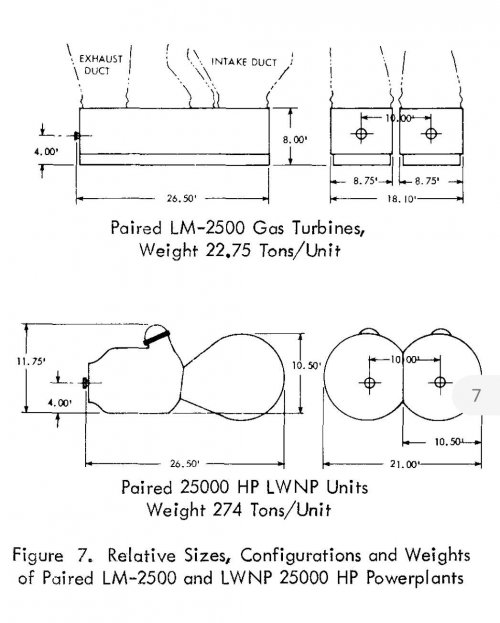
The benefits include the possibility of a relatively compact system (Westinghouse wanted a drop in replacement for an LM2500 footprint wise), and the logistical impacts of such - you replace the whole reactor in gas turbine as a unit in a shipyard.

The downsides include technical difficulties - significant development will be necessary and also potentially a requirement for more frequent refueling EG every one or two years, depending on the system design (although this may or may not be adjustable). There are also some concerns regarding the more aggressive technical design of a very high temperature reactor.

The Westinghouse proposal was for a nuclearized spruance DDGN, with the lightweight nuclear power reactors in place of the LM2500.

There are earlier proposals from the 1960s for podded nuclear gas turbines to attach to the bottoms of ships, those "nuclear outboard motors" were a worse idea but not dissimilar reactor concept.

https://medium.com/war-is-boring/this-nuclear-outboard-motor-was-a-really-terrible-idea-2966b898c5e9
 

Attachments

  • WestinghousMaritime (5).pdf
    948.3 KB · Views: 20
  • tempFileForShare_20240104-080030.jpg
    tempFileForShare_20240104-080030.jpg
    74.7 KB · Views: 44
  • Screenshot_20240104_075821_Adobe_Acrobat.jpg
    Screenshot_20240104_075821_Adobe_Acrobat.jpg
    92.3 KB · Views: 38
Last edited:
Previous threads of interest

https://www.secretprojects.co.uk/th...nuclear-propulsion-engines.31926/#post-614533
https://www.secretprojects.co.uk/threads/westinghouse-lwnpp-project-1970s-80s.19673/
For a while, nuclear gas turbines were investigated for propulsion purposes. Such systems typically use a very high temperature graphite moderated reactor to superheat helium gas to drive a turbine, and then use some other coolant loop to cool the helium before sending it back to the reactor.

The reactors chosen for these applications were often derivatives of reactors designed for nuclear thermal rocket applications or nuclear ramjet or nuclear aircraft applications.

The benefits include the possibility of a relatively compact system (Westinghouse wanted a drop in replacement for an LM2500 footprint wise), and the logistical impacts of such - you replace the whole reactor in gas turbine as a unit in a shipyard.

The downsides include technical difficulties - significant development will be necessary and also potentially a requirement for more frequent refueling EG every one or two years, depending on the system design (although this may or may not be adjustable). There are also some concerns regarding the more aggressive technical design of a very high temperature reactor.

The Westinghouse proposal was for a nuclearized spruance DDGN, with the lightweight nuclear power reactors in place of the LM2500.

There are earlier proposals from the 1960s for podded nuclear gas turbines to attach to the bottoms of ships, those "nuclear outboard motors" were a worse idea but not dissimilar reactor concept.

https://medium.com/war-is-boring/this-nuclear-outboard-motor-was-a-really-terrible-idea-2966b898c5e9
Thanks for this input and study PDF. It’s very interesting.

The Westinghouse idea you shared makes me think that we could “basically” put a compact Gas turbine modular helium reactor (GT-MHR) into a ship. Which looks interesting as it’s a quite safe and efficient design, to my knowledge.

On the long term it can even lead to a fast neutrons gas-cooled reactor.

Regarding the study, I see one main issue: the weight. Figure 7 in page 6 indicate that a paired “LWNP” power plants would be 274 tons, while paired LM-2500 are 22.75 tons. But table III and IV (page 7) indicate removing all LM-2500 installation would remove 1114 tons, and that the proposed “LWNP” installation would be 1284 tones. So it ‘only’ adds 170 tons to the ship.
 
Thanks for this input and study PDF. It’s very interesting.

The Westinghouse idea you shared makes me think that we could “basically” put a compact Gas turbine modular helium reactor (GT-MHR) into a ship. Which looks interesting as it’s a quite safe and efficient design, to my knowledge.

On the long term it can even lead to a fast neutrons gas-cooled reactor.

Regarding the study, I see one main issue: the weight. Figure 7 in page 6 indicate that a paired “LWNP” power plants would be 274 tons, while paired LM-2500 are 22.75 tons. But table III and IV (page 7) indicate removing all LM-2500 installation would remove 1114 tons, and that the proposed “LWNP” installation would be 1284 tones. So it ‘only’ adds 170 tons to the ship.
The weight is significantly greater, yes, but the footprint, as you can see from the pictures, could in theory be the same. Nuclear reactors are large and heavy (because they need a certain amount of neutron shielding), but not that large and heavy - proposals have been made to use them to power large hovercraft, ekranoplans, turbofan and turbojet aircraft, supersonic ramjet missiles, rockets - and even trains and very large road vehicles.

Obviously the ship would have to be totally redesigned, but it would not necessarily need to be significantly bigger.

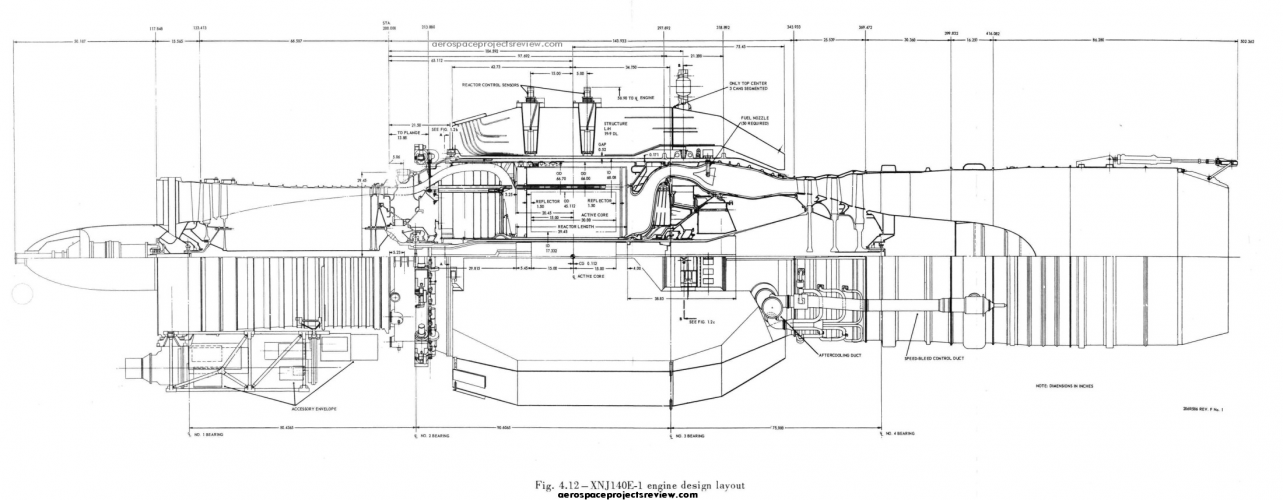
This is the classic 60s-era XNJ140E (and above, the E-1; it's a shorter, 12.5-meter long developmental engine apparently and lacks an afterburner, which was supposed to go on the full-length version). Peak output of 120 megawatts at roughly 30 metric tonnes. Of course, this thing was probably under-shielded and may not have "worked" per se (lord knows the development would have been tortuous and involved huge redesigns), but there's a lot you can do with Our Friend the Atom.


https://www.aerospaceprojectsreview.com/blog/?p=894
1749572549571.png

1749572581777.png

Note the similarities to the propulsion pod (also a general electric product derived from the descendants of the above).
https://up-ship.com/blog/?p=9286
1749573246937.png

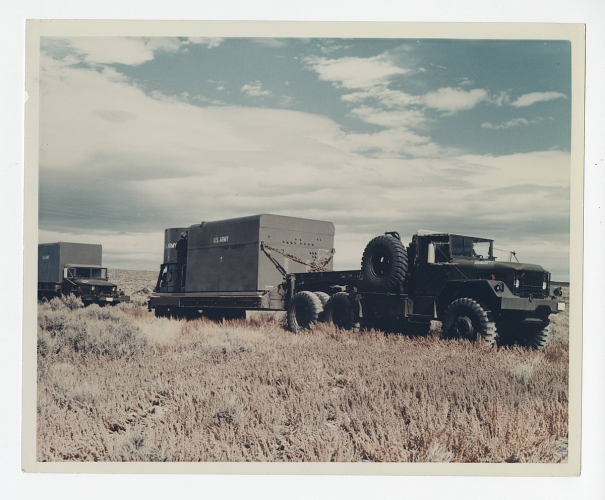
ML-1 reactor trailer.
1749573106288.png
Atomic Skies has more
https://atomic-skies.blogspot.com/https://alternatehistoryweeklyupdate.blogspot.com/2014/01/atomic-machines-atompunk-sampler.html
Fuel rods and gas - You can put them on a plane, you can put them on a train, you can fit them in a ship, you can fit them in a pod. You can take them on a trip, you can leave them in a plant. You can put them here and there, you can put them anywhere.

In the deep, in the dark, while you sleep, for your park.
In a drill, in a hill, will it work, yes it will.
Up in space, on the moon, my living-place? Coming soon!
 
Last edited:
Problem with naval nuclear propulsion is labor and machinery maintenance. Virtually all naval reactors are pressurized water type. Few experimented with liquid metal but came own problems. USA tried sodium however it had issues retaining superheating. Soviets tried molten lead, while it worked and provided subs with prodigious speeds excess 40 knots. But they're very expensive, prone malfunction, one rupture accident destroyed sub compartment and subs needed port heating to keep coolant flowing when idle and suffered significant corrosion.

Despite improved neutronics and denser power cores in PWR they're largely dead end in terms of improvement. They're are Two potential reactors in future that may offer change for vast economic improvements and simplicity of operations and labor man reduction.

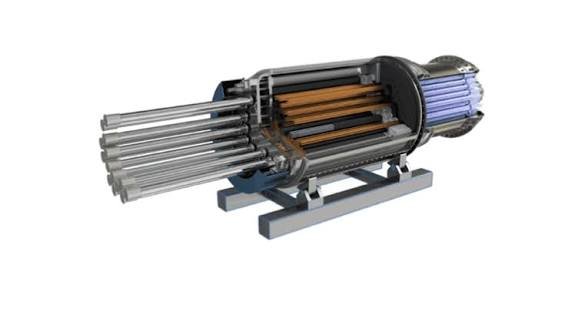
One is High temperature gas reactor. However unlikely used compact ships as core power density is lower than PWR. The 2nd is the heat pipe reactor currently investigated for use in space travel to power probes. Other than the control rod/drums they have no moving parts and convey thermal energy away using basic principle metal thermal conductivity, its same technology in your PC. Heat pipes can be geometrically shaped in anyway so bending them to accommodate odd floor plan or having turn up or down.

1000034568.jpg 1000034569.jpg

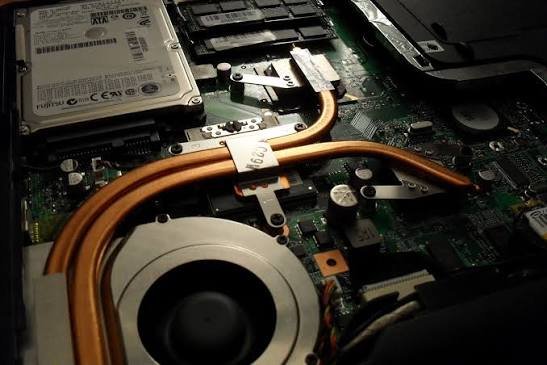
Unlike PWR there is no fluid in core to be pumped hence no pumps are needed nor design for natural circulation. Heat transfer begins from pipes which integrate thru gas heat exchanger which can use a brayton cycle gas turbine. With coolant temp of 650° C and upper echelons of 700+, Heat exchanger is backwards compatible to super-critical
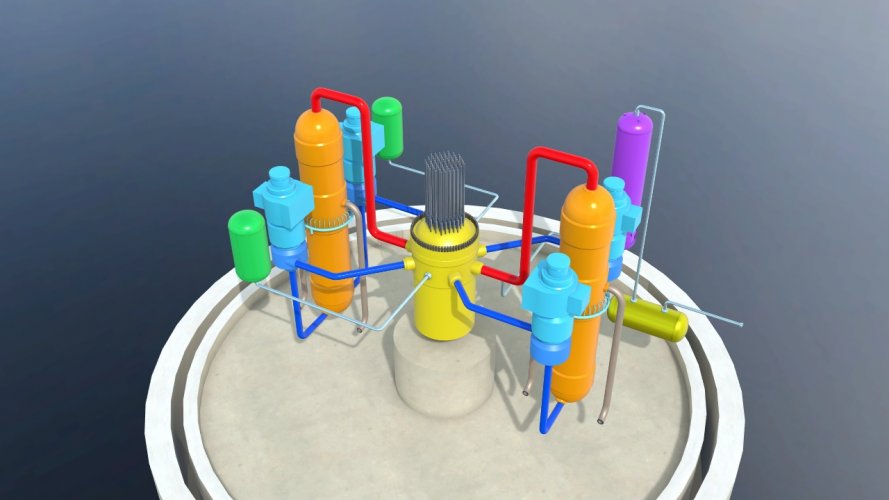
Steam boilers of previous ships. Thus pressurizer, steam generators, leggings pipes all which eliminated. (See below everything besides yellow would be gone)
In gas turbine brayton cycle gas would be cooled in seawater heat exchange.

1000034570.jpg
 

Similar threads

Back
Top Bottom