
You are using an out of date browser. It may not display this or other websites correctly.
You should upgrade or use an alternative browser.
You should upgrade or use an alternative browser.
NASA Langley STOL studies 60s-70s

- Joined
- 4 May 2008
- Messages
- 2,445
- Reaction score
- 828
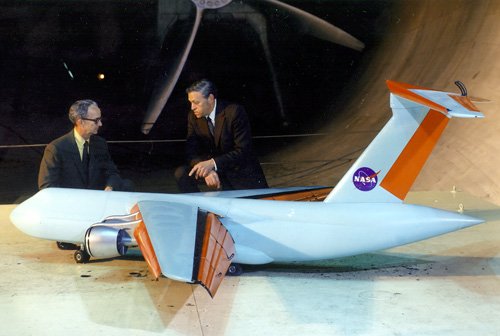
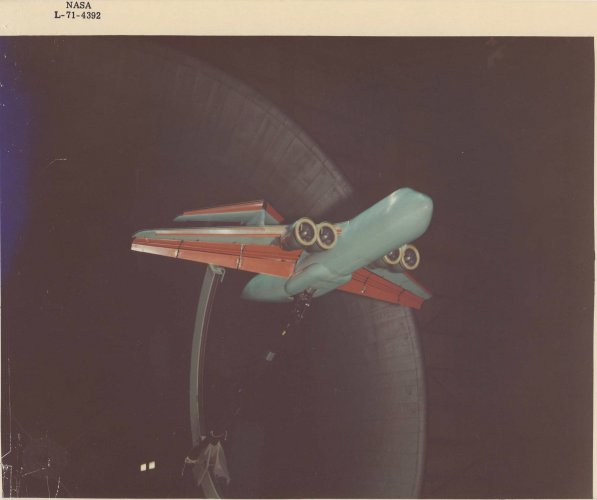
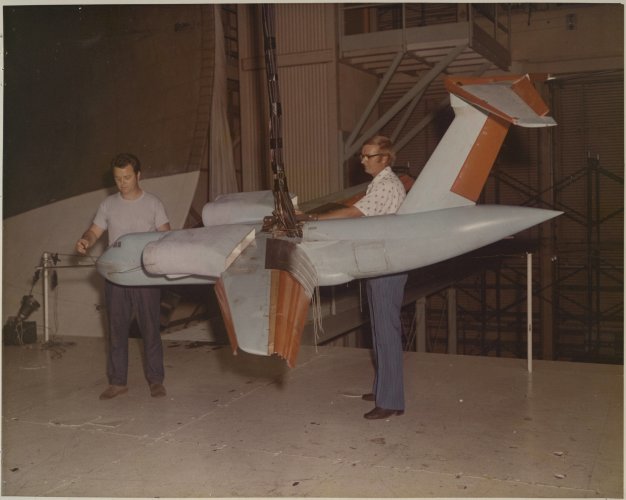
Interesting picture. Did it say somewhere explicitly that this was a C-5 derivative?
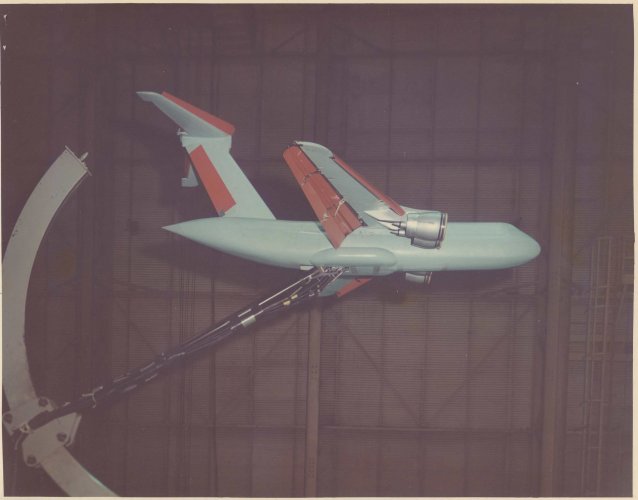
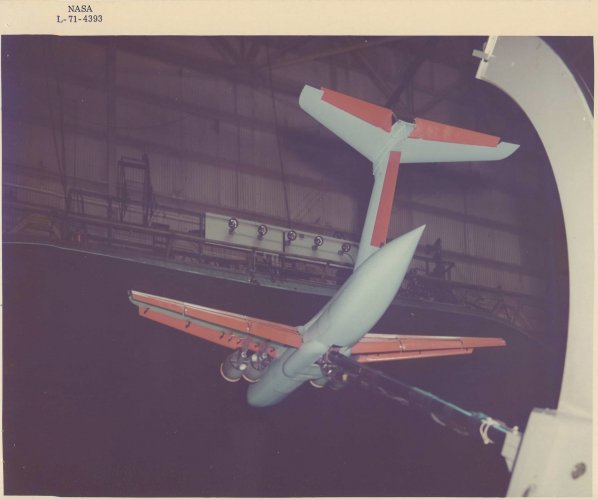
Besides the changes made to the wing, the tail looks obviously wrong. Looks like it's a variable incidence tail too (all moving).
Well, I guess that if you were going for high lift it would be a good idea to raise the horizontal stabilizer above the downwash off the wing.
But yeah, the engine position and type of flaps point to an externally blown flap configuration, with slats on top of that. Somebody was trying hard to get STOL. Do you know when this picture was taken?
Besides the changes made to the wing, the tail looks obviously wrong. Looks like it's a variable incidence tail too (all moving).
Well, I guess that if you were going for high lift it would be a good idea to raise the horizontal stabilizer above the downwash off the wing.
But yeah, the engine position and type of flaps point to an externally blown flap configuration, with slats on top of that. Somebody was trying hard to get STOL. Do you know when this picture was taken?

spectre
BOOM
- Joined
- 7 January 2007
- Messages
- 23
- Reaction score
- 3
Sorry, I have zero info on the picture. It was forwarded to me to try to get info on it...but I am a C-130 guy. I know very little about the C-5AeroFranz said:Interesting picture. Did it say somewhere explicitly that this was a C-5 derivative?
Besides the changes made to the wing, the tail looks obviously wrong. Looks like it's a variable incidence tail too (all moving).
Well, I guess that if you were going for high lift it would be a good idea to raise the horizontal stabilizer above the downwash off the wing.
But yeah, the engine position and type of flaps point to an externally blown flap configuration, with slats on top of that. Somebody was trying hard to get STOL. Do you know when this picture was taken?
hole in the ground
ACCESS: Secret
- Joined
- 6 August 2008
- Messages
- 244
- Reaction score
- 36
AeroFranz said:Besides the changes made to the wing, the tail looks obviously wrong. Looks like it's a variable incidence tail too (all moving).
Well, I guess that if you were going for high lift it would be a good idea to raise the horizontal stabilizer above the downwash off the wing.
I dont think it is an all moving surface, i think it is a leading edge flap deployed upwards...

- Joined
- 25 July 2007
- Messages
- 4,916
- Reaction score
- 5,537
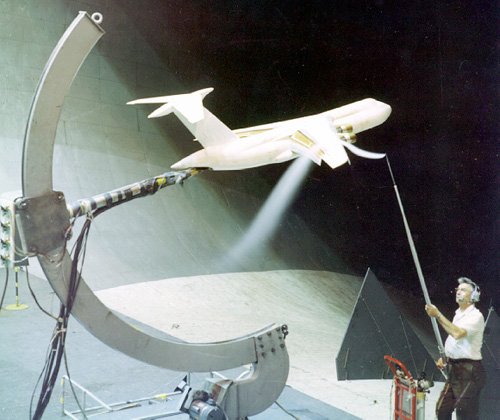
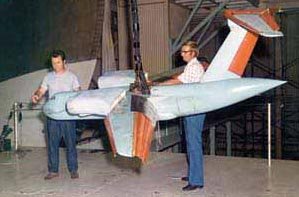
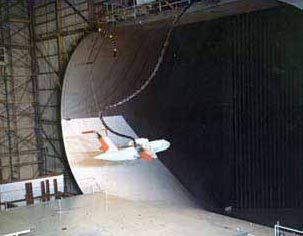
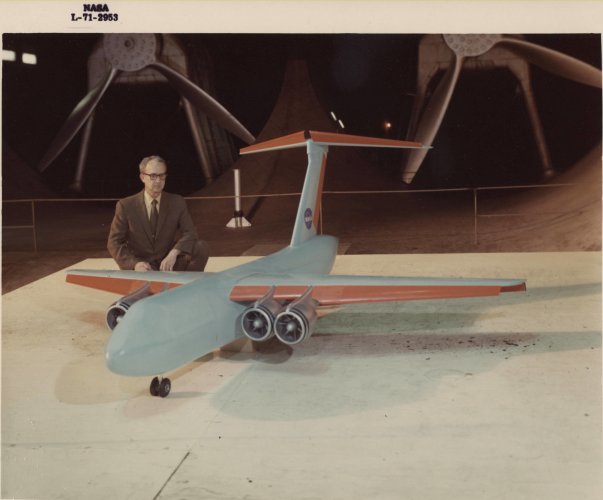
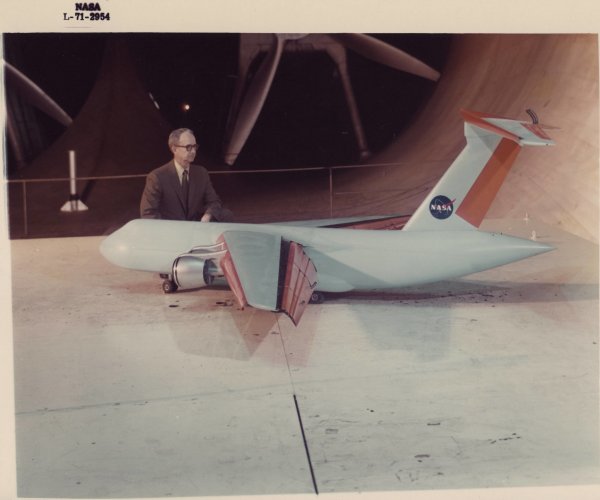
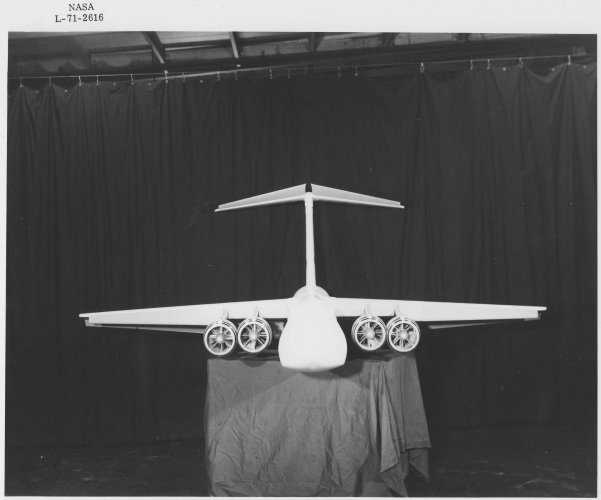
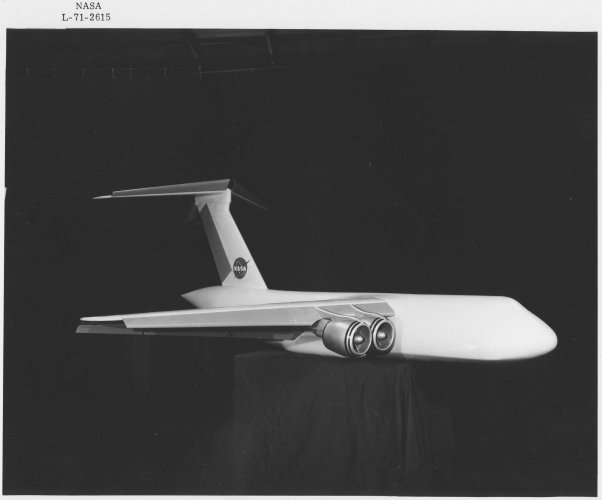
NASA did identify this model as a "C-5" but I think that was only a matter of convience. The same "C-5" model was used in the early '70s for 'free-flight' windtunnel test for NASA upper surface blowing development.
The tail was enlarged and moved forward to avoid the wake of new "siamese" USB nacelles on top of the wings.
The tail was enlarged and moved forward to avoid the wake of new "siamese" USB nacelles on top of the wings.
Attachments
- Joined
- 4 May 2008
- Messages
- 2,445
- Reaction score
- 828
I dont think it is an all moving surface, i think it is a leading edge flap deployed upwards...
[/quote]
hmmm...you are right. Now that I zoom on the picture i see the deflected flap, I hadn't even noticed it at first. Leading edge slat and all moving tail would probably be overkill.
What made me think of the all moving tail was that rounded fairing at the intersection of the fin and the 'bullet' fairing of the horizontal tail. In other aircraft that's necessary to permit the rotation of the all-moving tail. Well, this being a wind tunnel model that has seen many uses, it is possible that it had provision for both, although I can't really tell except for that suspicious rounded fin.
[/quote]
hmmm...you are right. Now that I zoom on the picture i see the deflected flap, I hadn't even noticed it at first. Leading edge slat and all moving tail would probably be overkill.
What made me think of the all moving tail was that rounded fairing at the intersection of the fin and the 'bullet' fairing of the horizontal tail. In other aircraft that's necessary to permit the rotation of the all-moving tail. Well, this being a wind tunnel model that has seen many uses, it is possible that it had provision for both, although I can't really tell except for that suspicious rounded fin.
spectre
BOOM
- Joined
- 7 January 2007
- Messages
- 23
- Reaction score
- 3
Thank you!!Apophenia said:NASA did identify this model as a "C-5" but I think that was only a matter of convience. The same "C-5" model was used in the early '70s for 'free-flight' windtunnel test for NASA upper surface blowing development.
The tail was enlarged and moved forward to avoid the wake of new "siamese" USB nacelles on top of the wings.
Any more information would be great.
It looks like the pictures #2 and #3 that you posted have much different engines then the picture I posted and your #1 picture. Those engines defiantly have the exhaust blowing over the top of the wing...
What was the outcome of this project, and if able to provide, what were the development or project numbers.
Thanks again
- Joined
- 25 July 2007
- Messages
- 4,916
- Reaction score
- 5,537
I'm not sure if NASA staff had specific engines in mind for their overwing USB model. Langley Research Center staff were looking at USB for a number of reasons -- quiet(er) airliners, civilian short-field transport aircraft, and an anticipated DOD request for a STOL Hercules replacement.
The first two resulted in the C-8A QSRA or Quiet Short-haul Research Aircraft (NASA 715, a modified DHC Buffalo). For the latter project (USAF's Advanced Medium STOL Transport), based partly on NASA USB windtunnel results (Nov 1971) Boeing selected USB for its YC-14 candidate for the AMST contest. Well, at least that's what Langley claims ;D
The first two resulted in the C-8A QSRA or Quiet Short-haul Research Aircraft (NASA 715, a modified DHC Buffalo). For the latter project (USAF's Advanced Medium STOL Transport), based partly on NASA USB windtunnel results (Nov 1971) Boeing selected USB for its YC-14 candidate for the AMST contest. Well, at least that's what Langley claims ;D

- Joined
- 26 May 2006
- Messages
- 38,282
- Reaction score
- 20,422
Attachments
Last edited by a moderator:
- Joined
- 25 July 2007
- Messages
- 4,916
- Reaction score
- 5,537
NASA called the model a "C-5" but, as AeroFranz suggests, it represented a generic transport shape used to test various flap/slat arrangements and USB nacelles (hence tailplane position change).
Last edited by a moderator:

- Joined
- 25 June 2009
- Messages
- 15,515
- Reaction score
- 9,444
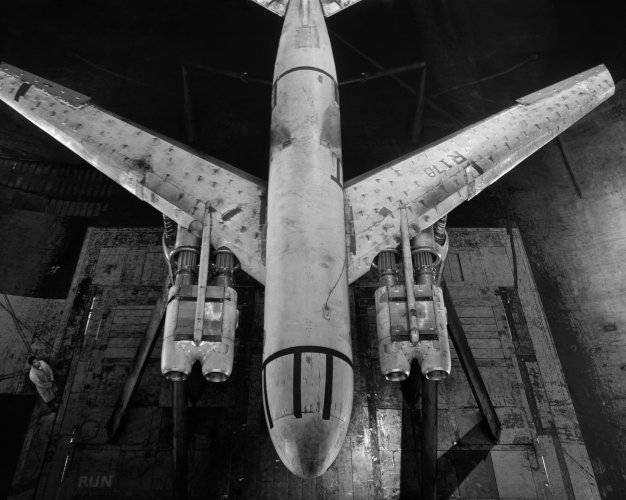
As I was browsing through the impressive collection of photographs released by NASA on their CRgis website, I came across this formidable and unlikely project: a VSTOL version of the C-5 Galaxy! As I couldn't tell if it was an actual Lockheed project or a NASA initiative, I decided to create this separate topic.
Four photographs are available on the site:
http://crgis.ndc.nasa.gov/historic/Additional_Photos_for_30_X_60_Full_Scale_Tunnel:_Other_Tests_2#VSTOL_Model
Four photographs are available on the site:
http://crgis.ndc.nasa.gov/historic/Additional_Photos_for_30_X_60_Full_Scale_Tunnel:_Other_Tests_2#VSTOL_Model
Attachments
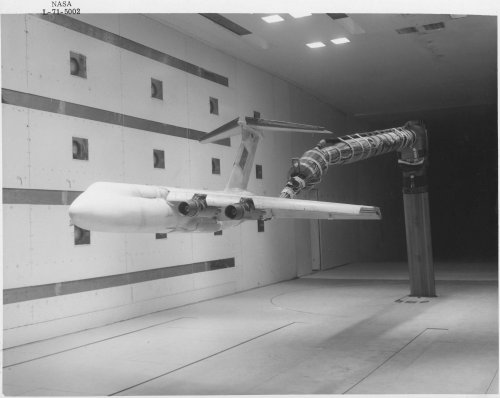
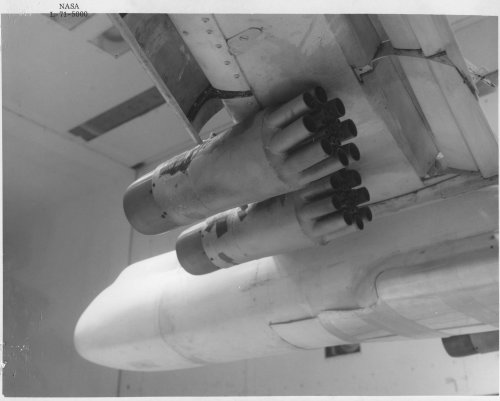

My guess is that the C-5 model was just a convenient, on-han d model for testing with the basic engine concpt. Ain't no way of horsing the C-5 into the air straight up, especially with *those* dinky engines.

- Joined
- 13 August 2007
- Messages
- 10,423
- Reaction score
- 18,114
that more a STOL in stile of C-17
can this be Lockheed part of The Advanced Medium STOL Transport (AMST) competition ?
can this be Lockheed part of The Advanced Medium STOL Transport (AMST) competition ?
- Joined
- 25 June 2009
- Messages
- 15,515
- Reaction score
- 9,444
More pics of the VSTOL Galaxy here:
http://crgis.ndc.nasa.gov/historic/File:L-70-7127.jpg
http://crgis.ndc.nasa.gov/historic/File:L-70-7128.jpg
http://crgis.ndc.nasa.gov/historic/File:L-70-7129.jpg
http://crgis.ndc.nasa.gov/historic/File:L-70-7130.jpg
http://crgis.ndc.nasa.gov/historic/File:L-70-7131.jpg
http://crgis.ndc.nasa.gov/historic/File:L-70-7127.jpg
http://crgis.ndc.nasa.gov/historic/File:L-70-7128.jpg
http://crgis.ndc.nasa.gov/historic/File:L-70-7129.jpg
http://crgis.ndc.nasa.gov/historic/File:L-70-7130.jpg
http://crgis.ndc.nasa.gov/historic/File:L-70-7131.jpg
- Joined
- 25 July 2007
- Messages
- 4,916
- Reaction score
- 5,537
The forward-placed fin, modified horizontal tail, and full-span flaps shown in some of the windtunnel photos suggest that this is the same model used for USB and other tests.
http://www.secretprojects.co.uk/forum/index.php/topic,5366.0
http://www.secretprojects.co.uk/forum/index.php/topic,5366.0

Grey Havoc
ACCESS: USAP
- Joined
- 9 October 2009
- Messages
- 24,500
- Reaction score
- 18,175
Pity the site is 'under review' at the moment.More pics of the VSTOL Galaxy here:
http://crgis.ndc.nasa.gov/historic/File:L-70-7127.jpg
http://crgis.ndc.nasa.gov/historic/File:L-70-7128.jpg
http://crgis.ndc.nasa.gov/historic/File:L-70-7129.jpg
http://crgis.ndc.nasa.gov/historic/File:L-70-7130.jpg
http://crgis.ndc.nasa.gov/historic/File:L-70-7131.jpg


Маска
ACCESS: Confidential
- Joined
- 16 May 2026
- Messages
- 127
- Reaction score
- 428
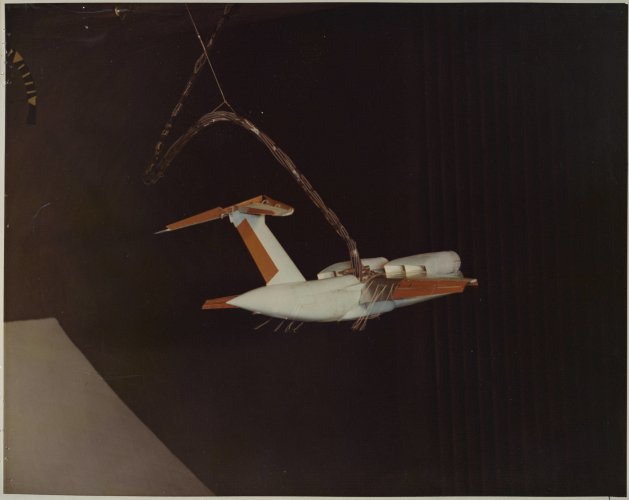
EBF Flying Model June 23, 1971Can someone shed some light on this C-5 Galaxy/NASA project? I was given this picture via email. Looks like STOL C-5? Blown flaps?
Thank you in advance.
Attachments
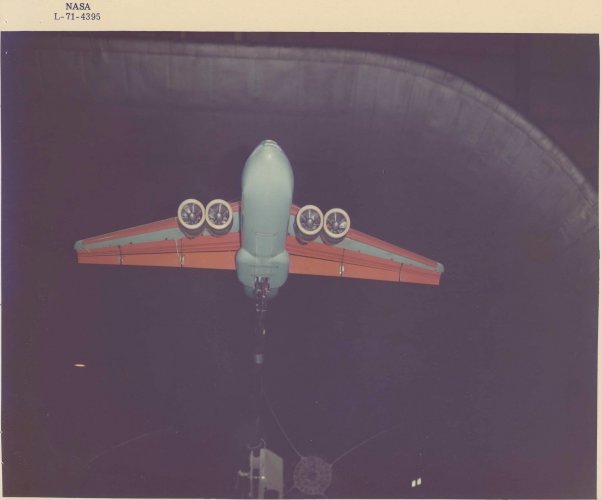
Not a C-5
- Joined
- 13 August 2007
- Messages
- 10,423
- Reaction score
- 18,114
the mention PDF in post #9 is title:Not a C-5
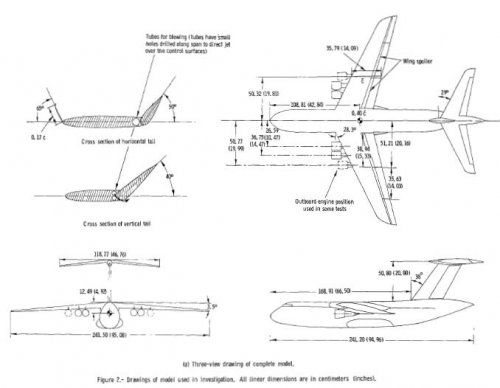
Wind-tunnel Investigation of an external-flow jet-Flap transport configuration having full-span Triple-slotted flaps
A wind-tunnel investigation has been conducted to determine
the performance and static stability and control characteristics of an external-flow jet-flap transport configuration
having inboard pod-mounted engines and full-span triple-slotted flaps. Tests were made
with the engines mounted clustered at 22.0 percent and 30.4 percent semispan to represent
double (Siamese) pods and with engines mounted at 22.0 percent and 41.7 percent semispan
to represent a more spread arrangement. Tests were also made to evaluate the effectiveness
of wing leading-edge blowing as a means of improving the aerodynamic efficiency of the con-
figuration and of eliminating the large engine-out roll asymmetries that ,occurred for the
configuration when the wing with an engine out stalled first.
I guess they use a C-5 model for the test to have reverence data to compare the resultsThe investigation was conducted on the four-engine high-wing jet transport model illustrated by the three-view drawing of figure 2
And they probably had it laying around in a storage room collecting dust, might as well put it to use...I guess they use a C-5 model for the test to have reverence data to compare the results

- Joined
- 1 April 2006
- Messages
- 12,285
- Reaction score
- 15,110
original model from 1969
https://ntrs.nasa.gov/citations/19690026880
https://ntrs.nasa.gov/citations/19690026880
Attachments
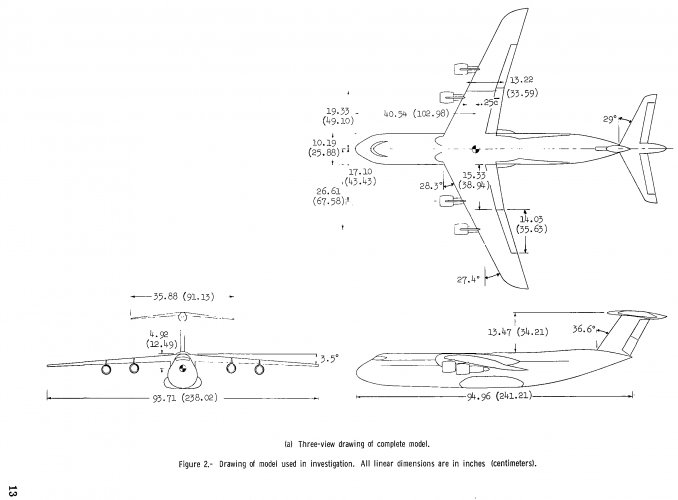
it isn't nothing like the C-5 tailI guess they use a C-5 model for the test to have reverence data to compare the results
Similar threads
-
Various Lockheed military transport projects
- Started by Dronte
- Replies: 30
-
 Lockheed ADP/NASA Langley 1990 Mach 4 - Mach 5 methane fueled aircraft studies
- Started by flateric
- Replies: 28
-
 Lockheed Martin C-5M Super Galaxy replacement
- Started by Triton
- Replies: 46
-
McDonnell Douglas/NASA Langley propfan ADVANCED TACTICAL TRANSPORT (1989)
- Started by flateric
- Replies: 2
-
McDD Impact of agility requirements on configuration synthesis study (1994)
- Started by flateric
- Replies: 10