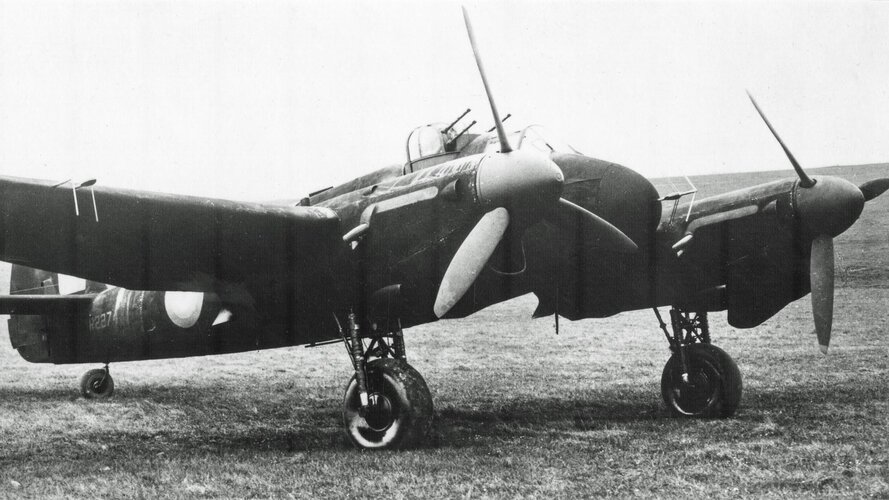
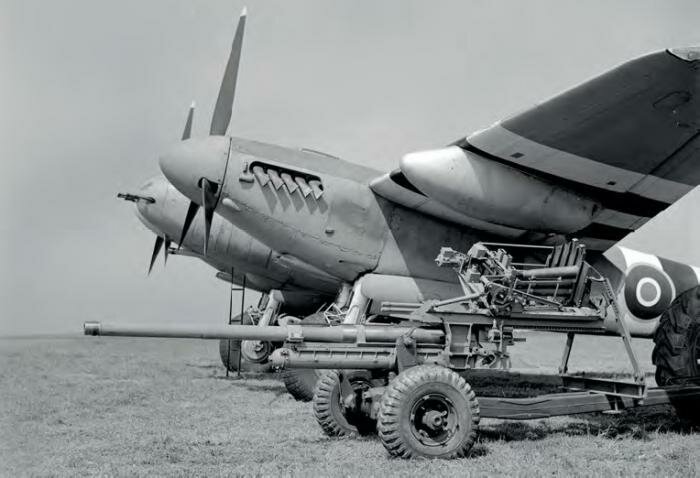
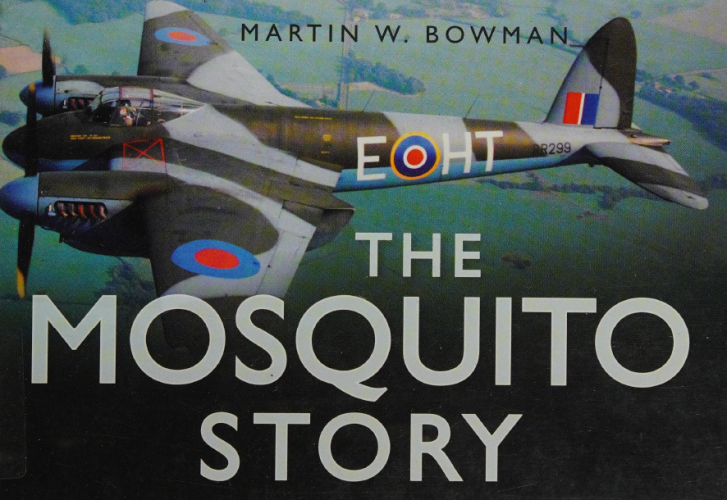
Mosquito night fighter in combat
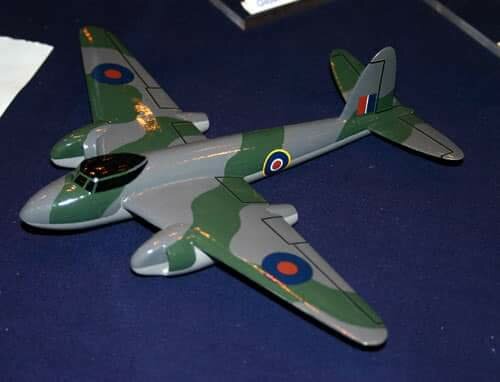
A long-range day time fighter version of the de Havilland D.H. 98
Mosquito fast bomber was ordered in July 1940 to counter the threat of the Focke-Wulf Fw 200 German bombers over the Atlantic.
The structure comprised a balsa-birch plywood sandwich monocoque, with a smooth surface and part stressed-skin construction.
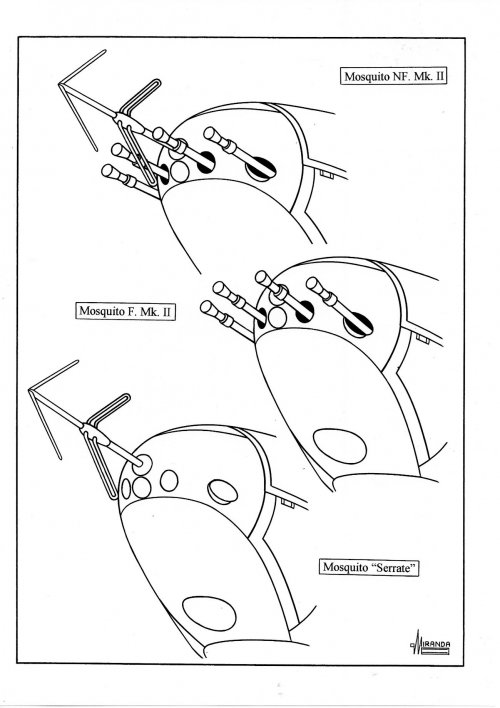
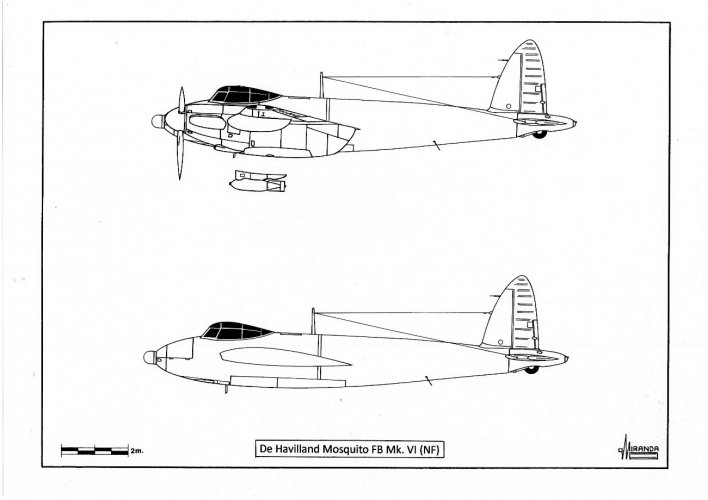
In August, a series of twenty-seven F. Mk. II pre-production aircraft were built with strengthened wing spars, optically flat bullet-proof windscreen, fighter stick for the pilot, door on the starboard side of the fuselage, four nose mounted 0.303 in. Browning machine guns, with armored bulkhead and four belly mounted (belt-feed) 20-mm. Hispano cannons.
During the German night blitz, between September and May 1941, the British emergency night fighters
Blenheim, Beaufighter, Defiant, Hurricane and
Spitfire inflicted less than 2 per cent casualties to the
Luftwaffe bombers.
By mid-1941, the risk of a second night bombing offensive forced the Ministry of Aircraft Production to reconsider the use of the
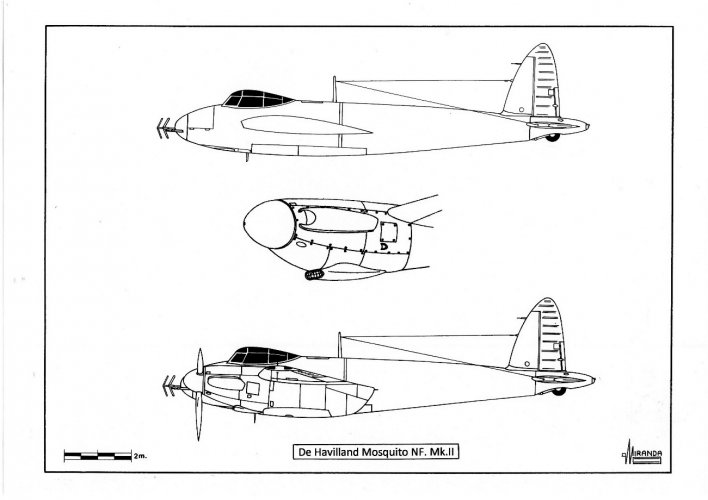
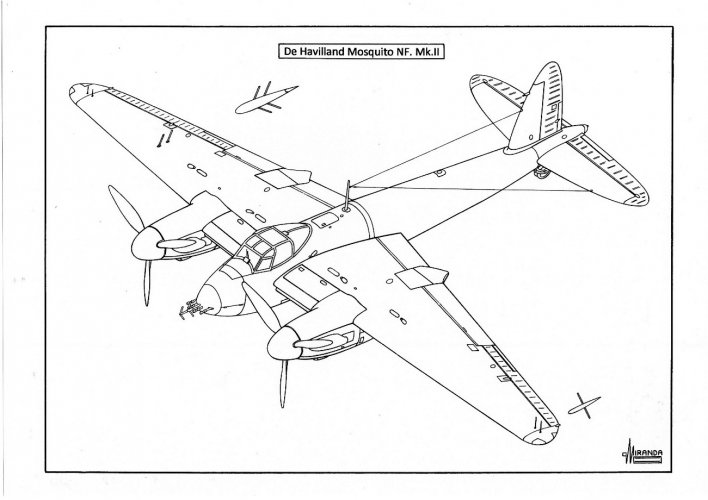
Mosquito fighters, and all airframes nearing completion, to be modified into NF. Mk. II night fighters with a nose mounted AI. Mk. V radar, shrouded exhausts, and cone-shaped muzzle suppressors for the machine guns, which had a tendency to blind the pilot when they were fired.
The first squadron to be equipped with the type, replacing the slow
Beaufighters and
Havocs on January 26, 1942, was the No. 157 (RS)
The NF. Mk. II was also used by the Squadrons Nos. 23 (YP), 25 (ZK), 27 (PT), 85 (VY), 141 (TW), 151 (DZ), 169 (VI), 239 (HB), 264 (PS), 307 (EW), 410 (RA), 456 (RX), 515 (3P) and 605 (LA).
The first night kill, one Dornier Do 217 bomber, was achieved during the night of 29/30 May 1942.
The
Mosquito proved a very capable night fighter, but the limited range of the AI Mk. V radar prevented the NF. Mk. II to develop its full potential until July 1943.
During the war,
Mosquito night fighters downed 487 enemy aircraft and 428 flying bombs over the British Isles.
The AI. Mk. V radar used the same antenna system as the older AI Mk. IV but had an additional screen to assist the pilot during the last phase of the interception.
Because the long wavelengths used, minimal radar range was too large and any target closer than 1,000 ft. could not be detected.
The night fighter had to approach up to a distance of 600 ft. to be able to visually identify the target before firing, but often radar contact was lost before the pilot could see it and the enemy managed to escape.
The AI. Mk. V was classified as top secret because it used a very high frequency spectrum between 0.2 and 0.5 GHz, and the night fighters carrying it were not allowed to fly over the Reich.
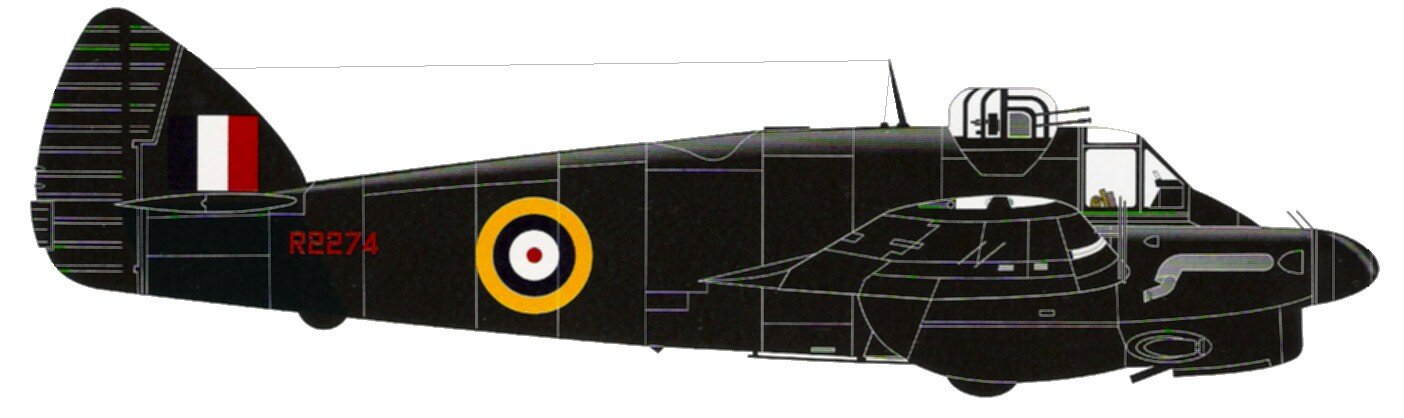
Since March 24, 1941, all the British nigh fighters were painted with super-matt RDM2A
Special Night overall finish, 54 in. Type B roundels in the upper wing surfaces, 42 in. Type A.1 fuselage roundels, Dull Red (FS 30109) codes and serial numbers.
In March 1942, during the comparative trials between the
Mosquito W4078 (painted in
Special Night) and the
Mosquito W4082 (painted in standard black
Smooth Night DTD 308), the speed differential was some twenty-six miles per hour.
The A&AEE Establishment at Boscombe Down disagreed and measured a drop of only eight miles per hour on April 8.
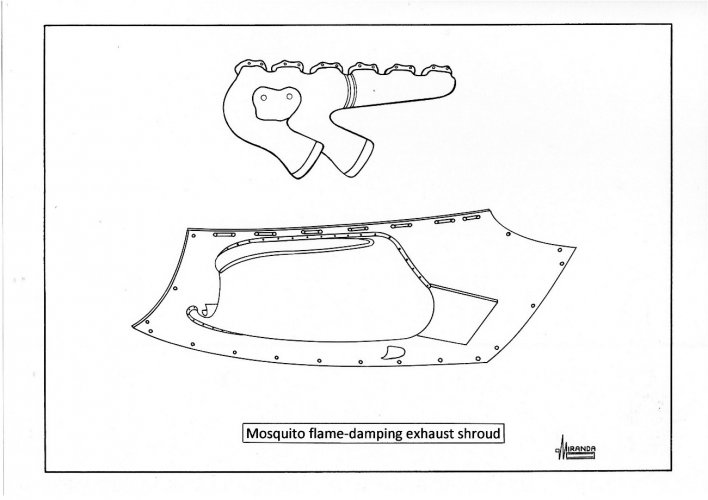
A new bulbous streamlined covering which enclosed the ‘saxophone’ exhaust stubs on each side of the engine nacelles was introduced in January 1942.
The flame-damping exhaust shrouds were needed to prevent the flames, betraying the night fighter position in the darkness. But these devices slowed the plane down by 10 mph and sometimes were removed in squadrons.
The radar array in the nose and wings also slowed the aircraft by some 20 mph, due to the parasite drag.
On February 5, 1942, the Fighter Command urged that
Smooth Night DTD 308 paint finish be introduced to all
Mosquito night fighters.
On December 1, the camouflage scheme of the night intruders was changed to Dark Green (FS 34079)/Medium Sea Grey (FS 36270) upper surfaces
, Smooth Night under surfaces, Type C.1 fuselage roundels, Dull Red (FS 30109) codes and Black serials.
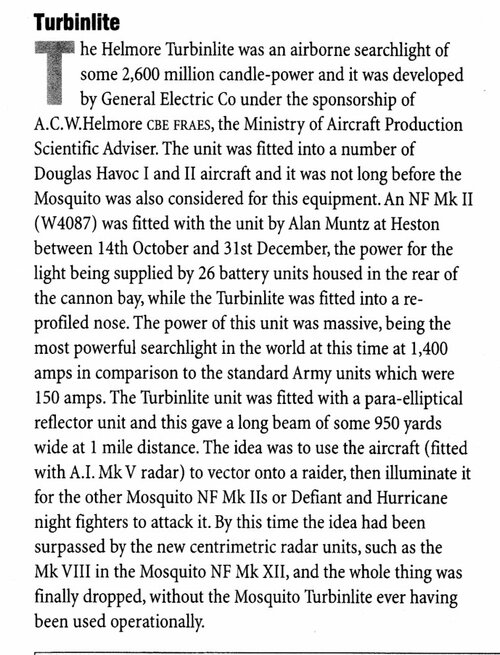
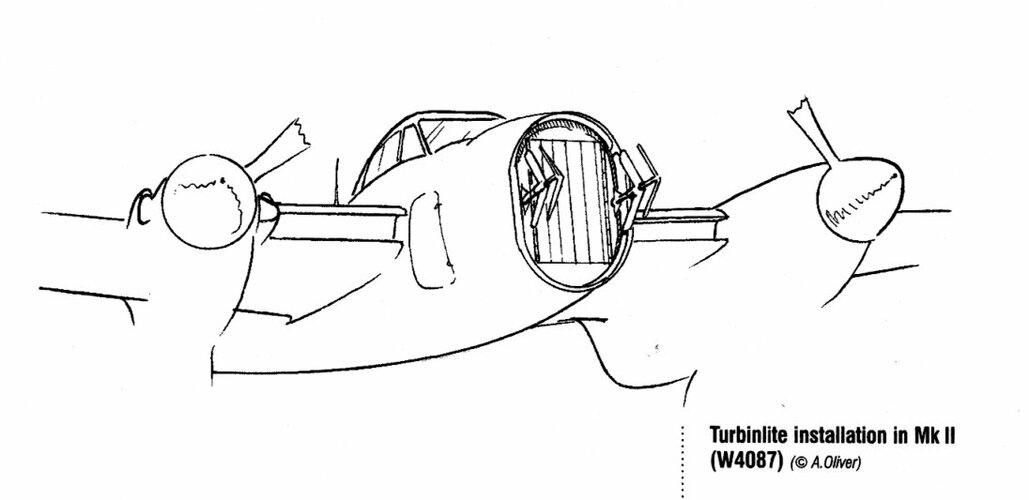
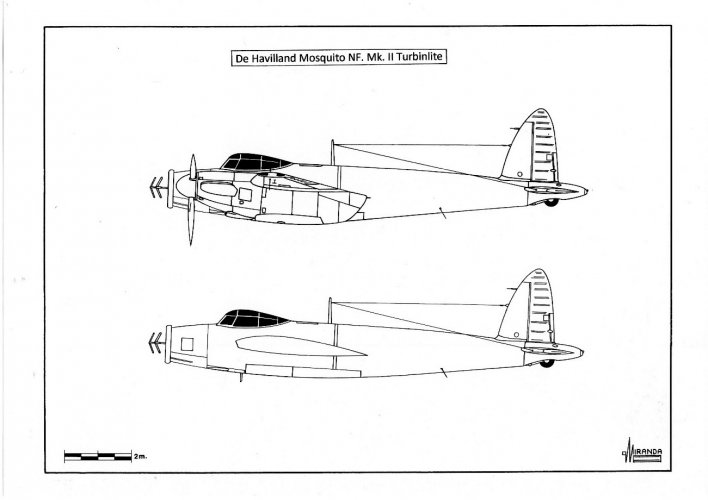
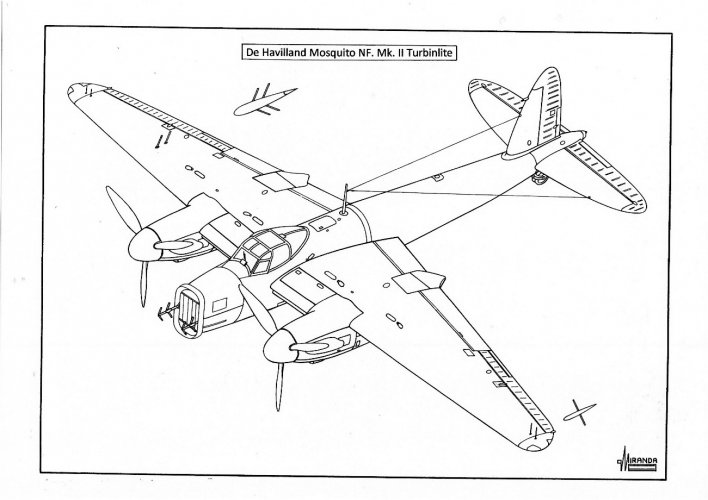
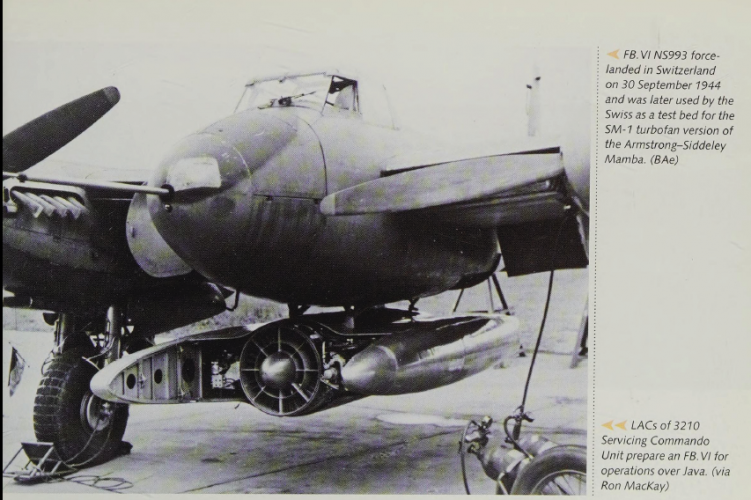
In October 1942 the NF. Mk. II (W4087) was experimentally fitted with the mixed system of radar and searchlight Helmore
Turbinlite.
The nose mounted reflector unit gave a light beam of 1,000 yards wide and one mile range.
One
Townend type ring was used to smoot out turbulences and hydraulically opened shutters concealing considerable glow after ‘blipping’ the light.
The power was supplied by 26 battery units housed in the bomb bay.
The prototype retained its armament, and it was hoped that the aircraft could operate as an independent night fighter without ‘satellite’ aircraft, locating the target with its Mk. V radar, and using the searchlight during the last phase of the interception.
Early in 1943, the W4087 was tested by Squadrons Nos. 85 (VY), 151 (DZ) and 532 (NH), but trials showed that the system was ineffective and the pre-production batch of 21 machines was cancelled.
In July 1942, twenty-five NF. Mk. II airframes from the 6th and the 9th production batches were modified into night intruders, with their radars removed, one additional fuel tank with 150 imp. gal housed in the bomb bay, extra ammunition, and
Gee navigational aids.
The
Gee system allowed the navigator to calculate the fighter location by receiving pulse radio signals from a trio of ground stations in Britain.
The new version was re designated NF. Mk. II Special and used by the Squadrons Nos. 23 (XP), 25 (ZK), 239 (HB), 264 (PS), 333 (KK), 455 (UB), 456 (RX), 458 (BP) and 605 (LA) in
Ranger night intruder operations in France, Italy, and Tunisia.
The NF. Mk. II Special type was also used in
Instep long-range daytime operations over the Bay of Biscay against the German
Zerstörers Junkers Ju 88 C-6.
Each
Instep mission was performed by six aircraft flying at 100 ft. altitude over the sea.
Early in July 1943, the AI. Mk. V radar was replaced by the old AI. Mk. IV equipment and the NF. Mk. II’s were allowed to fly over the Reich.
By the end of the year a number of
Serrate Mk. II homers and
Perfectos devices were installed in the NF. Mk. II night fighters of the 100 Group, to locate the emissions of electronic equipment used by the
Nachtjagd.
Perfectos tracked German FuG 24a IFF signals and
Serrate tracked the emissions of the AI FuG 202
Lichtenstein BC in conjunction with the AI. Mk. IV radar But if the target was further away from the
Mosquito than the ground, the reflection would swamp the radar screen.
The AI. Mk. IV was completely jammed by the Germans by mid-1944, but shorter wavelengths would solve many of these problems.
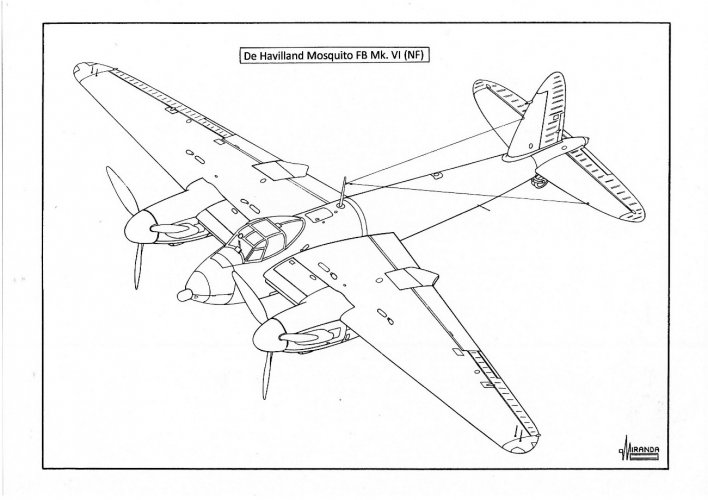
In autumn some FB. VI Series I fighter-bombers were modified as NF. Mk. VI night intruders/night fighters with the installation of one AI. Mk. XV ASH ‘centimetric’ radar pod in the nose, azimuth aerials in both wingtips, RT-5 transmitter/receiver,
Monica tail warning radar,
Rebecca radio-beacon system, GEE radio-navigation device,
Lucero IFF Mk. III, infra-red telescope for Type F/Type Z IR/IFF identification systems and a 150 imp. gal housed in the bomb bay.
The 3.2 cm. wavelengths of the ASH radar allowed to detect targets flying at low altitudes.
The NF. Mk. VI type was similar to the NF. Mk. II, but had a new wing which could accommodate drop tanks or bombs in external racks.
In June 1943 most of the FB. VIs production was appearing as night fighter, finished in Dark Green/Ocean Grey/Medium Sea Grey with Red codes and Black serials.
Towards the end of 1943,
Mosquitoes NF. Mk. II and NF. Mk. VI supported each Bomber Command raid by carrying out three attacks on the
Nachtjagd with several hours of interval between them.
The first attack consisted of a low-altitude penetration against the German airfields, to create confusion and delay the take-off of the enemy night fighters in advance of the Bomber Stream. Only the Mk. VI night intruders were used in this operation, armed with two 250 lb bombs.
The second attack consisted of a high-altitude penetration by the Mk. II’s night fighters to form a protective screen, flying 30 miles in parallel with the ‘Bomber Stream’, to counter the
Nachtjagd tactic of infiltrating its night fighters into the ‘Stream’.
The third attack used to be a repeat of the first, to harass the German night fighters as they returned to land on low fuel. During this operation the Germans illuminated the runways and the planes that landed could be easily attacked by the intruders.
The
Mosquito intruders caused alarm among the German night crews for their numbers proportion. Night
Mosquitoes became the main scare for the
Nachtjagd, forcing their night fighters to carry rear gunner and tail warning radars
Neptun-R or
Lichtenstein SN-2d.
At the end of 1942, the
Luftwaffe began strengthening the
Luftflotte 3 based in France with a force of 120 Dornier Do 217 and Junkers Ju 88 A-14 modern bombers.
The Fighter Command assumed that German raids, in retaliation for the RAF’s growing bombing campaign on British cities, would begin in early 1943.
In January 1943, the American bombers based in England started their daylight incursions over the Reich. Simultaneously, the RAF started to use the H2S cartographic radar that greatly improved the accurateness of night bombing. The German defences, despite their sophisticated early warning network, could not stop them.
The British launched 600 tons of bombs over Berlin on March 1. The German retaliation meant the loss of 57 bombers for the
Luftwaffe, with the mediocre result of 100 tons launched at London outskirts. After the failure of the Messerschmitt Me 210, the Germans did not have anything to compete against the
Mosquito.
The British defenses had been continually reinforced since 1940. By 1943 they consisted in 100 radar stations, some 2,000 barrage balloons, 2,500 anti-aircraft cannons and new GL radars in the searchlights. But the new
Beaufighter NF. Mk. VI F night fighter, fitted with AI. Mk. VII radar lacked the speed needed to catch the German night fighters Messerschmitt Bf 110 G-4 or the night intruders Focke-Wulf Fw 190 A-4/A5.
In April 1943, the Fw 190 intruders would initiate attacks, flying over the sea at low altitude to avoid the detection of the Chain Home Low radar system that would be faster than the
Mosquito night fighters after being freed from the weight of the bombs. These ‘hit-and-run’ tactics took advantage of the very limited range of the AI Mk. IV radar of British night fighters when flying at low altitude.
The RAF responded by rapidly introducing new aircraft like the
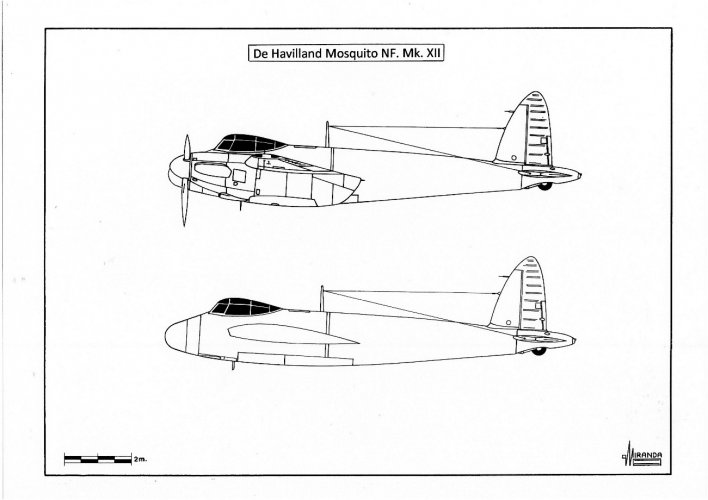
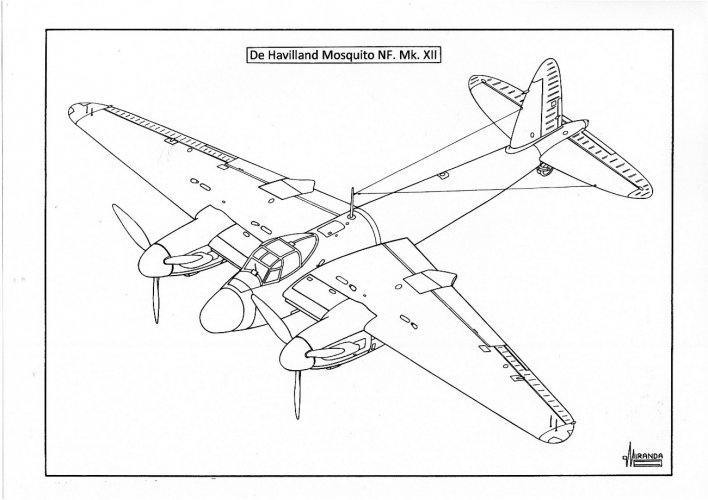
Mosquito NF. Mk. XII.
The new type was an old NF. Mk. II fitted with a ‘thimble’ nose radome containing the spinning-dish scanner for the pre-production AI. Mk. VII low-looking ‘centimetric’ radar, two dipole antennas mounted above and below each wingtip and an AN/APN-1 radio-altimeter with two inverted “T” dipoles under both wings.
The AMRE radio-transparent radome was a composite material of polystyrene and cotton, bound with phenol formaldehyde resin.
Ninety-seven NF. Mk. II airframes without machine guns were modified into Mk. XII’s by Marshall Aviation in Cambridge.
The type entered squadron service in February 1943 and was used by Squadron Nos. 24 (RX), 46 (FH), 96 (ZJ), 108 (GB), 151 (DZ), 256 (JT), 307 (EW), 406 (HU), 488 (ME) and 604 (NG).
In August 1942, the Germans believed that the equipment able to operate on ‘centimetric’ wavelengths could not be achieved until 1944. In December 1942 the
Mosquito made the first accurate attack with the
Oboe system (an application of their IFF) although little afterwards the Germans could interfere it emitting on 1.25 m.
The Technical Service of the
Luftwaffe concluded on January 15, 1943, that the centimetric wavelengths did not represent a military advantage that justified the effort to obtain them. That would have meant to retire all the available radio technicians from the war front, modify the production lines to manufacture new types of radio lamps, obtain bigger quantities of wolfram from the allied countries and delay the series production of the AI FuG 216/217
Neptun.
On February 2, a
Stirling bomber of the Pathfinder Force, that marked targets for an incursion against Hamburg, was shot down by the flak over Rotterdam. The examination of the wreck showed that part of its electronic equipment operated on 9 cm wavelength. It was one of the first
H2S cartographic radars that could be recovered almost intact, as the self-destruction mechanism did not work. It was based on the cavity magnetron technology, a casual discovery made by J.T. Randall and A. H. Boot in 1940.
When the German technicians could make it work, they were astonished by the quality of the images received through its small parabolic mirror. Geographical features or even the shape of ships and airplanes could be clearly distinguished at a time when the FuG 220
Lichtenstein SN-2 still operated on 3.30 m.
The British were unaware that the enemy already knew the magnetron technology and their fighters equipped with ‘centimetric’ radars were not allowed over the Reich until May 1944.
The Mk. XII first night kill, one Dornier Do 217, was achieved during the night of 14/15 April 1943.
On May 14, one Fw 190 was shot down near Evreux. The first Messerschmitt Me 410 A was downed during the night of 13/14 July and the first Ju 188 on the 15/16 October.
The new Fw 190’s tactic
Jagdbomber mit vergrösserter Reichweite (
Nacht Jabo-Rei) proved a failure due to poor planning and the recent entry into service of the new
Mosquito N.F. Mk. XII.
Between April and November 1943, 36 Fw 190s from SKG 10 carried out ten night attacks on England, but 22 of them were lost in combat and accidents. The aircraft were painted overall with a heavy black distemper coat.
The few surviving intruders were modified to act as Fw 190 A-4/U2/N night fighters with the 2./JG300.
The AI. Mk. VIII A, developed by Telecommunications Research Establishment (TRE), operated with 3.3 GHz frequency and 9.1 cm. wavelength.
Pre-production model had a normal detection range about 4 miles, but in the Mk. VIII B version the range was to be extended to at least 10 miles, with reduced minimum range of 200 feet.
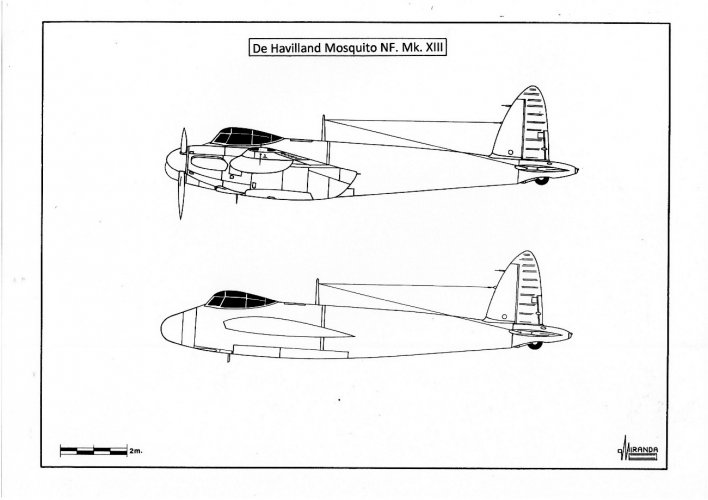
By the end of 1943, the NF. Mk. XII was superseded by the NF. Mk. XIII with much longer range.
The new type was a modified FB. Mk. VI with one nose mounted AI. Mk. VIII B radar, ‘thimble’ nose radome, two dipole antennas mounted above and below the wingtips, AN/APN-1 radio-altimeter,
Gee radio-navigation device and two wing attachments for 50 imp. gal drop tanks.
The radar beam scanned a cone ahead the fighter 45 degrees, from center line in all directions.
The NF. Mk. XIII became operational with Sqn. No. 488 (ME) on October 8, 1943, and with the Sqns. Nos. 29 (RO), 96 (ZJ), 108 (GB), 151 (DZ), 256 (JT), 264 (PS), 409 (KP), 410 (RA) and 604 (NG) operating as an intruder, long range escort and defensive night fighter.
The first kill scored was a Messerschmitt Me 410 intruder from KG2 downed on November 8, 1943.
Of the two hundred and sixty units built, one hundred and eighty-seven airframes from the late production batch were delivered with AI. Mk. X radar and Perpex ‘bull nose’ universal radomes and fifty aircraft of the first production batch (HK 382 to HK 432) were retrofitted with AI. Mk. X radar and Nitrous-Oxide power boost system, resulting in a speed increase of 47 mph at 27,000 ft.
Most of these machines were operated by Sqns. Nos. 96 (ZJ) and 410 (RA).
On July 24, 1943, the Bomber Command performed a mass attack on the heart of the Reich, using
Window, interference equipment installed in the aircrafts, electronic decoys and long range escort fighters.
At the beginning of 1944, in retaliation for the bombing of German cities, the
Luftwaffe began the last strategic bombing campaign
Unternehmen Steinbock against some British towns with 474 bombers, one Group of Me 410 night-intruders,
Düppel chaff and FuG 123
Truhe navigation system.
The offensive was a costly failure: night after night the German bombers were located and hunted down by twenty-three squadrons of British night fighters equipped with ‘centimetric’ interception radars, resulting in the shooting down of hundred-and-twenty-one Dornier Do 217, two-hundred-and-seventy Junkers Ju 88, thirty-five Junkers Ju 188, twenty-five Focke-Wulf Fw 190 A-4/U8, twenty-seven Messerschmitt Me 410 and forty-six Heinkel He 177.
The prototype of the high-altitude pressurized bomber D.H.
Mosquito B. Mk. XVI was flown on August 8, 1942.
Early in September, De Havilland’s design staff was asked to produce an emergency high-altitude fighter capable of intercepting the Ju-86 R-2 bomber.
The
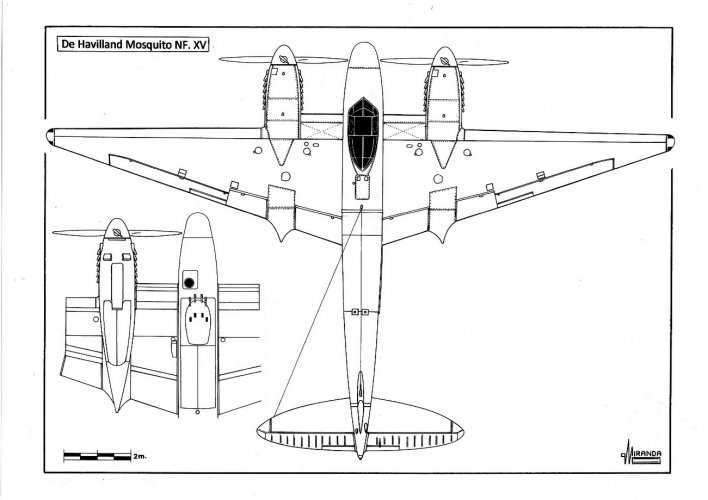
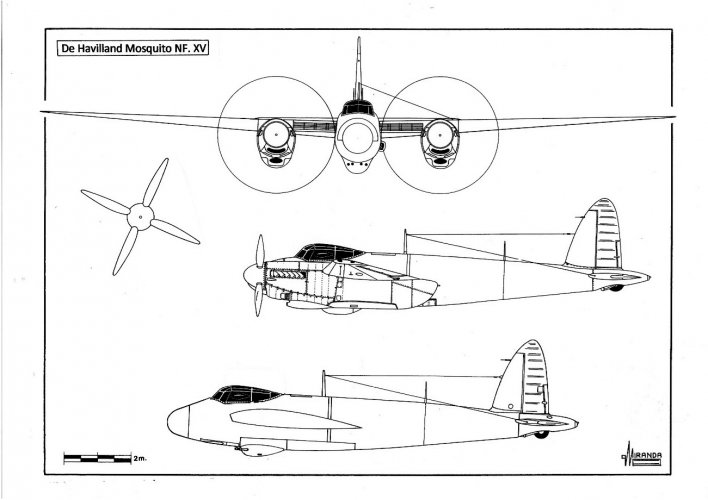
Mosquito F. Mk. II (MP 469) was converted into the F. Mk. XV high-altitude, pressurized interceptor and flew on September 14, 1942, powered by two R.R. two-speed, two-stage Merlin 61 supercharged engines driving four-blade Hydromatic metal propellers with 12 ft. diameter.
The new fighter was fitted with pressure cabin, lightened airframe, extended span wings (59 ft.) and tailplane, and four nose mounted 0.303 in. machine guns.
On September 16, the aircraft was attached to High Altitude Flight at Northolt but did not participate in the high-altitude combat of September 27, 1942.
During trials at Boscombe Down, on January 13, 1943, the prototype attained 43,000 ft altitude in 33 minutes and 408 mph top speed at 15,000 ft.
By the end of November 1942, four B. Mk. IV bombers (DZ 366, DZ 385, DZ 409 and DZ 417) were converted at Hatfield plant into NF. Mk. XV pressurized night fighters with 63 ft. wingspan, bomber “Vee” windshield and ventral hatch, smaller wheels, Merlin 77 engines, fighter stick, AI. Mk. VIII radar with revise style nosecone, AN/AP-1 radio-altimeter, AN/ARA-8 radio direction finder and four 0.303 Browning machine guns housed in an external fairing below the fuselage.
On March 1943, one NF. Mk. XV attained 44,600 ft. with only two Brownings and 200 rounds of ammo.
These airplanes went to No. 85 Sqn (VY) Special ‘C’ Flight for service trials between April and August 1943 but never made a successful interception.
The prototype was painted in standard day camouflage Dark Green (FS 34079)/Ocean Grey (FS 36152) with P.R.U. Blue (FS 35189) undersurfaces and spinners.
Pre-production aircraft were painted overall Matt Deep Sky (FS 35102) with 54 in. Type B upper wing roundels and 36 in. Type C.1 fuselage roundels and Black spinners, serial, and nose radome.
Early in 1943 the British government placed an order for 2,900 sets of the American AI ‘centimetric’ radar SCR-720B, under the codename AI. Mk. X.
When the first AI. Mk. X set became available in February, it was mounted in the nose of NF. Mk. II (DZ659) that made its first flight in March 1943.
DZ659 proved to be a very effective night fighter and, during the summer, 100 late production Mk. IIs (with the old wing and no drop tanks) were converted into NF. Mk. XVII with AI Mk. X and ‘bull nose’ made by Indestructo Glass Company with 0.31 in. thick Perpex.
The new radar operating in 9.1 cm. wavelength and 3,300 megacycles, with 70 Kw power, and detection ranges, covered between 10 miles and 375 feet.
Compared to FuG 202 German radar, the AI Mk. X had a much wider helical scanning arc and better minimum range.
The type entered service with the Squadron No. 24 (RX) on January 4, 1944, and achieved its first night victory, one Ju 188, on February 20.
Squadrons Nos. 24 (RX), 29 (RO), 85 (VY), 239 (HB), 456 (RX) and FIU (ZQ) would use the NF. Mk. XVII against the V-1 flying bombs.
The Battle of Britain was not the only moment of panic experimented by the RAF, however. Between June 1944 and March of 1945 the RAF had to cope with the attack of 11,700 flying bombs.
In May 1943 the Allies intelligence services discovered the existence of a German catapult-launched missile that was being developed at Peenemünde-West test centre. In August, an air-launched prototype of pilotless airplane of the Karlshagen research centre crashed on Bornholm-Denmark and some pictures, taken by the Resistence, came into the hands of the Allies.
In September the photographic reconnaissance carried out by
Mustang Mk. III,
Mosquito PR IV and
Spitfire PR XI spy planes located 133 'ski shaped buildings' with axis pointing directly toward London. They were launch ramps built for the new cruise missiles V-1 manufactured by the firm Fieseler, under the designation Fi 103, using welded sheet steel and plywood with a 280 man/hour and 1,500
Reichmarks cost. They were powered by an Argus As 014 pulsejet that worked with 625 litres of
Br-Stoff (75-octane non-refined petrol) generating between 245 and 366 kp, enough to transport a warhead containing 830 kg of H.E. Amatol-39 A to London.
The Askania gyroscopic autopilot was a mechanical guidance system that could not be interfered by the Allies electronic countermeasures. A vane anemometer installed in the nose calculated the distance covered, cutting off the fuel flow when the V-1 was on the target. The autopilot of the flying bombs, designed to attack targets the size of a city, was not accurate enough to achieve impacts on Normandy beach heads, or in the ports in southern England, from where the supplies were sent to the armies of the Allies.
Yet the British did not know that and, during the weeks preceding the D-Day, launched a desperate offensive against the V-1 launch sites and storage buildings built between Cherbourg and Calais. Using all available aircraft, capable of carrying bombs or rockets, they were able to destroy a 25 per cent of the facilities, delaying the release of the first missiles until a week after the Normandy landings.
British anti-aircraft batteries, located between Dover and Hastings, were equipped with 2,729 anti-aircraft guns, shooting proximity-fuse shells, and fitted with predictor fire-control radar systems.
To face the 'robot offensive' the defences of the Operation Diver were formed by four lines: long range fighters, operated from the southeast of England to near the French coast; the anti-aircraft artillery located in the south coast of England; the area between the coast and London, covered by high performance interceptors, and the urban areas protected by balloons barrages.
The aerodynamic drag of the V-1 airframe was higher than anticipated, due to low standards of manufacturing, decreasing from projected 900 km/h to the real 640 km/h.
Fortunately for the Allies this made the new missile susceptible to be intercepted by conventional fighters.
In the outward perimeter operated the
Mustangs Mk. III of Squadrons 129, 306 (Polish), 313 (Polish) and the
Mosquitoes FB Mk VI of Squadron No. 418 (Canadian). By night,
Mosquitoes NF. Mk XII of Squadrons Nos. 29, 464 (Australian) and 488 (New Zealander), NF. Mk XIIIs of Squadrons Nos. 96, 264 and 409 (Canadian), NF. Mk XVIIs of the Squadron No.125, NF. Mk XVIIIs of the Squadrons Nos. 25 and 68, NF. Mk XIXs of the Squadron No. 157, and Northrop P-61
Black Widows of American Squadrons 422nd and 425th took part in the operations.
Since January 1944, the crews of
Mosquito and
Black Widow night fighters using night-vision binoculars developed at Stanford University.
Spitfires Mk IX of Squadrons Nos.1, 165, 274, 453 (Australian) and 610,
Spitfires Mk XV of the Squadron No. 41,
Tempest Mk V of the Squadrons Nos. 3, 56, 80, 274, 486 (New Zealander) and 501 and
Meteors Mk I jet fighters of the Squadron No. 616, operated in the inner area.
The V-1 had a reduced frontal area equivalent to half of the Bf 109, an engine with the diameter of a dish, a mechanic pilot fitted in a shoe box and a steel airframe. It was very difficult to shoot down. As they were camouflaged, it was very difficult to distinguish them from the landscape when over land. Over sea and at low altitude, the estimated height over the surface in diving attack left very little margin to the pilots. By night, the outburst of the pulsejet was visible from 24 km and gave false range measurements. Some
Mosquito pilots, dazzled by the shine, shot from 100 m and one lucky P-61 survived the blast of a V-1 just 46 metres from its nose.
Flying at 725 km/h, a
Tempest had just two seconds to dodge the debris produced by the explosion of the V-1, which had just shot from 275 m. Some pilots preferred to cross the centre of the explosion where there was less shrapnel, but the inflamed fuel affected the engine, and the paint and the fabric covered control surfaces.
To avoid this, a
Mosquito FB VI of the Squadron No. 418 destroyed a V-1 by simply cutting the missile trajectory and putting it out of control with the trail turbulence. On the contrary, a
Meteor of the Squadron No. 616 stroke the missile wing with the fighter wingtip, decontrolling the gyroscopes. This technique, called 'tipping', required speed and piloting ability, and was only used on 17 occasions.
For the
Spitfires the game was even more dangerous, due to its lower structural resistance. They used to start the attack with a dive to gain speed, moving on to horizontal flight at 230 m behind the missile to be able to shoot it. The calculation of relative speeds was complicated, and some pilots died when firing from a too short distance.
It was necessary to modify the fighters to make them fast enough to intercept the V-1. Some
Tempest and
Spitfires Mk XIV were tuned to operate at 11 and 25 psi boost pressures; the
Mustang Mk. III changed their exhaust by those of the
Spitfire engine that generated less drag; the P-47 M
Thunderbolts, with 2,800 hp war emergency power boosted engines, were modified halving its armament and fuel capacity, and the armour plates were also stripped.
To reduce the drag on some
Spitfires, wingtips, rear view mirrors and armoured glass windscreens were replaced by those of the P.R. versions of curved type. The camouflage paint was also removed to gain some speed. During the Operation Diver, between June 1944 and March 1945, sixteen squadrons of interceptors used the new aviation fuel '150 grade' produced in the USA. Out of the 3,957 V-1 destroyed during the 'robot war', 1,785 were shot down by fighters.
By mid-1944 the RAF night bombing offensive had reached its peak intensity. The Path Finder Force airplanes had gained much experience locating strategic targets at the heart of the Reich and marked them with colour codified fires, to help the bomber stream that followed with a delay of just a few minutes, to accurately launch their bombs.
Many bombers were equipped with the cartographic radar
H2S Stinker that could distinguish shorelines, rivers, and lakes, very efficiently supporting navigation.
But from Germany viewpoint, the worst of all were the small attacks of the
Mosquitoes made by a dozen of airplanes, to mislead the defences of the
Himmelbett system over the bombing chosen location.
With 385 mph (619 Km/h) top speed a B. Mk. IV bomber was faster than a Messerschmitt Bf 109 G-2, flying below 8,856 ft. (2,700 m).
Heavily armed and able to fly extremely high, the D.H.
Mosquito was the nightmare of the
Luftwaffe.
In daylight, the FB. Mk. XVIII ‘
Tse-tse’ intruders from No. 248 Sqn (WR) attacked the U-Boat in the Biscay Bay and small units of the
Kriegsmarine from France to Norway with 57 mm cannons. The B. Mk. VIs from No. 464 Sqn (SB) bombed administrative centres and
Gestapo headquarters, the precision attacks of the B Mk. IV bombers from No. 105 Sqn (GB) forcing the cancellation of previously announced political meetings of Goebbels and Göring, with timely accurateness. At night, the N.F. Mk. II intruders of No. 23 Sqn (YP) attacked aerodromes and rail traffic in northwest France, the B. Mk. XVI bombers attacked Berlin with 1,800 kg bombs and the B. Mk. IX pathfinders marked targets with light markers for the big formations of four engine bombers
Lancaster and
Halifax.
Between 1944 and 1945 the
Mosquito night fighters from 100 Group destroyed 258
Luftwaffe airplanes, included many night fighters, using the superiority of their electronic equipment.
At its highest provocation point, the B. Mk. IV bombers of No. 109 Sqn (HS) equipped with the
Oboe navigation system, started to destroy the Ruhr factories with extremely accurate bombings during the night, even with fog flying at 32,800 ft. (10,000 m) of altitude. In some raids the
Mosquitoes achieved an 80 per cent impact within a radius of 164 ft. (50 m).
The
Oboe system was based on the IFF Mk .II transponder technology and comprised two ground radio transmitters, named ‘
Cat’ and ‘
Mouse’, based in the southeast of England, with a distance between them of 78 miles (125 km).
'
Cat' could calculate with great precision the distance between the
Mosquito and the ground station sending radio signals operating in 1.5 m wavelength.
The bomber had to fly towards the target following a curved trajectory, equidistant in all its points from the emitter '
Cat', until receiving the radio signal of '
Mouse' that indicated the exact moment in which the bombs should be launched.
The weakness of this system was that the radio signals were transmitted in a straight line and the
Mosquito had to fly at the maximum height to receive them because of the curvature of the horizon.
The B. Mk. IV had a service ceiling of 33,981 ft. (10,360 m) and could only operate on
the Ruhr in
Oboe mode. The B. Mk. IX could climb up to 36,080 ft. (11,000 m) and could not perform
Oboe raids beyond Dortmund.
When the Allies were able to install their radio transmitters in France and Belgium the
Oboe could be used to bomb Berlin.
The B. Mk. IV, with 385 mph (619 km/h) top speed and 26,896 ft. (8,200 m) ceiling, was unattainable for the Junkers Ju 88 C and R night fighters from 2./NJG1 that tried to intercept it over the North Sea.
Oboe could only guide one
Mosquito at a time, the other bombers had to fly one after another following the same predictable trajectory. Although they flew at high altitude, in theory they could be intercepted along one of the many alleys through which the intruders penetrated the German airspace.
But it would not be easy, the B Mk. IV could fly at 380 mph. (611 km/h) and had a ceiling of 33,981 ft. (10,360 m), while the B Mk. IX could fly at 408 mph (656 km/h) and its ceiling was of 36,080 ft. (11,000 m), and the B Mk. XII could reach a speed of 408 mph (656 km/h) and a ceiling of 40,016 ft. (12,200 m).
The
Oboe Mosquitoes were fitted with special shrouded exhausts with low visibility below 2,952 ft. (900 m) and low IR signature.
During the year 1943 the German night fighters only managed to destroy four
Mosquitoes.
The high-altitude bomber B. Mk. XVI, with two-stage R.R.
Merlin 73 engines, 408 mph (656 Km/h) and 40,000 ft. (12,195 m) ceiling, entered service with the No. 109 Sqn in December 1943. Its Pathfinder electronic equipment comprised
H2S, Gee H and
Boozer systems.
Developed in spring of 1941, the
Geführte Zame Sau was designed to direct a large number of night fighters against a ‘Bomber Stream’ and stay into the mainstream of bombers, attacking them until the fighters exhausted their fuel and ammunition.
Only the Me 110 and the Ju 88 heavy fighters had enough range and could carry enough electronic equipment to successfully use this tactic.
The
Luftwaffe intelligence services were able to pick up the radio transmissions of the British bombers while they were still over England, grouping together to form the ‘Stream’.
When the first bombers crossed the
Kammhuber Line, a large number of heavy night fighters were scrambled to orbit around several types of searchlight rotating beacons
Leuchtfeuer and radio beacons, using a homing device for navigation.
Once the track of ‘Stream’ had been established by their
H2S and
Monica emissions, the German ground controller directed the fighters
in masse to the incoming bombers, by means of their FuG 29 and FuG 120a report receivers.
The position of each fighter could be triangulated from its radio broadcast using the
Y-Bodenstellung and
Y-Stellung systems.
The five Y-control ground stations tried to direct the fighters towards the highest concentrations of
Windows interference in order to destroy as many bombers as possible before they reached the main target.
When the British started to use the
Window countermeasures, the FuG 202 was replaced by the FuG 220
Lichtenstein SN-2 by the end of 1943. The new radar used the huge
Hirschgeweih antenna with dipoles of 1.15 m, but it was immune to the
Window and had a range of 4,000 m.
The
Y-Linen system was used to direct single engine night fighters against lead bombers in the 'Stream'.
The FuG 120k was a simplified version for single seat fighters.
The FuG 120 could be used in combination with the FuG 10 K2 and FuG 16 radio transmission system, and with the EBl3 receiver of the
Funklandegerät FuBl2 blind landing system.
FuG 29
Reportage ground to air control and airborne situation report receiver
To save fuel, the single engine fighters only took off when the head of the 'Stream' was at the closest point to thei airfields. They were tracked via FuG 25a and
Freya EGON systems until they were established on an interception vector.
The British response to the tactics of
Zahme Sau and
Wilde Sau consisted of numerous countermeasures.
-Use of complicated routes of penetration in the German airspace, avoiding the large concentrations of
Flak, the
Nachtjagd beacons and the main air bases of the
Luftwaffe.
These routes were designed to threaten several important strategic targets, forcing the
Jagdwaffe to disperse its forces and placing the maximum number of bombers on the target, in minimum time, to minimize the possibilities of interception.
-
Corkscrew: Was a violent performed by a British aircraft, after being tracked by the AI radar of a German night fighter or a master searchlight, to break contact and escape.
When a bomber took a violent evasion action, the weight of the bombs made it descend about 2,000 ft and sometimes the aircraft suffered structural damage.
-
Spoof: a diversionary attack performed by a decoy ‘Bomber Stream’ to confuse the German defenses about the true objective of the raid, forcing the night fighters to uselessly waste their fuel.
-
Airborne Cigar (ABC): airborne jamming device with transmissions of false instructions to confuse German night fighter crews.
-
Monica: rear warning radar installed in the tail of British four engine bombers.
-
Fishpond: It was a version of the
H2S cartographic radar adapted as a rear warning device for the British bombers.
-Night Intruders: On December 1943 a number of D.H.
Mosquito NF. II night fighters, equipped with AI Mk. IV radar, performed
Mahmoud patrols to hunt down German night fighters, while orbiting assembly beacons in France and
Flower patrols against the
Nachtjagd airfields, in an attempt to engage night fighters that were landing or taking off.
The low-level intruder operations were timed to coincide with known enemy scrambles and multiple landings with scarce fuel.
-Night fighter escort: In May 1943 the ‘Bomber Stream’ was escorted by the
Mosquito NF Mk. II night fighters from No. 141 Sqn (TW), flying 30 miles in parallel with the ‘Stream’.
-These aircraft were equipped with AI Mk. IV radar,
Gee Mk.2 radio navigation system and
Serrate homers, fitted in place of the machine guns.
T.R.E. scientists were able to examine a top secret AI radar set FuG 202
Lichtenstein BC, after the capture of the Ju 88 C-6/R1 (D5+EV) on May 9, 1943, and design the
Serrate ECM based on the information obtained.
The new homing radar device shared the two CRT display tubes of the AI Mk. IV radar and was capable to detect the 485-505 Mc/s transmissions of the German AI FuG 202/212 radars up to 100 miles away.
Serrate could detect bearing and elevation of the UHF-band versions of
Lichtenstein radars, but not range.
The first
Serrate kill was an Bf 110 night fighter, downed 50 miles west of Berlin by one
Mosquito NF. Mk. II from No. 141 Sqn. during the night of December 16/17, 1943.
-Free fighting missions over the Reich: Performed at the end of 1943 by
Beaufighters NF. Mk. VI and
Mosquitoes NF. Mk. II from Nos. 141 and 239 (HB) Squadrons.
In May 1944 these aircraft were replaced by the new
Mosquito NF XIX, fitted with AI Mk. VIII ‘centimetric’ radar,
Monica Mk. VI tail warning radar, to attract the enemy fighters feigning to be a four engine bomber,
Perfectos Mk. IV, to locate the FuG 24a IFF emissions, and
Serrate Mk. IV.
At the end of 1943 the
Window and
Serrate British tactics had rendered the German AI radar almost useless.
The German response was based on the use of new jammers operating at 188-193 MHz, (the same as the AI Mk. IV radar) the new
Zhame Sau tactics and the entry into service of the AI radar
Lichtenstein SN2, with 84-85 M/cs frequency range.
The SN2 frequencies were stablished by the “Y” Service (RAF Wireless Intelligence) after the capture of a Ju 88, fitted with SN2 radar, on July 13, 1944.
The
Serrate Mk. IV was developed to detect SN2 emissions but was used only by aircraft of Squadrons Nos. 157 (RS) and 169 (VI).
In December 1944 the presence of
Mosquito night fighters and nigh intruders over the Reich meant that the
Nachtjagd only achieved sixty-six night victories, 0.7 percent of the Bomber Command's sorties. The
Mosquitoes were so effective that German night fighters returned to their bases following complicated low-altitude routes to elude their attacks.
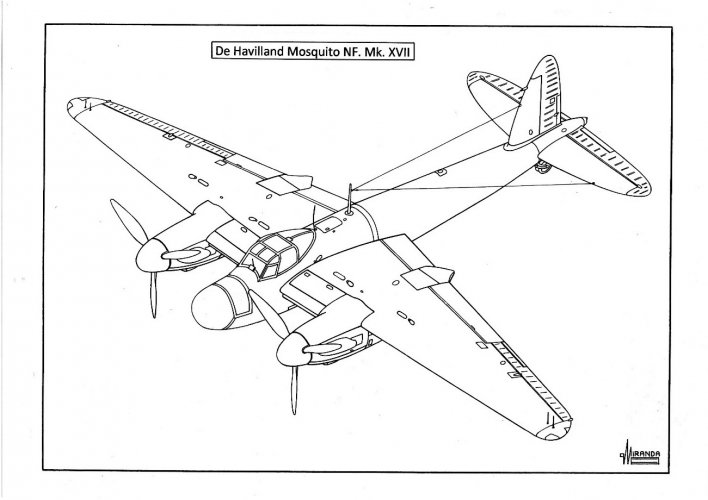
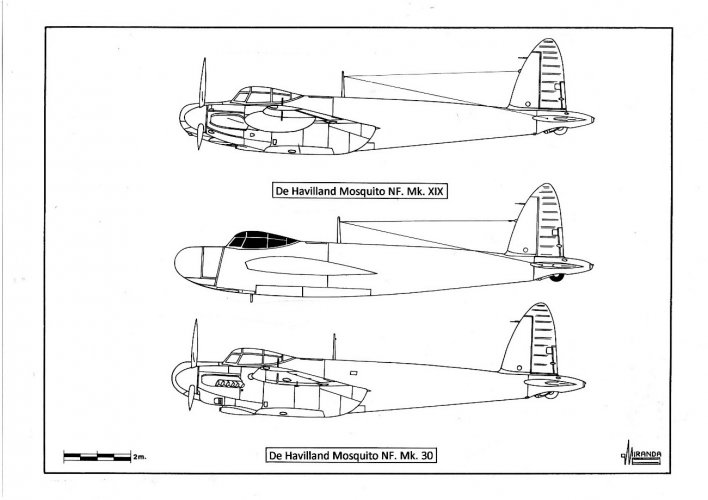
The new
Mosquito NF. Mk. XIX was built to locate and destroy these aircraft. With AI. Mk. X ‘centimetric’ radar, ‘bull nose’ radome, and underwing drop tanks, it was powered by two
Merlin 25 engines with +18 lb boost pressure for intruder low-medium performance.
This type entered service with No. 157 (RS) Sqn in May 1944 and was also used by the Squadrons Nos. 68 (WM), 85 (VY), 89 (WO), 169 (VI), 255 (YD), 256 (JT) and 600 (BQ) during the anti-V1 Operation Diver.
Serial production based in the FB. Mk. VI airframe began in March 1944, with a total number of 220 machines built.
Its first night victory was dated in July 1944.
The NF. Mk. XIX was used by the 100 Group in night missions of free fighting, flying at low altitudes over the Reich.
The British bombers also started using the
Monica tail warning radar since the summer of 1943. When the presence of an aggressor was detected, pilots made a brusque turn or
Corkscrew to break contact and escape, in the case of bombers, or positioned themselves behind the attacker, in the case of the fighters. In this type of fighting, in the darkness, the advantage was on the side of the radar with the wider angle. For this reason, some Messerschmitt Bf 110 G-4d/R3 and Junkers Ju 88 G-1 enemy night fighters carried additional antennae for the FuG 227
Flensburg passive receiver in the wings.
When British intelligence discovered in July 1944 that the Germans were using devices to detect
Monica emissions, its use in Bomber Command was stopped, but it was retained on 100 Group
Mosquitoes, to lure German fighters toward them. Once within range, the Mosquito would switch off the Monica, turn behind the German, performing a
Corkscrew, and destroyed it.
Some NF. Mk. XIXs from Squadrons Nos. 85 and 157 (fitted with
Gee navigation aid,
Monica Mk. I and
Monica Mk. IV rearward-looking radars housed in a small blister aft of the tailwheel) tried to attract enemy fighters, feigning to be a British heavy bomber.
Some machines from No. 85 Sqn were also fitted with
Perfectos Mk. II, which located the enemy fighters by triggering their FuG 25a IFF devices, and
Serrate Mk. IV sets, which homed the emissions of the German AI radar FuG 220
Lichtenstein SN-2.
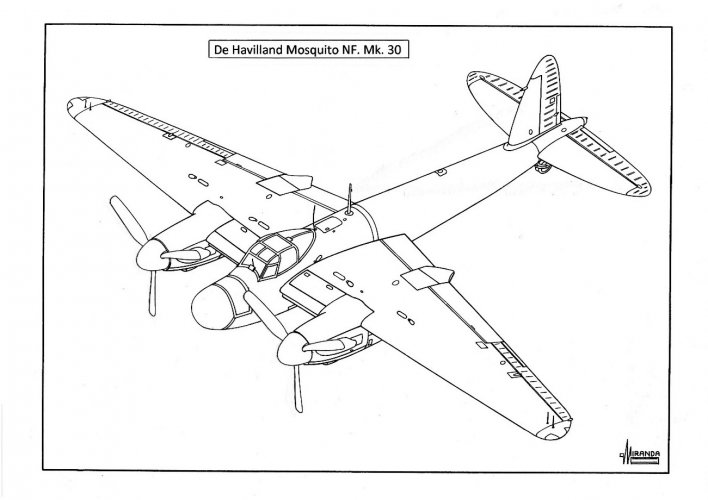
The
Mosquito NF. Mk. 30 was the high-altitude version of the Mk. XIX, with 100 imp gal underwing drop tanks, powered by two-stage, two-speed supercharged engines, driving four-bladed propellers.
The first 70 production machines were powered by two Merlin 72 engines rated at 1,680 hp and the other 460 units with Merlin 76 rated at 1,710 hp.
This type entered service on June 13, 1944, with the No. 219 Sqn, but suffered fire troubles when the inner shrouds started to burn, and the entire production was grounded in November. They would be replaced with new louvered shrouds designed for minimum drag, minimum IR emissions and almost invisible in darkness.
Until early 1945 the Mk. 30 was not in full-scale service with Squadrons Nos. 23 (YP), 25 (ZK), 29 (RO), 68 (WM), 85 (VY), 125 (VA), 141 (TW), 151 (DZ), 157 (RS), 219 (FK), 239 (HB), 255 (YD), 307 (EW), 406 (HU), 410 (RA), 456 (RX), 488 (ME), 616 (YQ) and US 416th NF.
Five squadrons (85, 151, 307 and 406) were used in support of the Bomber Command, operating with the No. 100 Group.
The first night kill was reached during the night of August 19/20, 1944.
Electronic equipment comprised: AI. Mk. X ‘centimetric’ radar with azimuth dipoles mounted above and below of the wingtips, AN/APN-1 radio-altimeter,
Perfectos Mk. IV,
Monica Mk. VI, Type F infra-red IFF flasher lamp mounted in the tail cone, Type Z IFF flasher lamp mounted in the wing leading edge and infra-red telescope mounted in the windshield.
The British bombers used infra-red navigation lights since 1944. To locate them, the Germans developed the IR seeker named
Falter with just 15 degrees of view field and difficult to use.
The
Luftwaffe started using
Verbandsflug tactics with a great number of night fighters operating in the same sector in 1944. To avoid confusions, the airplanes identified themselves using the infra-red lamp termed
Gaensebrust.
Another system termed
Mücke was being tested at the end of the war in Europe. Although the Allies preferred to use their advanced centimetric radars, the
Luftwaffe ordered the firms AEG and Siemens to develop the airborne warning devices
Froschauge and
Katze, the latest based on the
Spanner II, and an IR jamming device, known as
Wärmebold, that were never used in combat.
During the weeks that followed the 'D-Day', the forces of the Allies neutralized in their advance numerous V-1 launch sites built by the Germans in northern France. When the units of the
Wehrmacht retreated eastward, the new frontiers of the Reich got progressively further away from London. The V-1s launched from central Netherlands, with its maximum range of only 240 km, could no longer reach the British capital
The
Luftwaffe intended to continue its bombing offensive on July 9, 1944, launching the V-1 from the obsolete bombers Heinkel He 111 H-16 of the III./KG3.
Taking off with great difficulty from the Dutch airfields of Gilze-Rijen and Venlo, the Heinkels ventured far into the North Sea to launch their missiles against English cities. These V-1s came from the east, thus taking by surprise the British defenders that expected them from the south.
Until the end of the war in Europe, the III./KG3 made just 300 launches and it was a dangerous work as some V-1 exploded prematurely and others crashed against the bomber after the launch, because of turbulence.
From the strategic point of view, the low frequency of launches was useless and the Heinkels were easy prey for the all-weather interceptors
Mosquito NF. Mk. 30 and
Black Widow that searched them over the sea, led by the radars of the Chain Home.
Night fighter paint scheme: Medium Sea Grey (FS 36270) overall with Dark Green (FS34079) disruptive pattern upper surfaces, upper wing surface roundels Type B, 54-in, fuselage roundels Type C.1, 36-in. Dull Red (FS 30109) aircraft code letter and Black serials. Undersurfaces, without roundels.
Night intruder paint scheme: Medium Sea Grey (FS 36270) overall with Dark Green (FS34079) disruptive pattern upper surfaces, undersurfaces in Special night (FS 37038), without roundels, wing surface roundels Type B, 54-in, fuselage roundels Type C.1, 36-in. Dull Red (FS 30109) aircraft code letter and Black serials.
Mosquitoes attached to 2nd Tactical Air Force adopted Type C roundels in the upper wing surfaces.
The Mk. 30 was the last
Mosquito night fighter to see operational service during the World War II.
D.H.
Mosquito F. Mk. II Technical Data
Wingspan: 54.1 ft. (16.5 m), length: 41.7 ft. (12.7 m), height: 15.4 ft. (4.7 m), wing area: 454 sq. ft. (40.9 sq. m), max weight: 18,547 lb. (8,402 kg), max speed: 370 mph (595 km/h), service ceiling: 36,000 ft. (10,976 m), range: 1,705 miles (2,744 km), power plant: two Rolls-Royce
Merlin 23, twelve-cylinder, Vee, liquid-cooled engines, each rated at 1,460 hp, armament: four nose mounted 0.303-in Browning machine guns and four belly mounted 20-mm (belt-feed) Hispano cannons.
D.H.
Mosquito NF. Mk. II Technical Data
Wingspan: 54.1 ft. (16.5 m), length: 43.6 ft. (13.3 m), height: 15.4 ft. (4.7 m), wing area: 454 sq. ft. (40.9 sq. m), max weight: 20,000 lb. (9,060 kg), max speed: 356 mph (573 km/h), service ceiling: 34,500 ft. (10,518 m), range: 1,520 miles (2,446 km), power plant: two Rolls-Royce
Merlin 23, twelve-cylinder, Vee, liquid-cooled engines, each rated at 1,460 hp, armament: four nose mounted 0.303-in Browning machine guns and four belly mounted 20-mm (belt-feed) Hispano cannons.
Radar: AI. Mk. V ‘metric’, with 1.5 m. wavelength.
D.H.
Mosquito NF. Mk. II Special Technical Data
Wingspan: 54.1 ft. (16.5 m), length: 41.7 ft. (12.7 m), height: 15.4 ft. (4.7 m), wing area: 454 sq. ft. (40.9 sq. m), max weight: 18,547 lb. (8,402 kg), max speed: 370 mph (595 km/h), service ceiling: 36,000 ft. (10,976 m), range: 1,705 miles (2,744 km), power plant: two Rolls-Royce
Merlin 21, twelve-cylinder, Vee, liquid-cooled engines, each rated at 1,460 hp, armament: four nose mounted 0.303-in Browning machine guns and four belly mounted 20-mm (belt-feed) Hispano cannons.
D.H.
Mosquito NF. Mk. VI Technical Data
Wingspan: 54.1 ft. (16.5 m), length: 43 ft. (13.1 m), height: 15.4 ft. (4.7 m), wing area: 454 sq. ft. (40.9 sq. m), max weight: 22,300 lb. (10,102 kg), max speed: 362 mph (582 km/h), service ceiling: 33,000 ft. (10,061 m), range: 1,650 miles (2,655 km), power plant: two Rolls-Royce
Merlin 25, twelve-cylinder, Vee, liquid-cooled engines, each rated at 1,635 hp, armament: four belly mounted 20-mm (belt-feed) Hispano cannons.
Radar: AI. Mk. XV ASH ‘centimetric’, with 3.2 cm. wavelength.
D.H.
Mosquito NF. Mk. XII Technical Data
Wingspan: 54.1 ft. (16.5 m), length: 40.3 ft. (12.3 m), height: 15.4 ft. (4.7 m), wing area: 454 sq. ft. (40.9 sq. m), max weight: 19,700 lb. (8,938 kg), max speed: 370 mph (595 km/h), service ceiling: 36,000 ft. (10,976 m), range: 1,705 miles (2,744 km), power plant: two Rolls-Royce
Merlin 21, twelve-cylinder, Vee, liquid-cooled engines, each rated at 1,460 hp, armament: four belly mounted 20-mm (belt-feed) Hispano cannons.
Radar: AI. Mk. VIII ‘centimetric’, with 9.1 cm. wavelength.
D.H.
Mosquito NF. Mk. XIII Technical Data
Wingspan: 54.1 ft. (16.5 m), length: 40.5 ft. (12.34 m), height: 15.4 ft. (4.7 m), wing area: 454 sq. ft. (40.9 sq. m), max weight: 20,000 lb. (9,074 kg), max speed: 370 mph (595 km/h), service ceiling: 34,500 ft. (10,515 m), range: 1,860 miles (2,993 km), power plant: two Rolls-Royce
Merlin 23, twelve-cylinder, Vee, liquid-cooled engines, each rated at 1,460 hp, armament: four belly mounted 20-mm (belt-feed) Hispano cannons.
Radar: AI. Mk. X ‘centimetric’, with 9.1 cm. wavelength.
D.H.
Mosquito NF. Mk. XV Technical Data
Wingspan: 62.3 ft. (19 m), length: 40.5 ft. (12.34 m), height: 15.4 ft. (4.7 m), wing area: 479 sq. ft. (43.1 sq. m), max weight: 17,600 lb. (7,983 kg), max speed: 360 mph (579 km/h), service ceiling: 45,000 ft. (13,715 m), range: 1,030 miles (1,657 km), power plant: two Rolls-Royce
Merlin 72/73, twelve-cylinder, Vee, liquid-cooled engines, each rated at 1,680 hp, armament: four belly mounted 20-mm (belt-feed) Hispano cannons.
Radar: AI. Mk. VIII ‘centimetric’, with 9.1 cm. wavelength.
D.H.
Mosquito NF. Mk. XVII Technical Data
Wingspan: 54.1 ft. (16.5 m), length: 40.5 ft. (12.34 m), height: 15.4 ft. (4.7 m), wing area: 454 sq. ft. (40.9 sq. m), max weight: 20,393 lb. (9,250 kg), max speed: 370 mph (595 km/h), service ceiling: 36,000 ft. (10,976 m), range: 1,705 miles (2,744 km), power plant: two Rolls-Royce
Merlin 21, twelve-cylinder, Vee, liquid-cooled engines, each rated at 1,460 hp, armament: four belly mounted 20-mm (belt-feed) Hispano cannons.
Radar: AI. Mk. X ‘centimetric’, with 9.1 cm. wavelength.
D.H.
Mosquito NF. Mk. XIX Technical Data
Wingspan: 54.1 ft. (16.5 m), length: 40.5 ft. (12.34 m), height: 15.4 ft. (4.7 m), wing area: 454 sq. ft. (40.9 sq. m), max weight: 21,750 lb. (9,865 kg), max speed: 378 mph (608 km/h), service ceiling: 28,000 ft. (8,534 m), range: 1,905 miles (3,065 km), power plant: two Rolls-Royce
Merlin 25, twelve-cylinder, Vee, liquid-cooled engines, each rated at 1,620 hp, armament: four belly mounted 20-mm (belt-feed) Hispano cannons.
Radar: AI. Mk. X ‘centimetric’, with 9.1 cm. wavelength.
D.H.
Mosquito NF. Mk. 30 Technical Data
Wingspan: 54.1 ft. (16.5 m), length: 44.3 ft. (13.5 m), height: 15.4 ft. (4.7 m), wing area: 454 sq. ft. (40.9 sq. m), max weight: 18,547 lb. (8,402 kg), max speed: 424 mph (682 km/h), service ceiling: 39,000 ft. (11,890 m), range: 1,300 miles (2,092 km), power plant: two Rolls-Royce
Merlin 72, twelve-cylinder, Vee, liquid-cooled engines, each rated at 1,680 hp or two Rolls-Royce
Merlin 76, each rated at 1,710 hp, armament: four belly mounted 20-mm (belt-feed) Hispano cannons.
Radar: AI. Mk. X ‘centimetric’, with 9.1 cm. wavelength.
BIBLIOGRAPHY
BOOKS
Birtles, P.,
De Havilland Mosquito: The Original Multiplace Combat Aircraft, Fonthill Media, 2015.
Birtles, P.,
Mosquito: A Pictorial History of the DH 98, Janes Publishing Co., 1980.
Bishop, E.,
The Wooden Wonder, TBS Ltd. 1980.
Bowman, M.,
Mosquito Fighter/Fighter-Bomber Units, Osprey, 1998.
Bowyer, M.,
De Havilland Mosquito Mk. IV, Profile Number 209, 1973.
Bowyer, M.,
Mosquito Squadrons of the Royal Air Force, Ian Allan Ltd. 1984.
Brandon, L.,
Night Flyer, Crecy Publishing, 1961.
Caruana, R.,
De Havilland Mosquito, Warpaint Special No.3
.
Clarke, R.,
De Havilland Mosquito Portofolio, Brooklands Books, 1986.
Franks, R.,
De Havilland Mosquito, Fighter, Fighter-Bomber & Night Fighter, Valiant Wings, 2017.
Franks, R.,
The De Havilland Mosquito, Modellers Datafile No.1, SAM Publications, 1998.
Green, W.,
Warplanes of the Second World War-Fighters-Volume Two, Macdonald, 1961.
Green, W.,
RAF Fighters, Part I, Arco Publishing Co., 1978.
Halley, J.,
The Squadrons of the Royal Air Force, Air Britain Ltd. 1980.
Hardy, M.,
De Havilland Mosquito Super Profile, Haynes Publishing Group, 1984.
Howe, S.,
De Havilland Mosquito, an illustrated history, Crecy Publishing, 1998.
Jones, R.,
Camouflage & Markings Number 6, Ducimus Books Ltd, 1970.
Lucas, P.,
Camouflage & Markings No.1, RAF Fighters 1945-1950, Scale Aircraft Monographs, 2000.
Lucas, P.,
Combat Colours Number 5, Scale Aircraft Modelling, 2002.
Mackay, R.,
De Havilland Mosquito Walk Around No.15, Squadron/Signal, 1998.
Mackay, R.,
De Havilland Mosquito. Vol. 1, Schiffer, 2019.
Mason, F.,
De Havilland Mosquito, Aircam Aviation Series No.28, 1972.
Moyes, J.,
The De Havilland Mosquito Mks. I-IV, Profile Number 52, 1965.
Ogilvy, D.,
The De Havilland Mosquito: Through the Eyes of a Pilot, Amberley Publishing, 2017.
Rawlings, J.,
Squadron Codes 1937-56, Patrick Stevens, 1979.
Robinson, A.,
Night Fighter: A Concise History of Nightfighting Since 1914. Ian Allan Publishing.1988.
Scutts, J.,
Mosquito in action, Part 1, Squadron/Signal No.127, 1992.
Scutts, J.,
Mosquito in action, Part 2, Squadron/Signal No.139, 1993.
Sharp, M.,
Mosquito, Faber & Faber, 1971.
Streetly, M.,
The aircraft of 100 Group, Hale, 1984.
Sweetman, B.,
Mosquito, Crown and Random House, 1984.
Sweetman, B.,
Mosquito, Wing and Anchor Press, 1981.
Tanner, J.,
British Aviation Colours of World War II, Hippocrene Books Inc., 1976.
Thirsk, I.,
De Havilland Mosquito, an illustrated history, Crecy Publishing Ltd. 2007.
Thomas, A.,
Mosquito Aces of World War 2, Osprey, 2005.
Wheeler, B.,
Military Aircraft Markings and Profiles, Gallery Books, 1990.
Wynn, H.,
Prelude to Overlord, Presidio Press, 1983.
PUBLICATIONS
Cotter, J., “A bigger bite”, FlyPast, March 2001.
Donald, D., “Wings of Fame Vol. 18”, Aerospace Publishing, 2000.
ED., “De Havilland Mosquito Database”, Aeroplane, November 2000.
ED., “The Helmore Turbinlite”, The Aeroplane Spotter, May 31, 1947.
ED., “The Mosquito’s Merlins”, Aeroplane, November 2000.
Giraud, R., “Les Bombardiers Rapides”, Le Fana de l’Aviation No. 476.
Hooton, T., “Nocturnal navigator”, Aeroplane Montly, May 1996.
Lambert, F., “Confound and Destroy”, Fine Scale Modeller, March 1992.
Monteagle, P., “Aircraft with altitude”, Scale Models International Vol.28, No. 32, 1997.
Ogilvy, D., “From obscurity comes light”, Aeroplane, January 2009.
Rayner, J., “And the walls came tumbling down”, FlyPast, March 1994.
Rocher, A., “Chasseurs de nuit 1941-1945”, Le Fana de l’Aviation Hors-Série No. 59, may 2017.
Sandham, C., “D.H. Mosquito Modellers Portofolio”, Scale Modeller International, October 2015.
Sperbund, H., “Black Monday”, FlyPast, March 2001.
Streetly, M.,
The aircraft of 100 Group, Scale Models, July 1981.