

magnus_z
ACCESS: Confidential
- Joined
- 15 August 2009
- Messages
- 124
- Reaction score
- 94
Postage stamp: The Mutawakelite Kingdom of Yemen, 1969:


Photo:

“Scientists look forward to the time when the moon and planets will be explored for mineral wealth that can be shipped back to earth. This concept of a space vehicle was created by the research laboratories of Northrop Corp. Equipped with caterpillar treads and a rocket system, it would be capable of crawling or making short flights over moon terrain.”
Credit: Mike Acs
View: https://www.flickr.com/photos/apollo4ever/52315770764/in/photolist-2r4XANR-2nGXZZE-2r4yYZz
Newspaper: Northrop-Norair News (El Paso). - March 1, 1961, p. 1.

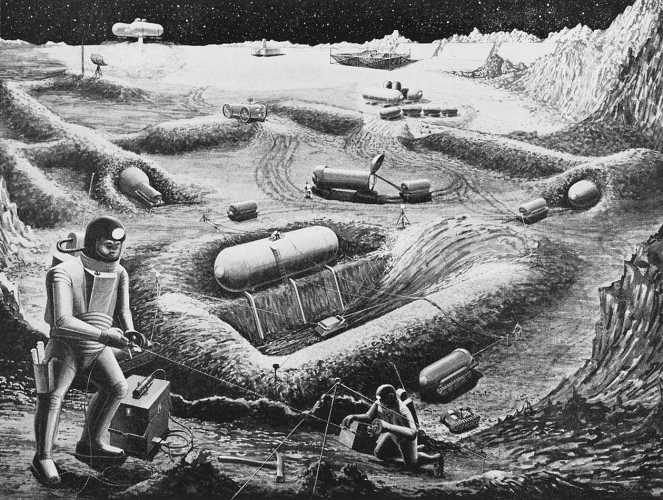
NORAIR’S ASTRO SCIENCES group makes study of construction and development of manned lunar base. Complete range of needs, from earth communications to surface vehicles, is planned. Artist’s conception shows base at midpoint of completion. Moon location is in the “foothills" of the Apennine Mountains. (See story adjoining.)
Norair Scientists Make Study of Lunar Base
What is it like on the moon?
How would it be to live and work there?
Actual firm knowledge of lunar surface conditions is the objective of NASA’s series of investigative vehicles among which is “ Prospector Project”. This will be an unmanned system that will send back data to help science prepare for the eventual step—a manned lunar base.
Norair’s Astro Sciences group, N. V. Petersen, chief, is conducting studies in both areas. Work is now underway in anticipation of participation in “ Prospector Project” . NASA is scheduled to let contracts within the next six months.
SCIENCE VIEW
In addition to “Prospector” preparation, Astro Sciences has also conducted intensive studies in preparation for construction and development of the manned base itself. To give readers a science- eye view of lunar conditions, the Northrop-Norair News presents this concept.
Illustration above, at right, depicts such a base assembled from dual purpose prefabricated components and modules. This material was originally assembled in an earth orbit to form a special purpose lunar payload landing vehicle.
IN FOOTHILLS
The base illustrated is located in Palus Putredinis, approximately midway between Archimedes, Linne, and the Apennine Mountains. The panorama is seen from the “foothills” of the Apennine Mountains.
The base is assembled from prefabricated cylindrical cans which are interconnected by airlock equipped tunnels. The cans and tunnels are located approximately 20 feet underground. An excavation for one of these cans is being carried out by a drag bucket that is powered and controlled from two general purpose vehicles by a cable system.
The use of a drag bucket, rather than dozers, illustrates the reduced effectiveness of traction and the application of simple but effective support equipment.
An unimproved landing area is shown in the background, together with solar energy collectors and communication antennas.
MOON SUITS
The men in the foreground illustrate one type of surface vehicle — the manpowered moon suit. The suit illustrated depicts several controversial features— the articulated joints, the use of gloved hands or special tools, an exterior armor, the vulnerability to cosmic or other radiation, the vulnerability to meteorites. The suit and the nature of the terrain imply considerable difficulties in moving about the surface unaided. At the foot of the hill can be seen a “ crawler” which is used to give the moon-suited man additional mobility and range.
Two general purpose vehicles are shown providing the power and control to lower the “ life supporting” cylinder into the pit. To the left of the photo, another general purpose vehicle is shown coupled to an airlock on the end of a life support cylinder. On the far side of the pit, one with a crane attachment is depicted loading the cargo vehicle. In the background, to the right, a “ train” of these vehicles is shown approaching the base.
The cargo vehicle being loaded is a larger vehicle than the general purpose machine but it utilizes a great many components common to both.
A wheeled vehicle is shown approaching the base from the upper left. The large spoked wheels shown here may be more desirable than the “track laying” type for cross-country transport over a known suitable route.
In the background, at the left, a special purpose lunar payload landing vehicle is shown during the landing phase.
On the surface, to the right of the special purpose payload vehicle that is landing, is a logistics vehicle which may be used to transport personnel, fluids, and equipment by selecting the proper logistics module. It carries its payload between the moon’s surface and lunar orbiting space vehicles.
It should be understood that to date, the actual conditions on the moon remain a controversy. Scientific authorities do not agree on many points. These include, presence or lack of water molecules in the rocks; and is the moon made up of volcanic or sedimentary materials? Are lunar craters the result of meteors or of volcanic action?
SAME AS EARTH
Many scholars believe that the material of the moon is the same as that of the earth in texture and origin.
Even moon space conditions, amount of oxygen, radiation, light, and temperatures, have not been proved beyond doubt.
“Prospector Project” in which Norair hopes to take part, and other NASA vehicles such as Ranger and Surveyor, will answer many questions. But enigmas will remain until man first sets his foot there.
Norair’s additional study on development and construction of a manned lunar base is in support of this event.
Credit: San Diego Air and Space Museum
https://archive.org/details/casdam_000056/page/n31/mode/2uphttps://californiarevealed.org/challenge?destination=/do/c9ccb4af-0e96-4c56-92a1-9e6e6c5f83a6
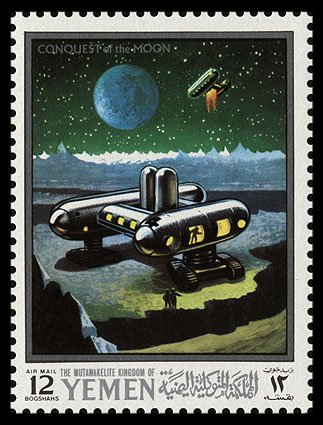
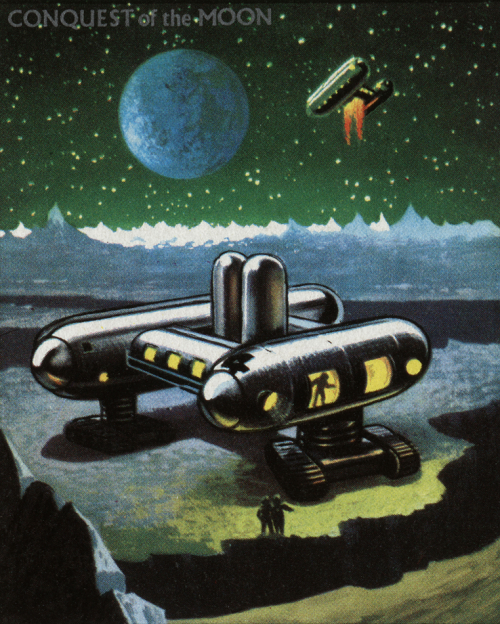
Photo:
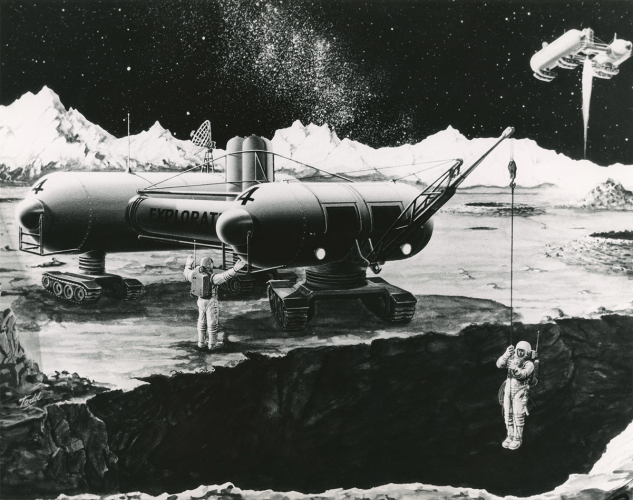
“Scientists look forward to the time when the moon and planets will be explored for mineral wealth that can be shipped back to earth. This concept of a space vehicle was created by the research laboratories of Northrop Corp. Equipped with caterpillar treads and a rocket system, it would be capable of crawling or making short flights over moon terrain.”
Credit: Mike Acs
View: https://www.flickr.com/photos/apollo4ever/52315770764/in/photolist-2r4XANR-2nGXZZE-2r4yYZz
Newspaper: Northrop-Norair News (El Paso). - March 1, 1961, p. 1.
NORAIR’S ASTRO SCIENCES group makes study of construction and development of manned lunar base. Complete range of needs, from earth communications to surface vehicles, is planned. Artist’s conception shows base at midpoint of completion. Moon location is in the “foothills" of the Apennine Mountains. (See story adjoining.)
Norair Scientists Make Study of Lunar Base
What is it like on the moon?
How would it be to live and work there?
Actual firm knowledge of lunar surface conditions is the objective of NASA’s series of investigative vehicles among which is “ Prospector Project”. This will be an unmanned system that will send back data to help science prepare for the eventual step—a manned lunar base.
Norair’s Astro Sciences group, N. V. Petersen, chief, is conducting studies in both areas. Work is now underway in anticipation of participation in “ Prospector Project” . NASA is scheduled to let contracts within the next six months.
SCIENCE VIEW
In addition to “Prospector” preparation, Astro Sciences has also conducted intensive studies in preparation for construction and development of the manned base itself. To give readers a science- eye view of lunar conditions, the Northrop-Norair News presents this concept.
Illustration above, at right, depicts such a base assembled from dual purpose prefabricated components and modules. This material was originally assembled in an earth orbit to form a special purpose lunar payload landing vehicle.
IN FOOTHILLS
The base illustrated is located in Palus Putredinis, approximately midway between Archimedes, Linne, and the Apennine Mountains. The panorama is seen from the “foothills” of the Apennine Mountains.
The base is assembled from prefabricated cylindrical cans which are interconnected by airlock equipped tunnels. The cans and tunnels are located approximately 20 feet underground. An excavation for one of these cans is being carried out by a drag bucket that is powered and controlled from two general purpose vehicles by a cable system.
The use of a drag bucket, rather than dozers, illustrates the reduced effectiveness of traction and the application of simple but effective support equipment.
An unimproved landing area is shown in the background, together with solar energy collectors and communication antennas.
MOON SUITS
The men in the foreground illustrate one type of surface vehicle — the manpowered moon suit. The suit illustrated depicts several controversial features— the articulated joints, the use of gloved hands or special tools, an exterior armor, the vulnerability to cosmic or other radiation, the vulnerability to meteorites. The suit and the nature of the terrain imply considerable difficulties in moving about the surface unaided. At the foot of the hill can be seen a “ crawler” which is used to give the moon-suited man additional mobility and range.
Two general purpose vehicles are shown providing the power and control to lower the “ life supporting” cylinder into the pit. To the left of the photo, another general purpose vehicle is shown coupled to an airlock on the end of a life support cylinder. On the far side of the pit, one with a crane attachment is depicted loading the cargo vehicle. In the background, to the right, a “ train” of these vehicles is shown approaching the base.
The cargo vehicle being loaded is a larger vehicle than the general purpose machine but it utilizes a great many components common to both.
A wheeled vehicle is shown approaching the base from the upper left. The large spoked wheels shown here may be more desirable than the “track laying” type for cross-country transport over a known suitable route.
In the background, at the left, a special purpose lunar payload landing vehicle is shown during the landing phase.
On the surface, to the right of the special purpose payload vehicle that is landing, is a logistics vehicle which may be used to transport personnel, fluids, and equipment by selecting the proper logistics module. It carries its payload between the moon’s surface and lunar orbiting space vehicles.
It should be understood that to date, the actual conditions on the moon remain a controversy. Scientific authorities do not agree on many points. These include, presence or lack of water molecules in the rocks; and is the moon made up of volcanic or sedimentary materials? Are lunar craters the result of meteors or of volcanic action?
SAME AS EARTH
Many scholars believe that the material of the moon is the same as that of the earth in texture and origin.
Even moon space conditions, amount of oxygen, radiation, light, and temperatures, have not been proved beyond doubt.
“Prospector Project” in which Norair hopes to take part, and other NASA vehicles such as Ranger and Surveyor, will answer many questions. But enigmas will remain until man first sets his foot there.
Norair’s additional study on development and construction of a manned lunar base is in support of this event.
Credit: San Diego Air and Space Museum
https://archive.org/details/casdam_000056/page/n31/mode/2uphttps://californiarevealed.org/challenge?destination=/do/c9ccb4af-0e96-4c56-92a1-9e6e6c5f83a6


