

You are using an out of date browser. It may not display this or other websites correctly.
You should upgrade or use an alternative browser.
You should upgrade or use an alternative browser.
Montford Point Class Mobile Landing Platform
- Thread starter Triton
- Start date

- Joined
- 6 November 2010
- Messages
- 6,359
- Reaction score
- 8,240
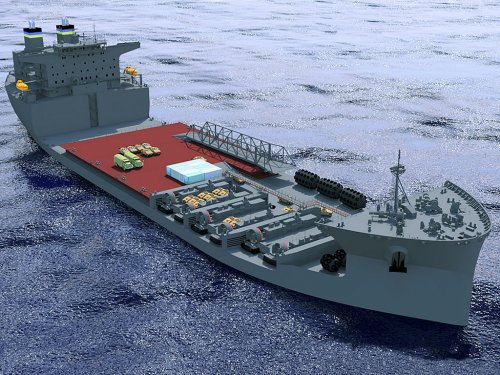
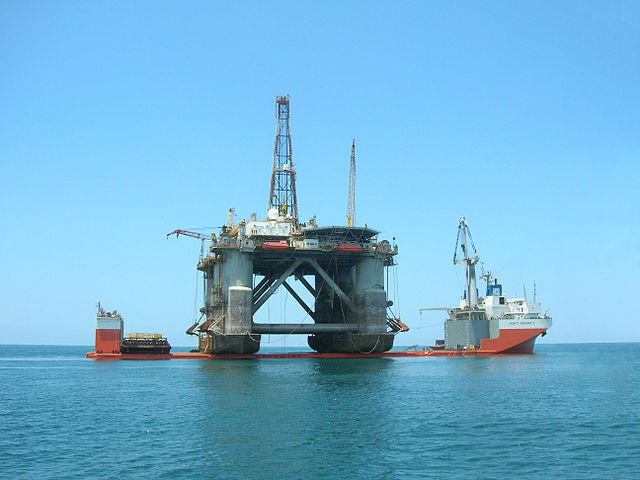
Having fixed structures on both ends of the cargo deck limits usability of the vessel. Civilian semi-submersibles have been around for some time now. Most of them do without the fixed structures abaft the cargo deck; the ship shown has removable aft casings.


- Joined
- 4 July 2010
- Messages
- 2,691
- Reaction score
- 3,751
The civilian ships also have a completely different mission. MLP borrows the semi-submersible configuration, but its roll is a mobile LCAC loading beach not as an outsize cargo transport.Arjen said:Having fixed structures on both ends of the cargo deck limits usability of the vessel. Civilian semi-submersibles have been around for some time now. Most of them do without the fixed structures abaft the cargo deck; the ship shown has removable aft casings.
- Joined
- 6 November 2010
- Messages
- 6,359
- Reaction score
- 8,240
If that's
I repeat, having fixed structures at both ends of the cargo deck is a bad idea as it limits deck space and usability.
Using a self-propelled freighter for any length of time in that role is a waste of money. Using a tug and semi-submersible pontoon is a much cheaper solution. Get it to its destination. Leave the pontoon there, and the tug is available for other missions.Moose said:The civilian ships also have a completely different mission. MLP borrows the semi-submersible configuration, but its roll is a mobile LCAC loading beach not as an outsize cargo transport.
I repeat, having fixed structures at both ends of the cargo deck is a bad idea as it limits deck space and usability.
- Joined
- 4 July 2010
- Messages
- 2,691
- Reaction score
- 3,751
A tug and barge combination is very vulnerable to varying conditions in transit, and for the desired size platform would require a rather large Fleet tug. T-ATFs have other duties than tagging along with Amphibious Groups, they're too big for SEABEE or INLS work, and there are only 4 in the MSC inventory. Moreover, if there's an emergency when the Tug is elsewhere you may end up abandoning/scuttling the rather expensive barge, fighting a defensive action around it until a tow shows up, or simply missing a critical window to be somewhere more advantageous. So in all likelihood you're buying more tugs in addition to a handful of big, newly designed, semi-submersible barges and those Tugs are staying married at the hip to their barge most of the time. By Grabthar's Hammer, what a savings.
Yes, they've had to compromise from the perfect ideal multipurpose platform. As it happens, the original MLP concepts were Blue Marlin on steroids, then it started to look like Marlin and an LPD had a kid. But the funding wasn't there to make it happen, they needed to use an off-the-shelf, mature hull rather than designing something from scratch in hopes of shaving dollars and years from the program. NASSCO's the best MSC yard, they'll be good ships. In time, there may be more.
Yes, they've had to compromise from the perfect ideal multipurpose platform. As it happens, the original MLP concepts were Blue Marlin on steroids, then it started to look like Marlin and an LPD had a kid. But the funding wasn't there to make it happen, they needed to use an off-the-shelf, mature hull rather than designing something from scratch in hopes of shaving dollars and years from the program. NASSCO's the best MSC yard, they'll be good ships. In time, there may be more.
- Joined
- 6 November 2010
- Messages
- 6,359
- Reaction score
- 8,240
On the point of barges/pontoons: leasing civilian tugs would be an option in peacetime, while requisitioning them in wartime. Tugs have been hauling barges across the oceans for ages now, so it is feasible. If vulnerabilty to weather and availability of tugs are a big concern, a self-propelled freighter is the choice to make. At a price. Which brings me to my second point:
I don't see how this design is going to be any cheaper to build than the single-superstructure civilian designs, which are available in a range of sizes. The civilian ships are designed with economy of operation in mind because they have to earn their keep; they have been in profitable service for years.
To me, it seems like not-invented-here working overtime.
I don't see how this design is going to be any cheaper to build than the single-superstructure civilian designs, which are available in a range of sizes. The civilian ships are designed with economy of operation in mind because they have to earn their keep; they have been in profitable service for years.
To me, it seems like not-invented-here working overtime.

- Joined
- 18 March 2008
- Messages
- 3,529
- Reaction score
- 1,220
Arjen said:To me, it seems like not-invented-here working overtime.
Either that or the people in the Navy thiat wrote the specification for the new capability know a lot more about it than you do.
- Joined
- 6 November 2010
- Messages
- 6,359
- Reaction score
- 8,240
I grew up in a town where operating semi-submersibles wasn't invented, but where it was turned into a profitable business. I once had a lengthy conversation with a friend of my parents who was employed by that particular company as one of their commanding officers, in which he explained the reasons why the ships were designed the way they were. One of my brothers made a trip on one of them, from Okpo, South Korea to Cameron, Texas Louisiana as part of his training. I am slightly familiar with the matter, but I admit I am no expert.
There may be reasons why this configuration has been chosen, but they are not obvious to me.
There may be reasons why this configuration has been chosen, but they are not obvious to me.
I really, really hope so, but what-should-be and what-is don't always match.Abraham Gubler said:...or the people in the Navy thiat wrote the specification for the new capability know a lot more about it than you do.

- Joined
- 16 April 2008
- Messages
- 10,604
- Reaction score
- 18,186
They don't need the additional complexity of the removable aft structures because they don't plan to use this ship to carry out-sized cargoes, which is what drove that capability on heavy-lift ships. It doesn't need to have a totally arrangeable deck like a lift-ship, but it does need to be self-propelled. It's supposed to supoprt the idea of an offshore sea-base, which is inherently not moored in one place.
The main capability they were interested in from heavy lift ships was the ability to submerge the load deck. The planned operation is for the MLP to dock alongside a cargo ship and act as a floating dock for cargo to offloaded from the cargo ship and reloaded onto LCACs or other high-speed connector vessels.
The configuration they chose is basically a minimum-change version of NASSCO's BP Tanker design with the cargo tanks cut out.
The main capability they were interested in from heavy lift ships was the ability to submerge the load deck. The planned operation is for the MLP to dock alongside a cargo ship and act as a floating dock for cargo to offloaded from the cargo ship and reloaded onto LCACs or other high-speed connector vessels.
The configuration they chose is basically a minimum-change version of NASSCO's BP Tanker design with the cargo tanks cut out.
- Joined
- 6 November 2010
- Messages
- 6,359
- Reaction score
- 8,240
That isn't the design's expensive bit. They're empty steel boxes that bolt onto the cargo deck. What it does add as a bonus is more usable space on the cargo deck. You can make do with a smaller ship for the same useful deck space.TomS said:They don't need the additional complexity of the removable aft structures because they don't plan to use this ship to carry out-sized cargoes, which is what drove that capability on heavy-lift ships.
That actually makes the design cheaper.TomS said:It doesn't need to have a totally arrangeable deck like a lift-ship
Fair point.TomS said:...but it does need to be self-propelled. It's supposed to supoprt the idea of an offshore sea-base, which is inherently not moored in one place.
And that turns out to cost $500 million a copy. Triton's site:TomS said:The configuration they chose is basically a minimum-change version of NASSCO's BP Tanker design with the cargo tanks cut out.
That's a lot. I don't have the numbers on Blue Marlin. ISTR that was a lot cheaper.The MLP is supposed to be about 800 feet/ 250m long, but built to commercial standards rather than combat vessel standards. The ships will be about 34,500 tonnes, with a top speed of about 20 knots, and a range of around 9,000 nautical miles at most efficient speed. The Navy intends to build a total of 3 ships for $450 – 500 million each, with the 1st delivery expected in 2015.
Right. So the barge is out.Hobbes said:One important distinction is that these ships have a design speed of 20 kts. Try towing a barge at that speed...
- Joined
- 16 April 2008
- Messages
- 10,604
- Reaction score
- 18,186
I see I'd misunderstood the design of those dock ships; I thought the aft towers were exhausts, which is of course wrong now that I look closer. Some early renderings of MLP did show a ship with a clear aft end, so it's not so much that the spec precluded that feature as much as that the spec didn't require it and the winning offer didn't include it. Given that the ship had to be built in the US, the choices may have come down to NASSCO's adapted tanker or a clean-sheet design.
As to cost, I'm not sure about the Marlins, but the new Dockwise Vanguard is supposed to cost around $240 million. She is rather larger (and slower) but is being built in a Korean yard. US labor rates will of course drive that much higher for the MLPs (as will working for DoN, just as a matter of course). Still, the final price also includes the customized pallet they are adding for the LCAC landing slips and maintenance facilities, an articulating cargo ramp, fendering gear for the "skin to skin" docking of large cargo ships, the raised cargo platform, and so forth. It's probably not a bad deal all things considered.
As to cost, I'm not sure about the Marlins, but the new Dockwise Vanguard is supposed to cost around $240 million. She is rather larger (and slower) but is being built in a Korean yard. US labor rates will of course drive that much higher for the MLPs (as will working for DoN, just as a matter of course). Still, the final price also includes the customized pallet they are adding for the LCAC landing slips and maintenance facilities, an articulating cargo ramp, fendering gear for the "skin to skin" docking of large cargo ships, the raised cargo platform, and so forth. It's probably not a bad deal all things considered.
- Joined
- 6 November 2010
- Messages
- 6,359
- Reaction score
- 8,240
I'm a bit out of touch with what Dockwise is doing nowadays, so Dockwise Vanguard was something of a surprise. Thanks for the heads-up.


A minor note. I designed a heavy-lift ship option as a mothership during a BMT-UCL project for UK MoD. The main concerns we had regarding the "all-forward" approach were weather effects and stability / safety. The civilian ships get to choose when to dock down and do so only under appropriate conditions. Even so, this does not always go according to plan. Having "ship shaped" ends, with flare and subdivision was expected to improve seakeeping and survivability.
Of course, it does not provide as much deck area - we ended up with something similar to the dockwise ships, just to make deck space. However, if you don't need every last bit of space, more enclosed buoyancy would be desirable.
There could always be other reasons, however.
RP1
Of course, it does not provide as much deck area - we ended up with something similar to the dockwise ships, just to make deck space. However, if you don't need every last bit of space, more enclosed buoyancy would be desirable.
There could always be other reasons, however.
RP1
- Joined
- 6 November 2010
- Messages
- 6,359
- Reaction score
- 8,240
In 2006, Mighty Servant 3 sank near Luanda while off-loading the rig Aleutian Key - docking down is not to be taken lightly, especially with a top-heavy load. However, Montford Point is unlikely to carry that kind of cargo. In any case: transferring cargo on the high seas in moderate weather will be an interesting exercise. It will be downright impossible when the weather gets rough.RP1 said:The civilian ships get to choose when to dock down and do so only under appropriate conditions. Even so, this does not always go according to plan. Having "ship shaped" ends, with flare and subdivision was expected to improve seakeeping and survivability.
I repeat, I am no expert. I´ve been reading the reactions in this thread with considerable interest and I expect more informed people than I have been making the decisions that led to the Montford Point design. Even so, civilian semi-submersibles have been crossing the oceans for years now, sometimes in atrocious weather. Accidents have happened, but in general operations have been safe and succesful.
Nevertheless, I stand corrected. Thank you.
- Joined
- 12 July 2008
- Messages
- 395
- Reaction score
- 184
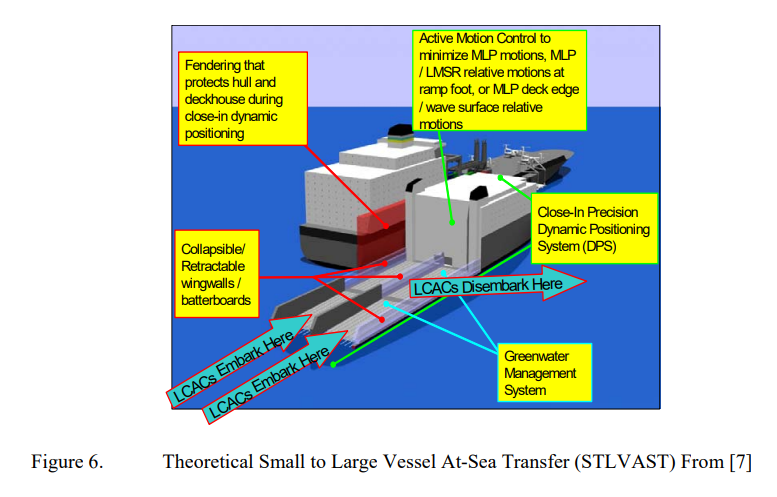
Its rated for sea state 3 vehicle transfer operations.
The original design for MLP was going to have a connecting bridge to the RO-RO which was actively stabilized allowing for vehicle transfers in significantly worse conditions, sea state 5 I believe, but that proved too expensive and so the final design merely has (ample) space and weight reserves for a future installation. The current bridge will just be a basic ramp.
The original design for MLP was going to have a connecting bridge to the RO-RO which was actively stabilized allowing for vehicle transfers in significantly worse conditions, sea state 5 I believe, but that proved too expensive and so the final design merely has (ample) space and weight reserves for a future installation. The current bridge will just be a basic ramp.

chimeric oncogene
ACCESS: Secret
- Joined
- 23 May 2019
- Messages
- 464
- Reaction score
- 729
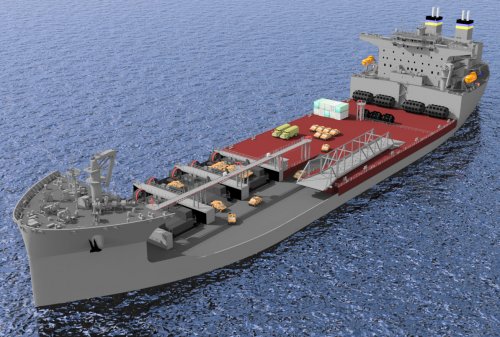
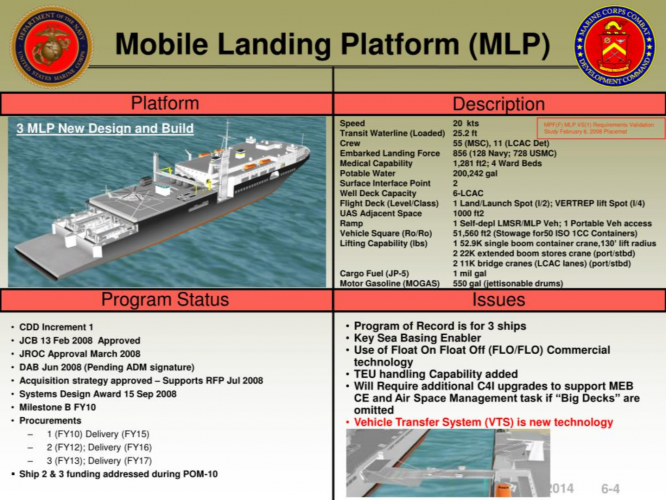
Does anyone have information on older Sea Basing/Expeditionary Transfer Dock/Mobile Landing Platform concepts?
Wikipedia and the various threads on the subject talk about bespoke vessels with room for as many as six LCACs and specialized bridges capable of transferring vehicles at Sea State 5, but I can't for the love of me find anything specific or any pretty pictures.
Globalsecurity seems to have a few pics; but I can't figure out how you're supposed to load the LCACs on this thing.
Are you supposed to drive through all the LCACs to load them? Won't that cause snafus when your tank is improperly placed behind your humvees and you need to reshuffle everyone?

Wikipedia and the various threads on the subject talk about bespoke vessels with room for as many as six LCACs and specialized bridges capable of transferring vehicles at Sea State 5, but I can't for the love of me find anything specific or any pretty pictures.
Globalsecurity seems to have a few pics; but I can't figure out how you're supposed to load the LCACs on this thing.
Are you supposed to drive through all the LCACs to load them? Won't that cause snafus when your tank is improperly placed behind your humvees and you need to reshuffle everyone?
Last edited:
Late response but here we go:Does anyone have information on older Sea Basing/Expeditionary Transfer Dock/Mobile Landing Platform concepts?
Wikipedia and the various threads on the subject talk about bespoke vessels with room for as many as six LCACs and specialized bridges capable of transferring vehicles at Sea State 5, but I can't for the love of me find anything specific or any pretty pictures.
As conceived the MLP was a CIVMAR crewed vessel with the capacity to move between 4 and 6 LCACs. It had some degree of cargo capacity (not a major function) and a limited ability to command operations.
The LCACs transit in the stern, which functions like a big well deck. Between 2 and 3 LCACs would be accommodated per lane and operations would be functionally identical to that of a large LPD such as a San Antonio.but I can't figure out how you're supposed to load the LCACs on this thing.
Are you supposed to drive through all the LCACs to load them?
The big difference is in the VTS (apparently nicknamed the bridge of death), which allowed the MLP to sustain operations for extended periods of time, hence reducing the reliance on land bases and increasing the ability to sustain operations in austere locales.
Now how we got to the ESD is actually a really cool story. Maritime Prepositioning squadrons got cut from 3 to 2 and the funding allocated for 3 MLPs (one per squadron) was insufficient to even build 1. NASSCO wanted some work and so a certain naval architect, inspired by the recent tanker to FLO-FLO conversions, saw an opportunity in converting the new Alaska class oil tanker design to an MLP analogue. The goal was ~70% the capability of MLP at ~30% and they delivered ahead of schedule, before the need for MLP could totally disappear. Ultimately ship 3 was cancelled and NASSCO then advanced the design into the ESB which better aligned with future USN seabasing needs
Attachments

Grey Havoc
ACCESS: USAP
- Joined
- 9 October 2009
- Messages
- 24,500
- Reaction score
- 18,175
I have a PDF around somewhere that might be of interest, I'll see if I can find it over the weekend.
Grey Havoc
ACCESS: USAP
- Joined
- 9 October 2009
- Messages
- 24,500
- Reaction score
- 18,175
I realised that I had gotten that PDF here on SPF in the first place, so you have probably already seen it:
https://apps.dtic.mil/sti/tr/pdf/ADA387250.pdf
Another interesting paper on MOB. Notice the comparison with a large monohull (larger than LMSR and CVN at 1200 feet length, 370 beam) presented on page 48-49
F_T
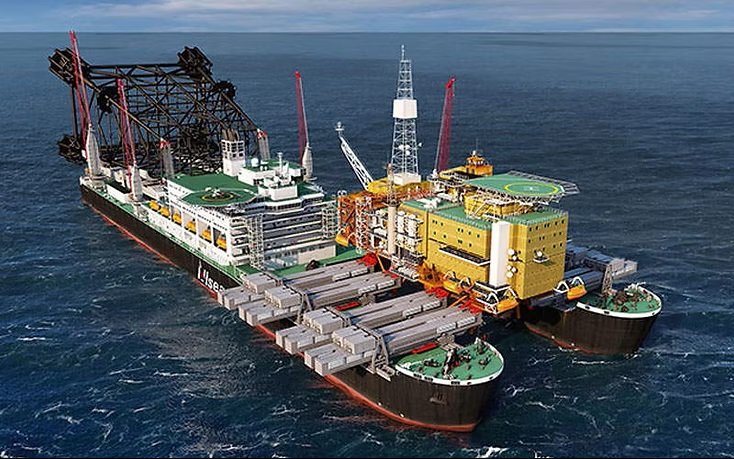
How about the Pioneering Spirit?I got a pretty close look at this last year.
https://en.wikipedia.org/wiki/Pioneering_Spirit
Late response but here we go:
As conceived the MLP was a CIVMAR crewed vessel with the capacity to move between 4 and 6 LCACs. It had some degree of cargo capacity (not a major function) and a limited ability to command operations.
The LCACs transit in the stern, which functions like a big well deck. Between 2 and 3 LCACs would be accommodated per lane and operations would be functionally identical to that of a large LPD such as a San Antonio.
The big difference is in the VTS (apparently nicknamed the bridge of death), which allowed the MLP to sustain operations for extended periods of time, hence reducing the reliance on land bases and increasing the ability to sustain operations in austere locales.
Now how we got to the ESD is actually a really cool story. Maritime Prepositioning squadrons got cut from 3 to 2 and the funding allocated for 3 MLPs (one per squadron) was insufficient to even build 1. NASSCO wanted some work and so a certain naval architect, inspired by the recent tanker to FLO-FLO conversions, saw an opportunity in converting the new Alaska class oil tanker design to an MLP analogue. The goal was ~70% the capability of MLP at ~30% and they delivered ahead of schedule, before the need for MLP could totally disappear. Ultimately ship 3 was cancelled and NASSCO then advanced the design into the ESB which better aligned with future USN seabasing needs
A question on the original idea mentioned here.
There is the open space at the stern which was to be the 'beach' the LCAC 'flew' up.
How much of a disadvantage would it have been to put walls each side of this or even pillars as with the current ESB to enable the flight deck to be longer?
It might complicate LCAC ops but would likely be possible. Dare I say it would've been wasted?How much of a disadvantage would it have been to put walls each side of this or even pillars as with the current ESB to enable the flight deck to be longer?
Thinking about the MPF(F) fleet architecture options, MLP supported between 7 and 9 other vessels which shared at least 36 land/launch spots between them. This includes Option 1 (Distributed Capabilities) which was the "least" ambitious right through to Option 4 (Family of Ships) which is to me the "most" ambitious.
Is a 37th and 38th really going to make or break the MPSRON? I would wager not, and further I would argue that given the need for well deck space nothing should really be added to MLP that could compromise it's primary function. Otherwise the MPF(F) squadron's throughput would've been significantly reduced.
jsport
what do you know about surfing Major? you're from-
- Joined
- 27 July 2011
- Messages
- 8,635
- Reaction score
- 6,932


