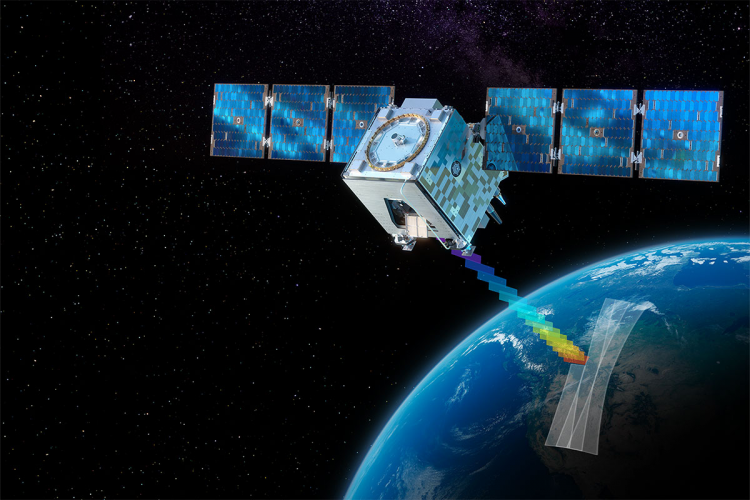
Thread for the USSF-261S-A launch with the EWS-I 1 satellite NET May 2025 aboard Minotaur IV

Space Systems Command Awards $45.5M Launch Service Order to Northrop Grumman Systems Corporation for Prototype EWS Mission

May 25, 2023

The U.S. Space Force’s Small Launch and Targets Division’s Office at Kirtland Air Force Base, Albuquerque, New Mexico, part of the Space Systems Command (SSC) Assured Access to Space organization, awarded a $45.5 million task order to Northrop Grumman Systems Corporation on May 24 via an Orbital Services Program (OSP)-4 Indefinite Delivery / Indefinite Quantity (IDIQ) contract. The contract will provide orbital launch services for the SSC Space Sensing Directorate’s latest spacecraft innovation, the Electro-Optical Infrared (EO/IR) Weather System (EWS) prototype, known as EWS Operational Demonstration-1, for a U.S. Space Force mission designated as USSF-261S-A. The EWS prototype will prove out new EO/IR sensor technology to provide operational quality data to the DoD weather community and inform development of a more cost-effective and proliferated operational architecture. Northrop Grumman Systems Corporation will accomplish one launch of its Minotaur IV rocket to deliver the prototype satellite to low earth orbit. The launch of EWS Operational Demonstration-1 on USSF-261S-A is planned for May 2025

[...]

Northrop Grumman wins $45 million Space Force contract to launch small weather satellite

The company’s Minotaur 4 rocket will launch the Electro-Optical Infrared Weather System

May 25, 2023

Northrop Grumman won a $45.5 million contract to launch a small weather satellite in 2025, the U.S. Space Force announced May 25.

The company’s Minotaur 4 rocket will launch a payload called Electro-Optical Infrared (EO/IR) Weather System (EWS) prototype that will demonstrate commercial weather imaging technologies for military use. The launch contract was a task order awarded by the U.S. Space Force’s Orbital Services Program-4.

[...]

The EWS weather satellite is a prototype made by General Atomics that will go to low Earth orbit for a three-year demonstration. The mission was designated USSF-261S-A.

[...]

EWS-I 1 Satellite
 
The U.S. Space Force’s Small Launch and Targets Division’s Office at Kirtland Air Force Base, Albuquerque, New Mexico, part of Space Systems command’s (SSC) Assured Access to Space (AATS) organization, awarded a $29.9 million task order to Northrop Grumman Systems Corporation on Sept. 30, 2022, for the Space Test Program (STP)-S29A launch service. This is the fourth task order under the Orbital Services Program-4 (OSP-4) Indefinite Delivery/Indefinite Quantity (IDIQ) contract. STP-S29A is a complex mission that will deliver technology demonstrations to orbit and contribute to future space system development. Northrop Grumman Systems Corporation’s Minotaur IV launch vehicle will deliver up to 200kg of STP cubesats, with specific payloads finalized during task order performance, to low earth orbit with a planned launch date in Sept. 2024.

U.S. Naval Research Laboratory's (NRL) Lightsheet Anomaly Resolution and Debris Observation (LARADO) instrument was successfully integrated and tested on the Space Test Program Satellite 7 (STPSat-7) spacecraft at National Aeronautics and Space Administration (NASA) Johnson Space Center, Houston, Texas, on July 17, 2024.

The spacecraft is scheduled for launch on a Department of Defense (DOD) STP sponsored flight out of Vandenberg Space Force Base, in September 2025, on a Minotaur IV launch vehicle.

https://phys.org/news/2024-08-naval-laboratory-larado-instrument-lethal.html [Aug 30]
 
Yesterday, NRO Director Dr. Chris Scolese mentioned upcoming launches…bet you didn’t guess that meant 3 in 1 week!

GO NROL-192, NROL-174, & NROL-145! Stay tuned for more updates.

Watch Dr. Scolese's full remarks here: https://nro.gov/news-media-featured...ull-potential-of-cutting-edge-space-capabili/

View: https://twitter.com/NatReconOfc/status/1910032516070732143

NRO Mission Page: https://www.nro.gov/Launches/launch-nrol-174/

NRO Press Kit: https://www.nro.gov/Portals/135/Doc...417_Press Kit book_Launch_NROL-174_4.9.25.pdf
Mentions "multiple payloads":
NROL-174 is a National Reconnaissance Office (NRO) mission consisting of multiple national security payloads designed, built, and operated by the NRO.
 
0955-EX-CN-2025 [Aug 27]

The overall goal of the Auburn Satellite Testbed for Research Activities with Hybrid Retrodirective Array for X-Band (ASTRA-HyRAX) mission is to use a 3U CubeSat designed to measure the calculated incoming signal vectors as determined by the payload when measured against the known locations of the satellite and source, and the satellite’s known attitude.

The HyRAX payload is a hybrid system in that, it can act as a traditional retrodirective array and store the phase shift of each element of the phased array for later transmission. These values can then be used to create a signal with the phased array such that the signal returns along the incident vector. Additionally, the system allows for high frequency sampling of incoming signals which allows for tracking of incoming signals in real time.

The satellite will be launched as a secondary payload aboard a Minotaur IV rocket (Northrop Grumman – Rocket Systems Launch Program (RSLP)), from Vandenberg no earlier than 10 December 2025. It will be inserted into a mid-LEO orbit at 500 km, on an inclination of 60 degrees. Transmission will begin 45 minutes after deployment and cease upon deorbiting due to atmospheric friction less than two years later. See the Orbital Debris Assessment Report for details.

The ASTRA-HyRAX satellite has dimensions of 340.4 mm x 118.6 mm x 117.025 mm (stowed configuration). The total mass is about 3.8915 kg.

ASTRA HyRAX Project Page
 
Re. NROL 174

NSF:

Mike McCants' TLE's for the 2 satellites shows them in 1100km orbits inclined 63.4 degrees. This is the same orbit as previous NOSS/Intruder launches, as well as the NROL-85, NROL-69 and NROL-77 missions which launched on Falcon 9 in the last few years.
 
From campus to space: Satellite AggieSat6 prepares for launch [Jan. 21]

Just southwest of the Zachry Engineering Education Complex sits an unassuming, square building. From the outside, it could easily be mistaken as an extension of Northside Garage, but inside, hundreds of students are designing projects that directly compete with industry and government standards.

The Munnerlyn Astronomical Instrumentation Lab is Texas A&M’s hub for aerospace innovation. Inside the AggieSat Laboratory Student Space Program, students design, build and operate space-based engineering projects — including a satellite set to launch from Vandenberg Space Force Base by the end of Spring 2026.

AggieSat6, or AGS6, is a 6U CubeSat satellite designed to improve space situational awareness using radiofrequency. Sponsored by the University Nanosatellite Program, or UNP, the satellite was entirely designed and built by AggieSat students. It will launch alongside a satellite manufactured by Aggie-owned Aegis Aerospace Inc. — making the project an all-Aggie mission.
0157-EX-CN-2026 [Feb 5]

The overall goal of the Ionospheric Neutron Content Analyzer-2 (INCA-2) mission is to demonstrate the functionality of a directional scintillator silicon photomultiplier-based neutron detector in Low Earth Orbit.

The satellite will be launched as a secondary payload aboard the S29A mission on a Minotaur IV launch vehicle from Space Launch Complex 8 (SLC-8) at Vandenburg Air Force Base, Spring 2026. It will be inserted into an orbit at 500 km apogee and 500 km perigee, on an inclination from the equator of 60 degrees. Transmission will begin 45 minutes after deployment, and cease upon command from the ground station, within 2 years after initiating operation. Atmospheric friction will slow the satellite and reduce the altitude of the orbit, until de-orbiting occurs 6 years after launch.

The spacecraft is a single unit with dimensions of 3 stacked 10 cm X 10 cm X 10 cm CubeSat modules (giving an overall dimension of 10 cm X 10 cm X 30 cm). The total mass is about 4 Kg
https://iaru.amsat-uk.org/formal_detail.php?serial num=1051
CANVAS Updated: 25 Aug 2025
...
Planning a Minotaur IV launch from Vandenberg into a 500 km orbit with 50 degree inclination in February 2026. These satellites are also expected to be on the same launcher - STPSat-7, Rawhide, MISR-C, AggieSat6, MAMBO, Auris, MOCI, USNA16, and INCA-2.

0189-EX-CN-2026 [Feb 28]

In response to your coordination request IARU confirms the frequency coordination for your satellite CANVAS.
For up- and downlink
437.250 MHz, emission designator 30K0G1DCN, EIRP 31dBm.
2405.300 MHz, emission designator 5M00G1DCN, EIRP 37.5 dBm.

Planned launch date: 10 February 2026;

CANVAS (Climatology of Anthropogenic and Natural VLF wave Activity in Space)

CANVAS is a SmallSat mission designed to explore the climatology of Very Low Frequency (VLF) waves generated by terrestrial lightning strikes. Lightning VLF waves propagate out of the upper levels of Earth’s atmosphere (including the ionosphere and the magnetosphere), sending electromagnetic energy into the inner radiation belt. CANVAS will be able to determine the power and directionality of lightning-generated VLF waves with its two instruments. University of Colorado Boulder graduate and undergraduate students are involved to every aspect of CANVAS, including the design, construction, testing, and eventual on-orbit operation, data analysis, and publication of scientific results.

CANVAS Mission Overview

The spacecraft has a design orbit of 500 km and 51.6° inclination to ensure global observations and frequent downlink opportunities with the LASP ground station.
 
This STP presentation from a year ago has some details about the STPSat-7 payload and includes a render.

Minotaur IV rocket motor stacking at Vandenberg's Space Launch Complex-8

Vandenberg’s 2nd Range Operations Squadron supported Northrop Grumman employees during the stacking of a Northrop Grumman Minotaur IV to prepare it for flight at Space Launch Complex-8 at Vandenberg Space Force Base, Calif., Mar 12, 2026. This Minotaur IV will support Space System Command’s Space Test Program 29A (STP-29A) mission. STP performs mission design, payload-to-bus integration, space vehicle-to-launch integration, and on-orbit operations for satellite and tracking payloads that exhibit potential military utility.

Vandenberg SFB utilizes strategic industry partners like Northrop Grumman to support its critical and diverse portfolio, encompassing orbital tracking, advanced air and space testing, homeland defense operations, and strategic deterrence.
 
Last edited:
Page won't appear.

On another note how many unexpended Peacekeepers are there left in storage for conversion to Minotaur launchers?
Thanks I’ve now fixed the link.

There’s another Minotaur launch later this year.
 
Okay, but after that how many unexpended Peacekeeper stages are there in storage before they've run out?
Should be around 50, if they haven't scrapped any. There have been 9 sets used for Minotaur IV and V launches.

Motors are also used for ICBM targets (i.e. ICBM-T3 target launch vehicle) and for non Minotaur launchers. Not a complete list:
https://space.skyrocket.de/doc_lau_fam/peacekeeper.htm
 
Confirmation of mission success:

NRL's Advanced Payloads Soar into Orbit Aboard STPSat-7 Mission
April 7, 2026

U.S. Naval Research Laboratory (NRL) successfully launched three advanced experimental payloads aboard the Department of War (DoW) Space Test Program’s (STP) Satellite-7 mission at approximately 4:33 a.m. PDT on April 7 from Vandenberg U.S. Space Force (USSF) Base, Calif.

NRL’s payloads included the Lasersheet Anomaly Resolution and Debris Observation (LARADO) instrument; the Global Navigation Satellite System (GNSS) Orbiting Situational Awareness Sensor (GOSAS); and the Gadolinium Aluminum Gallium Garnet (GAGG) Radiation Instrument (GARI-1C).

The STPSat-7 spacecraft is aboard the STP-S29A mission, which uses a Northrop Grumman Minotaur IV launch vehicle, marking a significant step forward in advancing U.S. space-based capabilities for the U.S. Navy and national security. By improving understanding of the space environment and testing next-generation satellite technologies, NRL is ensuring the United States maintains its technological advantage and protects critical assets in orbit.

[...]

 

Similar threads

Back
Top Bottom